

HINGTHAM IN GREEN
Woven

Bhutan is an Asian country located between China and India. Green and nature are important in Bhutan, which is more than 70% covered with trees, and this is supported by the country's policy. The project area is located among a dense green texture and there is a river in the north. Considering this situation, a design approach in which the project is compatible with nature and intertwined with green has been adopted. A project design has been developed in which people are in contact with each other and cultural interaction is intense, as well as spaces that are suitable for the culture of the region and the requirements of slow tourism, hosting a quiet life. The project was named Hingtham In Green, which means weaving from the heart in relation to the subject and concept.
In addition, Bhutan, which has a traditional and quiet life, is generally a mountainous country and settlements are scattered. When starting the project concept; This scattered settlement of Bhutan was preserved and the units were grouped according to their functions. A central courtyard that lets people in from the entrance and the roads dispersing from this central courtyard have created quieter courtyards for the accommodation units. Water and green are included to separate the accommodation and social areas and also to add calmness to the project.
The project land is located on the tourism route of the country. For this reason, a central courtyard was designed, inviting passers-by and aiming to make the region important in terms of tourism.
There are two different types of transportation to the courtyard, from the main entrance and from the market. A slight hill was created to provide a controlled transition between these two entrances and these areas were supported by green. Two car parks were designed to the east and west of the land for those arriving from the airport and the families staying here permanently.
Users who came to the land were first asked to focus on the Bhutanese culture, Yathra. Social areas around the designed central courtyard; The amphitheater, exhibition, weaving workshop, wood workshop, shops, market area and cafe provide cultural experiences to the users. Shops and sales areas were spread out on the square and it was aimed to circulate the user in the area. First, after the cultural experiences were intensively experienced by the user, it was thought that the user would be able to reach other experiences by footpath ways. The living units were placed in such a way that they were more interactive with nature and water, and special calm courtyards were created. Cultural-quiet areas are separated by water and green. The family house was placed on the western side, which is the more dominant point of the land, the villas were placed linearly to the north of the land to interact with the river, and the dormitories were placed on the eastern front of the land.
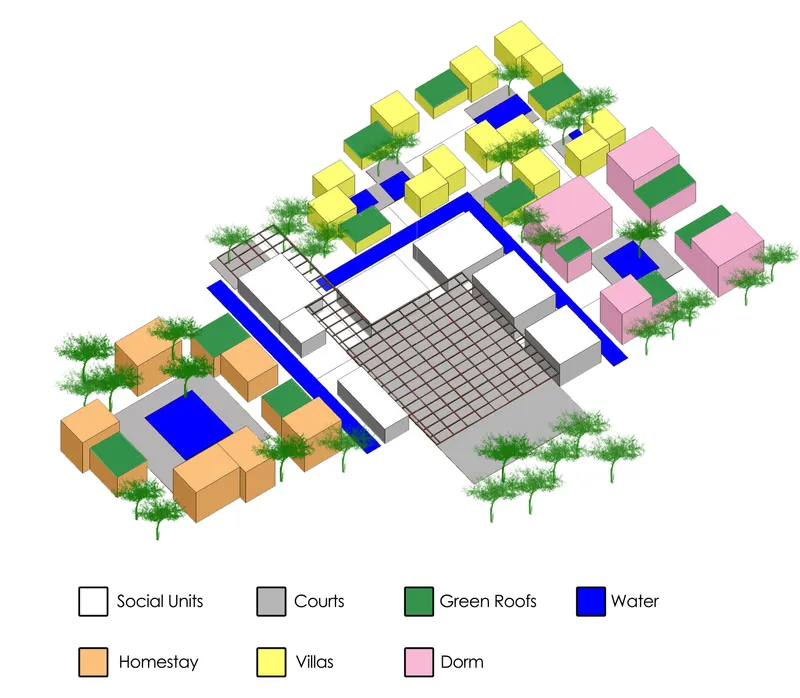
As you go up to the upper floors, the mass gets lighter and roof gardens are designed in the spaces formed. The family house was planned in such a way that each unit could be accessed from the outside. In the dormitories, there are common entrances in the masses. Platforms connecting the masses on the upper floor and providing the passage were considered. There are various user profiles for accommodation units in the project. Villas are divided into duplex and single storey, dormitory rooms are divided into single and double occupancy. In the family house, the living space of the guests and family members was desired to be separated.
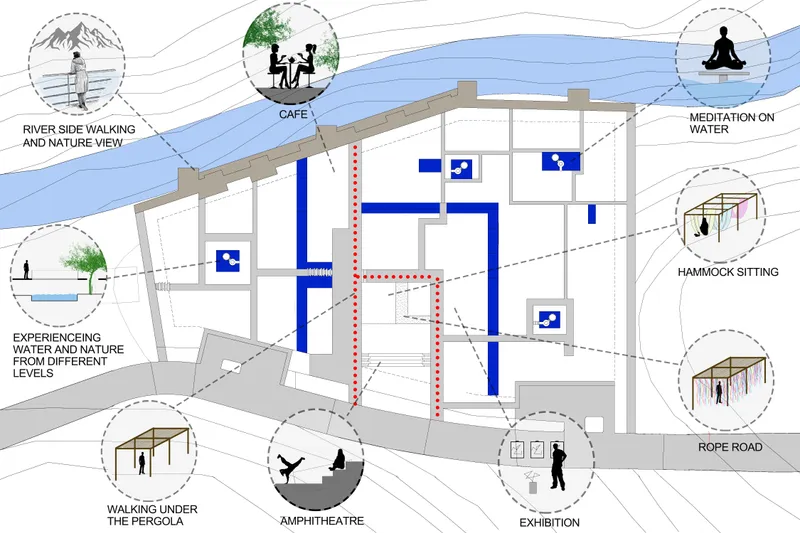
Workshops were designed that introduce the weaving and wood art of the region, provide information and offer guests a chance to experience it. In order for these activities to be moved to open areas and interact with water, their backyard was considered, and here, taking advantage of the difference in elevation, a waterfall was created.
A wooden walkway, where people will interact closely with the forest and the river in the north, along the riverside, piers and seating areas where the interaction with the water can be changed using elevation differences were designed. At the same time, by designing the villas by the river, gardens overlooking the landscape were created.
The cafe was designed on the riverfront to offer people a view of nature. The trade area is located on the circulation so that it is associated with the central square, and there are open stalls hanging from the top cover. It was wanted to introduce local dishes in the cafe and to give a cultural experience by selling local products in the trade area.
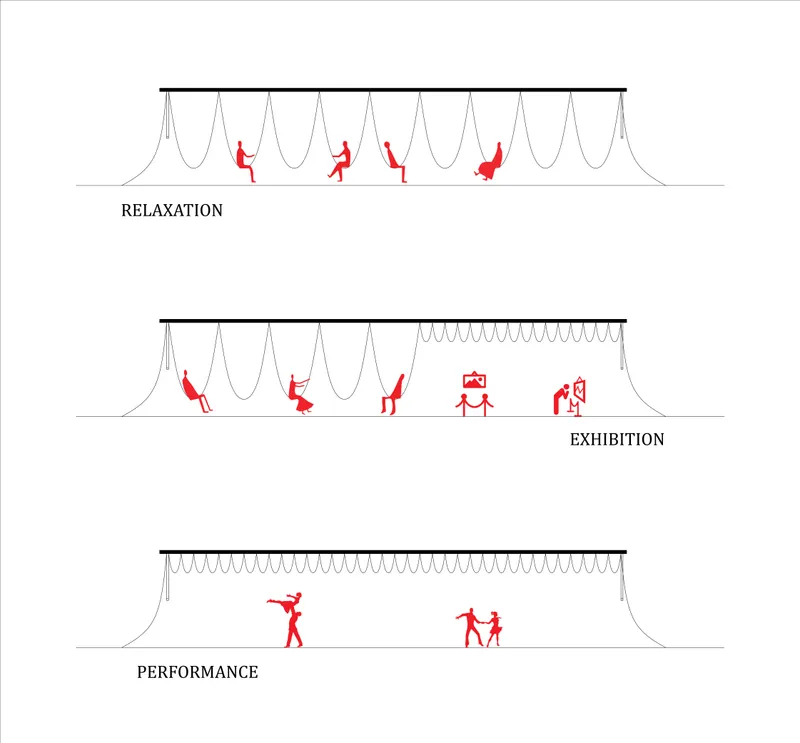
Traditional Bhutanese colors were used in the designed Dynamic cover.This cover descends to the floor in some places and forms the seating areas with hammocks. Yarns in woven colors were hung down from the pergola on the road, which was built under a fixed wicker cover, and the texture of the fabric was also tried to make itself felt in outdoor environments. Fixed cover texture was more frequent in some places, while in some places it was created at wider intervals, creating different canopy areas.
Stone and upper floors are designed with wooden structure. The roof, which has wide eaves, is carried by a truss system and is covered with wooden roofing material.
The facades were treated with a solution in which the traditional was preserved in accordance with the texture of the region. Panels and decorations that reflect the regional crafts and serve as a wooden exhibition were designed on the facade. These panels also serve as sunscreens.
For Bhutan, water is an important element both in the human avi and in the ecological sense. Both to reflect this situation and to take advantage of the calm provided by the water in the project, water was used in the courtyards. It was desired to use a biological pond system since no chemicals are used in the filtration system and it does not harm nature and human health. In the quiet courtyards within the living units, water and meditation, which are important for the region, were combined to provide users with an experience in this direction. In order to improve user focus, half-open capsules were created, hidden among the green, in harmony with the texture of the region.
When the characteristics of the region were examined, it was seen that the sunbathing period was long and it was a region that received a lot of precipitation. As a result of this; Photovoltaic panels on the roofs and a rainwater collection system were designed to comply with the ecological design, which is a criterion for slow tourism.

Popular Articles
Popular articles from the community


Faces of the Soviet Avant-Garde: Turning Moscow's Street Names into an Open-Air Museum
A network of sculptural installations across a Moscow residential district transforms forgotten architect names into spatial encounters with cultural memor
Opera by the Sea Estonia: Three Shells Dissolving Architecture into Tallinn's Coastline
A winning opera house proposal replaces monumental form with interconnected shells that blur the boundary between building, park and Baltic Sea.

Singing Woman: An Opera House That Performs Before the Curtain Rises
Ovidiu Cristian Pavel's conceptual opera house translates Estonia's choral identity into a sculpted waterfront landmark facing the Baltic Sea.
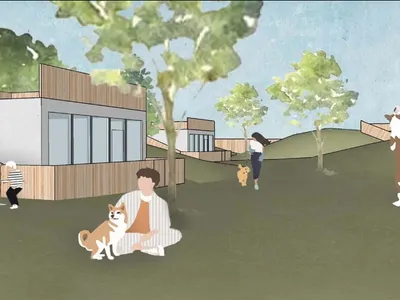
Temporary Home for Dogs: A Reversed Zoo Rethinks Animal Shelter Architecture
In Bucharest, a sinuous corridor and freed landscape flip the logic of containment, designing a shelter that works to make itself unnecessary.

Similar Reads
You might also enjoy these articles

Shakur's House: Exposed Brick as an Interior Organiser in a 168 m² Mashhad Residence
Brick moves indoors in this Mashhad residence, where masonry walls, glass partitions and teal planes sequence a compact home without closing it off.

Day and Night Park: A Time-Based Urban Newsstand in Beijing
A temporary urban newsstand in Beijing blending travel, light, and reading through poetic colors, compact form, and community-focused design.

Modernist Patio Renovation in El Masnou, Barcelona by Oliver Segura Arquitectura + Cebrià Arquitectura
Modernist patio renovation blending tradition and innovation with a movable pool, leveled floors, and Catalan materials in El Masnou.
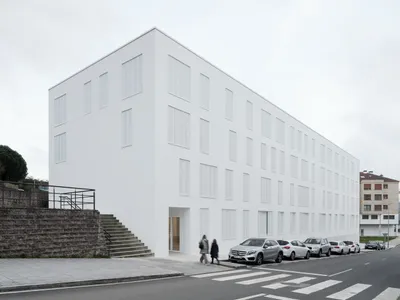
Alto Residencial Coop: Cooperative Housing Development in Santiago de Compostela by Carbajo Barrios Arquitectos
A linear cooperative housing complex blending white volumes and perforated metal façades, enhancing community living, natural light, privacy, and urban integration.

Explore Cultural Architecture Competitions
Discover active competitions in this discipline


Challenge to reimagine the Iron Throne

Photograph architecture without architects

Illustrate the lost glory of Angkor Wat - Render Challenge

Bring back Drive In's
Comments (0)
Please login or sign up to add comments
No comments yet. Be the first to comment!