House of culture in the Glogoczow Village Center
Multifunctional building connected with natrure and region


The project of the Multifunctional Cultural Center in the Głogoczów Village Center was created in line with the local identity of the region. Man and his perception are the most important in the project, which is why the building is connected with nature and the surroundings.
Głogoczów is a village divided by a highway, the facility is to become a socio-cultural center connecting residents, in which cultivating and developing the tradition of the region would be part of the development of society. The cultural offer is to be addressed to all inhabitants of the village.
The village Głogoczów has many buildings from different architectural epochs, the most important monuments are: the Church of St. Mary Magdalene from 1812, with four historic bells, a court storehouse from the 16th century and a court complex of the Konopek family from the 19th century. Historical buildings are surrounded by rural buildings, which are slowly being replaced by new buildings without a clear character referring to the region. The characteristic objects in the farm buildings are wooden barns, which are often in poor technical condition and fall into ruin or are demolished, which causes the loss of their rural character. Wood is a characteristic material for rural areas, which can be found in farm buildings as well as residential ones. Red or brown roofing is dominant in the center of the village. The buildings are varied in terms of the height and shape of the roof.
The project of the building of the cultural and recreation center in Głogoczów is a response to contemporary rural architecture. The lost nature of the region's former countryside is reflected in the design process. The main intention was to use the building tradition and the folklore of Głogoczów.
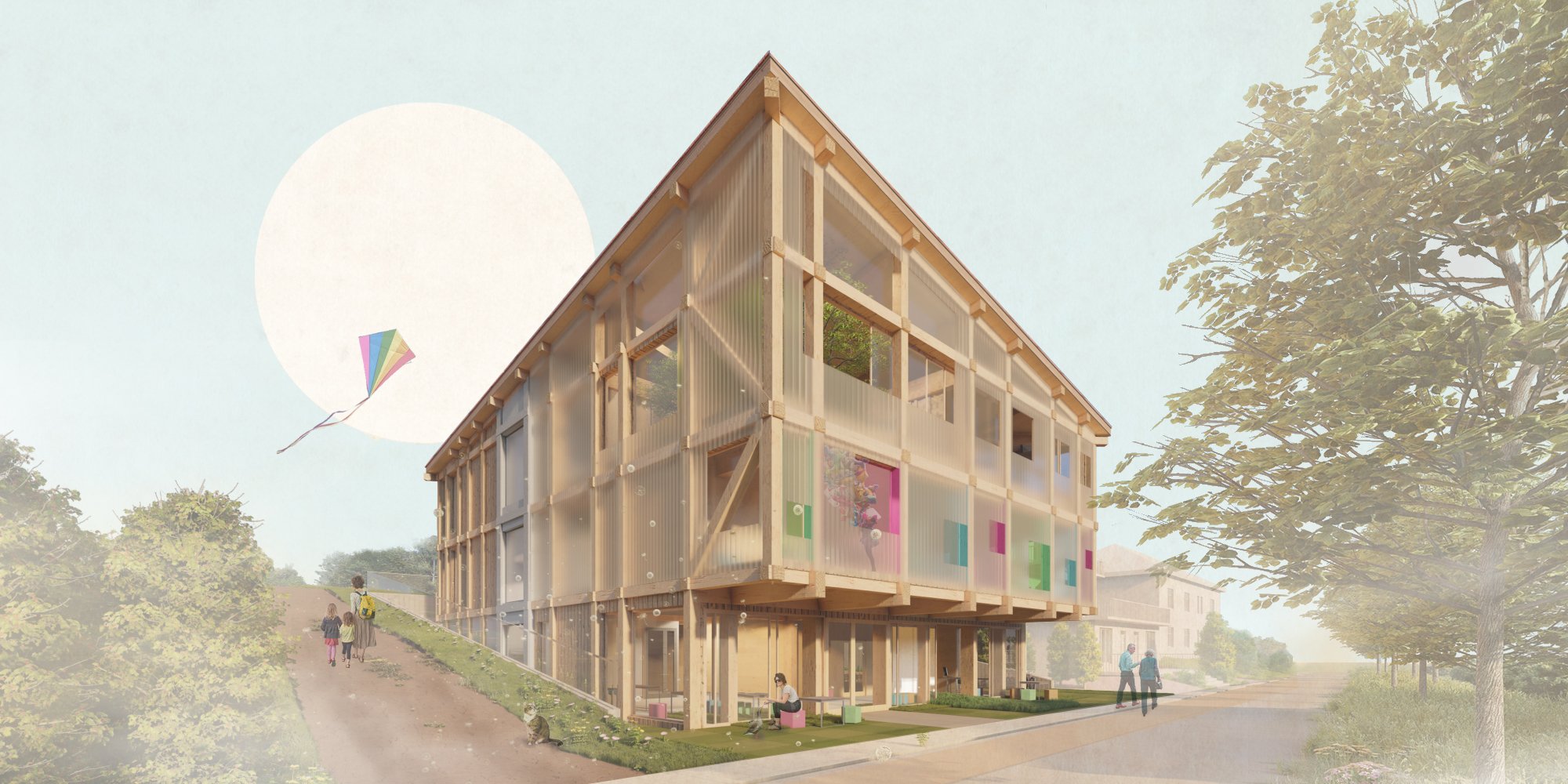
The building is connected with nature and the surroundings by means of large glazing connecting the outside with the interior, allowing in large amounts of natural light. A commonly used building material in the region is wood. The CLT (cross laminated timber) material used in the construction of the building combines modern solutions and natural material. The façade is covered with ash wood boarding. The building has large glazing with varying degrees of translucency. The first floor has multi-colored glazing in the part of the building intended for children. The visible structure of cross-laminated timber, dynamize the simple bsolid. The height of the building corresponds to the height of the surrounding buildings.
The complex roof structure with a dynamic degree of inclination contrasts with the simple form of the building, limited by a small plot area.
The use of formwork in a natural shade of wood brings the building closer to nature and evokes positive emotions in the recipient, giving the impression of a cozy space. Large glazing, which may seem foreign in the surrounding space, has been mitigated by a translucent membrane that allows light into the interior and at the same time provides a sense of comfort for the user. The color of the glazing of the windows in the children's playroom is a reference to the traditional flower gardens located next to the houses of old farms.
Current trends in modern construction assume universal design, i.e. design available to every resident. The facility provides access for everyone, regardless of age or disability. Each room is available and can be individually adapted to all needs. Wide corridors, spacious halls and bright room layouts facilitate the use of the facility. Large open rooms are divided by movable walls that allow for any arrangement of space. The lack of a strictly assigned function to most rooms makes the facility multifunctional and can be used in a variety of ways. The ground floor of the building, along with the arrangement, serves as a public space that opens onto the street with sliding windows, encouraging users to enter and use the facility.
The building integrated with the immediate surroundings fits it and gives the impression that it could not stand elsewhere. The unique character of the building can be obtained through the building's connections with nature, tradition and culture of the region. Drawing on regionalisms brings new buildings closer to society.
Building and nature form a coherent whole