
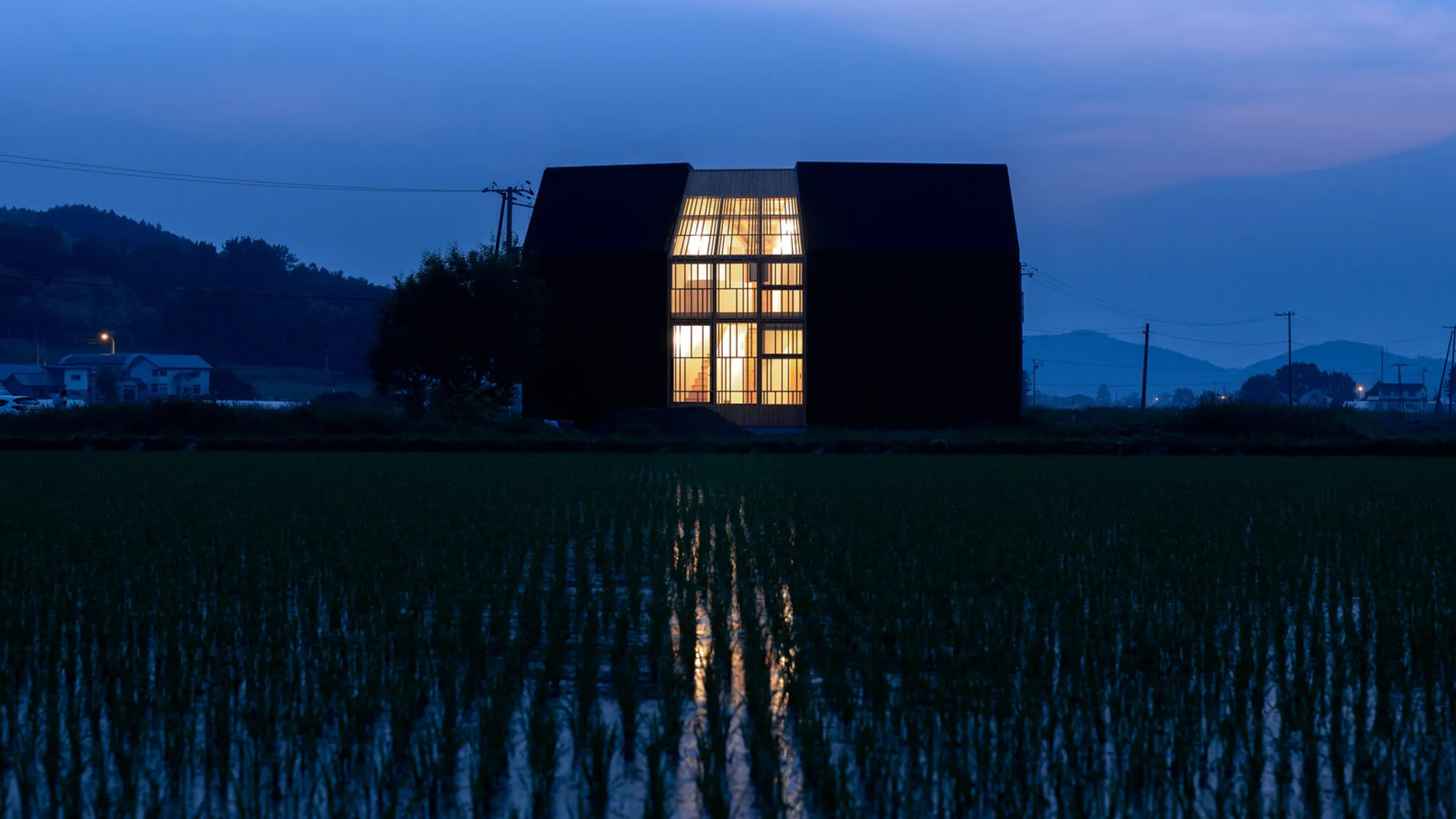
Florian Busch Architects Splits a Net-Zero House in Two to Harvest Hokkaido's Energy
On the Furano Plateau in Nakafurano, a timber house wrapped in photovoltaic skin produces nearly twice the energy it consumes.


Most net-zero houses play defense: thick insulation, minimal openings, compact form. House W by Florian Busch Architects does the opposite. Sitting on the western edge of Hokkaido's Furano Plateau, surrounded by rice paddies and asparagus fields, the 163 square meter residence breaks its volume into two rotated halves joined by a glazed timber connector. The result is a house that doesn't just survive its harsh climate but actively feeds on it, generating almost twice the energy it uses in a year.
What makes the project genuinely provocative is its refusal to treat sustainability and spatial generosity as opposites. Busch has described the concept as a house that behaves like a plant: rooted in place, oriented toward light, and responsive to seasonal shifts. Rather than the Corbusian machine for living, this is an organism for living with. The split volume, the steeply pitched roofs, the interstitial courtyard space, the 56-panel solar skin: each move serves both an experiential and an energetic purpose, and neither is allowed to compromise the other.
Two Volumes, One Thermal Logic
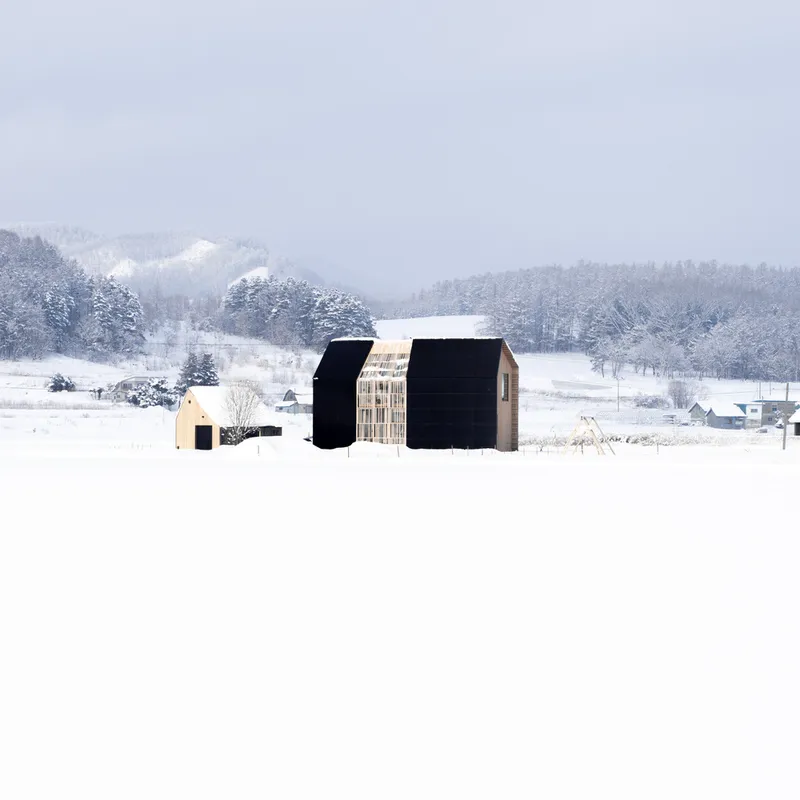
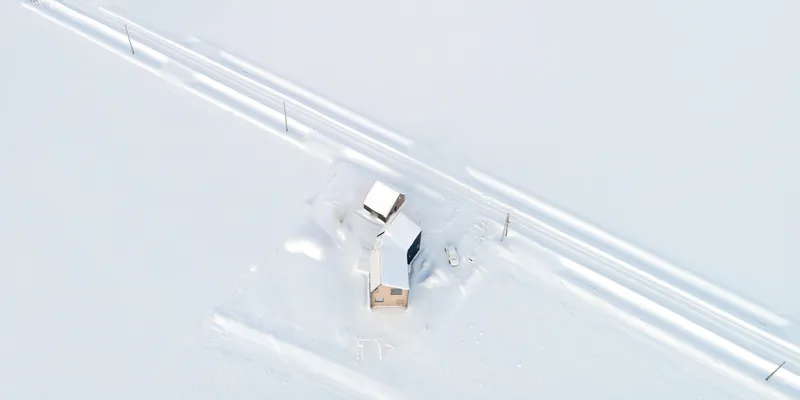
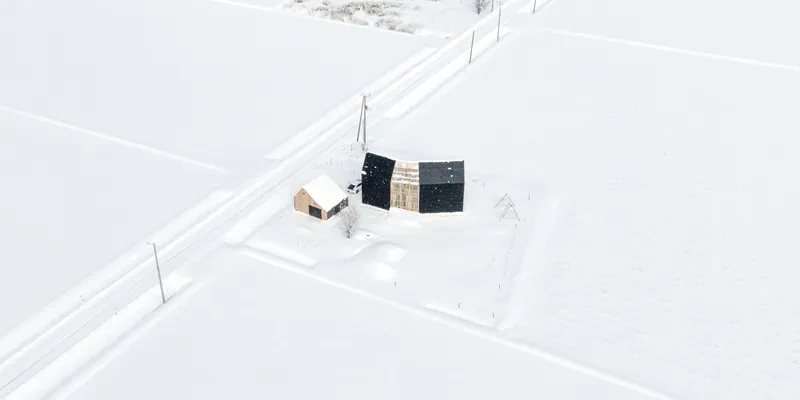
The two elongated gabled volumes are rotated against each other so that their short ends point toward the Tokachi mountain range to the east and the hilly landscape to the northwest. The gap between them faces the ski slopes of Mt Furano Nishi to the southwest. This isn't arbitrary geometry. By splitting the house rather than consolidating it, Busch creates an interstitial space that functions as a climate regulator: adjustable louvers block sun in summer and admit warmth in winter, turning what looks like a courtyard into a passive thermal engine.
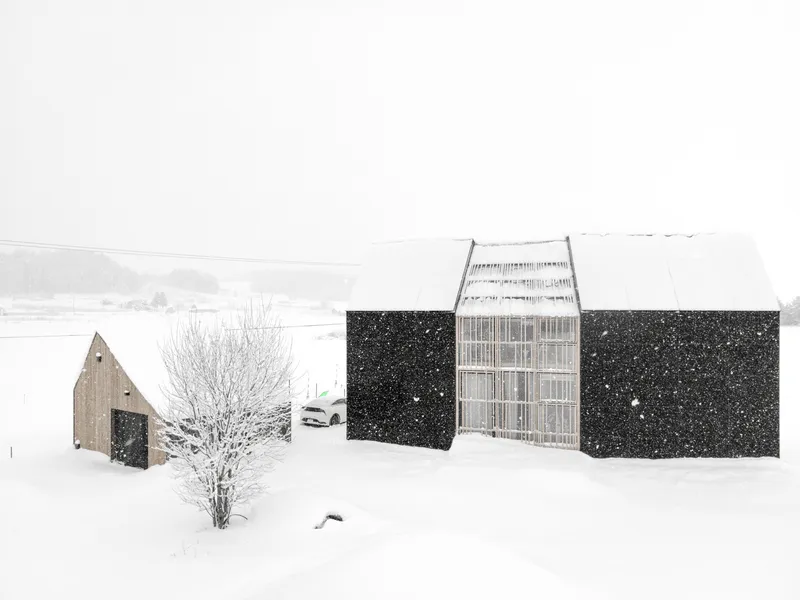
The phased, modular strategy also allows future annexes to extend the compound without disrupting its core logic. A 35 square meter barn and workshop was already added as a third volume, visible in aerial views as a quieter sibling tucked alongside the main house.
The Solar Skin
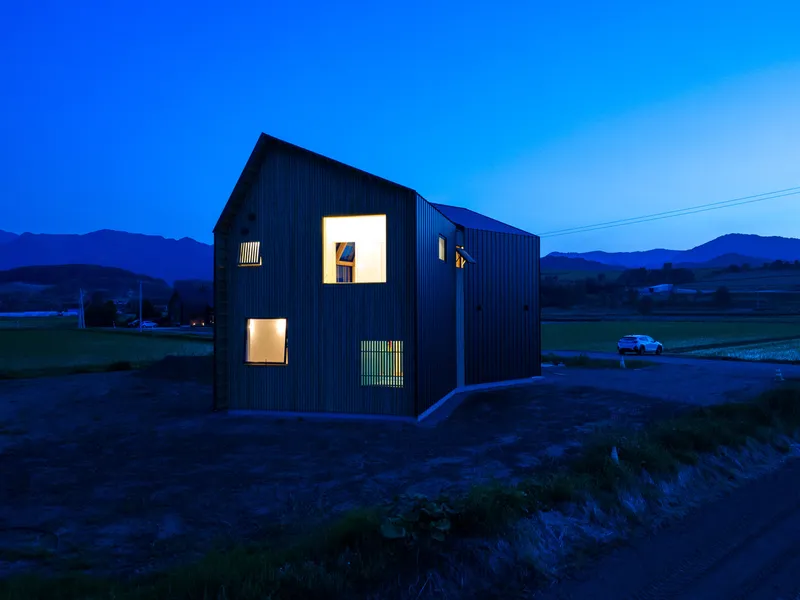
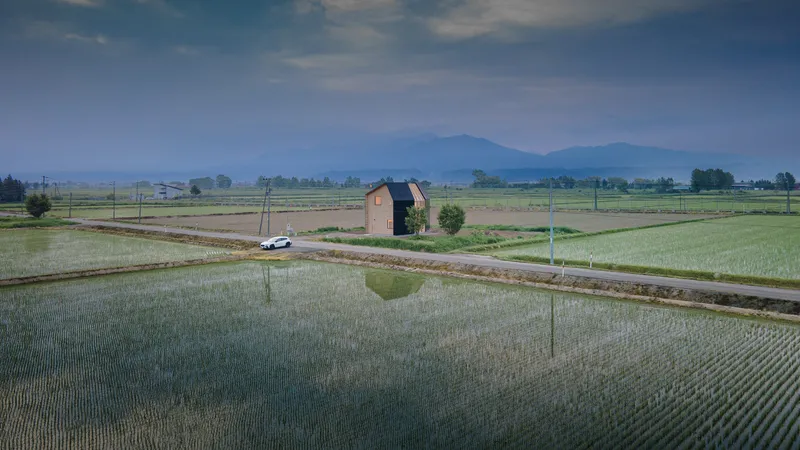
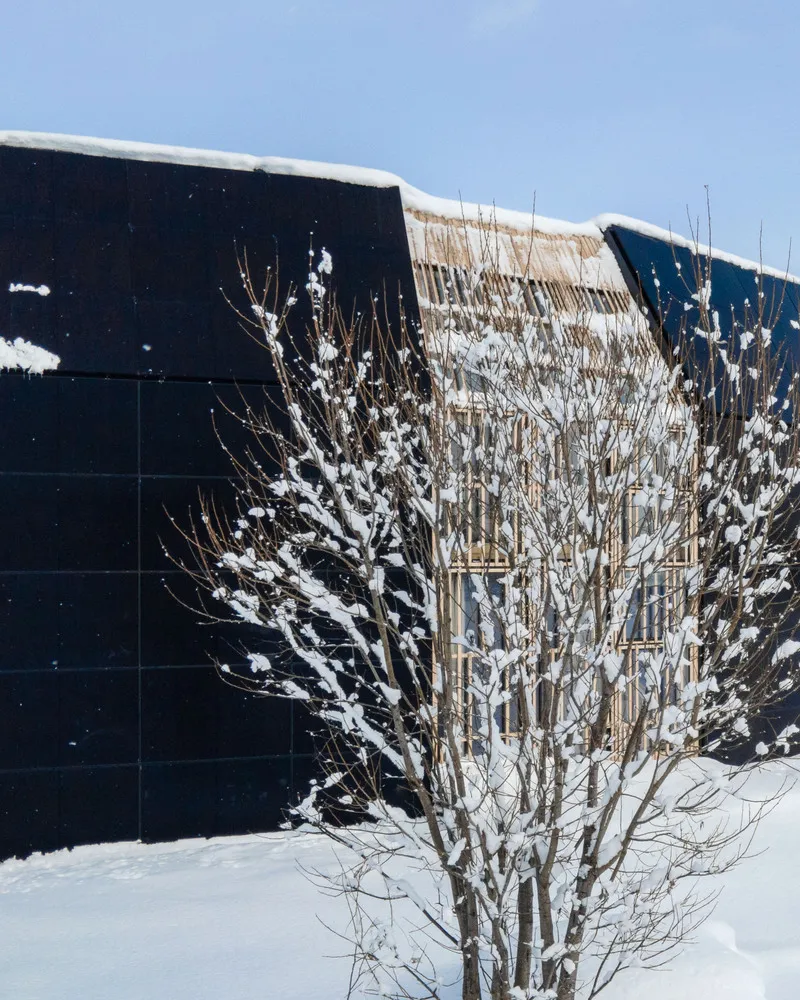
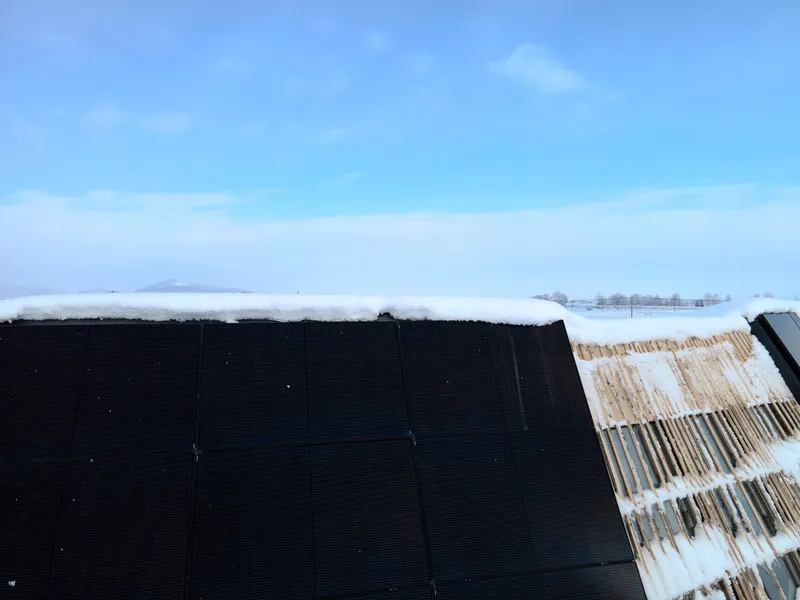
From a distance, House W reads as a cluster of dark agricultural buildings, a deliberate nod to the farmer's barn that previously occupied the site. Up close, the black exterior reveals itself as 56 photovoltaic panels with a 23 kW capacity, integrated from the outset rather than bolted on as an afterthought. The corrugated metal and solar cladding form a continuous, homogeneous surface that makes no visual distinction between energy-producing and non-producing areas.
Connected to the grid primarily to return surplus electricity, the house can also operate off-grid using a battery array. The steeply pitched roofs aren't just formal: they shed Hokkaido's heavy snowfall efficiently, keeping the panels clear and productive through winter months when energy demand peaks.
Timber Structure, Warm Interior
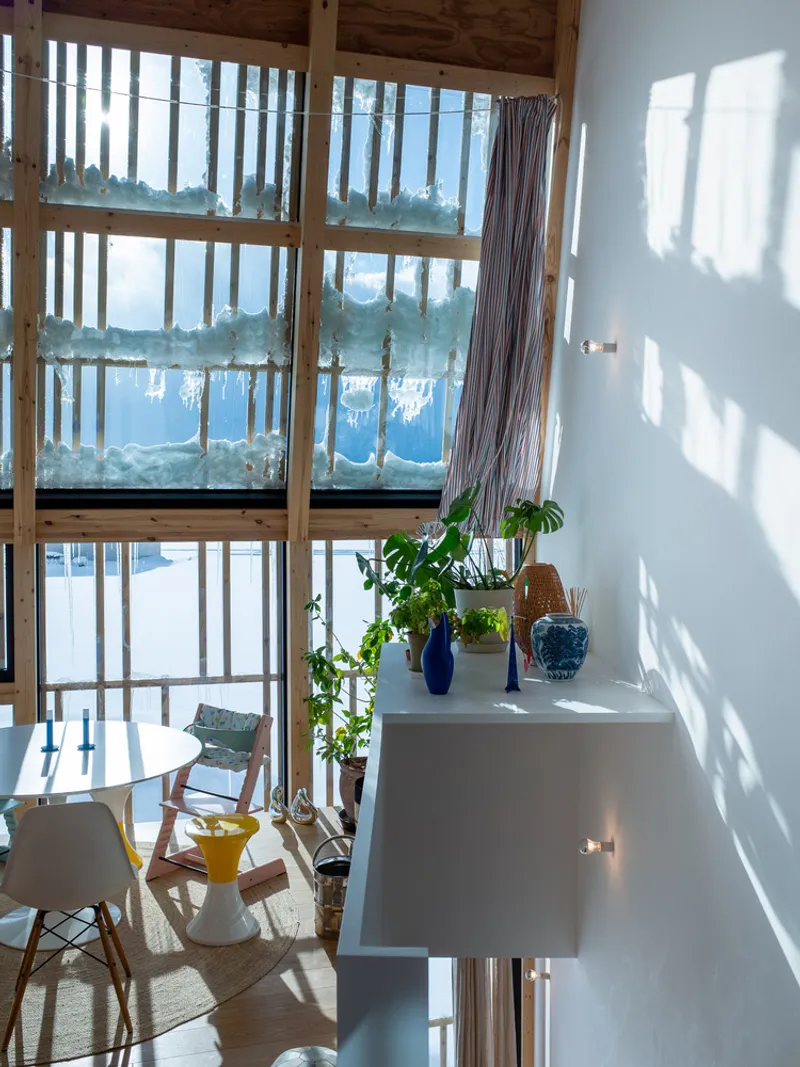
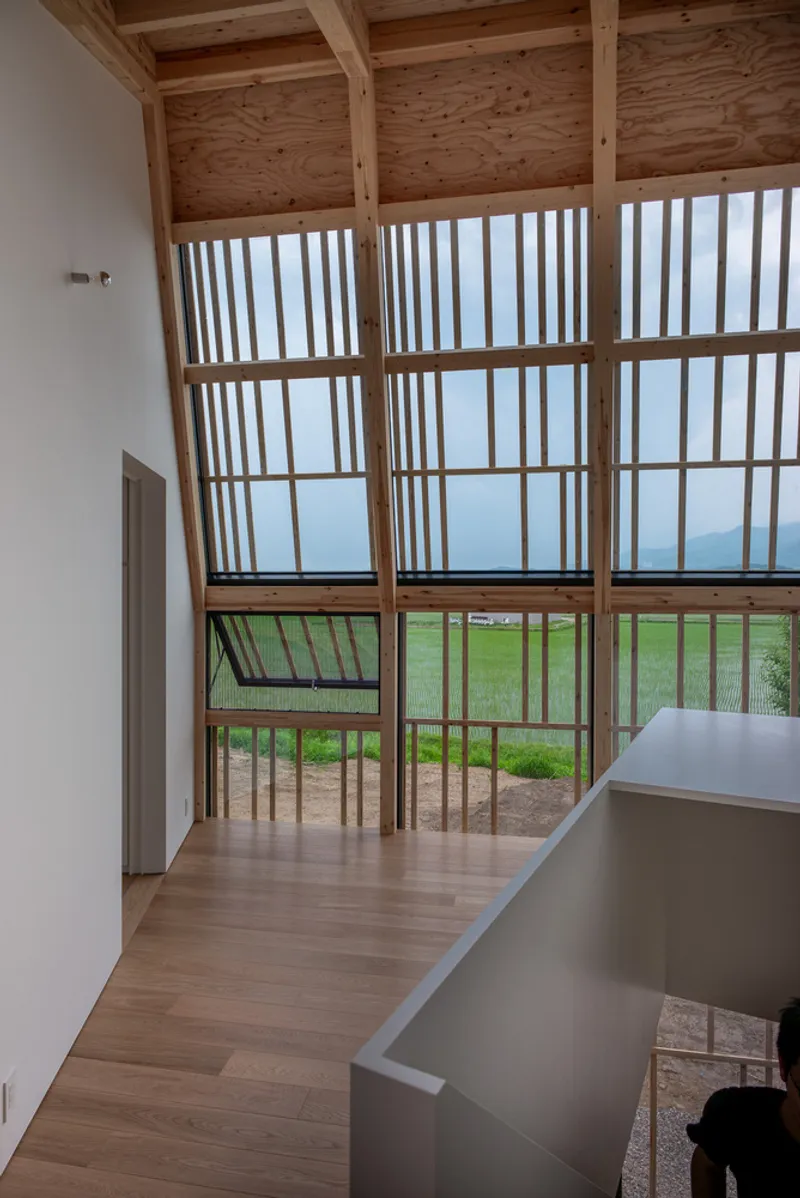
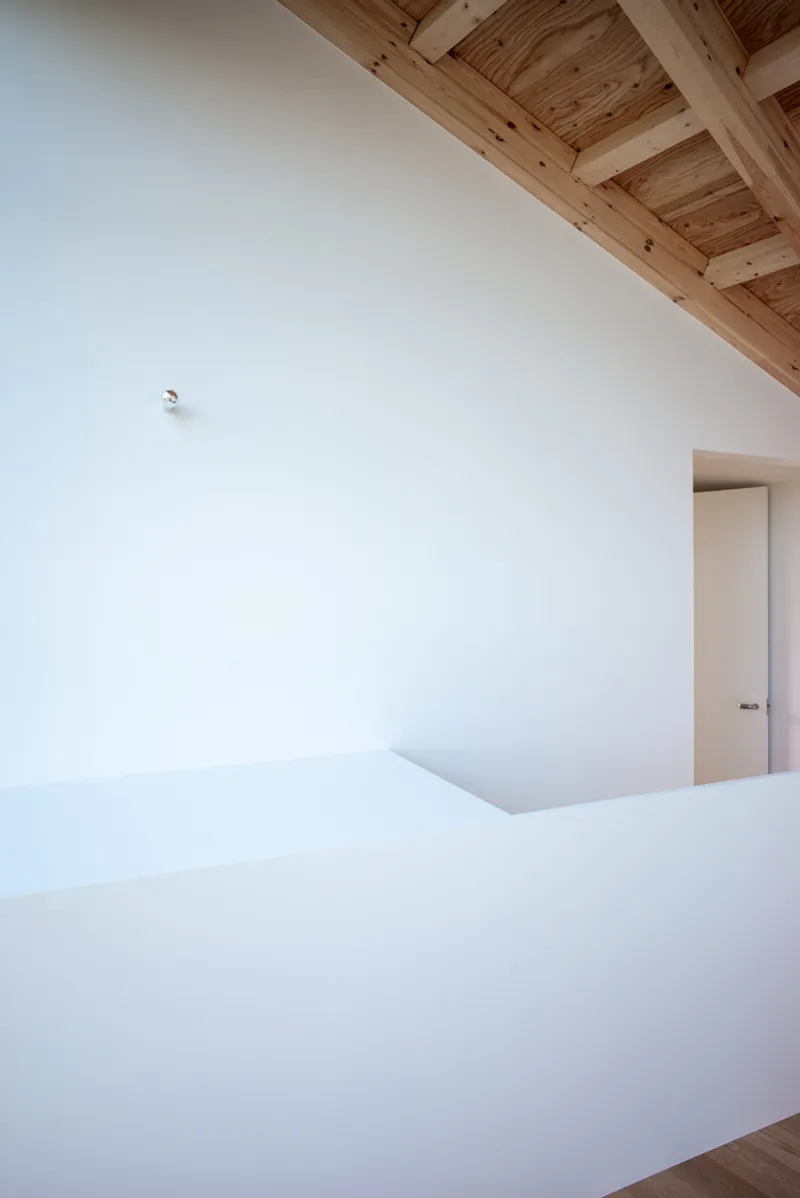
The contrast between exterior and interior is stark and intentional. Step inside and the black shell gives way to exposed timber framing, white walls, and generously proportioned rooms with high ceilings. The structure follows traditional Japanese timber frame construction logic, and the material palette stays disciplined: oak flooring, tongue-and-groove planking on ceilings, and structural beams left fully visible.
The double-height glazed walls facing the interstitial space flood the interior with light while the vertical timber slat screens filter views of the surrounding farmland. There's a barn-like honesty to the spatial arrangement. Nothing is concealed for the sake of refinement, yet every detail, from the beam junctions to the sliding partitions, is resolved with care.
Framing the Plateau
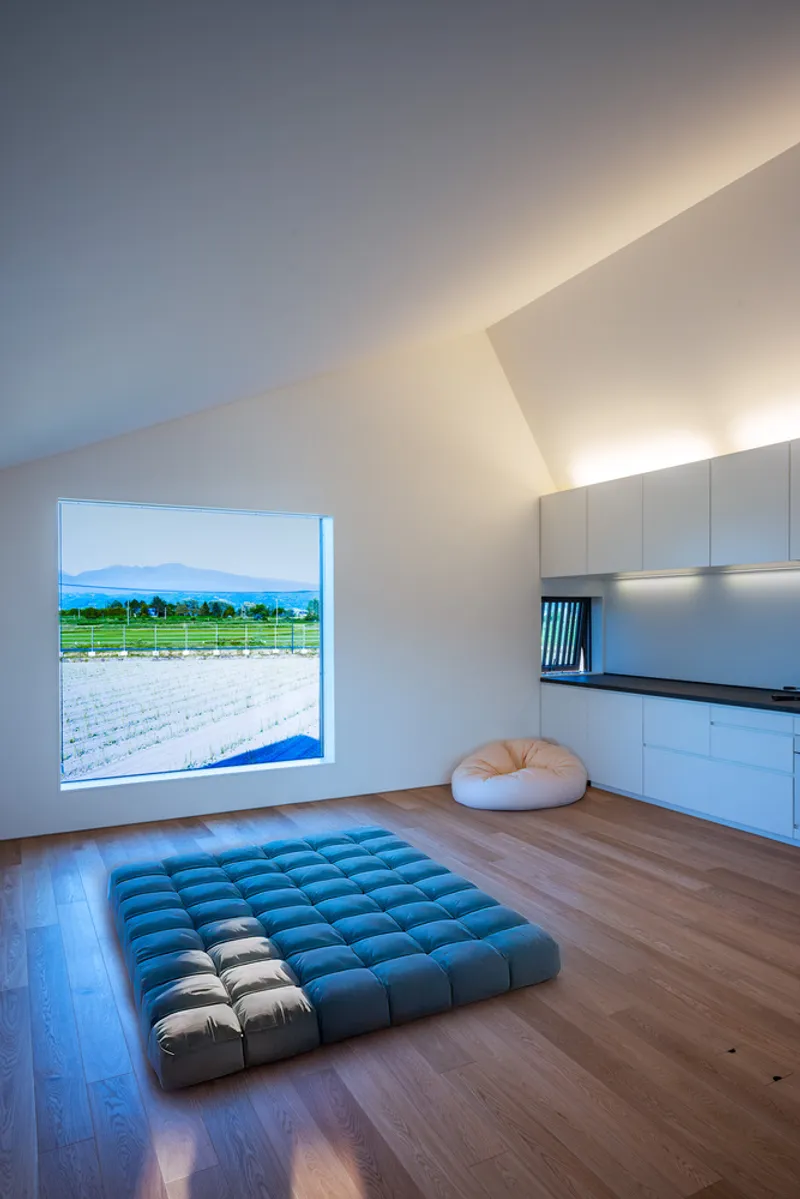
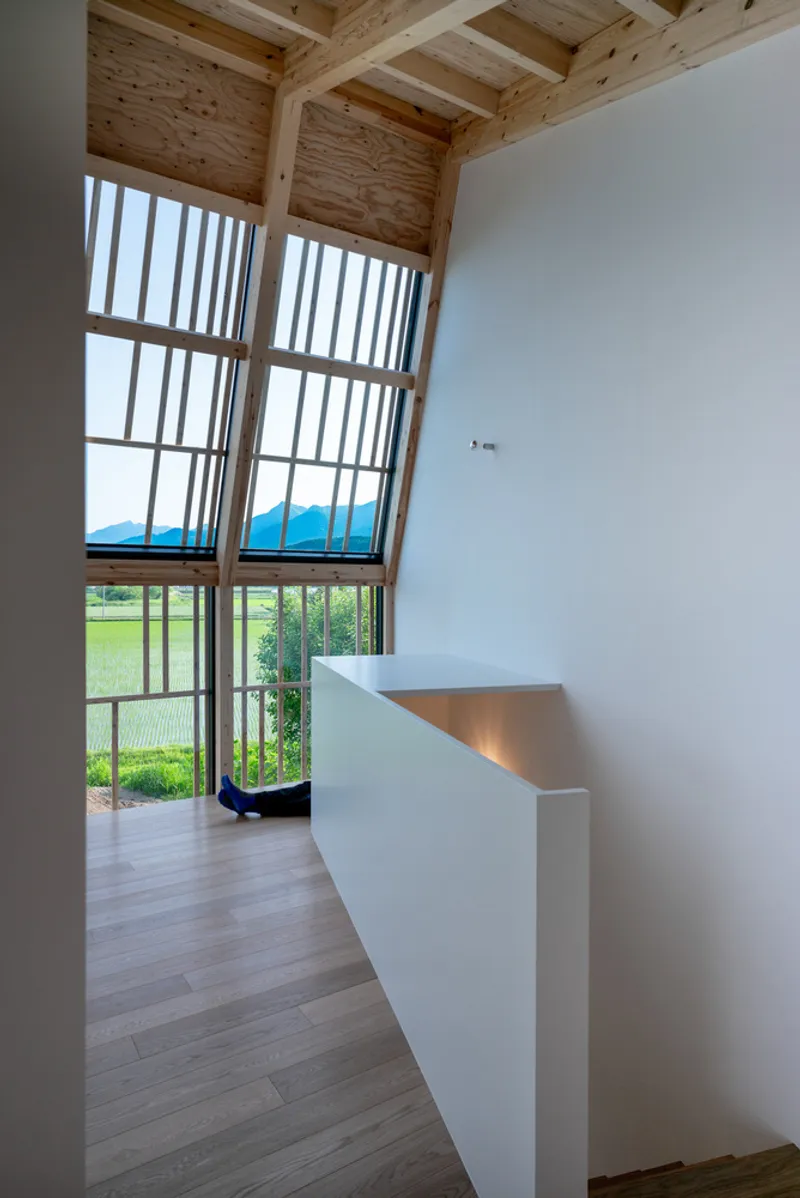
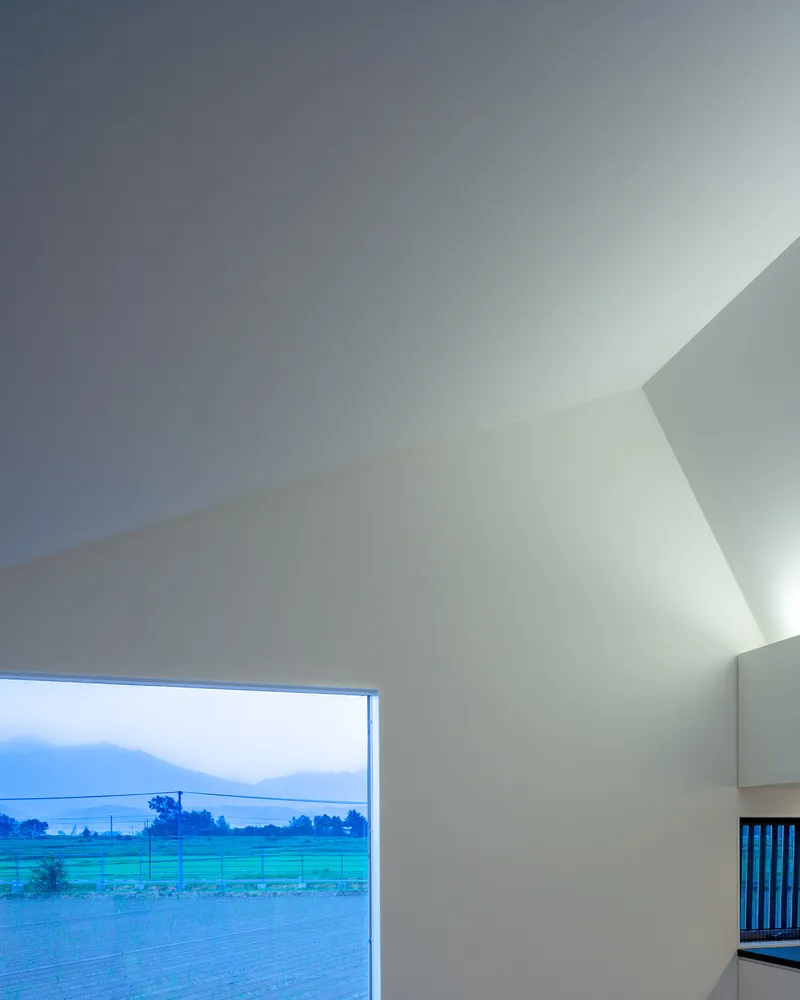
The rotation of the two volumes creates a series of precisely aimed windows that frame the Furano Plateau's shifting seasons. A square opening captures flooded rice paddies backed by distant mountains. A tall picture window stretches toward the Tokachi range across green fields. At twilight, an angled ceiling plane draws the eye down toward farmland dissolving into blue darkness.
These views are not pastoral decoration. They connect the occupants to the working agricultural landscape that surrounds them on every side: irrigation channels, utility poles, tire tracks in the snow. Busch doesn't romanticize the countryside. He positions the house within a productive terrain and lets its reality fill the rooms.
Interior Color and Detail
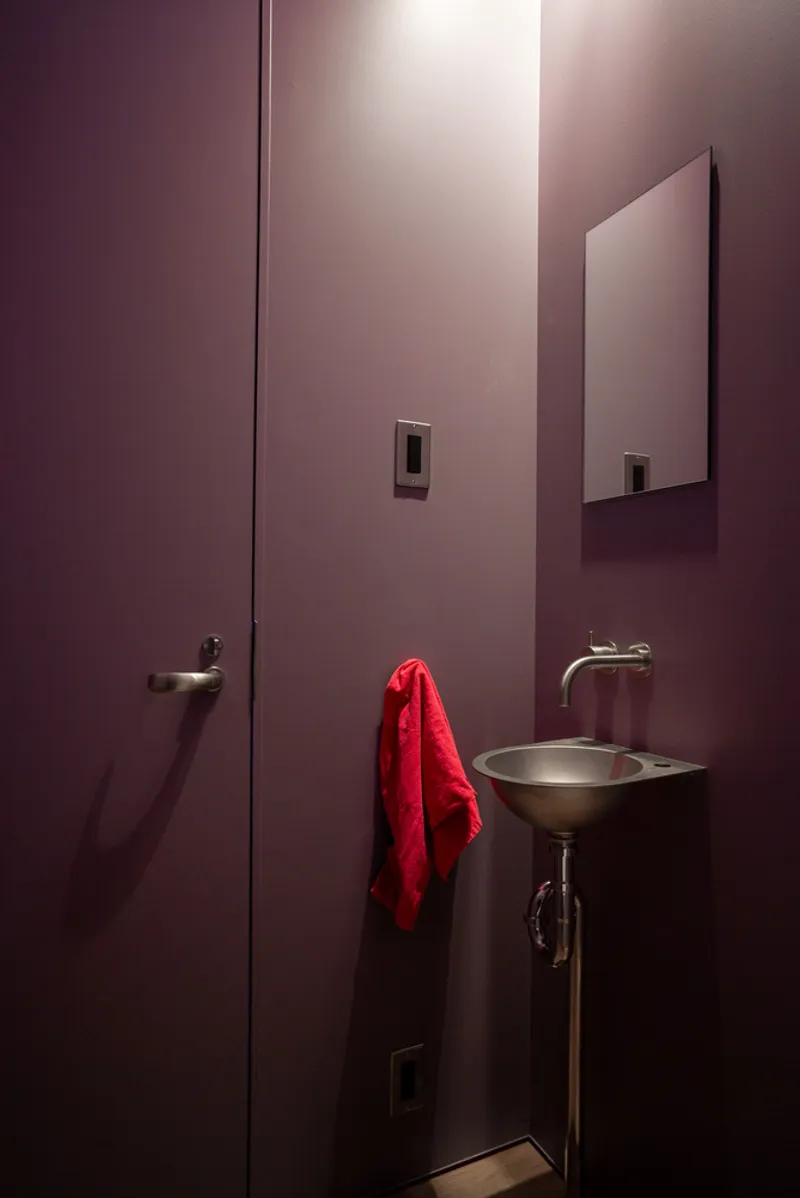
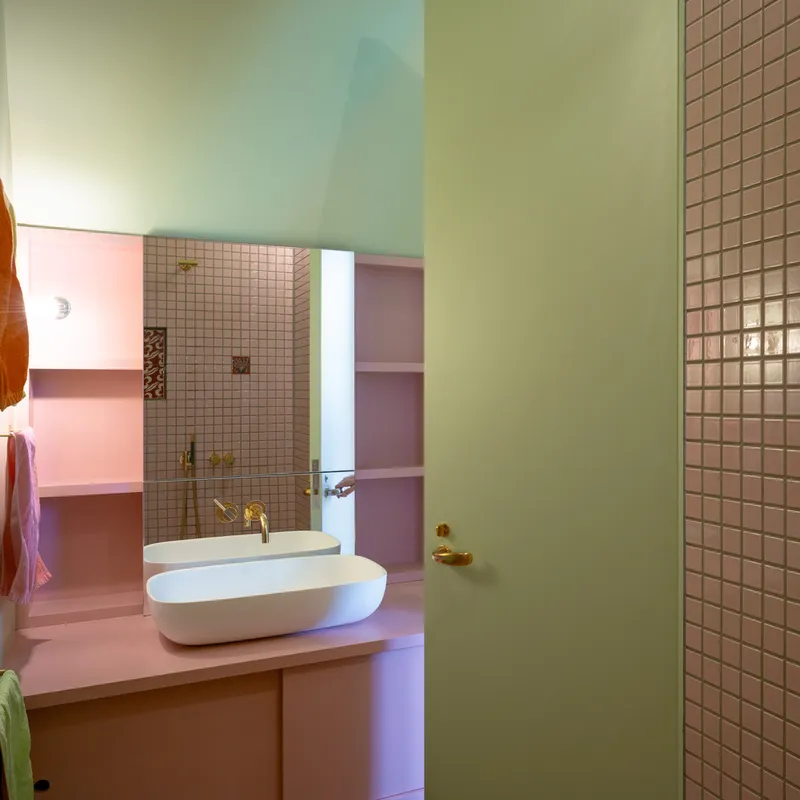
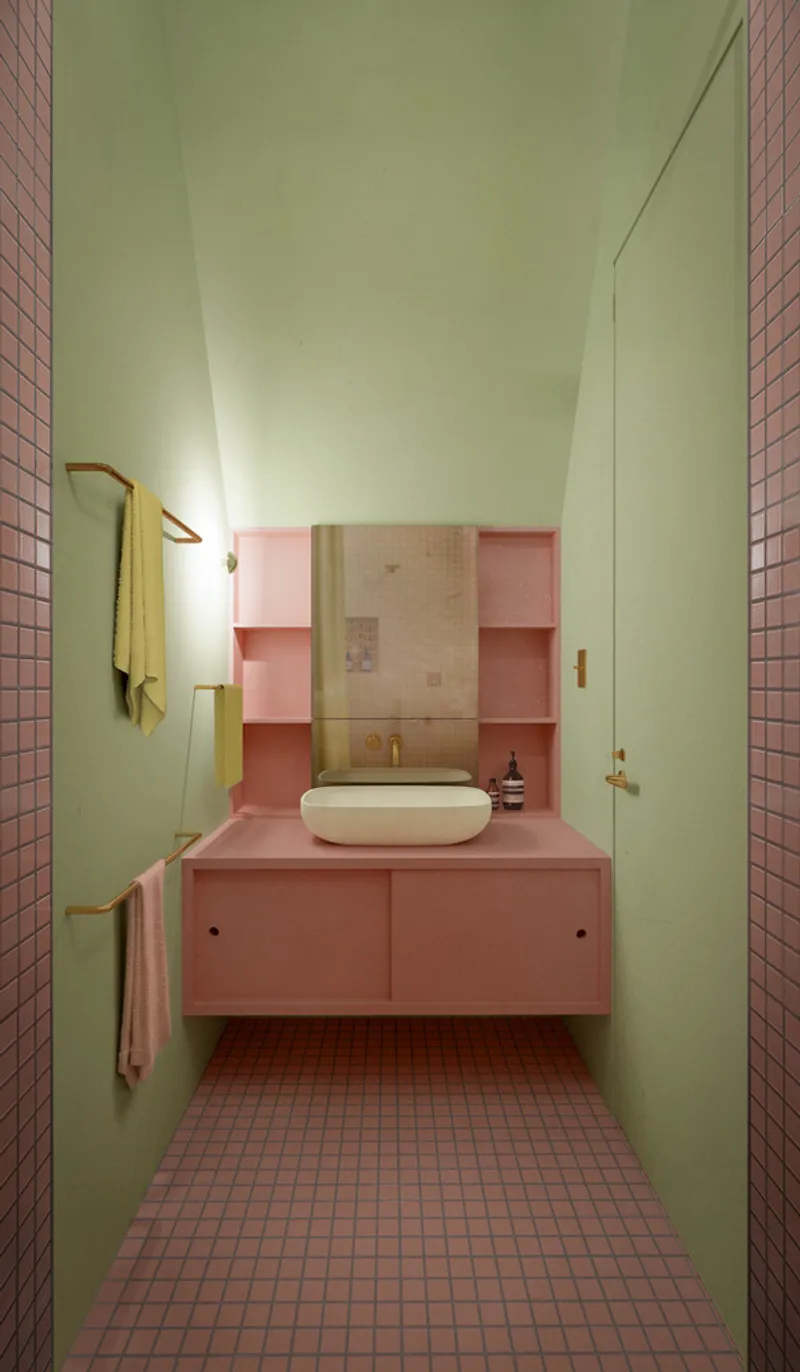
Against the restrained timber and white palette of the main living spaces, the bathrooms arrive as vivid punctuation. One is clad in purple with a pedestal sink and concealed door. Another layers pink mosaic tile on the floor and shower wall against mint green doors and surfaces. These rooms feel deliberately playful, as if the architects understood that a net-zero house risks feeling earnest and needed moments of irreverence.
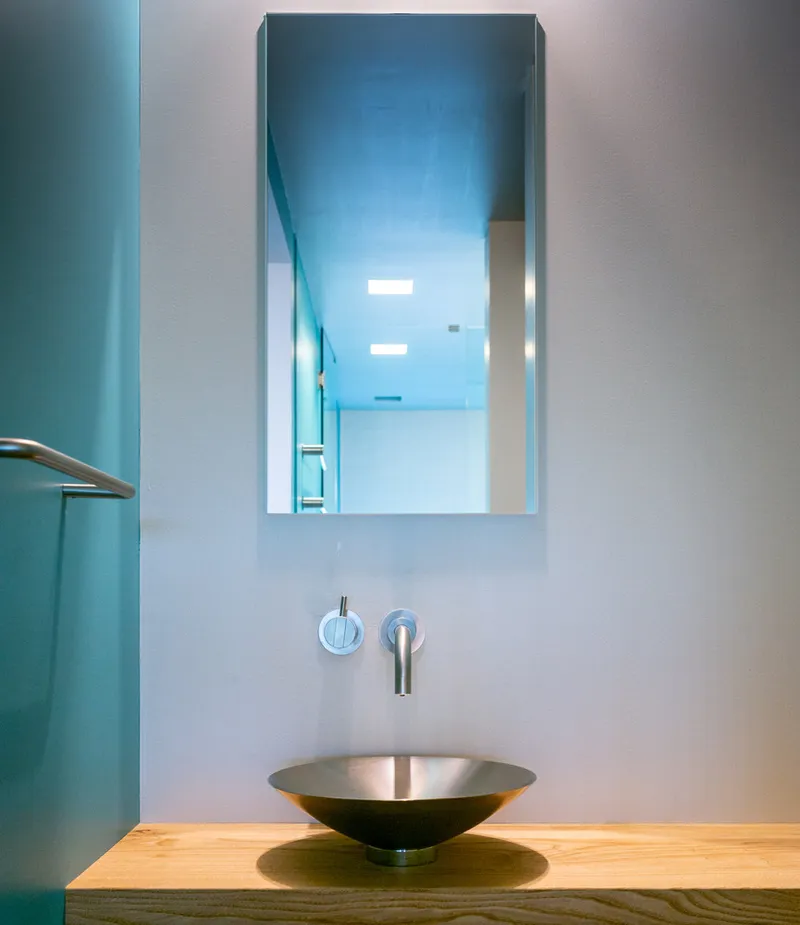
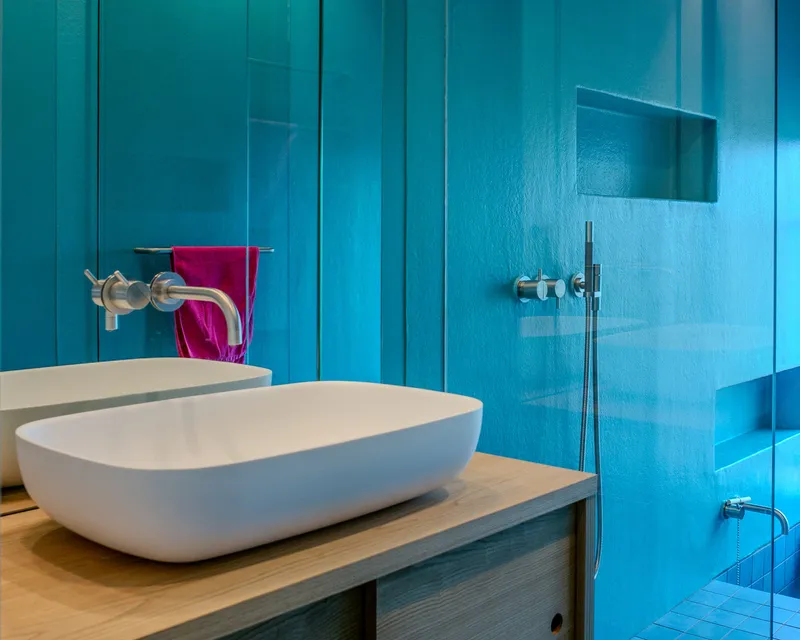
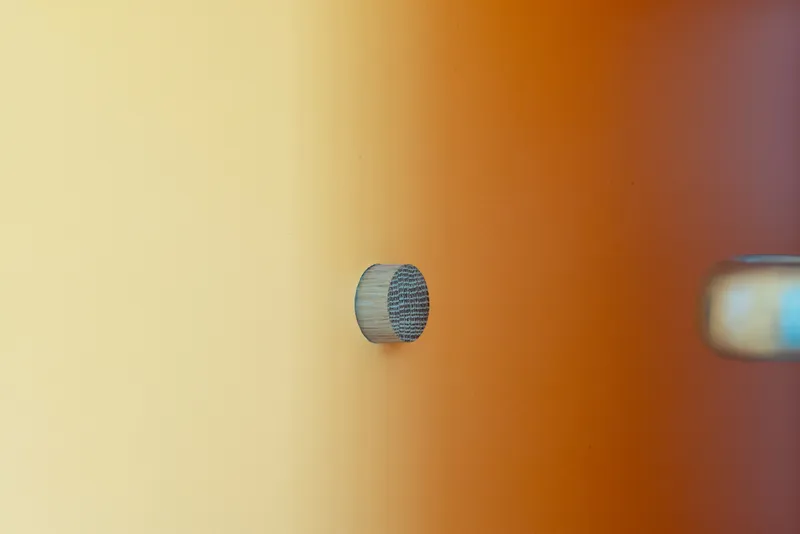
Hardware and fixtures carry the same attention. A conical metal vessel sink sits on a timber vanity. An oval basin meets turquoise tile. A circular wooden door knob catches warm gradient light. The cumulative effect is a house where sustainability is the backbone, not the personality.
Circulation and Spatial Flow
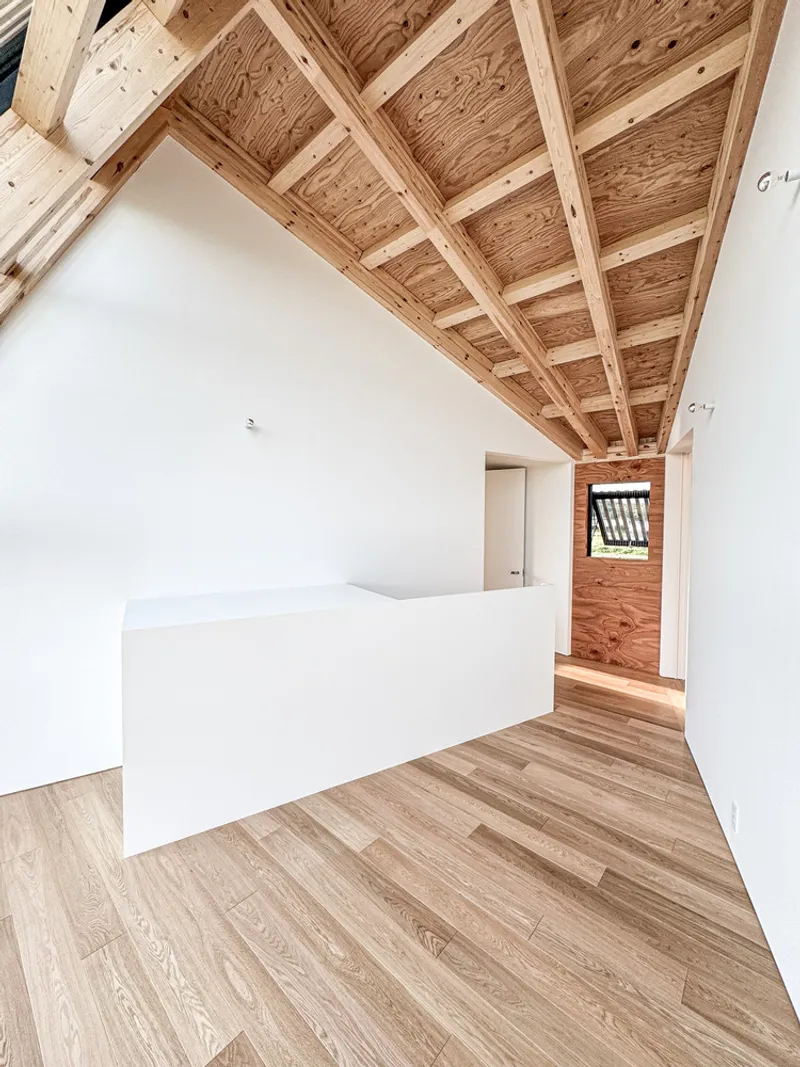
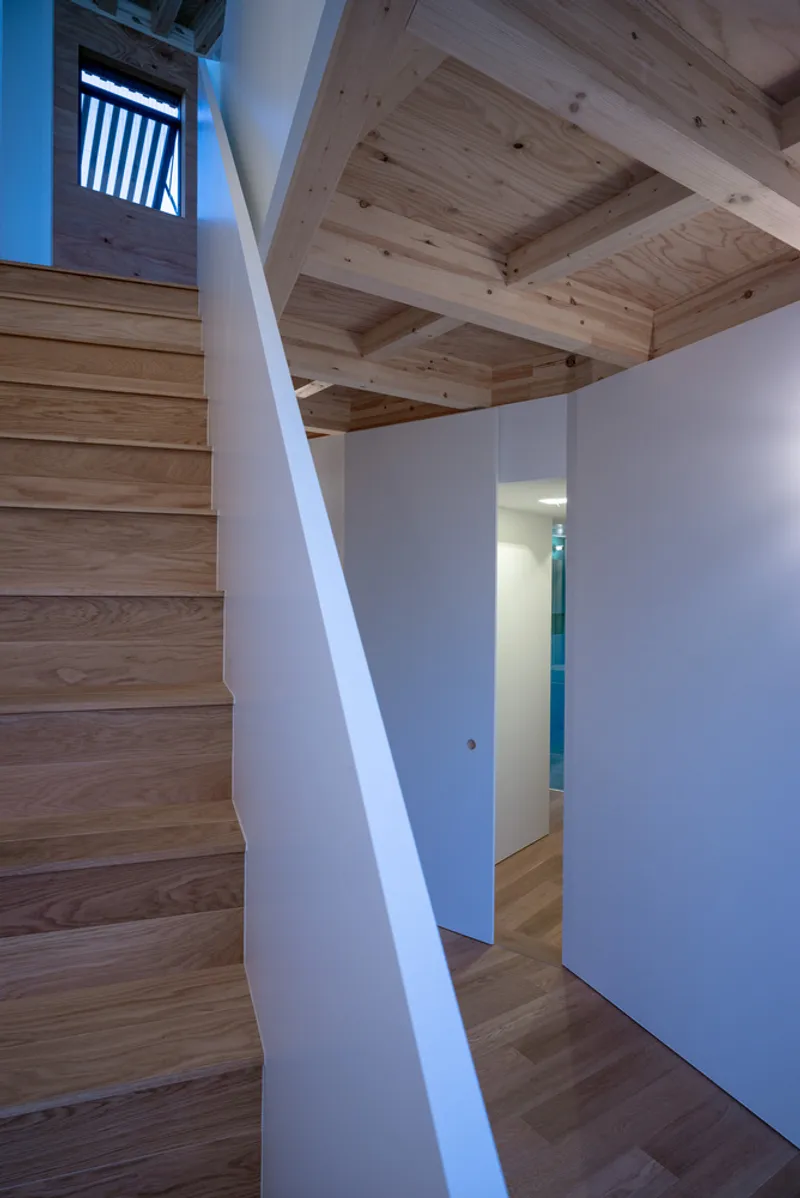
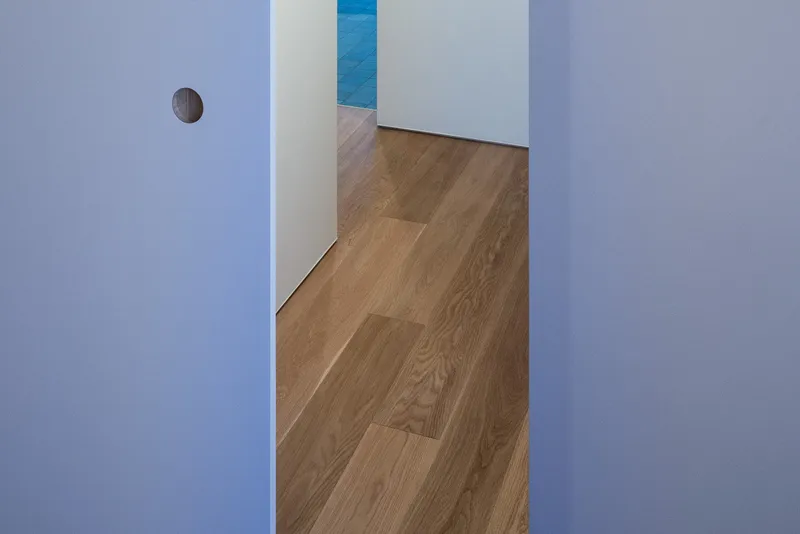
The upper level hallway runs beneath exposed roof rafters, its proportions compressed just enough to make the double-height spaces below feel expansive by comparison. Stairs rise past white walls and concealed doorways, with the timber structure overhead acting as a continuous orientation device: follow the beams and you know where you are in the plan.
Open-plan zones are managed with sliding partitions and threshold steps that mark transitions between volumes without closing them off. The house reads as porous rather than compartmentalized, allowing warmth and daylight to circulate freely between its two halves.
Ground and Geothermal
The solar panels handle electricity, but heating comes from below. A heat pump taps a nearby groundwater source that maintains a stable temperature year-round, feeding underfloor radiant heating and domestic hot water. In a climate where winters are long, snowy, and cold, this geothermal strategy is not a bonus: it's the difference between comfort and compromise.
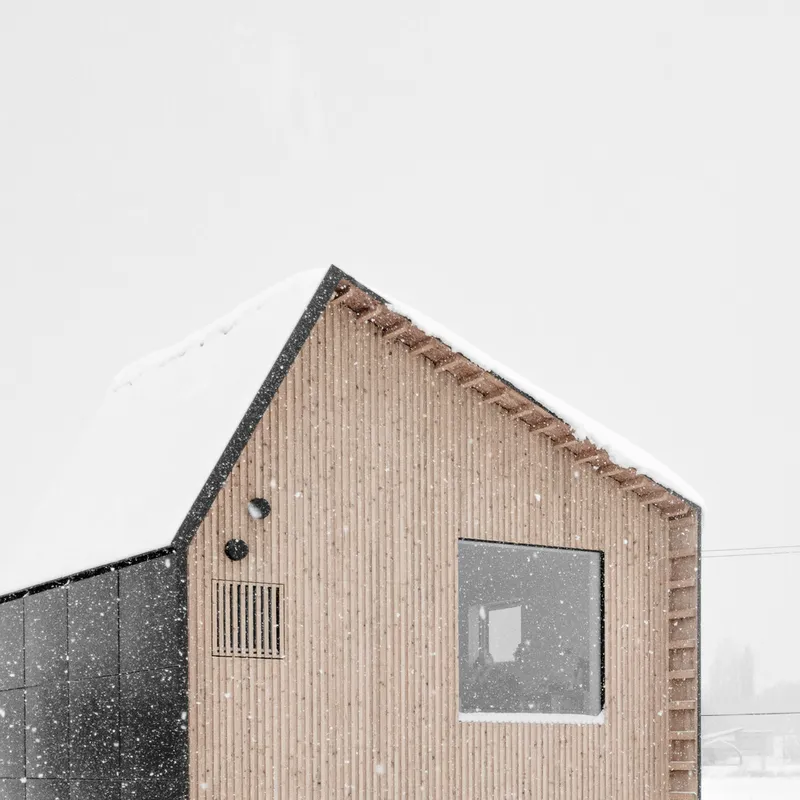
The courtyard view during snowfall reveals how the interstitial space shelters the glazed connector from wind while still admitting light. Vertical timber cladding on the gable faces, with its louvered vent panels, manages moisture and ventilation at the facade level. The roofline junction where black corrugated metal meets timber slats reads as a deliberate collision of the two material identities: the energy-harvesting shell and the inhabitable core.
Plans and Drawings
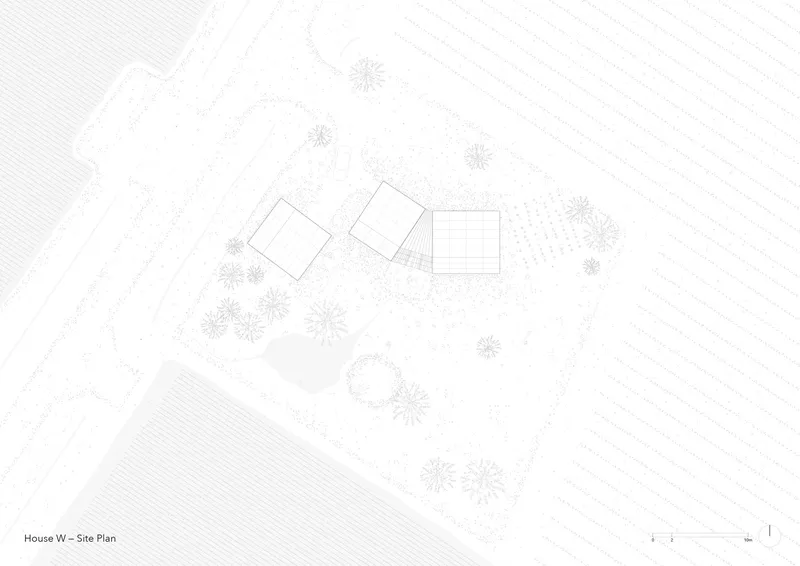
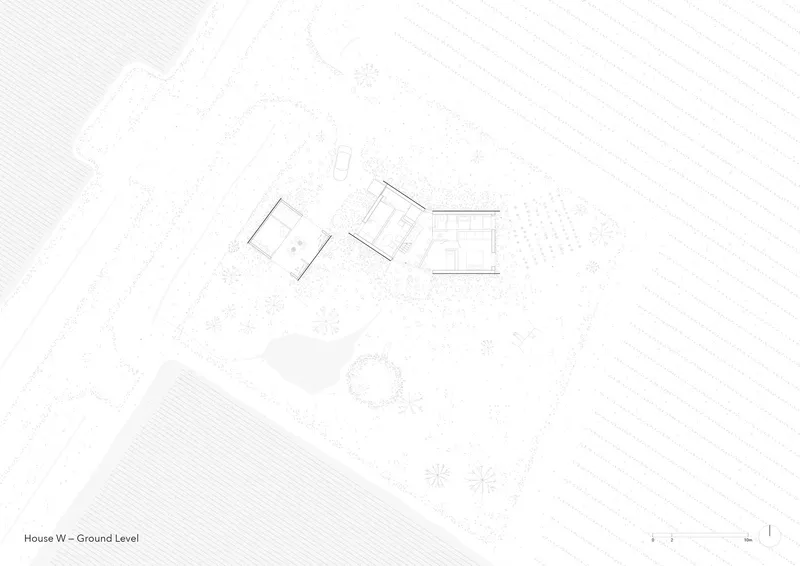
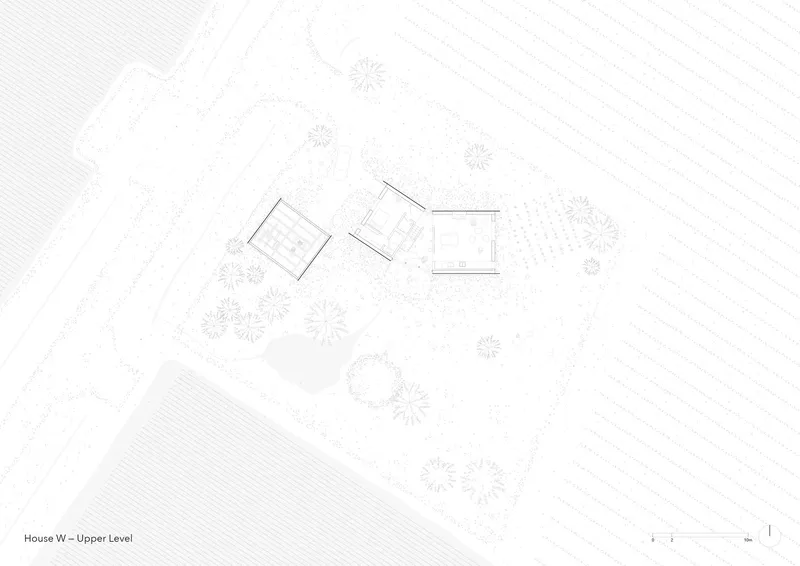
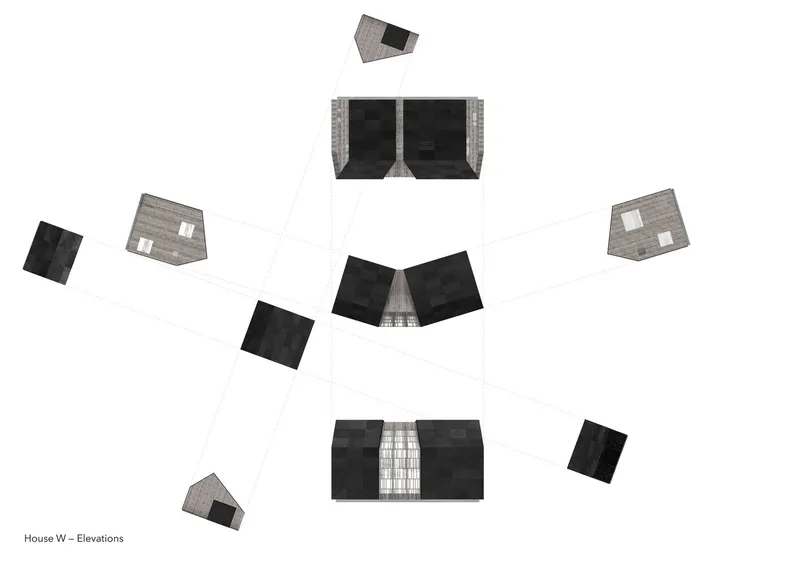
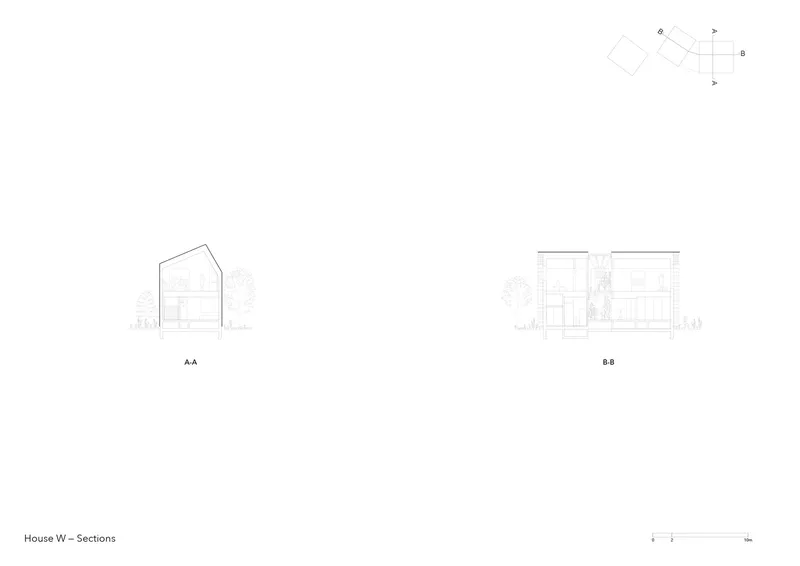
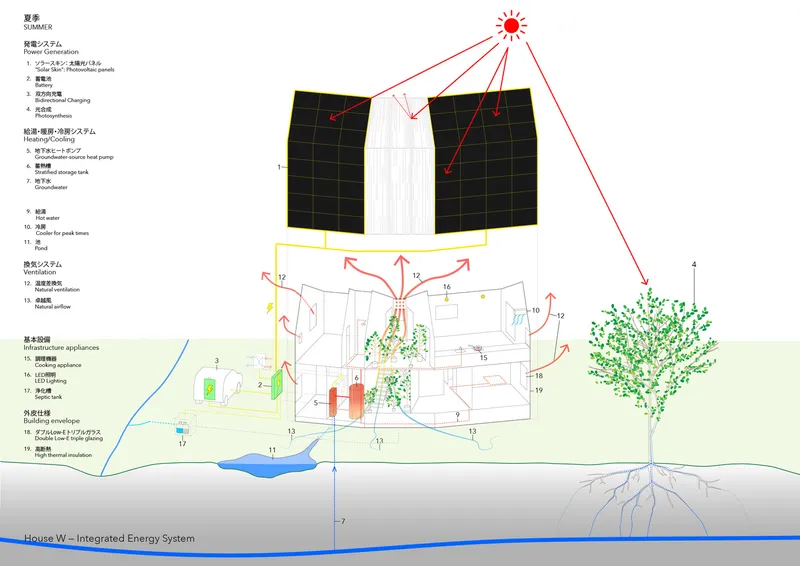
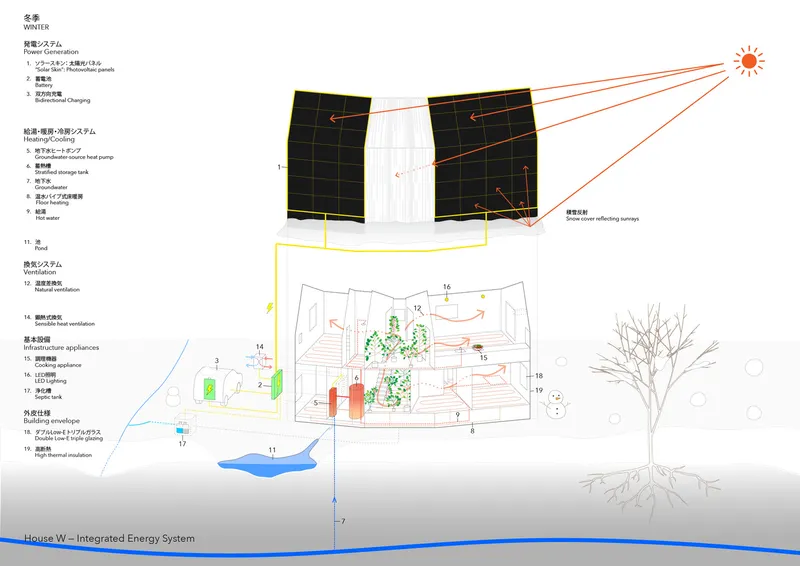
The site plan confirms how deliberately the three volumes are positioned on the agricultural plot, with the two main wings angled to capture views in opposing directions. Floor plans show the spatial discipline at work: rooms occupy the gabled wings while the glazed link between them serves as living core and thermal buffer. The sections reveal how the steep roof pitch creates high interior volumes that push warm air upward, and the energy diagrams lay out the full closed-loop system of photovoltaic capture, battery storage, geothermal heating, and seasonal louver adjustment.
Why This Project Matters
House W makes a quiet but forceful argument against two prevailing assumptions: that net-zero architecture must be compact and austere, and that sustainability demands urban density. By locating itself in active farmland and producing a significant energy surplus, the house demonstrates that rural living can be ecologically productive rather than extractive. Its modular, splittable form suggests a replicable logic for countryside settlement that doesn't mimic suburban sprawl.
More importantly, it refuses to let performance metrics define the experience of living. The playful bathrooms, the carefully framed views, the warm timber interiors: these aren't concessions to livability but evidence that environmental responsibility and architectural pleasure were never in conflict to begin with. Florian Busch Architects has built a prototype that feels like a home, and that distinction is exactly what the net-zero conversation has been missing.
House W by Florian Busch Architects. Located in Nakafurano, Hokkaido, Japan. 163 m² main house plus 35 m² barn. Completed in 2024.
About the Studio
Share Your Own Work on uni.xyz
If projects like this are the kind of work you want to make, uni.xyz is a place to publish your own, find collaborators, and enter design competitions.



Popular Articles
Popular articles from the community


Riyadh For All: Intergenerational Urban Design for Active Aging in Rabat
Riyadh For All reimagines urban design in Rabat with intergenerational co-living, adaptive courtyards, and Moroccan cultural exchange today.

Co-life: Sustainable Architecture for Age-Friendly Community Living
Co-life reimagines sustainable architecture for seniors through courtyards, rammed earth, shared gardens, and spaces designed for belonging.

The Musturak Paradise: Senior Living Architecture for a Connected Future in Temara, Morocco
The Musturak Paradise reimagines senior living architecture in Temara via private homes, social spaces, culture, community, and shared care.

Conexión: Biophilic Design Reimagines High-Rise Living in Hong Kong
Conexión reimagines high-rise living in Hong Kong through biophilic design, green facades, shared spaces, daylight, water and nature within.

Similar Reads
You might also enjoy these articles


Hodi-Mandai Geram
Project Function: Preservation and revitalization of the Intangible heritage and socio-spatial identity of the Hodi by Housing, Cultural Memory Center, Sacred Grove, landscape, local tourism economy


Olio Towers: A Mid-Rise for Performers That Fuses Housing, Rehearsal, and Stage
Located blocks from Houston's Theater District, this modular tower stacks living units around a central performance atrium.

Oasis: Modular Green Housing Carved into Dhaka's Urban Fabric
A shortlisted Plugin Housing entry reclaims unauthorized settlements in Dhaka with stepped concrete volumes, green roofs, and ventilation-driven design.

Black Hole: A Floating Megastructure for the Post-Physical Era
Emiliano Mazzarotto envisions a spherical, self-scaling arena where e-sports, digital hotels, and holographic stadiums replace traditional public space.

Explore Zero Energy Competitions
Discover active competitions in this discipline



Challenge to reimagine the Iron Throne


Photograph architecture without architects


Illustrate the lost glory of Angkor Wat - Render Challenge


Design challenge to reuse E-waste
Comments (0)
Please login or sign up to add comments
No comments yet. Be the first to comment!