

Housing Version 2.0: Vertical Neighborhoods That Breathe in Mumbai's Dense Fabric
A thesis project layers commerce, community, and modular housing into a single tower that reimagines dense urban living in Mumbai.


Mumbai's skyline is a monument to repetition. Tower after tower of identical floor plates, stacked without regard for climate, culture, or the messy vitality of the streets below. Housing Version 2.0 confronts that inertia head-on, proposing a residential tower organized not as a stack of identical apartments but as a layered vertical neighborhood where markets, shared courtyards, transitional terraces, and modular living units coexist within a single structural system. The core argument is spatial: if Mumbai's street life thrives on porosity and overlap, then its housing should translate those qualities vertically rather than sealing them off behind corridor walls.
Developed as a thesis project by Aishwarya Parab, the project draws on fieldwork across Mumbai's diverse housing conditions: chawls, cooperative societies, slum clusters, and contemporary towers. Each typology contributes lessons about adaptability, communal exchange, and climatic response that the city's mainstream housing production routinely ignores. The result is a design framework that treats housing as a dynamic, evolving system rather than a fixed typology, bridging private and public realms through carefully calibrated spatial layering.
Three Layers: Commerce at Ground, Community in Between, Living Above
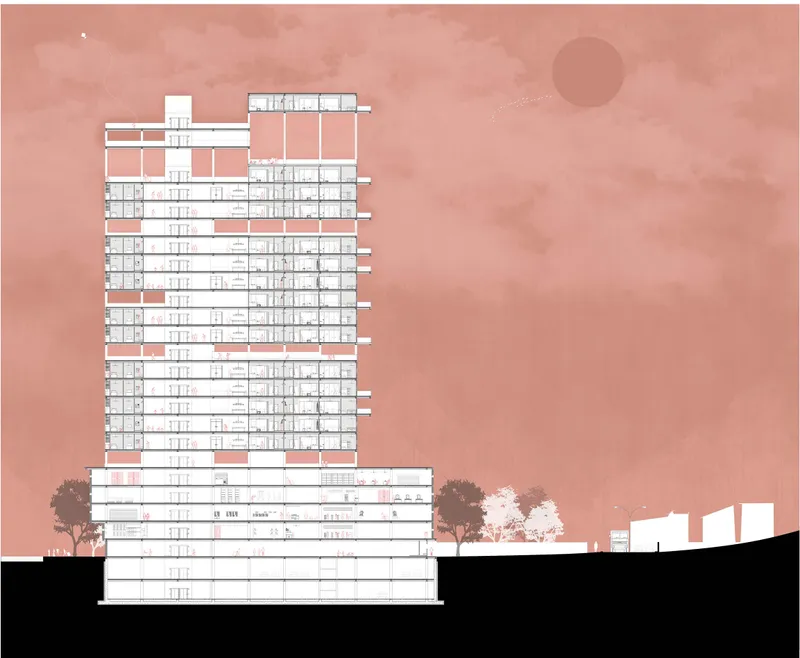
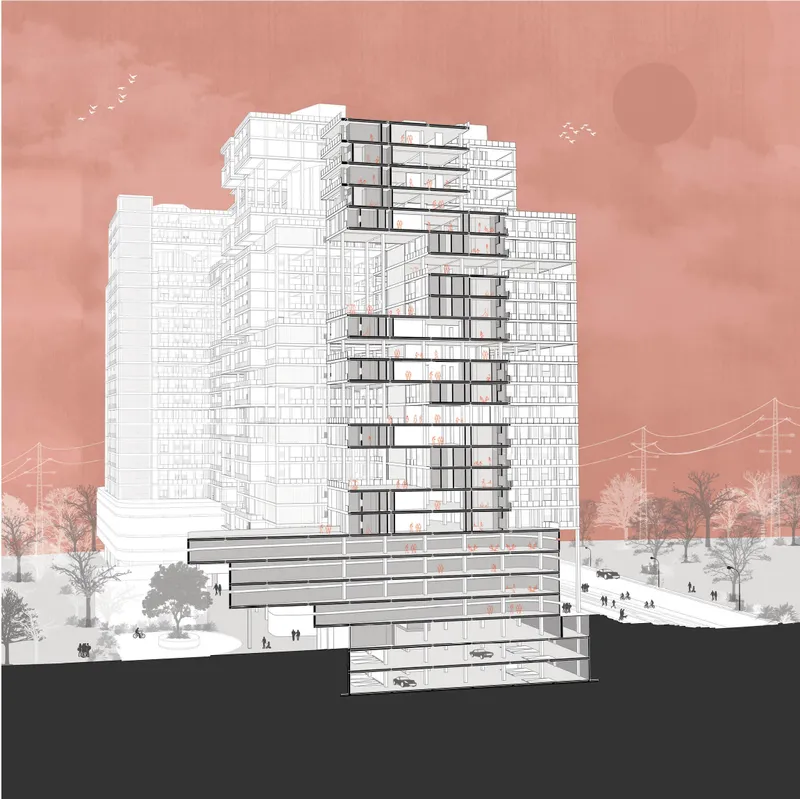
The sectional drawings reveal the project's organizational logic with clarity. A porous ground layer integrates markets, workshops, and pedestrian-friendly open spaces, functioning as a public platform that connects the tower to its surrounding neighborhood. Above that sits a transition layer of semi-public community spaces, acting as a social and spatial buffer between the active commercial zones below and the private residences above. The upper floors house modular residential blocks designed for flexibility, allowing occupants to alter and extend their living units based on changing needs. What makes the section compelling is how transitional terraces and shared courtyards punctuate the tower's height, introducing breathing spaces and visual connections between floors that dissolve the rigid boundary of the conventional apartment slab.
The staggered balconies and planted terraces visible in the second section are not decorative gestures. They perform as environmental mediators, shading lower floors, channeling airflow, and creating the kind of semi-open, in-between zones where informal social life actually happens. The section also shows how each layer operates as a semi-independent ecosystem while contributing to the collective life of the building, a strategy that echoes the self-organizing logic of Mumbai's informal settlements without replicating their infrastructural vulnerabilities.
A Facade That Registers Its Internal Complexity
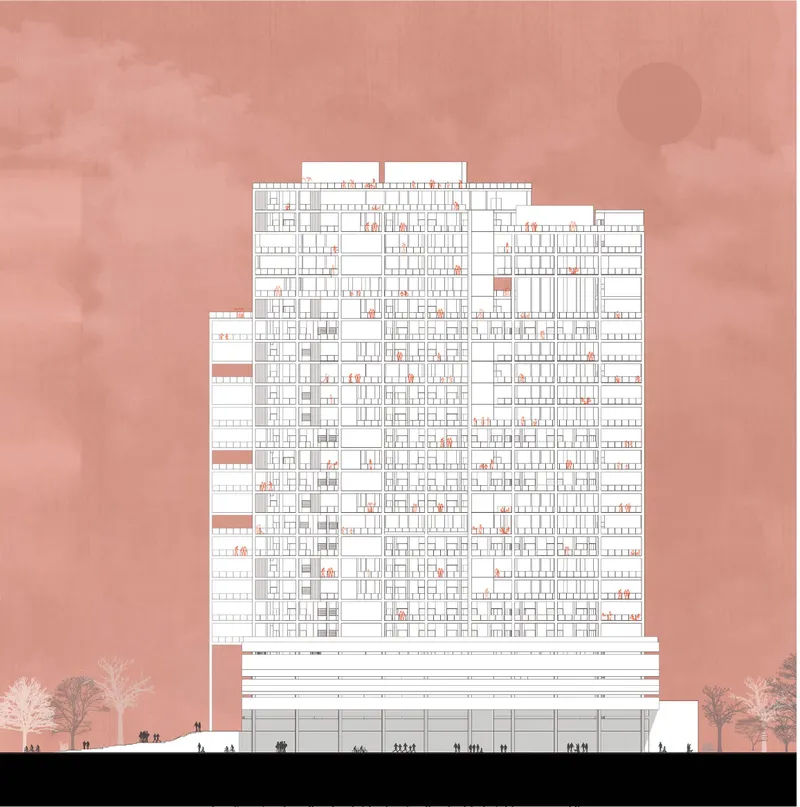
The elevation drawing strips away romantic rendering to show the tower's facade as a gridded system of openings, where window patterns, solid panels, and recessed balconies articulate the building's internal program on its exterior surface. Figures at the base establish the scale of the commercial podium, grounding the tower in pedestrian reality rather than abstract massing. The grid is regular enough to suggest a rational, modular construction system but varied enough to signal that different things happen behind different parts of the facade: living rooms, bedrooms, shared terraces, and community halls each register as distinct conditions within the same structural framework.
From Chawl Logic to Modular Framework: The Research Process


The presentation boards document the investigative process that underpins the design. Colored zoning studies and conceptual massing diagrams trace the iterative development of the tower's form, showing how the project moves from abstract spatial principles to specific volumetric relationships. The massing studies explore how vertical density can coexist with horizontal connectivity, a spatial translation of street-level vibrancy into a vertical habitat. Each iteration tests a different balance of density and porosity, solid and void, private enclosure and communal exposure.
The research board is equally revealing. Isometric drawings, floor plans, sections, and analytical diagrams map Mumbai's existing housing typologies, extracting the spatial affordances that make each one work (or fail). Parab's method is forensic: she dissects the chawl's shared corridor, the cooperative society's communal courtyard, and the slum cluster's incremental growth patterns, then recombines those principles into a new architectural framework. The text overlays make the analytical logic legible, turning the board into a design argument rather than a collection of precedent images. The modular planning approach that emerges from this research allows the building to evolve over time, accommodating infrastructural and social change without wholesale demolition and reconstruction.
Why This Project Matters
Housing Version 2.0 matters because it refuses to accept the premise that density and livability are opposed conditions. In a city where millions live in housing designed without regard for communal life, climatic comfort, or future adaptability, Parab's thesis demonstrates that a more responsive architecture is not only possible but can be derived directly from the spatial intelligence already present in Mumbai's own urban fabric. The project does not import a foreign typology; it synthesizes local knowledge into a new framework.
The strength of the work lies in its methodological rigor. By grounding every design decision in documented fieldwork across Mumbai's housing spectrum, the project avoids the trap of aesthetic novelty for its own sake. The layered organization, the modular structure, the transitional terraces: each element can be traced back to an observed condition in the city's existing built environment. That disciplined approach gives the proposal credibility as a replicable strategy, not just a one-off design exercise, and positions it as a serious contribution to the conversation about how South Asian cities can house their growing populations without sacrificing the qualities that make urban life worth living.
View the Full Project
About the Designers
Designer: Aishwarya Parab
Enter a Design Competition on uni.xyz
uni.xyz runs architecture and design competitions year-round that reward proposals with spatial conviction and real site intelligence.
Project credits: Housing Version 2.0 by Aishwarya Parab.


Popular Articles
Popular articles from the community


Singing Woman: An Opera House That Performs Before the Curtain Rises
Ovidiu Cristian Pavel's conceptual opera house translates Estonia's choral identity into a sculpted waterfront landmark facing the Baltic Sea.

The Amber Palace Opera: A Geological Fiction Surfaces on Tallinn's Baltic Waterfront
Pierre Brillard reimagines a Baltic legend as a public landscape, opera house, and waterfront promenade rooted in Tallinn's coastal identity.

Opera by the Sea Estonia: Three Shells Dissolving Architecture into Tallinn's Coastline
A winning opera house proposal replaces monumental form with interconnected shells that blur the boundary between building, park and Baltic Sea.

Faces of the Soviet Avant-Garde: Turning Moscow's Street Names into an Open-Air Museum
A network of sculptural installations across a Moscow residential district transforms forgotten architect names into spatial encounters with cultural memor

Similar Reads
You might also enjoy these articles

Play: Fragments of Their World: Remembered Architecture Rebuilt as a Modular Playground for Refugee Camps
Tom Gardner abstracts domes, arches and towers from the homelands of displaced families into a kit of child-scaled play parts for camp settlements.
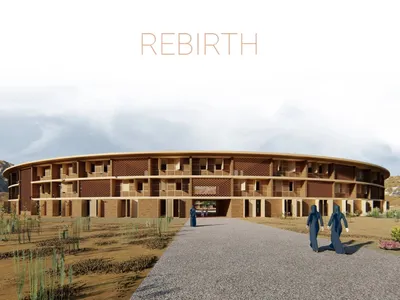
REBIRTH: A Circular Settlement Where Afghan Widows and Their Children Rebuild Life Together
A shortlisted Resile entry turns the circle into a protective ring of timber and brick, gathering homes, classrooms and gardens around a shared landscape.
The Main Dream: A Recycled Plastic Kit That Lets Refugee Children Build Their Own Playground
Thirty-centimetre interlocking cubes that connect on three axes turn play into construction, letting children author the spaces they occupy.

Lunar Spiral: A Fibonacci-Driven Moon Settlement Rising from Shackleton Crater
Golden-spiral geometry organises buried infrastructure and orbiting habitable spheres into a lunar base designed to grow as life on the Moon expands.

Explore Housing Block Competitions
Discover active competitions in this discipline

Challenge to reimagine the Iron Throne

Photograph architecture without architects

Illustrate the lost glory of Angkor Wat - Render Challenge

Design challenge to reuse E-waste
Comments (0)
Please login or sign up to add comments
No comments yet. Be the first to comment!