

How Data on the Internet Affects Societies: Social Media, Digital Forensics, Data Centers in Space
This paper will analyze how data on the internet will affect societies from the perspective of social media, digital forensics, and data centers in space.

Introduction
Data is information used to analyze or make decisions. As our societies evolve and Smart Cities develop, the use of data will grow. This paper will analyze how data on the internet will affect societies from the perspective of social media, digital forensics, and data centers in space.
1. Social Media

A recent report found that Gen-Xers (born 1967-1981) spend an average of six hours and 58 minutes a week on social media platforms, Millennials (born 1982-1996) spend six hours and 19 minutes a week, and Gen-Zers (born after 1996), comprising 26% of the world’s population as of 2023, spend two hours and 43 minutes a day (Childers, 2021, 6). The perception of social media has changed with the rise of Gen-Zers from a simple method of online communication into a multimedia tool for political, marketing and educational purposes.
On June 11 2020, the Trump campaign held a rally in Tulsa, Oklahoma. The Trump campaign’s Twitter account posted a tweet asking supporters to register for free tickets using their phones. Unexpectedly, many of the people registering for this rally were K-pop fans and Gen-Zers. They shared TikTok videos, encouraging people to register for the rally and then not show up. Rally participation data showed that this rally would be fully booked. However, many of the seats were empty (Pangrazio, 2021, 18).
Compared to other generations, Gen-Zers believe "Social Media Influencers" (SMI) strongly influence new trends. SMI is a new type of independent third-party endorser who shapes audience attitudes through blogs, tweets, and other social media (Childers, 2021, 3). SMIs have made it their business to understand the algorithms, or sets of data that rank content on a social platform, as a means of growing their follower-base. Advertisers and marketers have begun to recognize the power of SMIs by developing partnerships to build positive public perceptions of products and services. SMIs are able to relate to their following on a more personal level, so brands and organizations invest in them to leverage their potential for higher engagement with consumers. In 2021, approximately USD $4 billion was spent on influencer marketing in the US, and is forecast to hit $5.6 billion in 2024 (Er, 2024).
As Gen-Zers, compared to previous generations, focus more on short, brief information, with YouTube as a primary source for self-instruction (Childers, 2021, 6), teachers now look to social media’s educational potential, as a form of fast dissemination of information and data. Facebook is being used to connect educators with students so that they can communicate and send schedules, news, and education-related content. Additionally, Gen-Zers find social media useful when it comes to researching prospective colleges, following prospective colleges on Instagram to see if they are of good fit for them (Chakraborty, 2022).
With the rise of Gen-Zers, social media is being used as a multimedia tool; through it data is manipulated for political purposes, analyzed for marketing, and exchanged for education. As new generations arise, older generations will need to evolve their political, marketing and educational methods considering new technological trends.
2. Digital Forensics
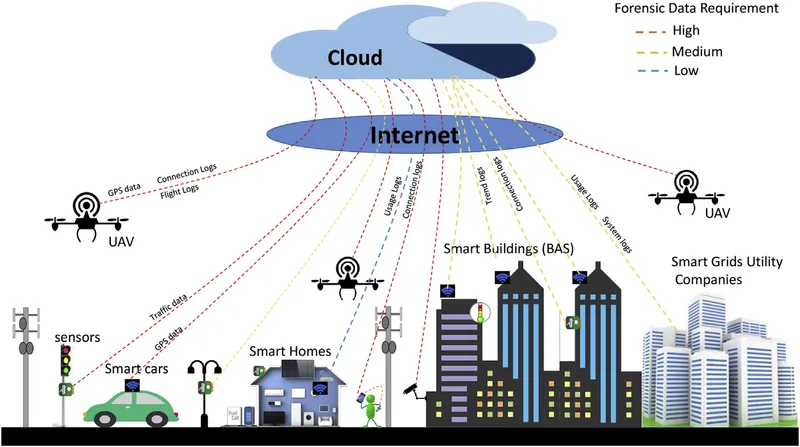
The Internet of Things (IoT) is the collective network that facilitates communication between devices and the Cloud and between the devices themselves. It is predicted that the global market for IoT will grow from USD $77.3 billion in 2020 to USD $110.6 billion in 2025 (Rejeb, 2022, 2). By 2030, 50 billion IoT devices will be used around the world, including smartphones, health monitors, home sensors, smart cars and more.
Digital forensics focuses on acquiring, analyzing, and reporting on data stored electronically. One example of its implementation is when a woman was found dead in Freiburg, Germany in 2016. Analysis of the suspect's health app data on his smartphone revealed that he was climbing stairs at the time of interest. The investigators speculated that the app recognized the process of dragging and descending the body to a riverbank where it was found, as a stair climb in the app (Chung, 2020, 2). Digital forensics will be used more with more IoT devices; smart meter usage logs may help forensic investigators detect in-house marijuana growing operations which have been linked to electricity theft (Baig, 2017, 3).
This brings up the question of privacy. In one case, New York state sought to have Apple crack the phone of a drug dealer, but that judge expressed doubt that Apple could be forced to do so. In another case, the US government filed to force decryption of an iPhone taken from one of the terrorists involved in mass killings in San Bernardino; the judge agreed to it as it was a much more emotionally compelling case (Losavio, 2018, 7). In the future, the line between justified digital forensics and invasion of privacy may be further blurred.
How this line is handled also may change depending on the country. In the US, there is disagreement among law enforcement and government regarding legal concerns in digital forensics, and often the courts need to make case decisions. The EU established the General Data Protection Regulation (GDPR) in 2018 to enhance data protection for individuals within the EU. Penalties for compliance failures with the GDPR include €10 million or 2% of global annual turnover for commercial entities (Losavio, 2018, 6). This could lead to increased international conflicts related to data management. In the 2001 criminal case of the US v. Ivanov, an investigating US officer used a US court order to authorize remote access to Russian server data that contributed to the imprisonment of Aleksey Vladimirovich Ivanov, without Ivanov’s consent. In response, Russian state security filed criminal charges for illegal access without proper authority and outside the jurisdictional powers of the US (Losavio, 2018, 2).
Where we draw the line between what is digital forensics and invasion of privacy will be debated across different entities as the Internet of Things becomes more complex. Eventually, a common ground in the form of globally accepted legislation may need to be established.
3. Data Centers in Space
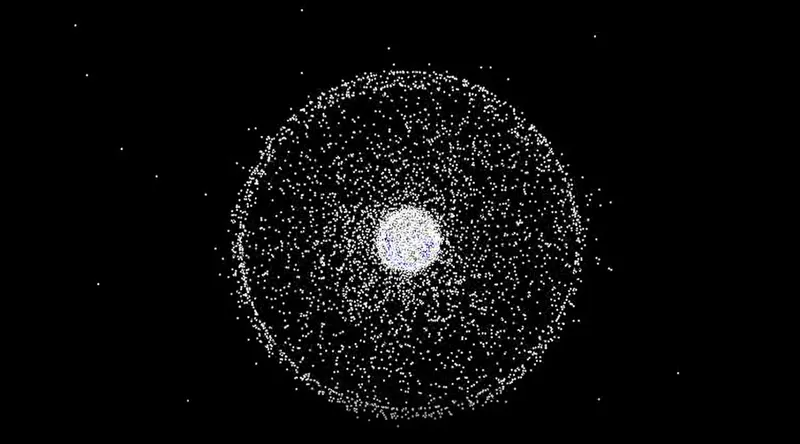
To meet the computing and data storage demands of the world, the Cloud now has a greater carbon footprint than the airline industry. Data centers collectively devour more energy than some nation-states (Monserrate, 2022, 1). They are also inefficient; in some cases, only 6-12 percent of energy consumed is devoted to active computational processes (Monserrate, 2022, 6). The main computational processes that take up the most energy, machine learning (AI) and cryptocurrency mining, are gradually being widely used.
Data Centers also impact the environment. The Utah Data Center in Bluffdale, a facility of the US National Security Agency, consumes seven million gallons of water daily to operate. In 2021, Chicago residents complained of constant fan noise from a Digital Realty data center in the Printer's Row downtown area. Residents in adjacent condo blocks say the constant noise from rooftop HVAC fans is keeping them awake and causing a constant nuisance (Monserrate, 2022, 8). It is clear that there needs to be a solution to solve data center environmental impact and impact on city residents.
One possible solution discussed has been to move data centers into low earth orbit or on the moon’s surface. Tidally locked in orbit, the moon’s near side always faces earth, making line-of-sight communication possible (Shendar, 2023). It also has lava tubes large enough to host a small city. Advantages of low earth orbit placement include having an abundance of solar energy, natural cooling, global coverage and enhanced security (Shendar, 2023). Some tech companies and startups are conducting feasibility studies and developing technologies that could support future space-based data infrastructure.
The deployment of data centers in space would raise complex legal and regulatory questions. Issues of orbital rights, space debris management, and international jurisdiction would need to be addressed. Various countries have been implementing lunar exploration programs, including the US, South Korea, China, India and Russia, which could lead to territorial disputes. Laura Forczyk, executive director of Astralytical, a space consulting firm based in Atlanta claims that “The US is pointing to China and saying, ‘We need to fund our space initiatives to the moon…because China is trying to get there and claim territory.’ And then Chinese politicians are saying the same thing about the US" (Chow, 2023).
Data requires data centers to support it, and data centers require a lot of power that impacts the environment. Bringing data centers into low earth orbit or the moon seems to be a realistic possibility. However, there will be more complex problems regarding space debris and international jurisdictions that will likely complicate the management of data in the future.
Conclusion
Data currently influences politics, marketing and education through social media, creates a blurred line between digital forensics and privacy invasion, and impacts the environment through data centers. As society moves forward, new generations will establish new technological trends, more devices will be connected to the Cloud, and new solutions of reducing environmental impact, such as moving data to space, will be tested. In order for society to thrive under the development of data, old generations must continue to adapt to trends of new generations, new globally agreed legislation regarding data privacy must be established, and the consequences of moving data to space must be considered.
Bibliography
Baig, Z. A., Szewczyk, P., Valli, C., Rabadia, P., Hannay, P., Chernyshev, M., Johnstone, M., Kerai, P., Ibrahim, A., Sansurooah, K., Syed, N., & Peacock, M. (2017). Future challenges for smart cities: Cyber-security and digital forensics. Digital Investigation, 22, 3–13. https://doi.org/10.1016/j.diin.2017.06.015
Chakraborty, A. (2022, May 3). Tallo Data Insights: How Gen Z feels about integrating social media and Education. Tallo. https://tallo.com/blog/how-gen-z-feels-about-integrating-social-media-and-education/
Childers, C., & Boatwright, B. (2021). Do Digital Natives Recognize Digital Influence? Generational Differences and Understanding of Social Media Influencers. Journal of Current Issues and Research in Advertising, 42(4), 425–442. https://doi.org/10.1080/10641734.2020.1830893
Chow, D. (2023, January 22). The space between Earth and the Moon is about to get a little more crowded. NBCNews.com. https://www.nbcnews.com/science/space/space-earth-moon-get-little-crowded-rcna64333
Chung, H., & Choo, K. R. (2020). The need for Internet of Things digital forensic black‐boxes. WIREs. Forensic Science, 2(6), e1385–n/a. https://doi.org/10.1002/wfs2.1385
Er, B. P. (2024, January 2). Study: Global influencer ad spending expected to jump by 13% in 2024. Marketting Interactive. Retrieved July 8, 2024, from https://www.marketing-interactive.com/influencer-advertising-industry-2024
Losavio, M. M., Chow, K. P., Koltay, A., & James, J. (2018). The Internet of Things and the Smart City: Legal challenges with digital forensics, privacy, and security. Security and Privacy, 1(3), n/a–n/a. https://doi.org/10.1002/spy2.23
Monserrate, S. G. (2022). The Cloud Is Material: On the Environmental Impacts of Computation and Data Storage. MIT Case Studies in Social and Ethical Responsibilities of Computing, Winter 2022. https://doi.org/10.21428/2c646de5.031d4553
Pangrazio, L., & Sefton-Green, J. (2021). Digital Rights, Digital Citizenship and Digital Literacy: What’s the Difference? Journal of New Approaches in Educational Research, 10(1), 15–27. https://doi.org/10.7821/naer.2021.1.616
Rejeb, A., Rejeb, K., Simske, S., Treiblmaier, H., & Zailani, S. (2022). The big picture on the internet of things and the smart city: a review of what we know and what we need to know. Internet of Things, 19, 100565. https://doi.org/10.1016/j.iot.2022.100565
Shendar, R. (2023, June 9). Data Centers in space: The promise of the moon. Western Digital Corporate Blog. https://blog.westerndigital.com/space-data-center-moon/


Popular Articles
Popular articles from the community


Cube Design Draws an Ecological Corridor Between Two Shenzhen Hills with the Nankai Building
Beside Shenzhen's container docks, the Nankai Building pairs stacked balconies with a climbing green screen to connect two hillsides across its height.

graciastudio Turns a Viewless Tijuana Lot Inward Around a Courtyard of Concrete, Timber and Trees
In Tijuana, Jorge Gracia's GA2 House stacks a timber-clad private floor over exposed concrete and replaces a missing view with a planted interior patio.

LT2A and OPEN Architectes Thread a Brick and Glass High School Through a Wooded Belgian Campus
In Braine-l'Alleud, a 3,000 m² wing for Collège Cardinal Mercier pairs pale brick with a glazed colonnade, deferring to a small chapel and a dense wood.


The Amber Palace Opera: A Geological Fiction Surfaces on Tallinn's Baltic Waterfront
Pierre Brillard reimagines a Baltic legend as a public landscape, opera house, and waterfront promenade rooted in Tallinn's coastal identity.

Similar Reads
You might also enjoy these articles

Vereda Arquitetos Renovates a 40-Square-Meter Apartment Inside Niemeyer's Copan Building
A compact unit in São Paulo's most iconic residential tower gets a material overhaul that pairs exposed concrete with bold blue Formica.

Shakur's House: Exposed Brick as an Interior Organiser in a 168 m² Mashhad Residence
Brick moves indoors in this Mashhad residence, where masonry walls, glass partitions and teal planes sequence a compact home without closing it off.

Day and Night Park: A Time-Based Urban Newsstand in Beijing
A temporary urban newsstand in Beijing blending travel, light, and reading through poetic colors, compact form, and community-focused design.

Modernist Patio Renovation in El Masnou, Barcelona by Oliver Segura Arquitectura + Cebrià Arquitectura
Modernist patio renovation blending tradition and innovation with a movable pool, leveled floors, and Catalan materials in El Masnou.

Comments (1)
Please login or sign up to add comments
This article offers a compelling exploration of how data influences society, but could benefit from deeper analysis of the potential ethical challenges in space-based data centers.