Hyde’s Theatrical Haven
The concept of touring theatre
The concept of my project is based on my research about theatres in general but most of all their contribution to London as well as the importance of theatres that already exist nearby the park and their influence to the pavilion that is our location. I started off with the research of historic events that occurred in Hyde Park where I came upon the documentation called ‘Hyde Park Archive’. This archive was filled with a lot of information about all the performances that have happened in the past with the date, the name of the performance and with the mention of all the actors that have played in it. Since there is no actual documentation of a theatre physically existing I came upon the idea of a touring theatre.
At first I was working around multiple ideas inspired by different plays such as ‘Midsummer Night’s Dream’, ‘Hamlet’, ‘Henry V’ and ‘Waiting for Godot’. They all had an interesting way of showing the relationship between the government and its people, specifically the animosity between the two, how the people in charge don’t always put their people first and allow them to suffer instead. First I was thinking about the concept of poor theatres, the simplicity and the accessibility of it. I liked the fact that it was meant to be available to the masses while also making a spectacular show with the random props found on the way signifying the idea of ‘poor theatre’. That’s one of the reasons why I chose to present my project through simple strokes and lines. I wanted to take it one step further by expanding accessibility and making it a theatre that travels. In that way a much bigger variety of people would have the pleasure to experience those performances. In the end I felt like ‘Waiting for Godot’ perfectly described what I was trying to convey within the concept of a touring theatre, because that play talks about the common issues that are happening in society.
The concept of the touring theatre is quite simple as it is based on the narrative of changing the destination and travelling through cities, meeting new people, forming different stages and so on. So my idea was to make an object that will mainly represent a theatre but also when it’s not a theatre it can be used for plenty of other events like fairs, smaller concerts, informal political gatherings and bazars. I wanted to make a space that will attract different types of people which gives the opportunity to gather visitors who share different interests and cultures in one place. The space is presented through a multifunctional purpose, providing a wider range of users. Through its traveling character, this theater becomes a mobile point of interaction, encouraging connection and exchange between different cities and cultures. In the spirit of such a theatre I created an object that constantly experiences the change of its function and the change of the frequency of people that are using it.
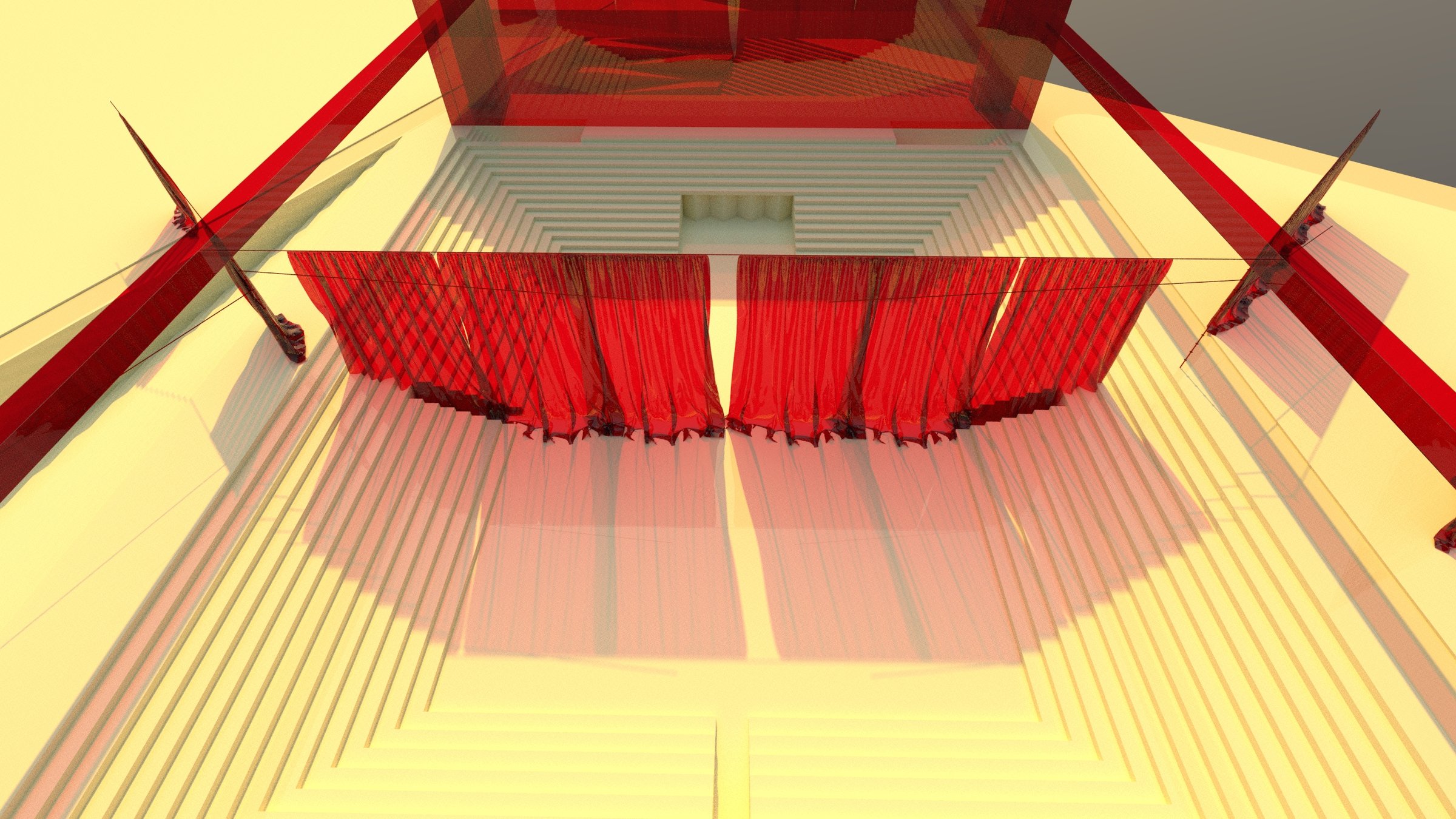
The main focus in the theatre and the beginning points in this project were the drapes. The idea for the drapes came from their frequent appearance in theatres and the effect that they provide to the viewers. The curtains are placed in focal points of the location giving an opportunity of movement. They are able to move 360 degrees whereby they can form new stages on the location and out of it. By their ways of moving they could also form not only divided spaces that could be used as stages but as well they can form a sort of eave which can protect people from bad weather or too much sun.
The drapes are set on columns that have a special system embedded inside of them so that they could actually move. The system is called the scaffold moving system which represents a perforated metal column which is 6 meters long that has rings placed on every 0.5 meters which have the role of carrying the beams. The columns have several parts that are folded on top of each other forming a stable base for hanging beams which carry the drapes. Even though the beams are long and the columns have smaller diameters the construction is steady because the drapes aren’t carrying much weight as they are made out of thin material and because they have a thorough foundation. There are 11 columns out of which 7 of them have the mobile drapes embedded in them as mentioned.
On top of the columns there is a so called ‘cat’s path’ that is used in theatres for setting up the lightning properly and any kind of props if needed. The path is made out of perforated metal that has a fence 1.2 meters tall and it continues to the work block which is made out of the same material and it is used for storage. The rest of the storage is placed underneath the bleachers where it’s easy to approach. The idea was hypermobility so all the stands and other required props are usually made with wheels to enable easy transport.
The theater itself is divided into two auditoriums called Poet’s Playhouse and Writers Theatre. Poet’s Playhouse is the smaller theatre which is open at all times and even when there is no activity planned for the theatre people that are walking by can use it to hang out. On the other hand, Writer’s Theatre is the bigger theatre that is limited by a fence and can be used only when there is some event organized. This theatre has two entrances, one oriented to the north and the other to the south, the north one being underground and considered main entrance, and the south one being above ground. The underground entrance is connected to the lobby with a reception and accompanying content such as the bathroom, the two elevators, the practice rooms and the dressing rooms.
This project has a potential to use the entire park as stage. One way that I would expand this theatre is by posting up the columns that carry drapes across the whole park leading to the theatre. In that way they would enable several different entrances into the park allowing multiple stages and other types of gatherings on the path to the theatre. It would create an interactive way of communicating with the audience. In the long run that would inspire creative growth and a sense of community of the people.
All in all, this theatre provides an inspiring and multifunctional use of space through different events that could occur in it. The touring theatre plays a crucial role in making live performances more accessible, while also promoting cultural exchange, as well as contributing to the variety of the performing arts. This theatre gives an opportunity to welcome people of all backgrounds to partake in cultural enlightening spaces as well as progress in political spheres.