

Indelible Wound: A Geological Museum Carved Into the Earth Itself
Descending beneath Iceland's terrain, this subterranean museum turns excavation into narrative and geological scars into spatial experience.


What if architecture didn't sit on the land but confessed to what we've done to it? Indelible Wound takes the act of digging, the very gesture that has scarred the planet through mining, extraction, and industrial expansion, and turns it into the building's own logic. The result is a geological museum that exists almost entirely underground, its presence above the surface limited to a sculpted roof that barely interrupts Iceland's volcanic horizon. Visitors don't enter so much as descend, moving through layers of excavated earth, exposed rock, and concrete to confront the physical record of human impact.
Designed by Chaeyeon Kim, 강민 조, and 예담 이, the project won the Rift competition on uni.xyz. Sited near the entrance of an Icelandic national park, the design draws directly from the country's tectonic rifts and rugged topography, shaping its mass to resemble slices of earth being pulled apart. The architectural form echoes the cut of a knife: a metaphor for how humanity has physically and metaphorically wounded the planet. Yet the building seeks harmony with its surroundings, preserving the terrain's organic curvature and keeping the skyline intact.
A Roof That Barely Breaks the Horizon
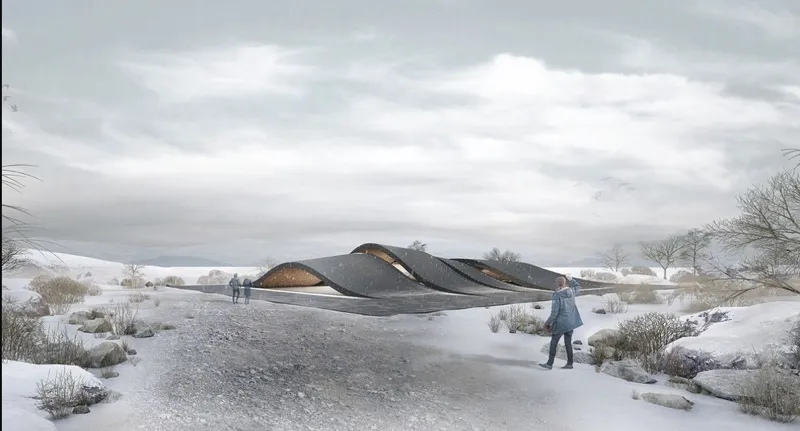
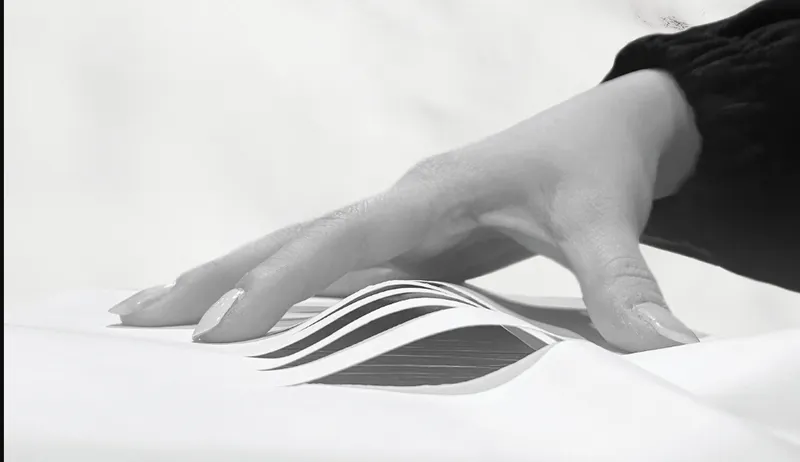
From above, the museum reads as three low, curved roof volumes resting in a snowy landscape, their profiles so restrained that visitors walking along the gravel approach path could mistake them for natural landforms. The physical model reveals the deliberate layering beneath: each undulating roof shelters multiple subterranean levels carved into the earth below. A key design principle was to avoid disrupting the natural horizon line. The building is built into the land rather than on top of it, with only these sculpted shells visible. Wind, sunlight, and visitor circulation all informed the placement, ensuring that accessibility to the national park entrance coexists with the terrain's existing rhythms.
Excavated Layers as Programme
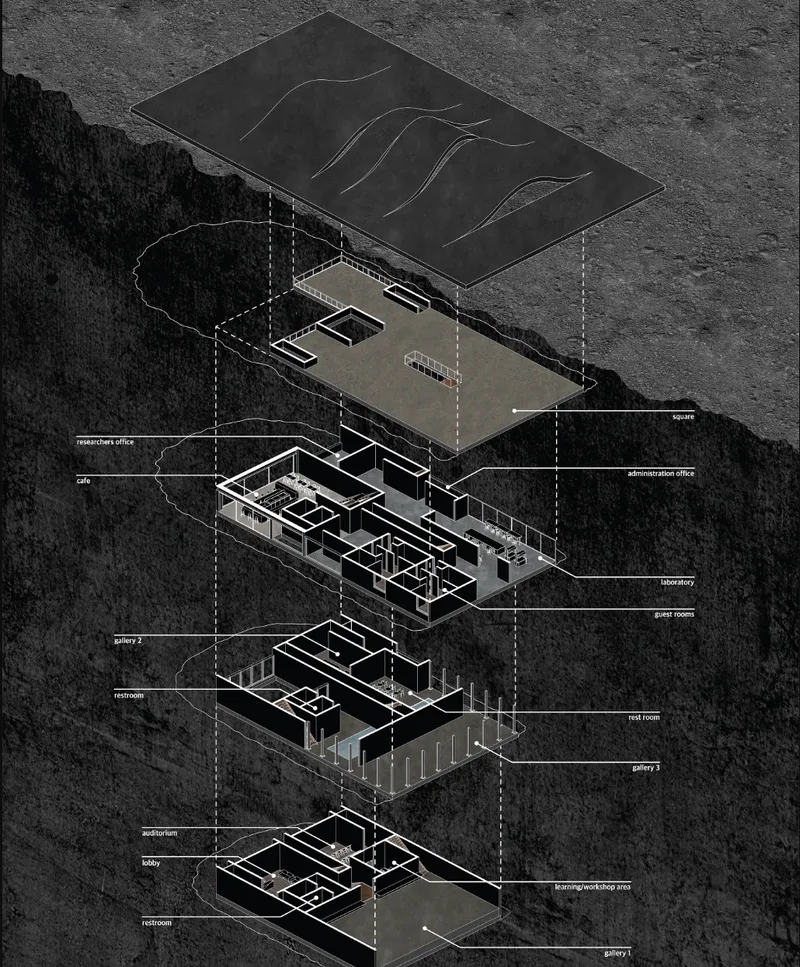
The exploded axonometric reveals the full ambition of the project. The architectural mass splits into two primary volumes: a cube-shaped core housing functional spaces like exhibition galleries, laboratories, and research areas, and a flat mass above that provides unobstructed views of the geological strata below. Between these volumes, vertical circulation and passages carved between rock and concrete connect multiple underground levels. The programme is substantial: galleries, auditoriums, research rooms, guest accommodations, and cafés are all embedded in layers of excavated earth. Each floor narrates a progressively deeper story of human and ecological evolution, so the physical act of descending mirrors the conceptual journey into geological time.
Timber Ceilings and Exposed Rock: The Sensory Threshold
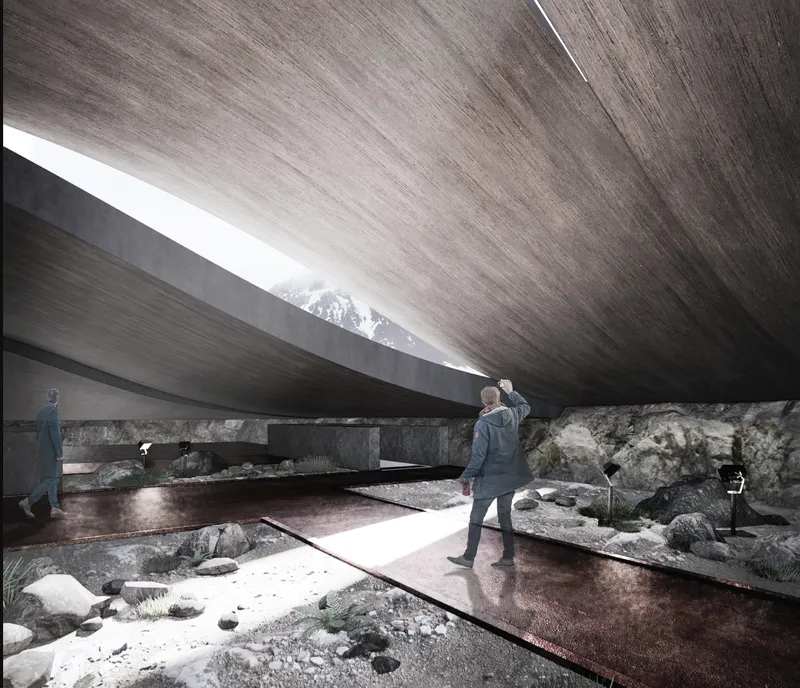
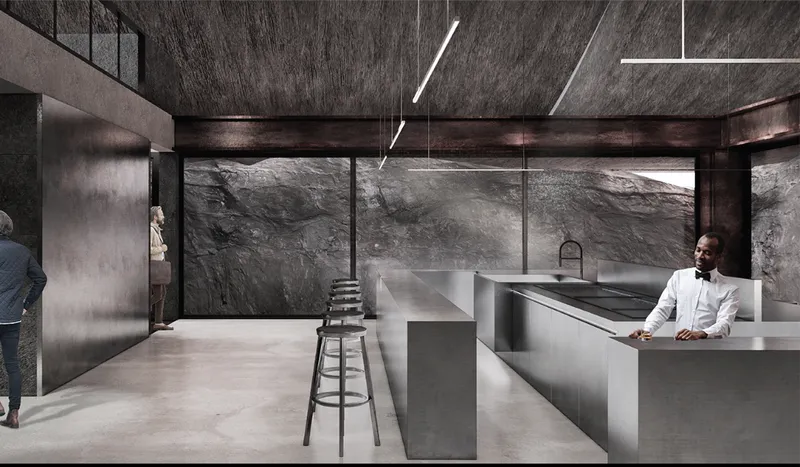
Inside, the spatial experience hinges on contrast. The sloped timber-lined ceiling in the upper gallery creates a warm, directional canopy that draws the eye downward toward the exhibition landscape below. Visitors stand at the edge, overlooking sunken display zones that expose the raw geology of the site. One level deeper, the reception area pairs a stainless steel counter with an exposed rock wall beneath a timber-grained concrete ceiling. The juxtaposition is precise: polished surfaces meet geological roughness, and the building refuses to let you forget that it occupies a wound in the earth.
These material choices carry conceptual weight. The smooth concrete and metal represent human intervention; the jagged stone represents the land's memory. Walking between them, you feel the tension between preservation and progress that the designers identified as the project's emotional core.
Stillness Below Ground: Water, Stone, and Framed Solitude
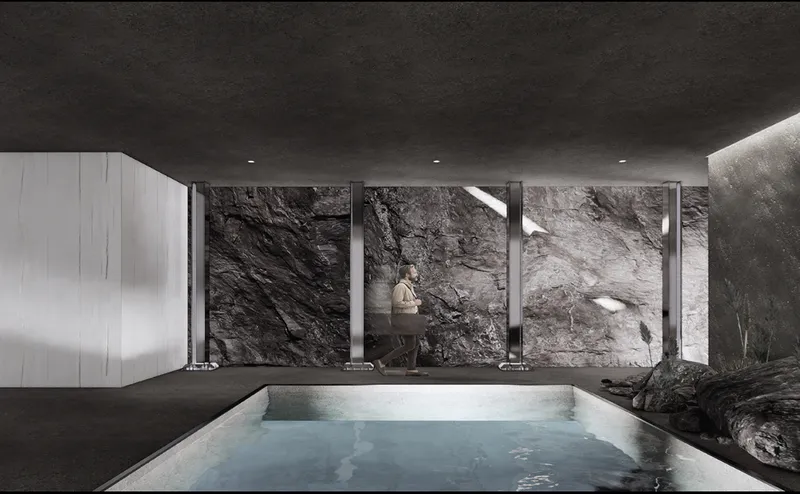
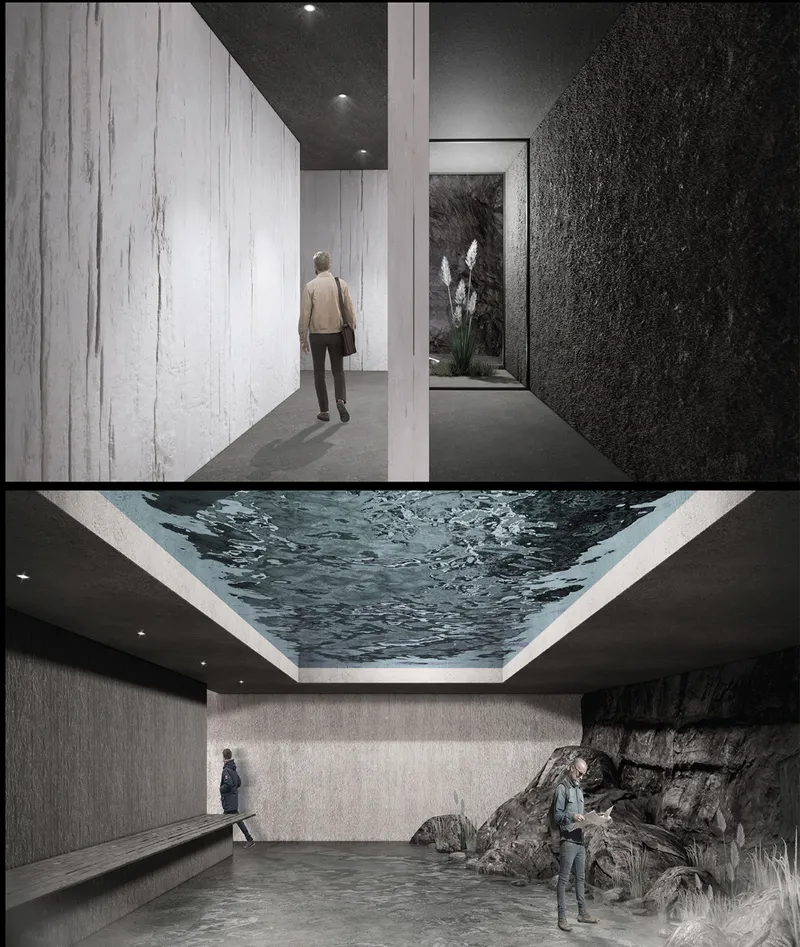
The deepest moments in the museum are its quietest. A seated figure framed by slender steel columns gazes at a rough stone wall beside a sunken water pool, a composition that strips the experience down to elemental confrontation: body, stone, water. Elsewhere, a corridor of white marble walls meets dark textured stone, leading to a courtyard where a cactus stands in diffused light. These are not decorative gestures. They are curated pauses that anchor the architectural narrative, allowing visitors to absorb the weight of what they've descended through.
The immersive quality of these spaces relies on their restraint. There are no grand atria or dramatic cantilevers. Instead, the architecture channels emotion through material proximity: your hand could touch the rock face, and that closeness to the earth's exposed layers is what delivers the message more powerfully than any exhibit label could.
Why This Project Matters
Indelible Wound proposes a new typology for environmental awareness, one where the building itself is the primary exhibit. By carving into the earth and making that excavation visible as architecture, the designers collapse the distance between the act of building and the geological damage it typically conceals. The museum doesn't lecture about ecological transformation; it makes you walk through it, floor by floor, layer by layer.
For a competition centered on the concept of rifts, this is a fitting winner. Kim, 조, and 이 understood that the most honest response to tectonic and ecological rupture isn't to build a monument above it but to go under, to occupy the wound and make it legible. The project asks a disarming question: if the scars we leave on the earth are indelible, what does it mean to inhabit one with intention, care, and the willingness to look down?
View the Full Project
About the Designers
Designers: Chaeyeon Kim, 강민 조, 예담 이
Enter a Design Competition on uni.xyz
uni.xyz runs architecture and design competitions year-round that reward proposals with spatial conviction and real site intelligence.
Project credits: Indelible Wound by Chaeyeon Kim, 강민 조, 예담 이 Rift (uni.xyz).


Popular Articles
Popular articles from the community


U.GA Architects Wraps an Oval Rooftop Pool in Curved Board-Formed Concrete on Busan's Jeollidan-gil
In Busan's Jeonpo-dong, a 454 m² mixed-use block stacks a neighborhood facility, guest rooms and an oval rooftop pool inside spiraling concrete walls.

Architekt Andreas Gruber Scatters 23 Dark Timber Chalets Across a South Tyrolean Forest Edge
In Molini di Tures, Amonti Chalets breaks a resort into a hamlet of gabled timber houses, with parking, storage and services pushed into the slope.

David Macias Steps a Doorless Stone and Plaster House Down a Tropical Colombian Hillside
In the humid hills of Colombia, Threshold House replaces the front door with an open void and terraces its 850 m² down the slope instead of fighting it.

David Ortega Stacks a Two-Story Mexico City Penthouse Around a Steel Stair and a Pergola-Shaded Roof Terrace
In Colonia Roma, a 300 m² penthouse uses oak joinery, a planted steel stair and a slatted roof pergola to make a new-build apartment feel like a house.

Similar Reads
You might also enjoy these articles


Vereda Arquitetos Renovates a 40-Square-Meter Apartment Inside Niemeyer's Copan Building
A compact unit in São Paulo's most iconic residential tower gets a material overhaul that pairs exposed concrete with bold blue Formica.

Shakur's House: Exposed Brick as an Interior Organiser in a 168 m² Mashhad Residence
Brick moves indoors in this Mashhad residence, where masonry walls, glass partitions and teal planes sequence a compact home without closing it off.

Day and Night Park: A Time-Based Urban Newsstand in Beijing
A temporary urban newsstand in Beijing blending travel, light, and reading through poetic colors, compact form, and community-focused design.

Modernist Patio Renovation in El Masnou, Barcelona by Oliver Segura Arquitectura + Cebrià Arquitectura
Modernist patio renovation blending tradition and innovation with a movable pool, leveled floors, and Catalan materials in El Masnou.

Explore Geological Heritage Competitions
Discover active competitions in this discipline

Challenge to design luxury tourism on rails

VR headsets Storefront design competition

Designing a staircase for a client
Comments (0)
Please login or sign up to add comments
No comments yet. Be the first to comment!