

Individual problems and their Collective solutions!
Uni's editorial team shares its thoughts on how working together is the future that we should embrace.


The role of Collaboration in Design
People who take up the creative arts as a profession generally do not like being defined by boundaries that confine them within a box of professional expectations. Designers are usually experimental artists, who believe in their passion and like working with their own styles and methods. The creative arts demand bespoke, original solutions, which have transformed the field into a culture of individual working. It is widely established that designers operate alone—refer to most design firms, which are usually named after the principal/founder. In this time where the creative arts are finally gaining recognition as real career options, and where professional competition is at an all-time high, designers need to re-invent themselves over and over again without losing their personal style in the process.
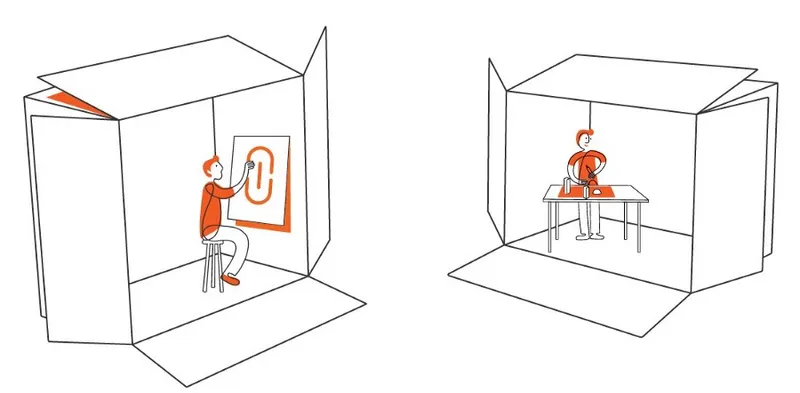
Although designers tend to work outside a box, their aversion to collaborate is limiting them in their boxes metaphorically.
With this in mind, it is easy to assume that solutions can be created by a group of individuals who are from the same educational background and whose work styles imitate each other. However, we cannot ignore the gradual paradigm shift that is taking place in the field of design– the development of a collective working culture that is evolving through the rise of small start-ups and entrepreneurs who believe that design re-evolution can take place by converting their practices into an inter-disciplinary collective. But before addressing the recent changes in work philosophies, we need to understand what a collaborative culture is, and how is it affecting design.
Let's dig a little deeper...
In the field of architecture, collaboration with engineers has always been of importance. Tracing the evolution of modern-day architecture, it is clear that the organized and logical profession of engineering often overlapped with the unboundedly creative field of architecture to create iconic structures. Architects like Santiago Calatrava are redefining infrastructure through the amalgamation of design and technological advancements in engineering. However, collective work culture in design is now broadening to incorporate other disciplines, apart from architecture and engineering. Professor and Architect Neri Oxman and her team, who form the Mediated Matter group at MIT Media Lab, are studying biological processes to design experimental architecture and products that respond to nature and to the human body in real-time. This interdisciplinary approach is a relatively new development, which is combining design with fields of scientific stature to create a unique partnership. At this point in time when sustainability is more of a requirement than a choice, implementing various disciplines like the biological and chemical sciences in design will not only help us experiment and re-invent, but will also promote the development of responsive architecture whose impact on the environment and human lifestyle can be controlled.
Such collaborations also mean a re-definition of design as a collective field. They can open up all creative arts to novel opportunities. Imagine a scenario where a graphic designer, working with a chemist, creates an issue-sensitive billboard and prints it with some pigmented colors that change hues with response to changing the weather or climatic conditions and hence, brings across the point in a more emphasized manner. Or, imagine a situation in which an artist works with a biologist and an engineer to create an installation that imitates the biological processes and responses of plants, which can be placed within internal spaces, surviving without the need for water or sunlight. These situations are actually not as far-fetched as they sound — innovators all across the globe are trying out these collaborations, paving the way for an interdisciplinary future for design. This approach can also help in inventing solutions for social and environmental issues.
Collaborative work culture is not just about professionally working with people from diverse backgrounds. It is more about the acceptance that answers can be innovated and made better through a partnership between passionate individuals with different areas of expertise, who bring in varying perspectives to the same problem and can hence create solutions that cover the biggest base.
Individual working can be enhanced to become collective working, by encouraging personal styles to be blended together for one unanimous result. The field of 'Design' is all-inclusive because design exists in all processes and all beings. The unification of these can lead to the greatest paradigm shift recorded in history, and possibly, pave the way for a new world.
At UNI, some competitions have invited and received innovative design ideas to create workspaces for the new times.
Check out the following competitions:
-
Coalesce - A coworking office retrofitted in an old abandoned warehouse

-
Breaking Work 4.0 - Challenge to design for shifting work trends in coworking

-
Breaking Work 3.0 - The coworking for the new normal

-
Live x Work x Play - Design challenge to fuse living

-
Artistory - Creating a co-working for creative minds


Popular Articles
Popular articles from the community


The Musturak Paradise: Senior Living Architecture for a Connected Future in Temara, Morocco
The Musturak Paradise reimagines senior living architecture in Temara via private homes, social spaces, culture, community, and shared care.

Play: Fragments of Their World
Familiar architecture becomes modular playground design, creating safe spaces where displaced children can learn, connect, imagine and play.

Hill & Cross Opera: Sculptural Opera House Architecture Shaped by Tallinn’s Landscape and Identity
Hill & Cross Opera reimagines opera house architecture in Tallinn through its sculptural hill, civic plaza, glass wave and a luminous cross.

Lunar Spiral: Space Architecture Shaped by the Mathematics of the Universe
Lunar Spiral reimagines space architecture through Fibonacci geometry, lunar regolith, levitating habitats, and self-sustaining Moon living.

Similar Reads
You might also enjoy these articles

Bao Huynh Watercolor Atelier: A Serene Art Retreat in Hội An
Bao Huynh Watercolor Atelier in Hội An blends multifunctional art spaces, sustainable design, local materials, and family-friendly living in a serene environment.

Atelier Macri Concept Store Interior Design by CASE-REAL
Atelier Macri store features a "ko" counter, walnut wood details, cork displays, blending retail, gallery, and seamless customer experiences.

Manuel Vargas Izquierdo Stadium and High-Performance Sports Center: Architectural Excellence in Jalpa de Méndez
The Manuel Vargas Izquierdo Stadium blends sustainable design, inclusive sports facilities, and cultural-inspired architecture, revitalizing Jalpa de Méndez’s public spaces.

KAKR Buluh Awar Hall: Revitalizing Community and Ecology Through Bamboo Architecture
Community built bamboo hall revitalizes Buluh Awar village, empowering youth, restoring ecology, celebrating vernacular craftsmanship through sustainable architecture and culture.

Comments (0)
Please login or sign up to add comments
No comments yet. Be the first to comment!