
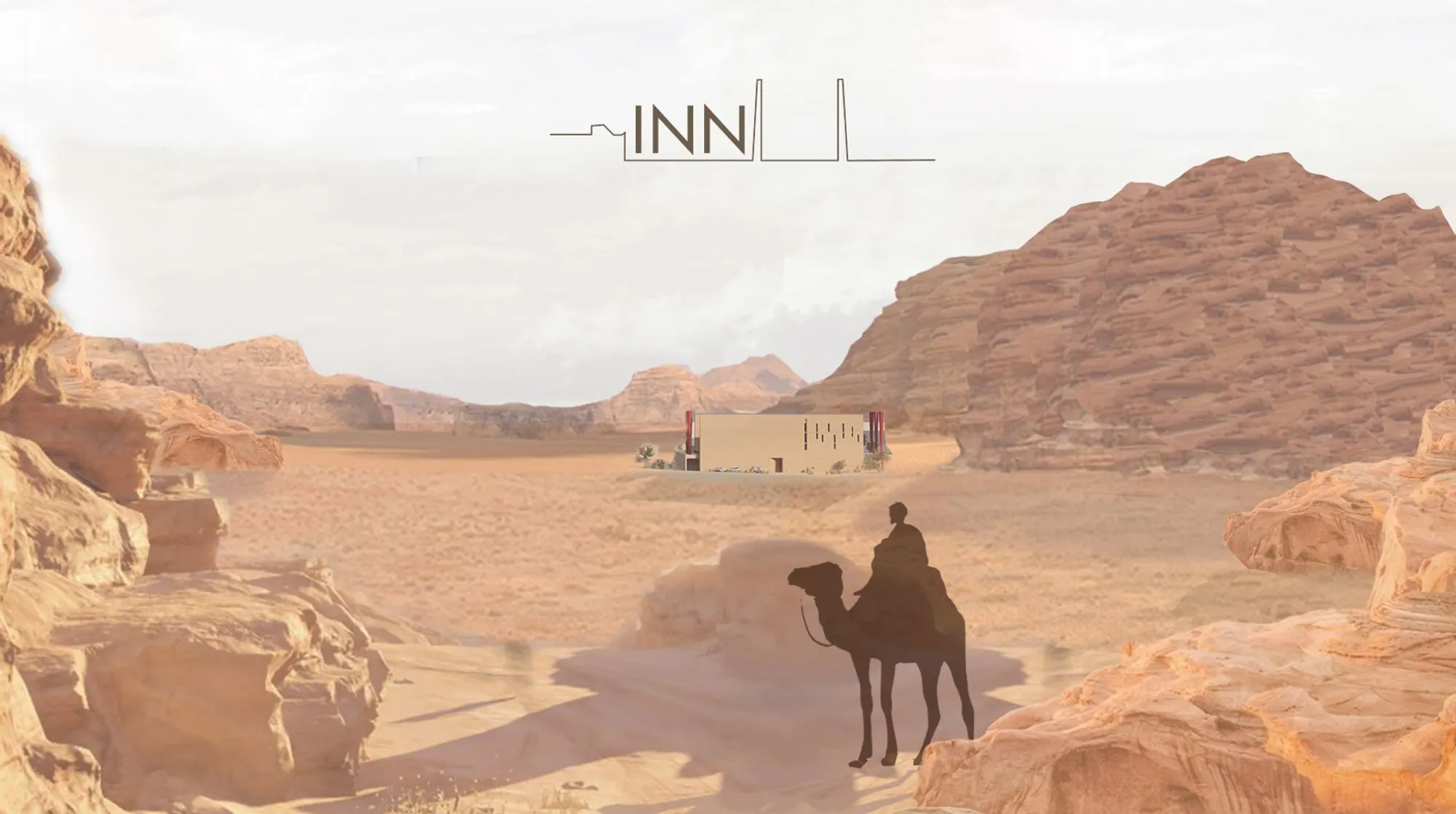
INN: Burying a Wellness Retreat Beneath the Libyan Desert
A sunken courtyard complex draws on Libya's buried typologies, earthbag construction, and six wellness domains to anchor cultural tourism in sand.


What if the most radical act of hospitality in the Sahara is disappearing into the ground? INN sinks its social heart into the natural slope of the Libyan desert, borrowing from the region's buried courtyard typology to create a retreat center that shields guests from sandstorms and 50°C heat while framing northern light through carefully placed skylights. The result is a building that reads less as an object dropped on the landscape and more as a geological event: walls rising from sand, courtyards carved into terrain, accommodation terracing upward from a communal core.
INN is the winner entry of the Cast Away competition on uni.xyz, designed by Esma Nur Erdeğer, Sati Kucuk, Uzuk Charyyeva, and Esra Öcal. Sited adjacent to historic rock art, camping routes, and active safari trails, the project positions itself as an anchor point for ecological and cultural tourism, structured around six wellness domains: spiritual, physical, emotional, professional, intellectual, and mental.
Timber Lattice and Sunken Rooms: The Spatial Logic of Protection
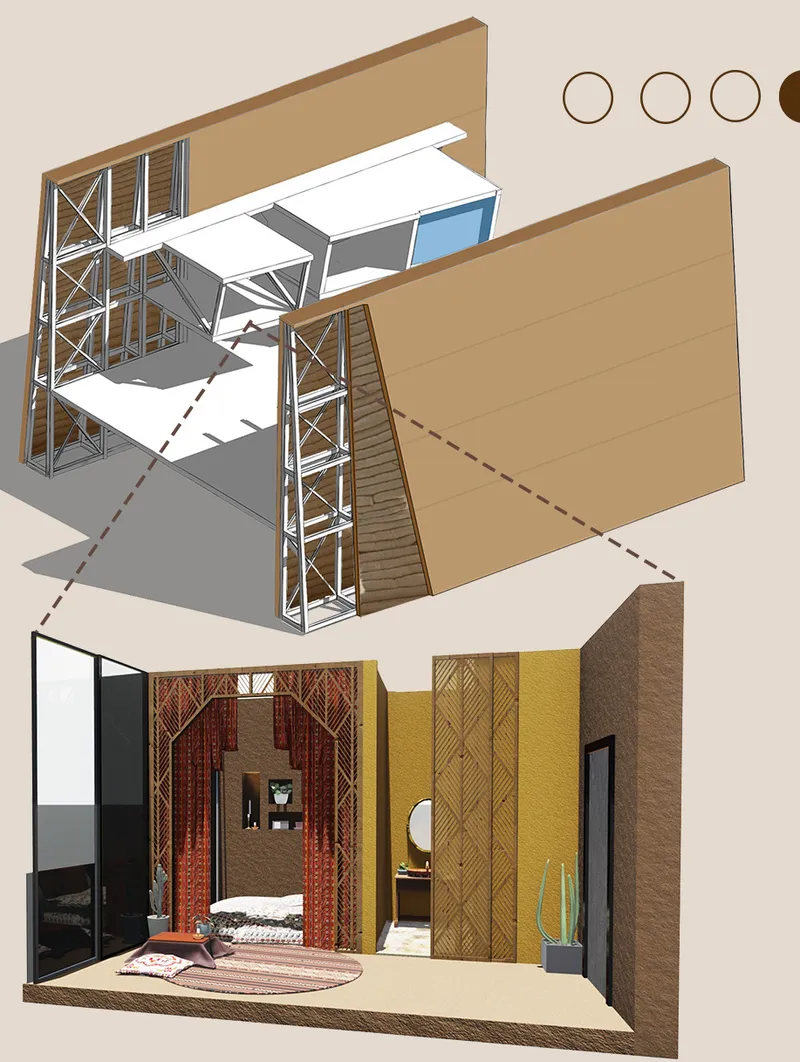
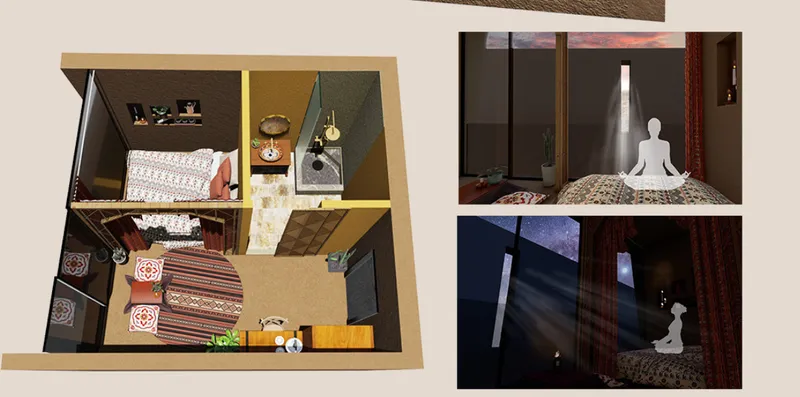
The axonometric drawing reveals how INN orchestrates enclosure without claustrophobia. Timber lattice walls filter harsh desert light into soft interior gradients, while hanging red curtains and yellow partitions subdivide spaces with textile flexibility rather than rigid walls. This layering strategy allows the ground-level programme, which includes yoga areas, spa facilities, sand therapy, and workshop zones, to breathe and reconfigure throughout the day.
The cutaway bedroom view reinforces the designers' commitment to Libyan interior traditions. Floor beds sit low against patterned textiles, and a meditation alcove opens directly off the sleeping area. Accommodation spans levels +7 and +10, with single, double, and suite configurations, each fitted with traditional motifs and soft lighting. The spatial intimacy here is deliberate: retreat is framed not as luxury isolation but as sensory quieting.
Testing Form Against Terrain: Physical Models in Sand and Stone
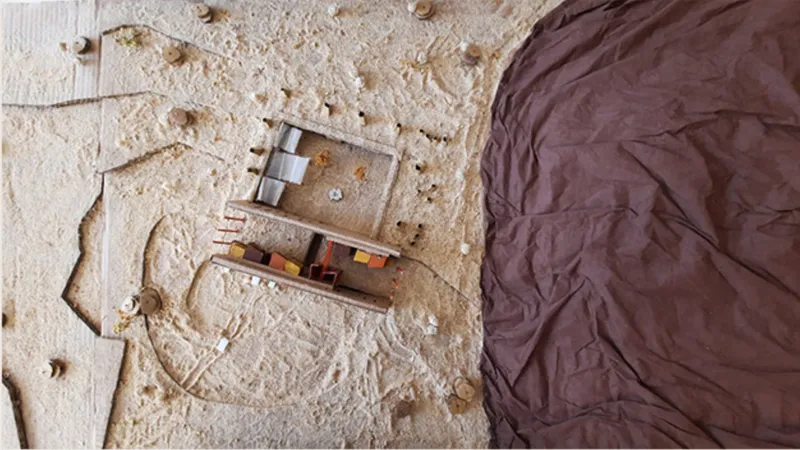
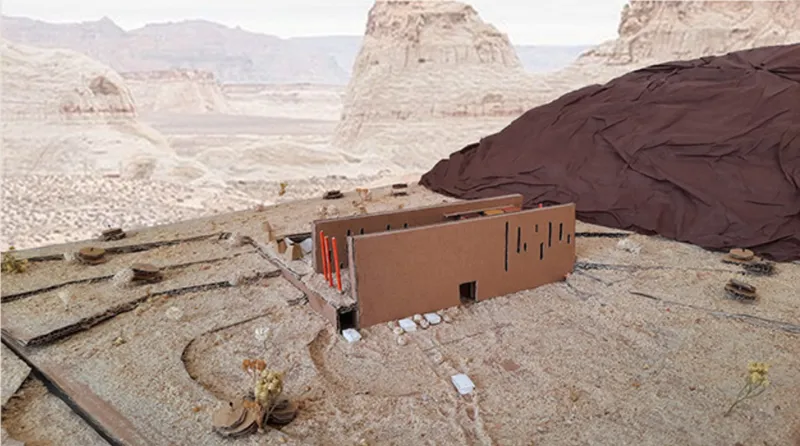
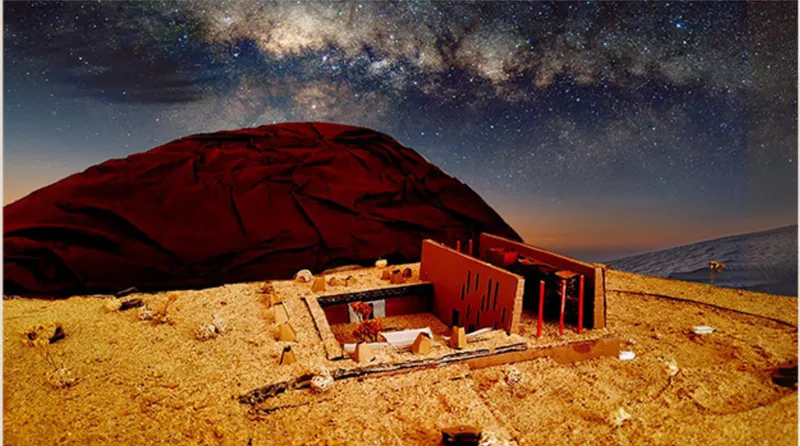
The design team built physical models and tested them in conditions that approximate the actual site. The aerial view of the scale model set in pale sand shows the draped fabric landscape element that echoes the project's relationship to topography, its forms emerging from and folding back into the ground. Placed on rocky desert terrain with pale sandstone formations receding in the background, the second model demonstrates how INN's massing reads at the scale of the Libyan landscape: low, horizontal, nearly camouflaged.
The long-exposure photograph under the Milky Way is more than atmospheric staging. It speaks directly to the courtyard's nighttime programme. The designers describe stargazing by fire under pristine desert skies as a core experience, and the courtyard's shading walls, which cast cooling shadows by day, become low parapets framing an unobstructed view of the sky at night. Bladeless wind turbines generate renewable energy quietly enough to preserve this atmosphere, avoiding disruption to both desert fauna and guests.
Earthbag Walls and the Courtyard as Emotional Core
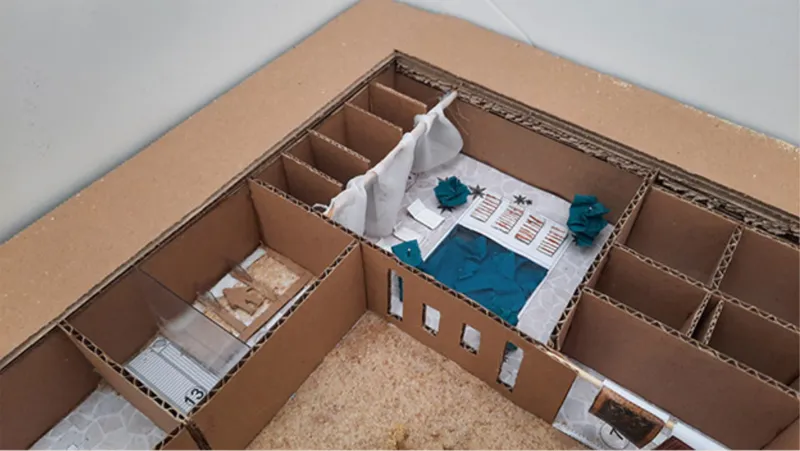
The construction model reveals the courtyard's bones: a white plaster enclosure with a blue water feature at its center, built from cardboard at a scale that exposes the section clearly. The earthbag system that INN employs uses local sand, clay, and gravel packed into bags and reinforced with steel carriers, creating walls that are both thermally insulating and structurally resilient against desert climate extremes. Adobe and contemporary steel detailing sit side by side, balancing vernacular craft with engineered performance.
The courtyard itself is designed to shift function with the sun. Morning hours bring yoga and meditation; afternoons host exhibitions and communal desert meals; evenings transform the space into a gathering point around fire. At level +4, circular seating areas and a bar service zone overlook this central void, while preparation zones equip guests for desert activities beyond the building's walls.
Cork, Sand Pits, and Pyramid Skylights: Interior Texture as Therapy
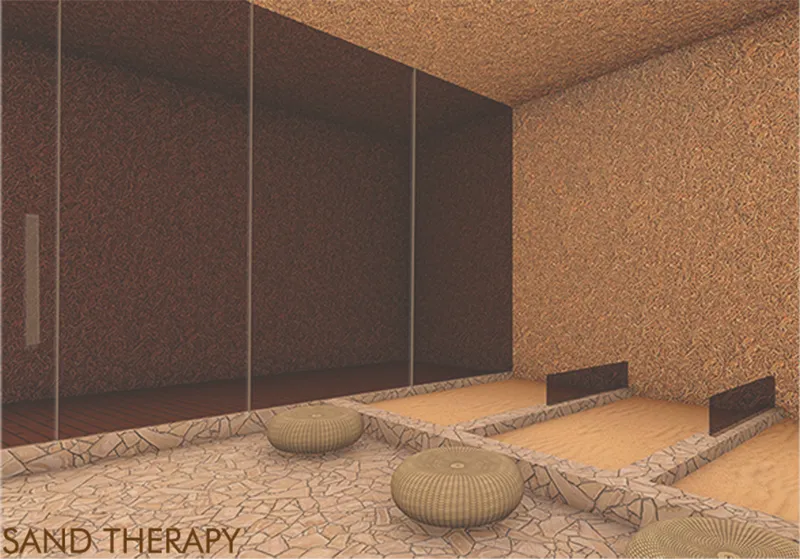
The interior view of a cork-textured room with a shallow sand pit and woven floor cushions captures INN's therapeutic ambition in material terms. Sand therapy is listed as a ground-level programme element, and here it is rendered as a physical space: warm, tactile, grounded. Cork surfaces absorb sound and regulate humidity, reinforcing the sensory reduction that the six wellness domains demand.
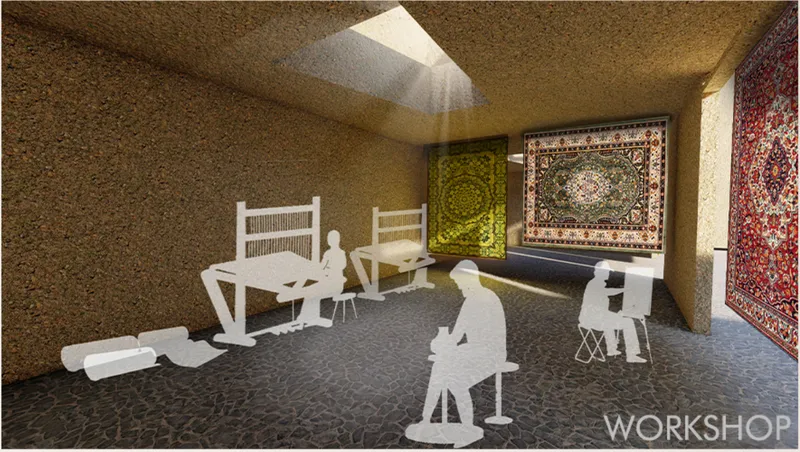
The workshop rendering pushes this further. Cork walls surround seated figure silhouettes beneath a pyramid skylight that channels northern light into the room's center. These are the spaces where INN's cultural integration programme takes shape: culinary demonstrations, traditional weaving workshops, and exhibitions that engage local communities. The designers frame this dual focus on sustainability and heritage as an economic engine, offering job opportunities while revitalizing fading traditions within a modern architectural framework.
Why This Project Matters
INN succeeds because it treats the desert not as a blank canvas for spectacle but as a collaborator in design. Every major decision, from the sunken courtyard to the earthbag walls to the bladeless turbines, emerges from a reading of site conditions: slope, wind, sand, light, heat. The wellness programme is not an afterthought draped over a form; it is the organizational logic that determines section, orientation, and material selection. That integration is rare in competition work at any level.
The project also demonstrates a sophisticated understanding of cultural sustainability. By positioning a retreat center alongside historic rock art and active safari routes, and by embedding local craft traditions into its daily programming, INN avoids the trap of the hermetic wellness compound. It connects visitors to place, to community, and to the deep history of desert habitation. For a winning entry in the Cast Away competition, this team has delivered a proposal that feels both buildable and generous in its ambitions.
View the Full Project
About the Designers
Designers: Esma Nur Erdeğer, SATI KUCUK, Uzuk Charyyeva, Esra Öcal
Enter a Design Competition on uni.xyz
uni.xyz runs architecture and design competitions year-round that reward proposals with spatial conviction and real site intelligence.
Project credits: INN by Esma Nur Erdeğer, SATI KUCUK, Uzuk Charyyeva, Esra Öcal Cast Away (uni.xyz).




Popular Articles
Popular articles from the community


The Earth Pod: 3D Printed Homes for Resilient Refugee Communities
The Earth Pod reimagines refugee housing through 3D printed homes made from clay, combining resilience, self-sufficiency, and rapid shelter.

Co-Life: Senior Housing Design That Reconnects Older Adults With the City
Co-Life reimagines senior housing design through healing gardens, shared streets, workshops, and a sustainable community across generations.

Play: Fragments of Their World
Familiar architecture becomes modular playground design, creating safe spaces where displaced children can learn, connect, imagine and play.

Lunar Spiral: Space Architecture Shaped by the Mathematics of the Universe
Lunar Spiral reimagines space architecture through Fibonacci geometry, lunar regolith, levitating habitats, and self-sustaining Moon living.

Similar Reads
You might also enjoy these articles

Day and Night Park: A Time-Based Urban Newsstand in Beijing
A temporary urban newsstand in Beijing blending travel, light, and reading through poetic colors, compact form, and community-focused design.

Modernist Patio Renovation in El Masnou, Barcelona by Oliver Segura Arquitectura + Cebrià Arquitectura
Modernist patio renovation blending tradition and innovation with a movable pool, leveled floors, and Catalan materials in El Masnou.

Alto Residencial Coop: Cooperative Housing Development in Santiago de Compostela by Carbajo Barrios Arquitectos
A linear cooperative housing complex blending white volumes and perforated metal façades, enhancing community living, natural light, privacy, and urban integration.

Vil Genis School by BPA ARCHITECTURE – Massy, France
Vil Genis School in Massy, France, features sustainable design, south-facing classrooms, community integration, accessible spaces, and modern educational architecture.

Explore Desert Architecture Competitions
Discover active competitions in this discipline



Challenge to reimagine the Iron Throne


Photograph architecture without architects


Illustrate the lost glory of Angkor Wat - Render Challenge


Design challenge to reuse E-waste
Comments (0)
Please login or sign up to add comments
No comments yet. Be the first to comment!