

Innovative School Library Design at Antonio Raimondi College by TERRITORIAL
An innovative school library in Lima redefines educational space with light, flexibility, color, and user-focused spatial design.


Transforming Education Through Spatial Innovation
The Antonio Raimondi College Library in Lima, Peru, designed by TERRITORIAL, is a remarkable example of how architecture can directly influence learning, behavior, and community engagement. Completed in 2024, this 240 m² project is not just a refurbishment but a transformation—redefining the spatial experience of a school library in the context of modern pedagogy. The intervention is grounded in a commitment to creating flexible, inclusive, and inspiring spaces that respond to the diverse needs of students across age groups.


Respecting the Existing Structure While Reimagining Function
The architectural intervention took place within a pavilion of an existing building, retaining its structural framework but entirely reprogramming its function. TERRITORIAL strategically relocated the library to the north façade to maximize the benefits of natural light. This subtle yet impactful move allows sunlight to warm the space during winter and protects it during the summer months, ensuring year-round thermal comfort and daylight without the need for excessive artificial intervention.


A Spatial Strategy for Pedagogical Engagement
The design reflects a deep understanding of how educational environments shape learning outcomes. Working closely with education specialists, the architects approached the project with a spatial-pedagogical vision. The new layout integrates a variety of hybrid spaces, including open reading zones, individual study cubicles, and a small auditorium for collaborative or focused activities. Walls were thickened and transformed into storage and shelving systems, increasing utility without introducing visual clutter.


The use of color adds another layer of educational intent. Yellow tones, associated with creativity and focus, were applied in zones for younger students, while turquoise tones, which evoke calm and alertness, are used for teenagers. These chromatic cues help orient users and support cognitive responses appropriate to different stages of development.


Furniture Designed for Interaction and Accessibility
Furniture and fittings in the Antonio Raimondi College Library were custom-designed to accommodate children and adults alike. With accessible heights and mobile configurations, the pieces encourage interaction, movement, and engagement. The design fosters an environment where learning is not confined to desks but is embedded in the very form and materiality of the space. The furniture promotes play, exploration, and casual conversation, helping to break traditional classroom hierarchies.


Durable Materials and Handcrafted Details
Given the high-traffic nature of school environments, material choice was critical. Wood, glass, and handcrafted aluminum panels were selected for their durability and aesthetic quality. The ceiling, crafted from perforated aluminum, not only conceals mechanical installations but also softens and distributes light evenly throughout the space. This tactile and visual refinement supports focus and tranquility, vital in learning environments.


A Model for Future Educational Architecture
The Antonio Raimondi College Library is more than just a repository for books—it is a dynamic, adaptive environment that blurs the lines between study, play, and community. Its success lies in the way it turns architectural components—walls, windows, ceilings—into multifunctional assets. By prioritizing light, flexibility, and comfort, TERRITORIAL has created a space that supports diverse educational needs while remaining warm, accessible, and inviting. This project stands as a compelling model for innovative school library design worldwide.


All Photographs are works of Eleazar Cuadros, JAG Studio


Popular Articles
Popular articles from the community


Aquadapt: An Underwater Habitat That Rewrites Its Rooms by the Hour
Curved modules ring the seabed while one shell shifts from breakfast room to cinema, farm and football pitch as residents' needs change.


FCC Arquitectura Expands a Portuguese Granite House with a Board-Marked Concrete Wing
In Portugal, JV House pairs a cleaned-up whitewashed and granite dwelling with a timber-shuttered concrete extension, courtyards and a garden pool.
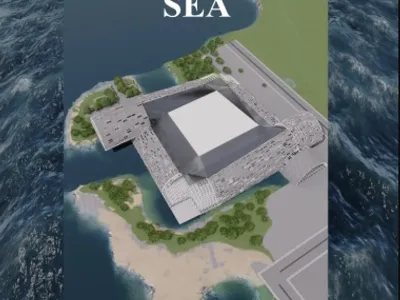
Opera on the Sea: Driftwood Logic Shapes a Timber Opera House on Estonia's Coast
Trevor Orgill's opera house translates the entangled drift of floating timber into a civic building where wood, water, and music converge.

ETEH Reworks the Shared Spaces of São Domingos School in Brazil Around Timber, Color and Hanging Plants
At São Domingos School in Brazil, 436 m² of hall, refectory and library are recast with timber joinery, a yellow and blue code and trailing greenery.

Similar Reads
You might also enjoy these articles

Cube Design Draws an Ecological Corridor Between Two Shenzhen Hills with the Nankai Building
Beside Shenzhen's container docks, the Nankai Building pairs stacked balconies with a climbing green screen to connect two hillsides across its height.

Praksis A and Studio Sted Bend a Red Timber Cabin Across the Granite of Norway's Southern Coast
On the southern Norwegian coast, a 105 m² cabin follows the rock on slender posts, pairing red cladding outside with pine, brick and plywood within.

David Ortega Stacks a Two-Story Mexico City Penthouse Around a Steel Stair and a Pergola-Shaded Roof Terrace
In Colonia Roma, a 300 m² penthouse uses oak joinery, a planted steel stair and a slatted roof pergola to make a new-build apartment feel like a house.

PARALELA and LB2 Thread a Public Walkway Through the Base of a Las Condes Residential Tower
In Las Condes, Santiago, the Hamlet Building gives its fenceless ground floor to a 70-metre wooded passage linking two streets and the metro.

Explore Learning Spaces Competitions
Discover active competitions in this discipline

Challenge to reimagine the Iron Throne

Photograph architecture without architects

Illustrate the lost glory of Angkor Wat - Render Challenge

Design challenge to reuse E-waste
Comments (0)
Please login or sign up to add comments
No comments yet. Be the first to comment!