
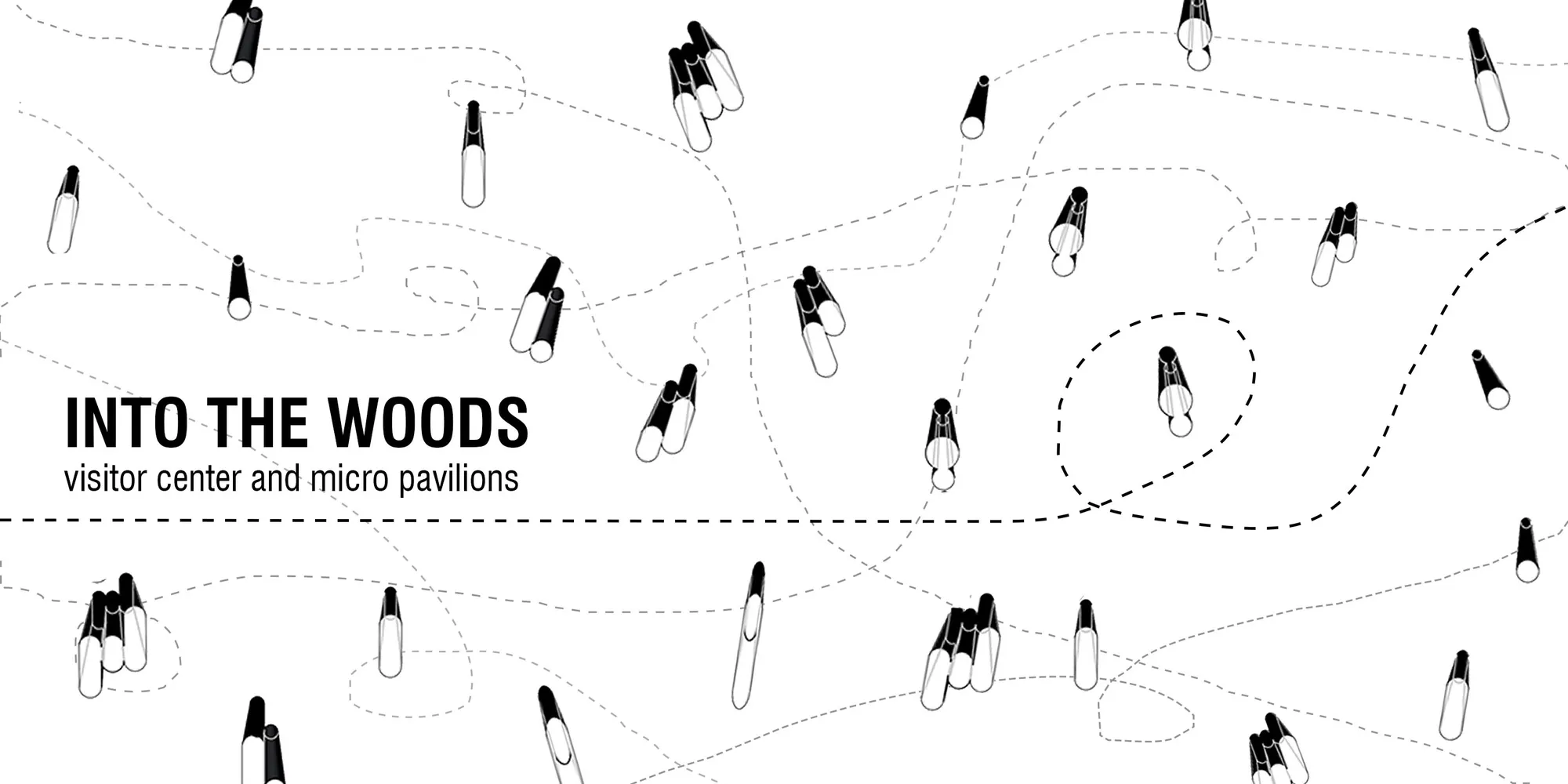
INTO THE WOODS
visitor center and micro pavilions

"Not all those who wander are lost." J.R.R. Tolkien
The project was inspired by the books The Hobbit and The Lord of the Rings, written by Tolkien. Tolkien spent his childhood in a village near Birmingham, and lived carefree in nature, separated from the industrial revolution that was gaining momentum in Birmingham. During his time in nature, he imagined new worlds, he climbed trees and ran away from an imaginary giant that was chasing him. The nature and secludedness of the British countryside had the greatest influence on the subject matter of his books later on. His books are full of natural landscapes, which best describe England: green rich villages, swamps, dense forests, glades and mountains. Later in his life, Tolkien had to move to urbanized Birmingham, which was very difficult to him. He alleviated his suffering for life in nature by writing small stories, inventing new worlds and languages that his imaginary creatures spoke. In his books, there is a constant motif of the battle between good and evil, which actually represents a constant battle between nature and man, whose needs sometimes become extremely greedy. That struggle can also represent the contrast between industrialized Birmingham and the nature that surrounds him, in which he grew up. In one such environment is the location where we intervene, and the battle of nature and man from Tolkien's stories set a framework for my idea.
"Still round the corner there may wait, A new road or a secret gate." J. R.R. Tolkien
All elements of the visitor center were created from several iterations by modifying the main elements that make it. Elements are inspired by Tolkien's stories and the life of the Hobbit. The main elements are: a vaulted ceiling (inspired by the underground house from the story), a circular tunnel, spontaneous paths made by walking in the forest, micro hideouts (inspired by the ones that Hobbits made on their travels), which are presented in the project as pavilions. By modifying these elements in many iterations, the final architecture of the object was created.
The exploration of form started by hand-drawing a map, the way Tolkien draw them in his books. This method helped me to see the location from a different angle and set the concept. By further drawing the elements, I connected them on a conceptual level, which later continued to elaborate in the 3D program.
"Courage is found in unlikely places." J.R.R. Tolkien
In organizing the elements of the architecture, the crucial goal was to minimize interference on the ground and make the best possible use of the facilities that the location itself offers. The project is divided into two phases. The first phase represents the main part of the visitor center. It is created in the form of one straight line that stretches across the meadow. It follow the topography of the terrain and is partly buried with a roof that can be walked on. The ceiling is the dominant element in that building. It is conceived in the form of a series of vaults similar to the interior of Hobbit houses. The upper part of the ceiling is inspired by the swamp landscape. There are perforations created by extracting elements of certain shapes, in order to obtain a ceiling that imitates the ground with circular swamp beds. This building is buried in the ground, but it is glazed on two sides, so that the view from the building extends along the meadow and along the wooded part of the site, as if the building is not even there. This object is multifunctional. In the second phase of development, pavilions are created and distributed all over the wooded part of the site. They are created from the shape of the take-out parts of the ceiling and connected to each other by forest paths. These two phases are connected by an underground circular tunnel, inspired by the story of The Hobbit. That tunnel begins at the visitor center as a porch, and later becomes underground due to the topography of the terrain, and opens again in a wooded area. In the underground seal, there are rest areas and cafes at certain distances.
Like the creation of the visitor center, the development of the program was divided into two phases. The first phase represents the main facility of the visitor center, which contains a cafe, a souvenir shop, a gallery, work spaces and a multi-functional hall. This program varies from events that take place in the visitor center. There are three scenarios: the visitor center as a place to relax, as an art gallery or as a space for laboratory research. Depending on this, the workspaces can be a place for daily work surrounded by nature and landscapes, a place for recreation, a place for art exhibitions or a place for working on laboratory research of the wetland by students, researchers or scientists. The function of the pavilions that appear in the forest is changing in the same way. Pavilions can be a place for meditation and contemplation, being in nature, micro exhibition spaces or micro laboratories, equipped for these purposes. The tunnel that connects the main building with the pavilions has another function, but at certain distances there are underground cafes and rest areas, which bring closer the underground atmosphere from the Hobbit books.
"If you really want to know what Middle-earth is based on, it's my wonder and delight in the earth as it is, particularly the natural earth." J.R.R. Tolkien
The dominant materials chosen for the main part of the visitor center are concrete and glass. Concrete is an existing material that is easy to mold into a certain shape, which in this case was the best fit for the characteristic ceiling. In addition, the concrete gives a sense of monumentality to the building, whose ceiling becomes a sculpture mimicking the swamp. The glass that runs along both long sides of the visitor center presents a transparency that contrasts with the solid concrete. It allows unobstructed views on both sides of the landscape, wooded and meadow. The tunnel connecting the two phases of the project is also made of concrete. It is circular and contains separated walls, which form interesting Hobbit passageways. The paths in the forest are wooden. They connect the pavilions and in certain segments they dissapear, in order to intervene as little as possible on the ground. The pavilions are made of natural materials, prefabricated wooden panels, and covered with membranes in natural colors in order to disturb the natural ambiance of the swamp as little as possible. Since they imitate the shape of the broken parts of the ceiling, in some parts there is glass, which gives the pavilions a touch of transparency. At night, these pavilions act like little lights in the dark, which follows spot lighting from the ceiling of the main part of the visitor center.
The main goal of the visitor center is to create an atmosphere that will only highlight and enhance the magic of the space that is already there. This type of space organization enables visitors to absorb nature to the fullest. The goal was to create an architecture that maximizes the beauty of the landscape and further increases its value. Like Hobbits, visitors can wander through a circular tunnel into a magical forest and stay in secluded pavilions.
The project represents a sustainable solution, whose functions can be easily changed depending on the user's needs. This solution offers easy expansion and modification because it consists of mobile pavilions and paths, which can be extended to the meadow area depending on the need. Due to its form, the visitor center can later become a large laboratory for scientists, or an educational center with a residence in nature.
"All we have to decide is what to do with the time that is given us." J.R.R.Tolkien


Popular Articles
Popular articles from the community


The Musturak Paradise: Senior Living Architecture for a Connected Future in Temara, Morocco
The Musturak Paradise reimagines senior living architecture in Temara via private homes, social spaces, culture, community, and shared care.

Co-Life: Senior Housing Design That Reconnects Older Adults With the City
Co-Life reimagines senior housing design through healing gardens, shared streets, workshops, and a sustainable community across generations.

Play: Fragments of Their World
Familiar architecture becomes modular playground design, creating safe spaces where displaced children can learn, connect, imagine and play.

The Ocean Hive: Sustainable Architecture for a Self-Sufficient Civilization at Sea
The Ocean Hive imagines sustainable architecture at sea, where modular habitats, algae, wave power and ocean waste sustain a growing colony.

Similar Reads
You might also enjoy these articles

The Rhythm of Seasons
A Farmers' Market Connecting Nature and the City


More Than a Building-Designing a Living System
More Than a Building-Designing a Living System
Base Beyond
DESERT COMPOUND ARID: TOURISM OF ABSENCE AND ABUNDANCE
Explore Museum of Woods Competitions
Discover active competitions in this discipline




Challenge to reimagine the Iron Throne


Photograph architecture without architects


Illustrate the lost glory of Angkor Wat - Render Challenge


Design challenge to reuse E-waste
Comments (0)
Please login or sign up to add comments
No comments yet. Be the first to comment!