
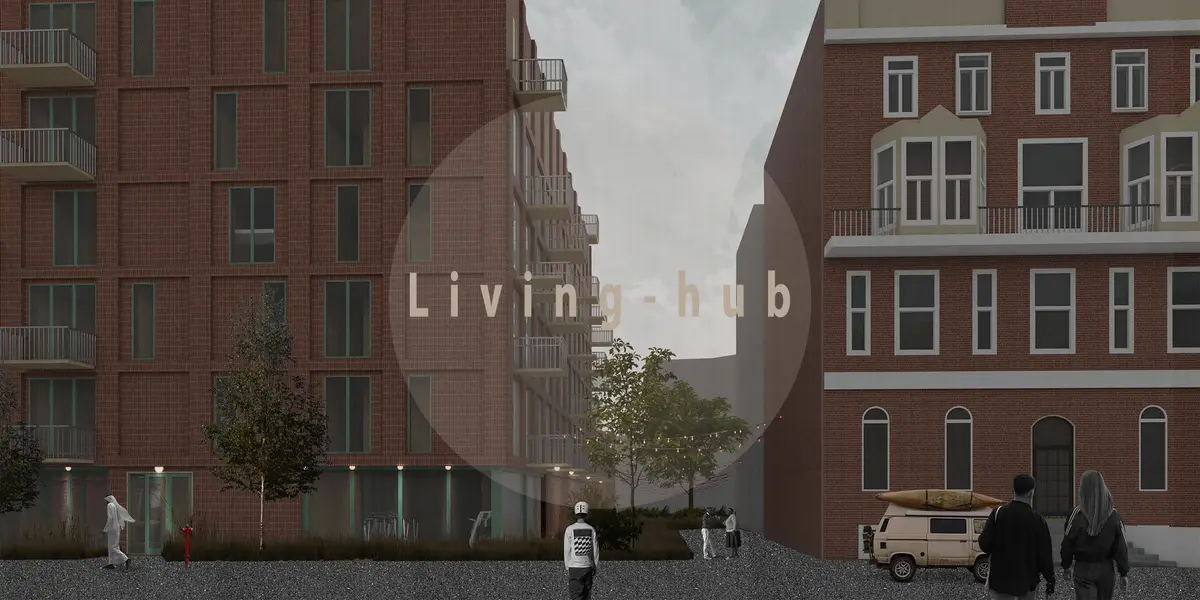
Living-hub
The project includes small housing units adapted for people aged 18-40, designed in the spirit of co-living.

INTRODUCTION
The subject of the competition work was to design a housing estate with a high population density for people aged 18-40. We wanted to create a complex of co-living buildings for approximately 100 residents on a plot of 2,657 m2 located in London, Great Britain.
PROBLEMATICS
Young people entering adulthood are not able to buy and maintain an apartment in the city center. This is a huge global problem, but the UK is leading the ranking due to the high cost of living. Cheaper apartments are usually deprived of the space needed to function properly. For this reason, a need arose to create cheap, compact apartments with common spaces that provide freedom.
CO-LIVING
The assumption through it’s spatial arrangement supports the circular economy model. Co-living, through the idea of sharing goods and resources, remains the most ecological form of living. Common spaces are friendly to the environment and residents due to space and material savings. This model of living, in addition to greater affordability, facilitates making friends. Co-living can be a good solution, among others for people consciously looking for interpersonal contacts who care about building relationships and communities sharing similar values. They include students and people starting their professional careers. Co-living is also attractive to people who often change their place of residence, for whom the ease of finding in a new city is important. These are, for example, digital nomads who can do their work remotely from anywhere on Earth, as well as people who are forced to move because of their work.
URBAN SCALE
In order to properly design the housing development, we have made a number of pre-design analyzes which show that in the vicinity of our plot there is a large number of service premises that can generate traffic on our plot. At the same time, we drew attention to two important park spaces, one of them located next to the metro station, and the other approximately 200-300 m from the northern border of the plot. We came to the conclusion that both aspect related to services and walking space should be an element determining the urban scale of buildings. We determined the radius of the impact of services adjacent to the plot and the intended walking route for pedestrians. To create optimal conditions for a walk, we designed a complex of five buildings connected with each other with the atrium in the middle. The premises on the ground floor have been fully allocated to services, which will cooperate with other existing once. A random passerby who are going to a nearby café can pay attention to the exhibition space in our building complex and visit the exhibition out of curiosity. The atrium is also a meeting place for people who need silence from the everyday hustle and bustle of the street. Buildings muffle sounds, but thanks to "punctures" they do not give the impression of being closed. In the analyzes, we also drew attention to the lack of semi-private greenery for the residents of housing estates. For this reason, we have created "mounds" in the atrium space, which are ensure contact with nature. The second part of the well-ordered greenery is located in the most exposed part of the plot. It is a public space that allows the stroller to take a breathe.
The heights of individual buildings are defined by the neighboring buildings - the tallest building is located in the southern part of the plot and corresponds to the tallest building in the area. On the other hand, the L-shaped building in the northern part of the plot corresponds to the height of the historic building.
ARCHITECTURAL SCALE
When we have been designing flats in the spirit of co-living, an extremely important aspect was to introduce a clear hierarchy of privacy and the scale of space. These are, in turn, the most private rooms to which only one or two people have access, i.e. bathrooms and bedrooms. The next ones are the spaces intended for eating and preparing meals, dedicated to the residents of two bedrooms. Subsequent, semi-public, horizontal common spaces combine the functions of vertical communication and spaces for relax or work, allowing you to spend time with roommates on the common floor. The context for larger events are public squares, and the pedestrian alley connecting them functions as an element integrating all residents of the estate.
APPLIED MATERIALS, CONSTRUCTION AND ECOLOGY
Simple, conservative architecture has been designed with attention to detail and sensitivity to the problems of the natural environment. Due to the rainy climate, we decided to design rainwater collection and storage system. Due to huge space on the roof on the L-shaped building, we designed photovoltaic panels there. The remaining roofs are provided with green low vegetation roofs. The basic construction materials are a monolithic skeleton that meets fire protection standards. The sides and walls are made of CLT wood. Simple forms, modularity of structures and forms, or the optimal use of materials are only a part of ecological solutions. The assumption also promotes public transport and bicycles, minimizing car communication within the estate, introducing the necessary services to the estate. We had designed also a charging station for electric cars, car-sharing and a bicycle shelter.

Popular Articles
Popular articles from the community


LT2A and OPEN Architectes Thread a Brick and Glass High School Through a Wooded Belgian Campus
In Braine-l'Alleud, a 3,000 m² wing for Collège Cardinal Mercier pairs pale brick with a glazed colonnade, deferring to a small chapel and a dense wood.


Singing Woman: An Opera House That Performs Before the Curtain Rises
Ovidiu Cristian Pavel's conceptual opera house translates Estonia's choral identity into a sculpted waterfront landmark facing the Baltic Sea.

The Amber Palace Opera: A Geological Fiction Surfaces on Tallinn's Baltic Waterfront
Pierre Brillard reimagines a Baltic legend as a public landscape, opera house, and waterfront promenade rooted in Tallinn's coastal identity.

Cube Design Draws an Ecological Corridor Between Two Shenzhen Hills with the Nankai Building
Beside Shenzhen's container docks, the Nankai Building pairs stacked balconies with a climbing green screen to connect two hillsides across its height.

Similar Reads
You might also enjoy these articles

The Rhythm of Seasons
A Farmers' Market Connecting Nature and the City

More Than a Building-Designing a Living System
More Than a Building-Designing a Living System
Base Beyond
DESERT COMPOUND ARID: TOURISM OF ABSENCE AND ABUNDANCE

Comments (0)
Please login or sign up to add comments
No comments yet. Be the first to comment!