LIVING IN THE FUTURE
Nano Nest 2023

The way we live is constantly changing. On one hand, the incredibly high demand causes the living costs to rise immeasurably - making it nearly impossible to own property alone. On the other hand, our lifestyles have also changed. In modern times, it is nothing out of the ordinary to not follow the so-called “traditional family” standards, but to choose what family means to you. For instance, it could be getting married and having children or not getting married at all. Another change is in the aging of the population. With the help from modern medicine, the average lifespan is constantly increasing, which means not only younger but also older generations may have, or even want, to adapt to the new ways of living – the reason being financially or socially motivated. That is because the way we appreciate our time together with friends and family has changed drastically due to the Corona Pandemic and it corroborated to the idea that us humans are “pack animals” and not made to withstand being isolated for long periods of time.
For those reasons, shared flats are the living of the future. It not only allows cheaper rent or buying costs, but also takes into consideration the social needs of its residents. Aside from the community aspect, your house should also feel like a nest, somewhere you can relax and be free in your own privacy. Ultimately, these concepts served as main inspiration for our project.
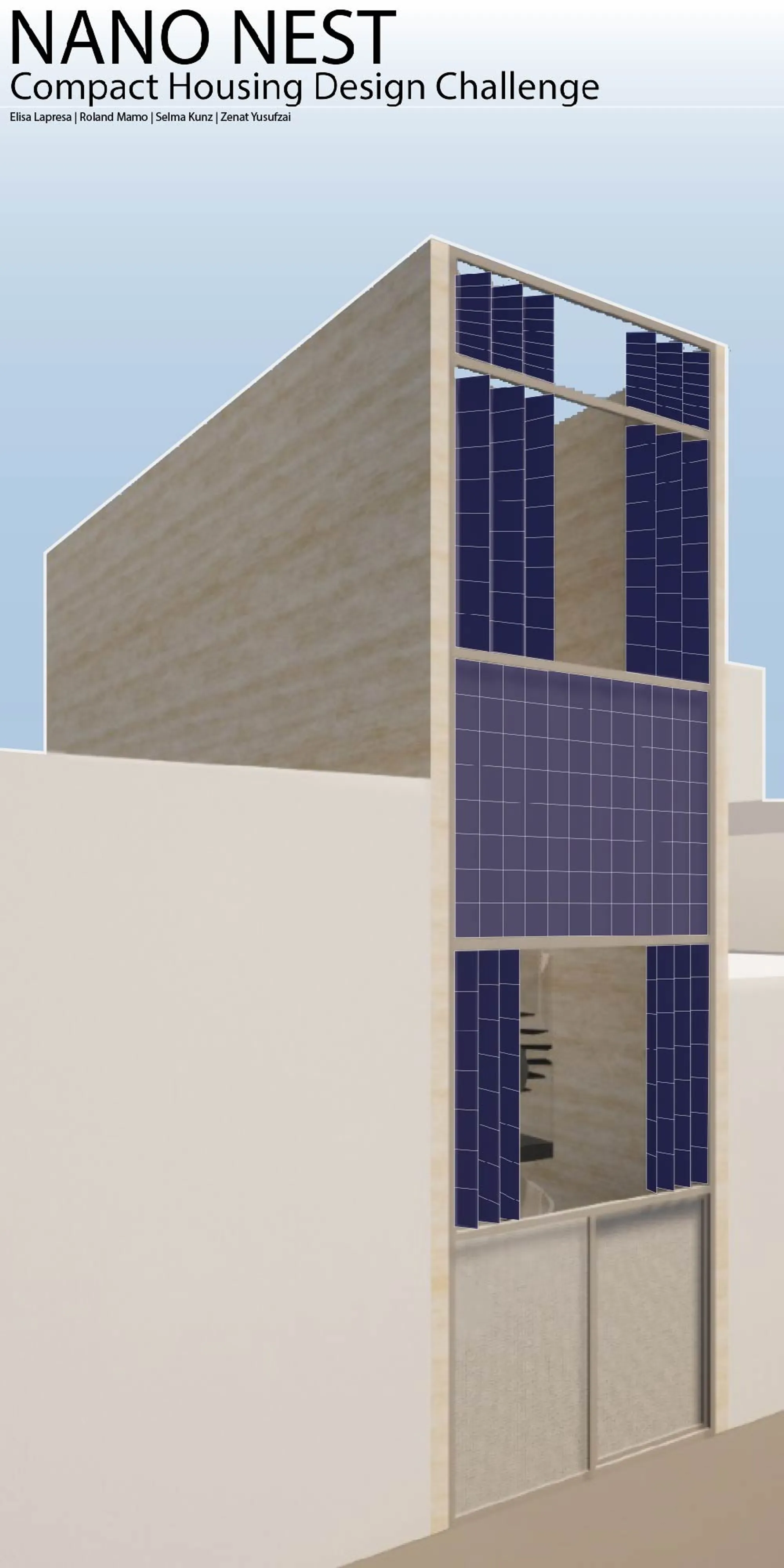
Our idea is to combine, but not mix, the private and public spheres of the house. On the ground floor and the rooftop are the community rooms, where people can meet to cook, eat, or just sit and chat together while also enjoying the outside, the views of the city and the swimming pool- if the weather allows it! On the three middle floors are the private spaces, where one can store their belongings, do their necessities, practice their hobbies or just lay down and enjoy their peace.
Another factor that influenced our design was the location. To make the concept even more challenging, we were looking in areas of extreme climate. That´s when we found the amazing project: “New Cairo”- where, in response to the overcrowded Egyptian capital not being expandable anymore, it´s planned to be the next big city in Egypt, for 8,5 million habitants. To recognize your environment is to work with and not against it. In that way, we needed to work with the desert, considering its intense sun and heat. Our first solution was to optimize the air circulation. Primarily, we divided our lot into three sections, in which only in the middle one would be constructed and the other two- at the front and back- are left free to serve as courtyards. We then also planned floor-to-ceiling windows in every floor, allowing an optimized circulation and a connection with the outside. Our other solution was to not only protect the house from direct sun, but to use it to our advantage. The front of the house is made of moveable solar panels, that can be completely closed off during the day or be opened up at night. This way we would not only be reflecting the heat away but also capturing solar energy, allowing the house to be sustainable with its energy resources, as well as diminishing the use of damaging cooling methods such as air conditioners.
Sustainability also impacted our choice in materials since sandstone can be found all over the world and it is practically an inexhaustible resource. But there are especially plenty in Egypt, therefore not requiring long transportations and, consequently, avoiding astronomical gas emissions. The sandstone will be found bricked on the walls and will also be used for the furniture, giving the impression that the house has been created from a single volume that has been hollowed out, and allowing an easier transit of the residents- since a flat share tends to not be a long-term facility, but rather a constant flow of different occupants.
In addition, the house can react to not only the inside, but also the outside changes, more precisely, the neighbors. If they were to increase or demolish their houses, it would not affect our house in the slightest, because instead of using the existing walls from the surrounding buildings, we raised them ourselves- creating an independent house
In summary, we have combined all the topics of the future of new living in one house: community, sustainability and accepting new challenges to create a harmonic living space.


Popular Articles
Popular articles from the community


Co-life: Sustainable Architecture for Age-Friendly Community Living
Co-life reimagines sustainable architecture for seniors through courtyards, rammed earth, shared gardens, and spaces designed for belonging.

Play: Fragments of Their World
Familiar architecture becomes modular playground design, creating safe spaces where displaced children can learn, connect, imagine and play.

Hill & Cross Opera: Sculptural Opera House Architecture Shaped by Tallinn’s Landscape and Identity
Hill & Cross Opera reimagines opera house architecture in Tallinn through its sculptural hill, civic plaza, glass wave and a luminous cross.

The Musturak Paradise: Senior Living Architecture for a Connected Future in Temara, Morocco
The Musturak Paradise reimagines senior living architecture in Temara via private homes, social spaces, culture, community, and shared care.

Similar Reads
You might also enjoy these articles
The Rhythm of Seasons
A Farmers' Market Connecting Nature and the City

More Than a Building-Designing a Living System
More Than a Building-Designing a Living System
Base Beyond
DESERT COMPOUND ARID: TOURISM OF ABSENCE AND ABUNDANCE
Explore Architecture of Tomorrow Competitions
Discover active competitions in this discipline




Challenge to reimagine the Iron Throne


Photograph architecture without architects


Illustrate the lost glory of Angkor Wat - Render Challenge


Design challenge to reuse E-waste
Comments (0)
Please login or sign up to add comments
No comments yet. Be the first to comment!