

NØ ARQ Wraps a Concrete Courtyard House Around an Irregular Corner Plot in Trofa, Portugal
PPA House uses raw concrete and an inward-facing courtyard to carve privacy from a transitional urban-rural landscape in northern Portugal.


Corner plots are tricky. They give you two street frontages, which sounds generous until you realize that means two sides of unwanted exposure and a geometry that resists simple rectangular plans. In Trofa, a town north of Porto where scattered housing developments are slowly stitching together a landscape that is neither fully rural nor confidently urban, NØ ARQ confronted exactly this condition with PPA House: a 384-square-meter single-story residence that embraces its wedge-shaped, 931-square-meter site rather than fighting it. The result is an irregular polygon whose walls run parallel to the angled streets, closing off the exterior while opening everything inward to a central courtyard.
What makes PPA House worth studying is not just the courtyard typology, which has deep roots in Portuguese and Mediterranean architecture, but the specificity with which NØ ARQ deployed it here. The courtyard is not a nostalgic gesture. It is the operational logic of the entire plan: the mechanism for light, ventilation, privacy, and spatial hierarchy on a site that offers almost none of those things naturally. Paired with exposed concrete structure, ETICS-insulated facades, and endemic planting designed to soften the building's visual presence over time, PPA House is a careful negotiation between material austerity and domestic comfort.
Reading the Site
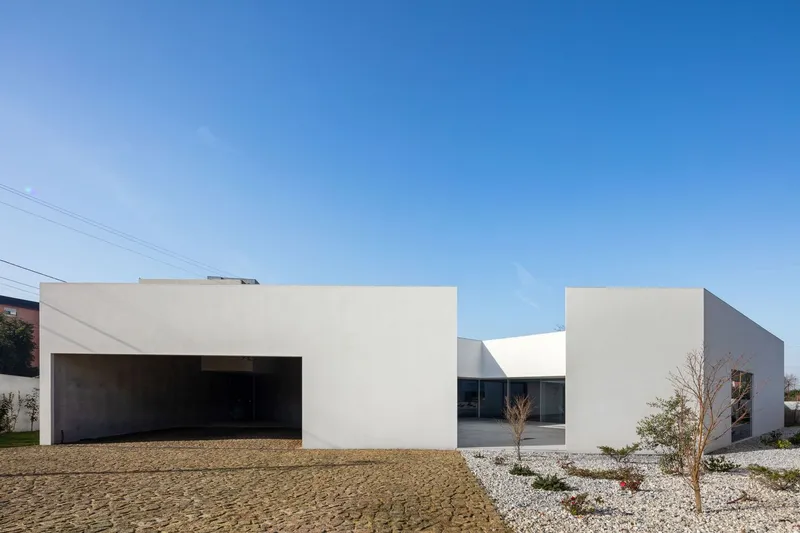
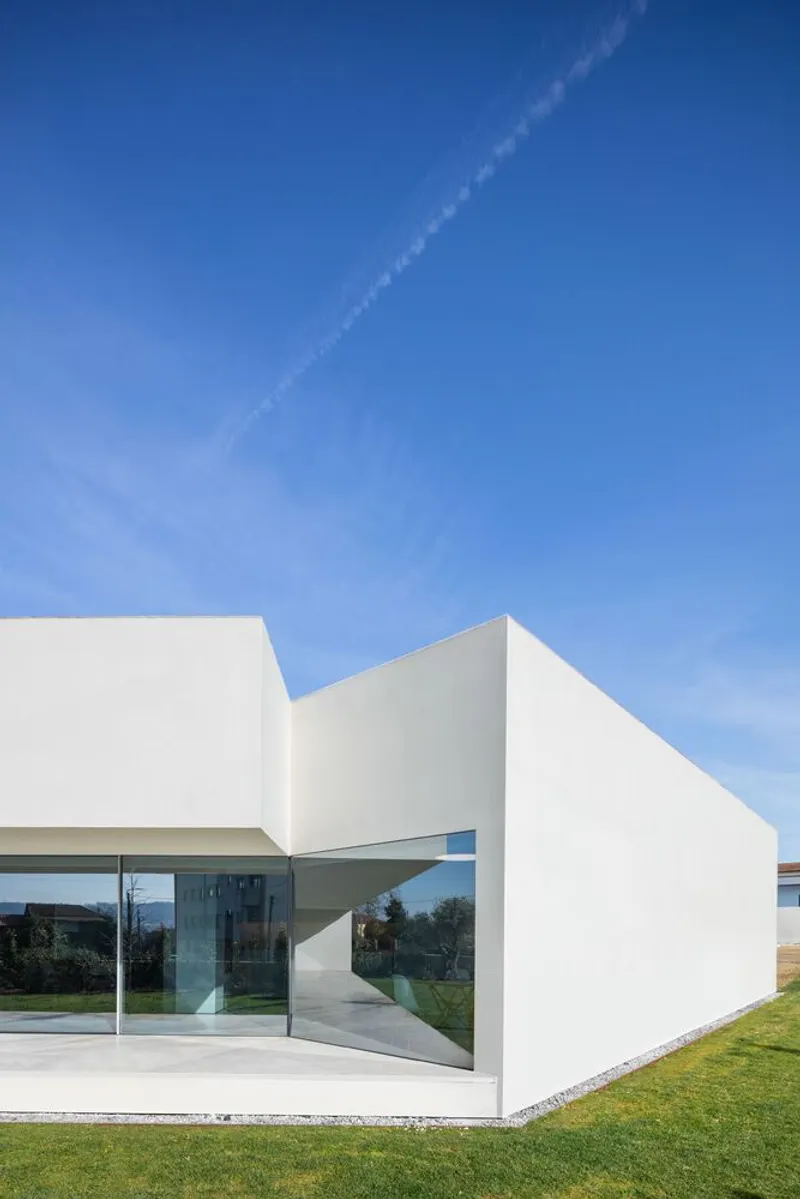
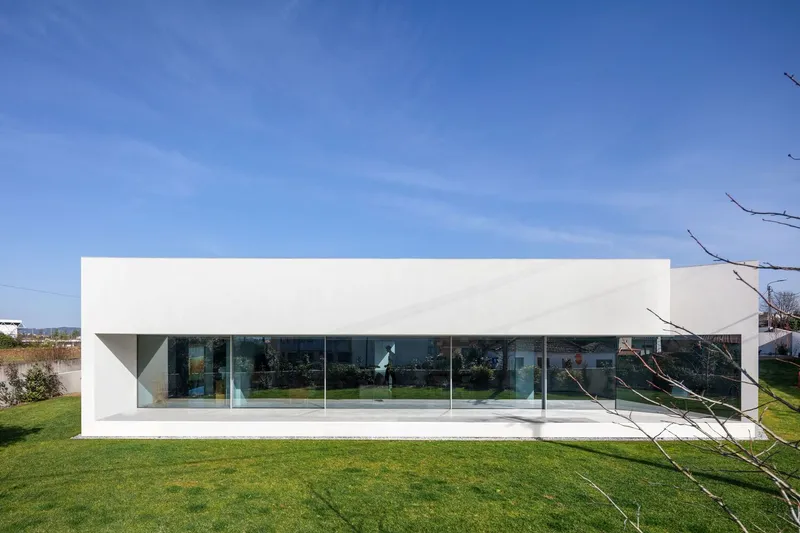
Trofa sits in a zone the architects describe as eclectic, fractured, and dispersed. The plot is elevated roughly a meter above the surrounding street level and curves at its southern tip where two roads converge. NØ ARQ responded by letting the building's footprint track the lot's boundaries, producing a faceted plan that appears almost fortress-like from the street. White rendered volumes stack and cantilever over recessed garage openings and gravel landscaping, presenting a calm, opaque face to the neighborhood.
From the exterior, the house reads as a series of interlocking geometric masses hovering above a granite cobblestone base. The street-facing facades are deliberately restrained: minimal glazing, white stucco, and a hovering roof plane that stretches across green lawn. The architecture does not broadcast domesticity. It withholds, and that withholding is the first act of a design strategy centered on interiority.
The Courtyard as Engine
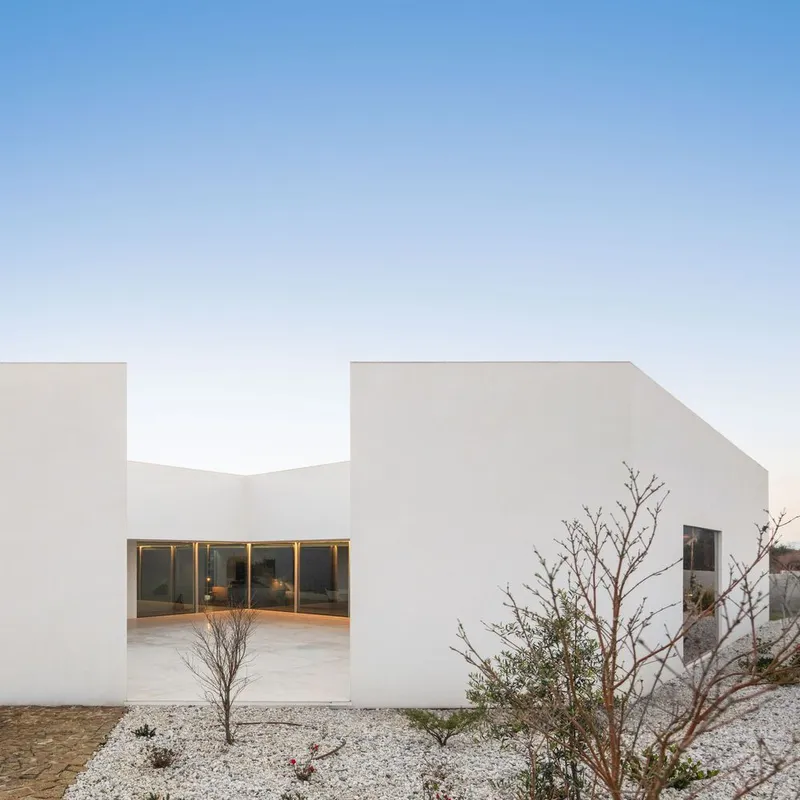
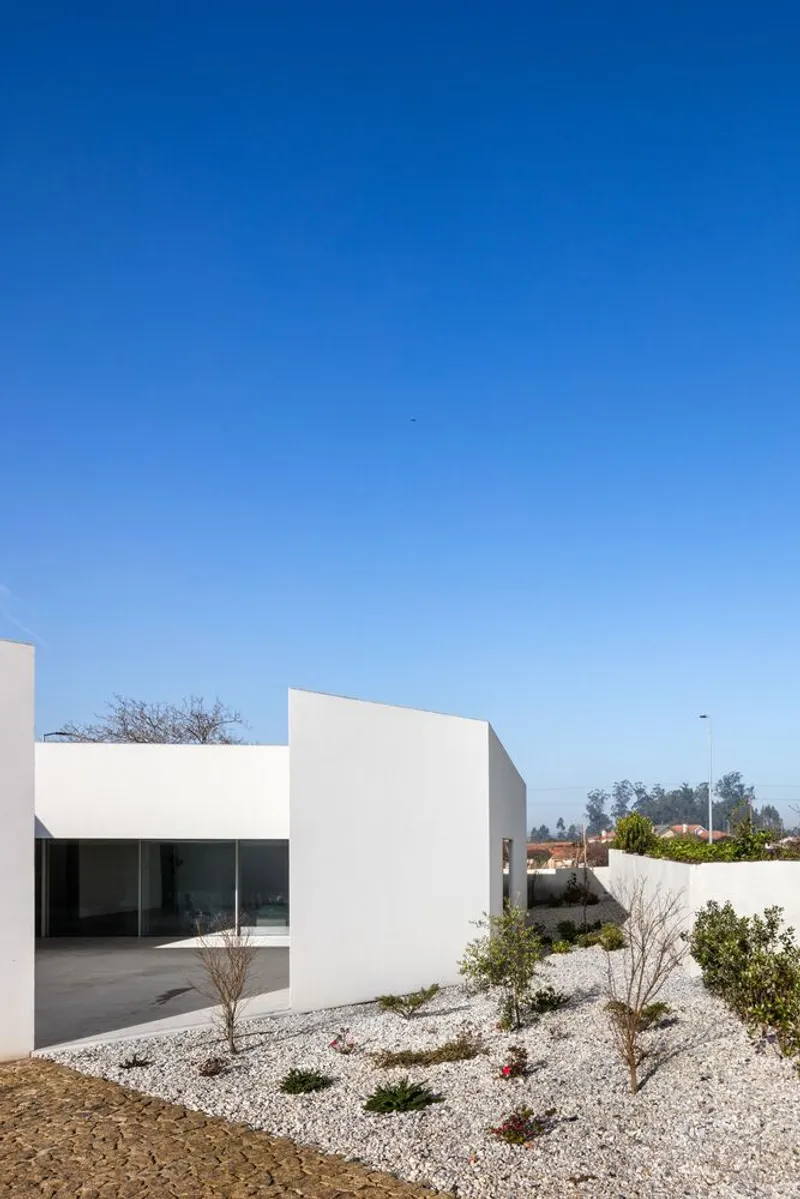
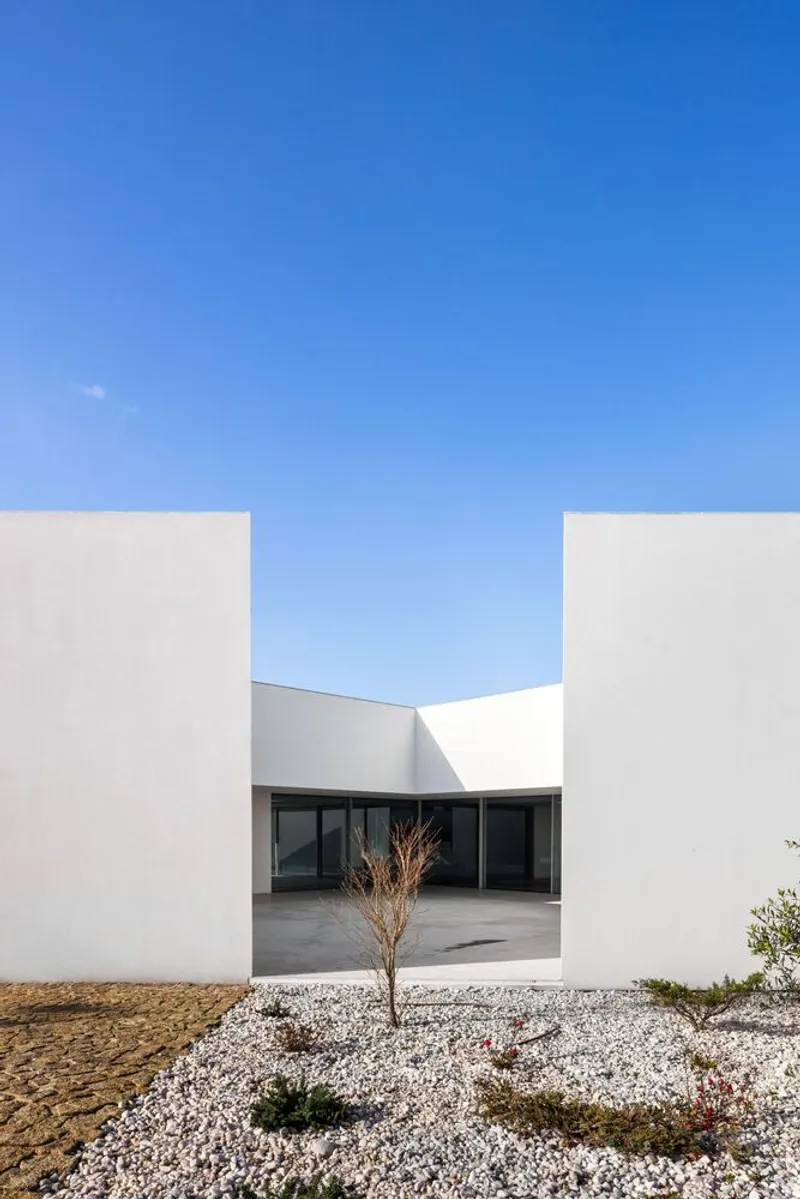
Step past the threshold and the logic inverts. Every room in the house faces a central quadrangular courtyard filled with white gravel beds and young saplings, species endemic to the region selected as part of a deliberate landscape strategy. Over time, as these trees mature, they will further screen the interior from view and root the building more firmly in its ecological context. The courtyard is not a void; it is the densest part of the plan in terms of spatial connections.

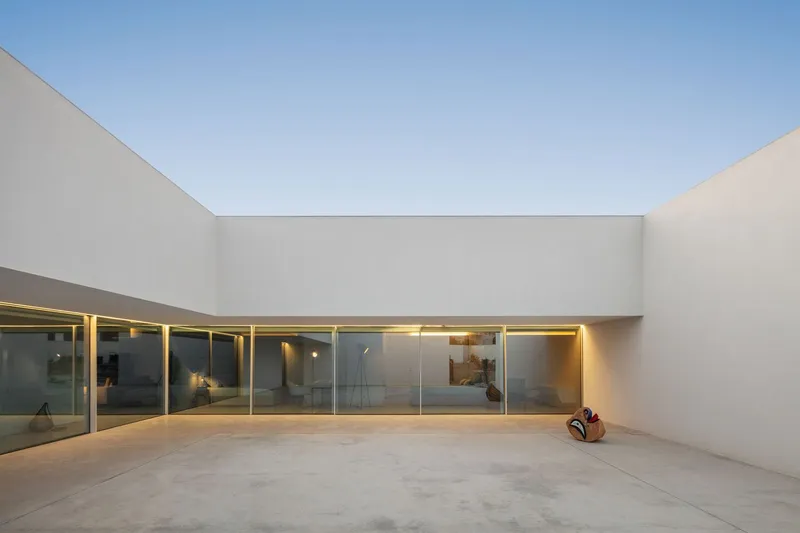
A covered exterior gallery wraps the courtyard, sheltering circulation and providing weather protection without closing off the connection between inside and out. At dusk, the glazed walls of the surrounding rooms glow, turning the courtyard into a kind of domestic lantern visible only from within. The passive benefits are significant: every room gets direct natural light and cross-ventilation through the courtyard, reducing dependence on mechanical systems. Integral underfloor heating handles the rest.
Three Zones, One Plan
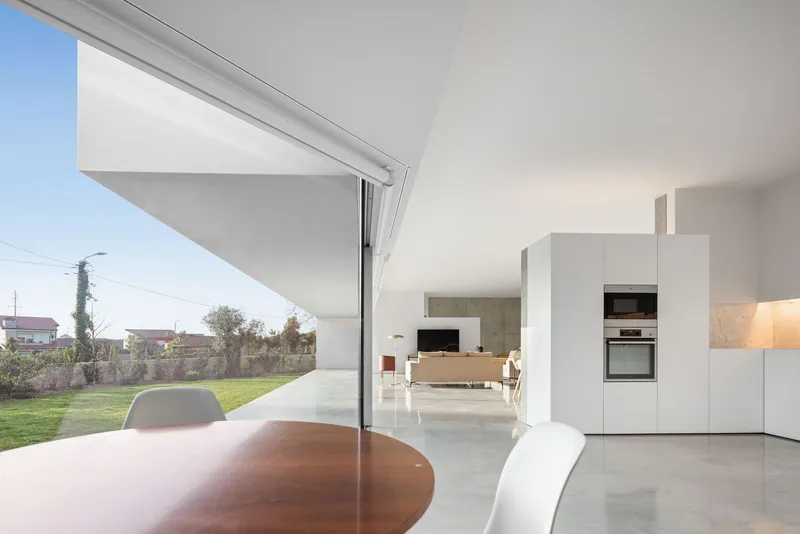
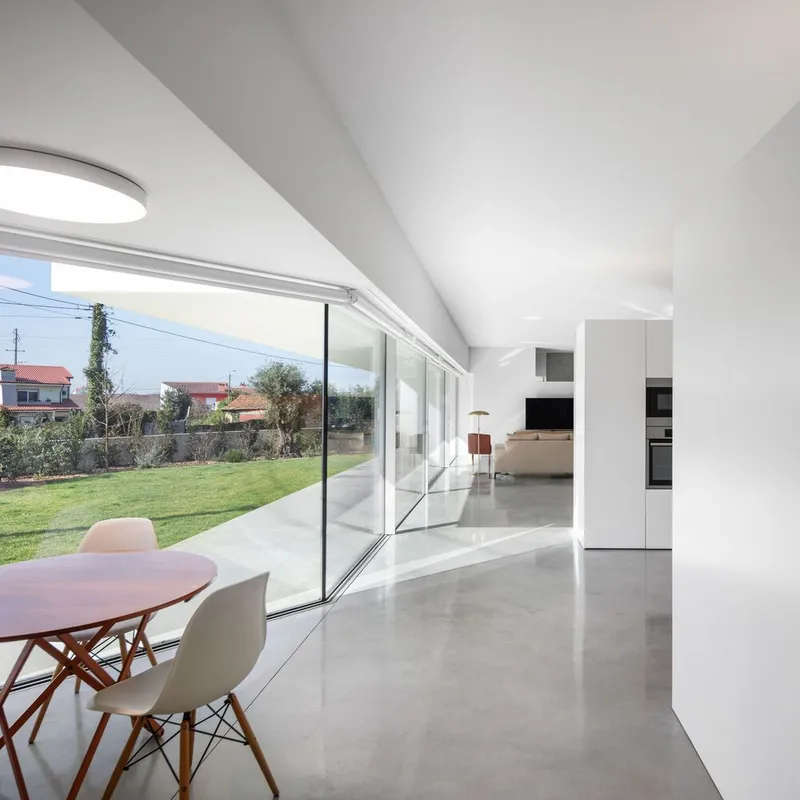
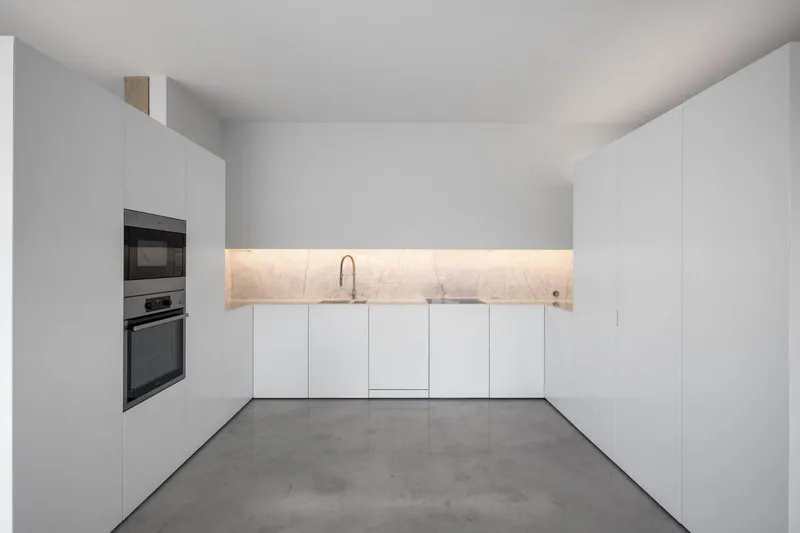
The plan divides neatly into three programmatic zones. To the southwest, occupying the prominent corner, sits the social area: living room, dining room, and a kitchen that flows into both without interruption. NØ ARQ used 2.1-meter-high cabinetry to subtly partition the kitchen from the pantry and laundry beyond, a move that maintains visual continuity across the open plan while keeping service functions out of sight. Floor-to-ceiling glazing on two sides pulls the garden and courtyard into the living space, and the angled ceiling soffit gives the room a vaulted quality that amplifies its scale.
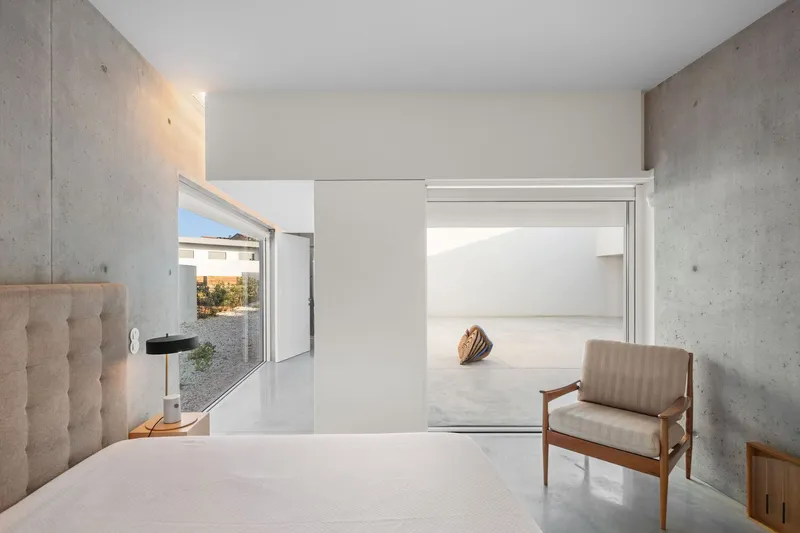
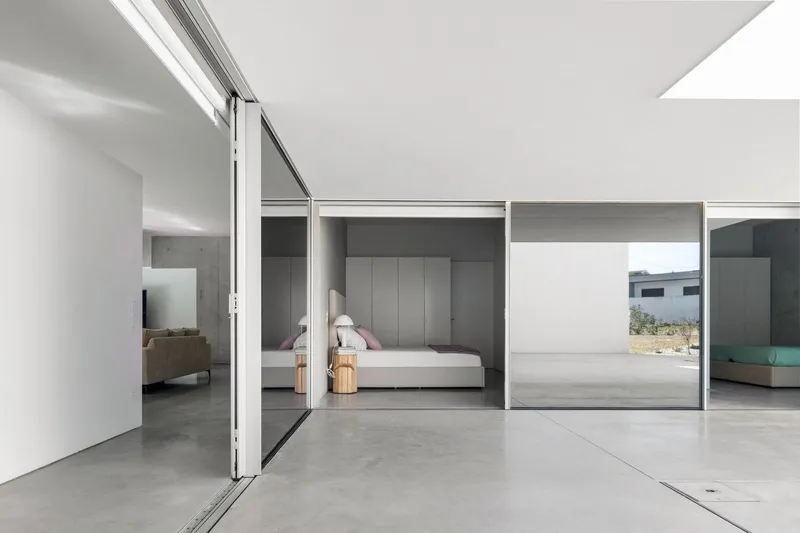
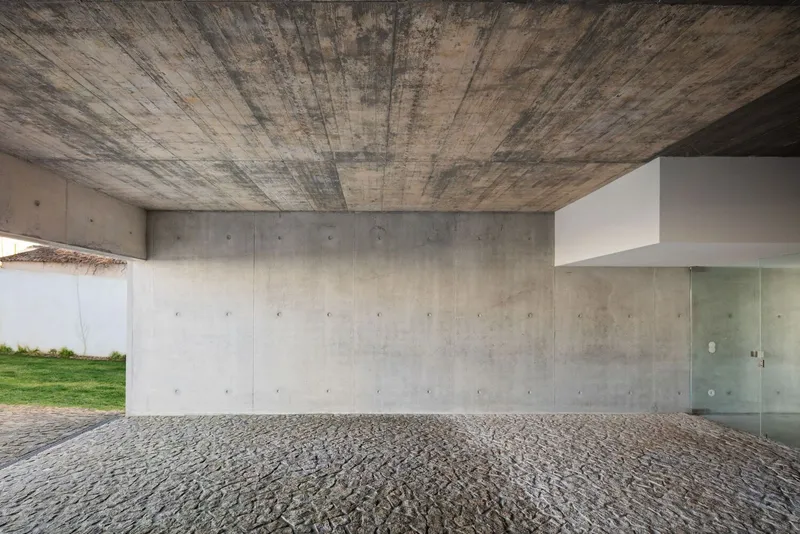
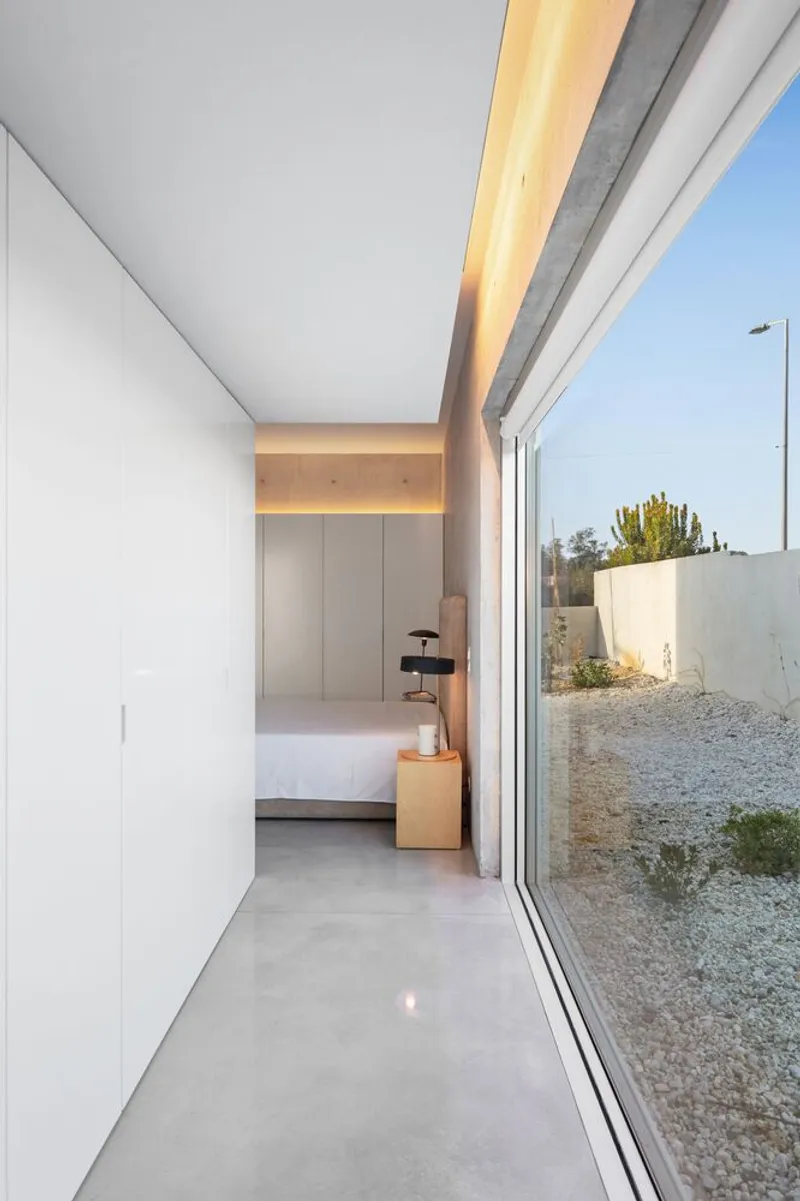
The private wing pushes north and east, where two bedrooms share a bathroom and a master suite gets its own dressing area and en-suite. Sliding partition walls and full-height glazing onto the courtyard keep the bedrooms from feeling isolated. The third zone, the covered carport along the southern boundary, connects to the kitchen through a glass vestibule. It is a pragmatic arrangement, but it also means the car enters and exits at the plot's narrowest point, leaving the rest of the site for habitable space.
Concrete and the Honesty of Structure
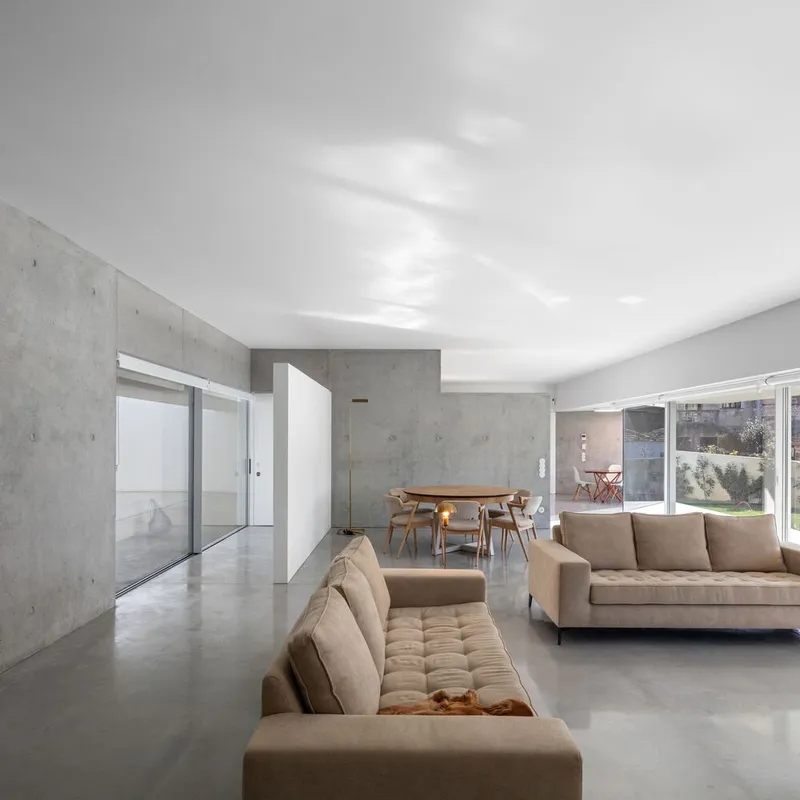
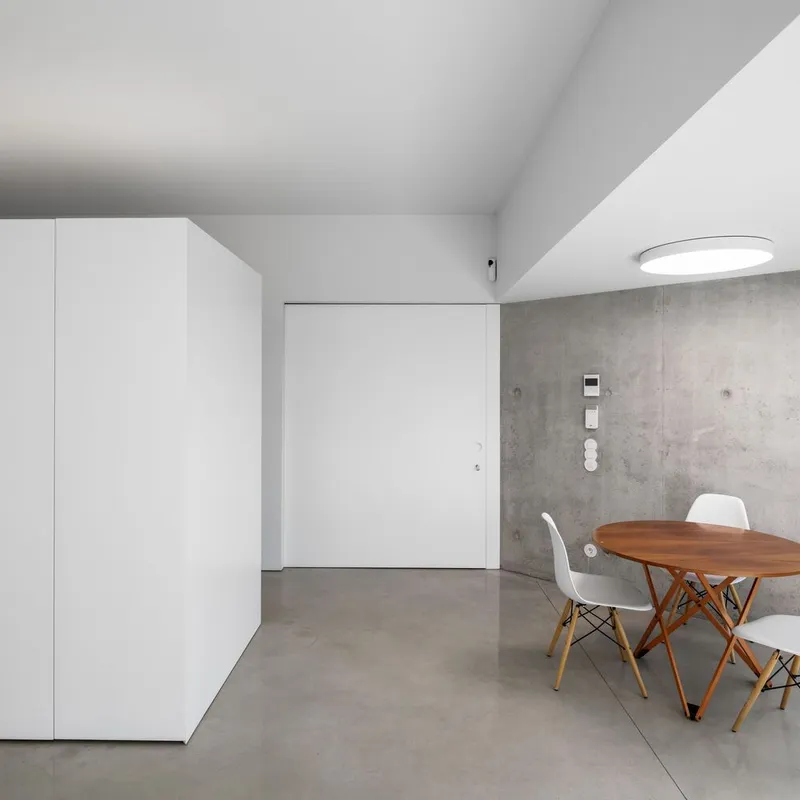

The structural system is load-bearing concrete walls and slabs, left exposed wherever the program allows it. Board-formed surfaces in the living and dining areas carry the imprint of their formwork, giving the walls a texture that is both industrial and tactile. This is not concrete deployed for shock value. It serves as the primary structural and finish material simultaneously, reducing redundancy in the construction assembly. Where concrete does not appear, plastered masonry takes over on non-structural partitions, and plasterboard ceilings conceal mechanical and electrical infrastructure for easy future access.
The material palette is deliberately narrow: raw concrete, white stucco, grey polished concrete floors, and the occasional stone backsplash in the kitchen. NØ ARQ's restraint here is less about minimalism as style and more about economic sustainability over the building's life cycle. Fewer materials mean fewer interfaces, fewer maintenance regimes, and fewer points of failure. The granite cobblestones that pave the exterior terraces, described by the architects as a material that emerges from the ground, tie the building to its northern Portuguese geography.
Light, Geometry, and Overhead Moments
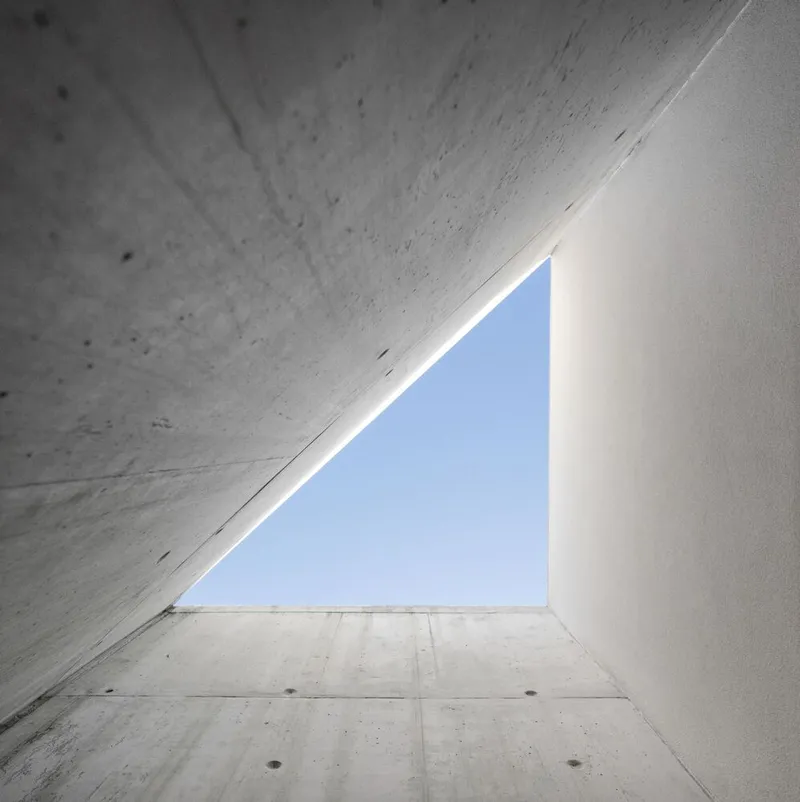
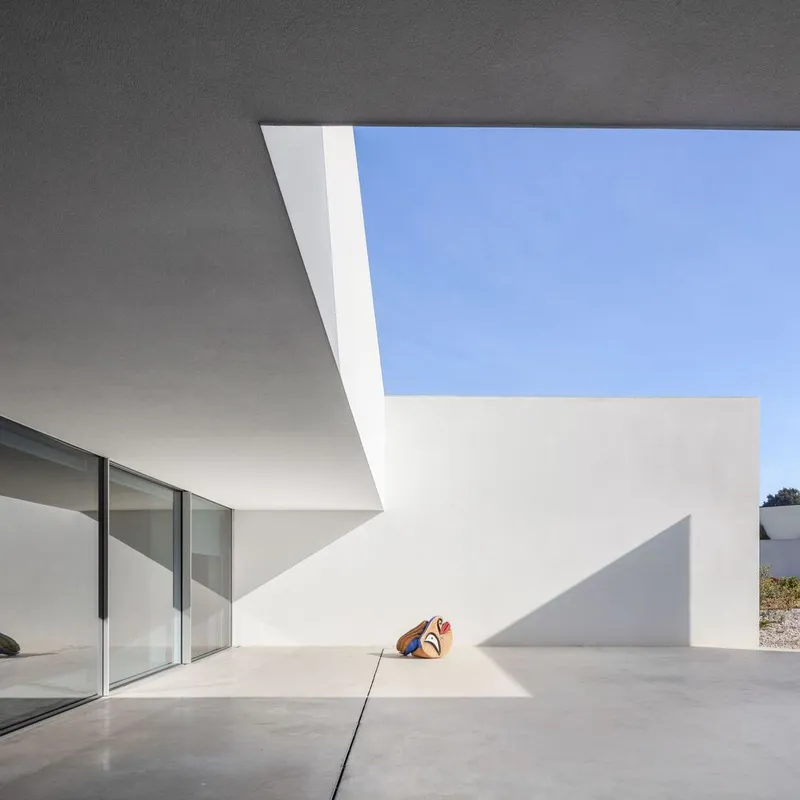
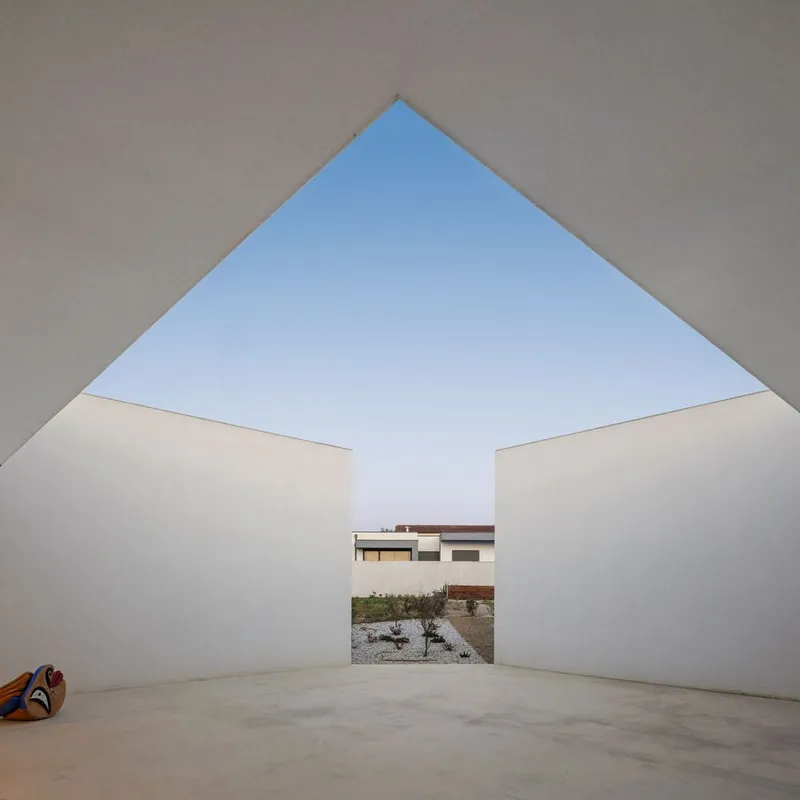
Some of the most compelling moments in PPA House occur where geometry and light intersect overhead. A triangular skylight, framed by concrete walls and white plaster, channels a shaft of light deep into the plan at a point where the corridor might otherwise feel compressed. The covered terraces play with sharp shadows cast by cantilevered overhangs, creating a graphic interplay between sun and surface that shifts throughout the day. These are not decorative incidents; they are direct consequences of the angular plan geometry and the roof profiles that follow from it.

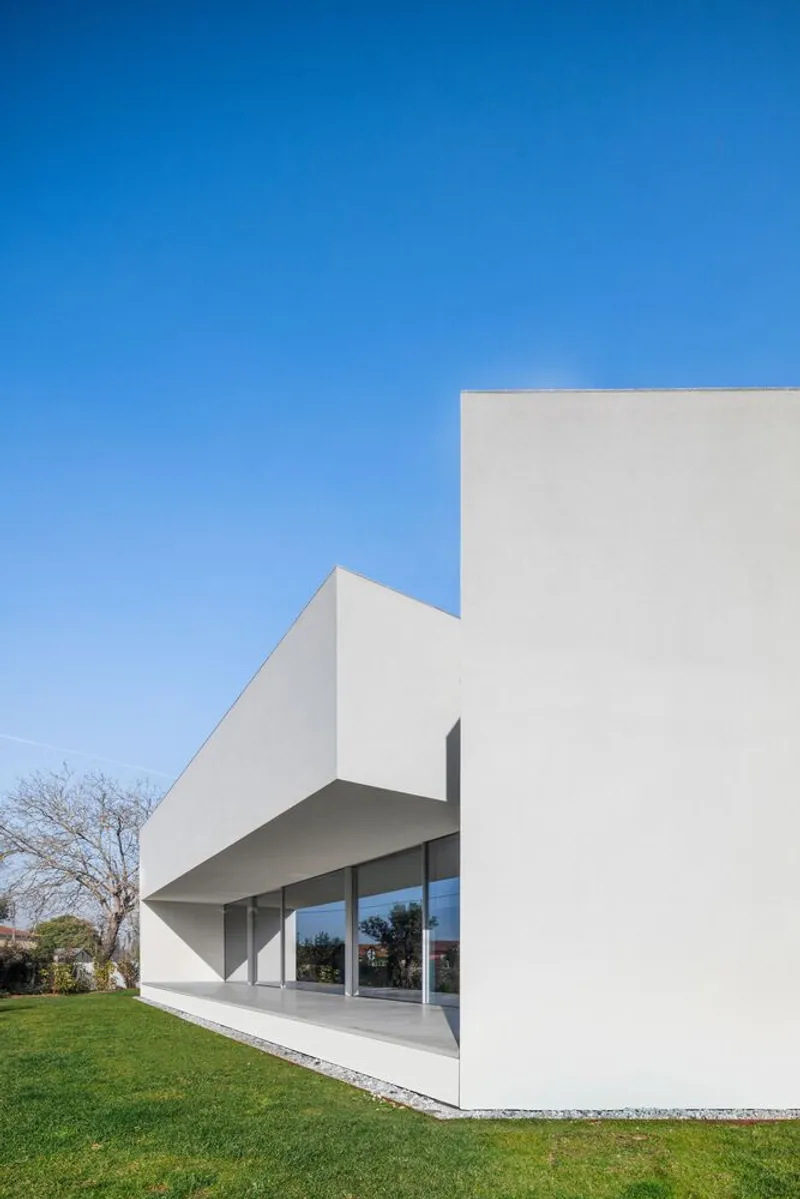
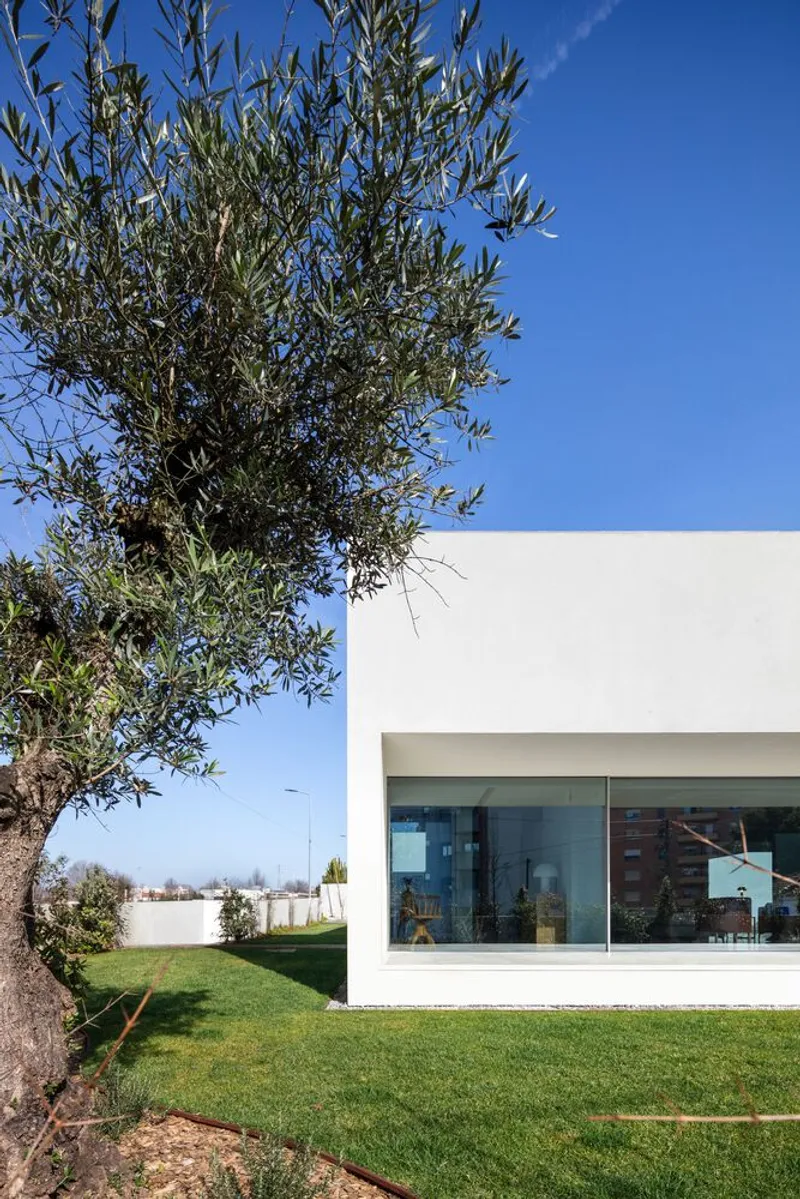
At twilight, the relationship between the house and its garden becomes especially legible. Recessed glazed corridors glow warm against the cool white volumes, and the olive trees and lawn that surround the building begin to merge with the endemic planting strategy. NØ ARQ clearly designed for this condition: a building that recedes as the landscape grows, its walls gradually enveloped by the vegetation the architects chose precisely for this purpose.
Dwelling at Dusk
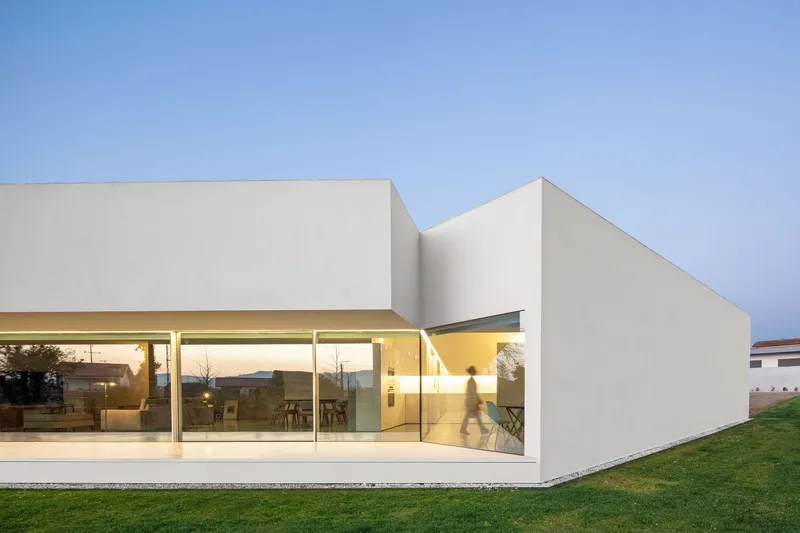
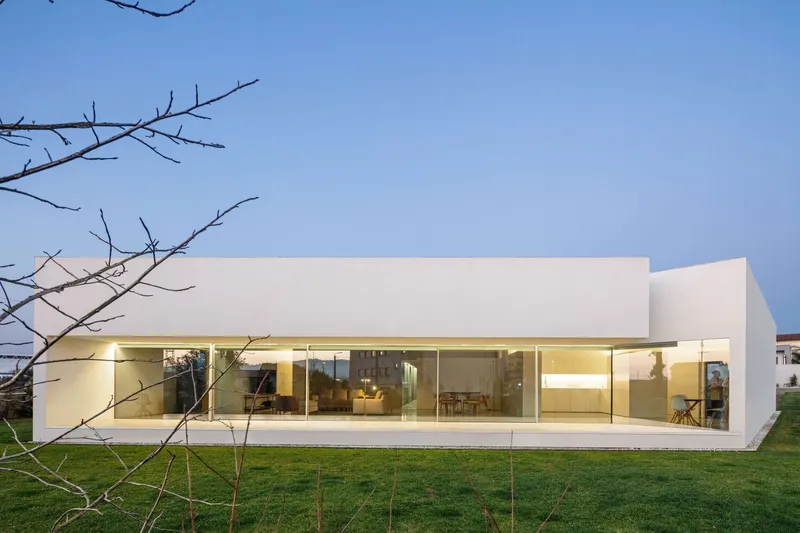
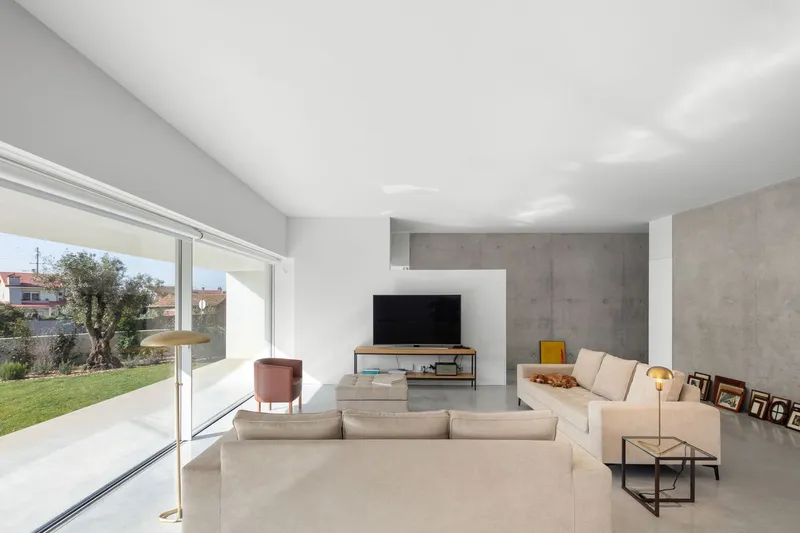
Several of the most revealing photographs of PPA House were taken at dusk, and that is no accident. The building is designed to perform as a sequence of illuminated frames after dark, its full-height glazing transforming each room into a visible tableau from the courtyard and garden. A figure passing the corner glass volume, bare winter branches framing the garden facade, the living room's concrete walls washed in warm light: these are scenes of inhabitation that the architecture stages but does not over-determine. The building creates the conditions for domestic life without dictating its choreography.
Plans and Drawings
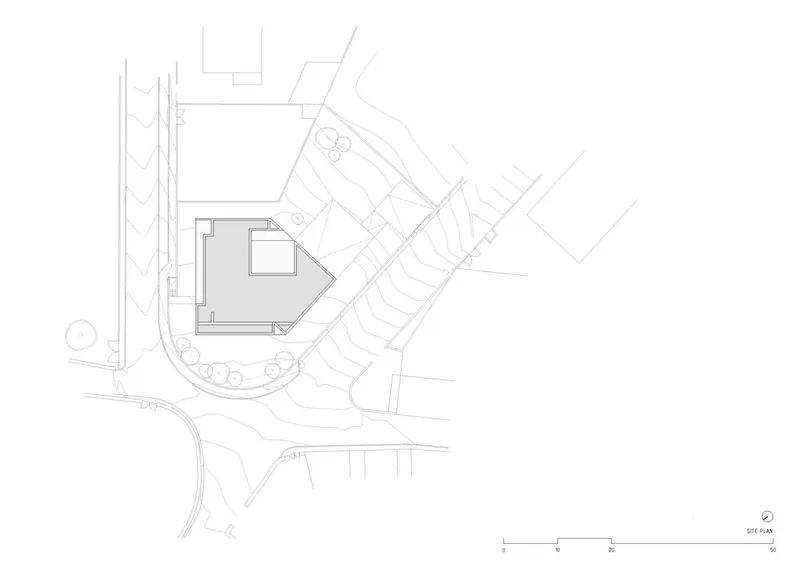
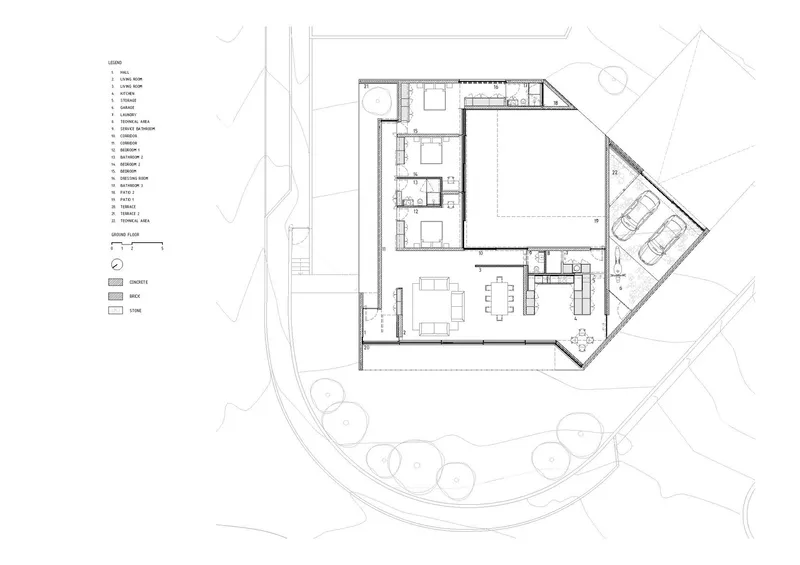
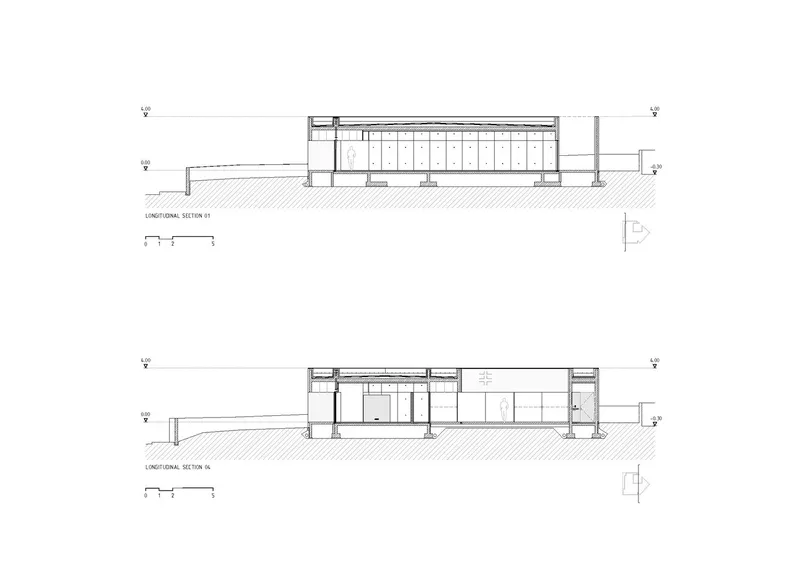
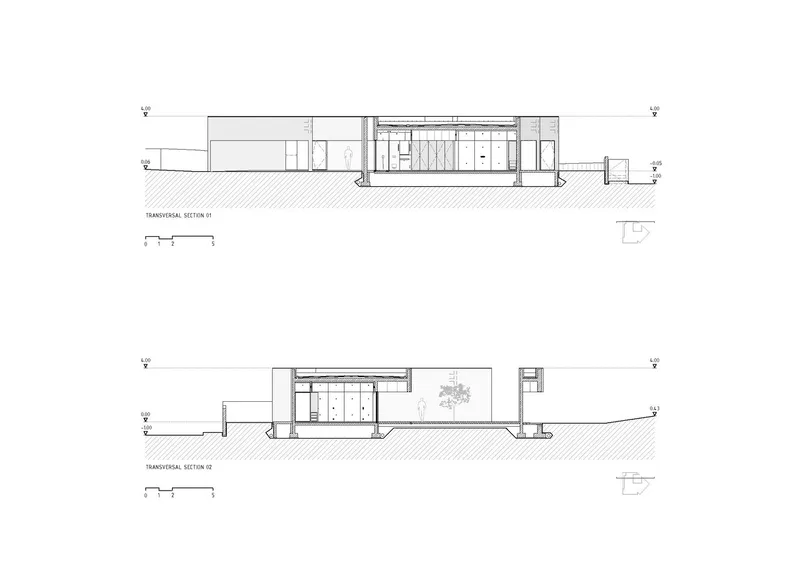
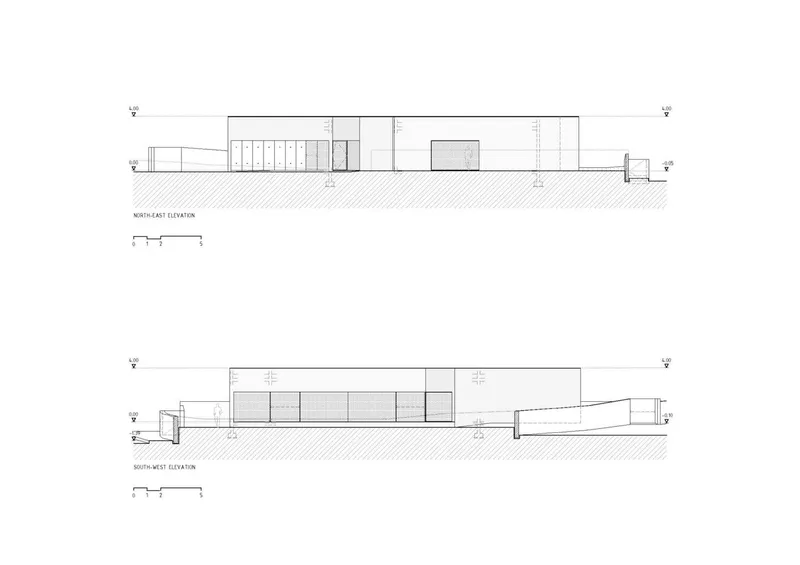
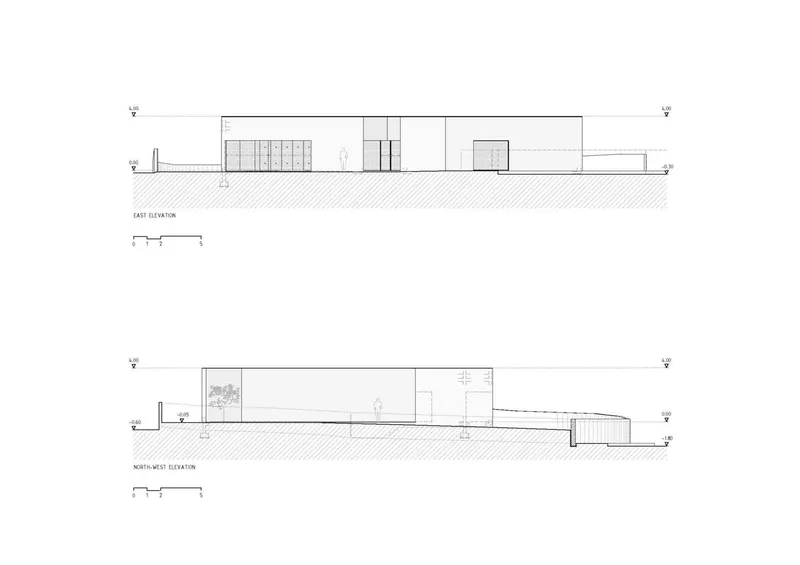
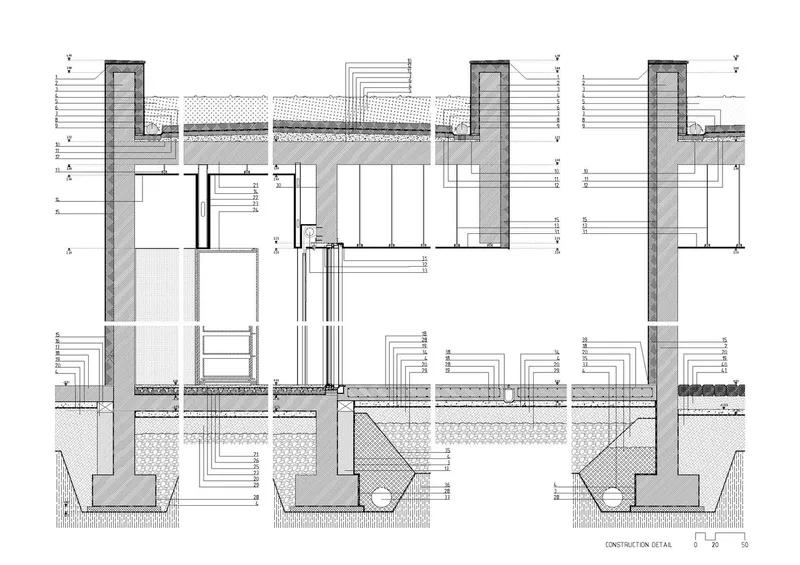
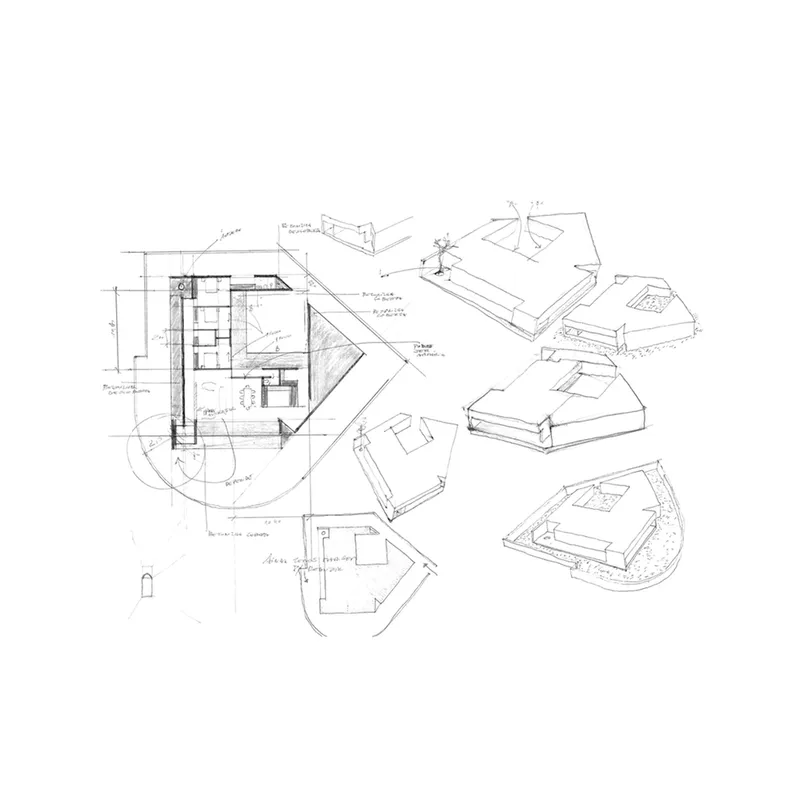
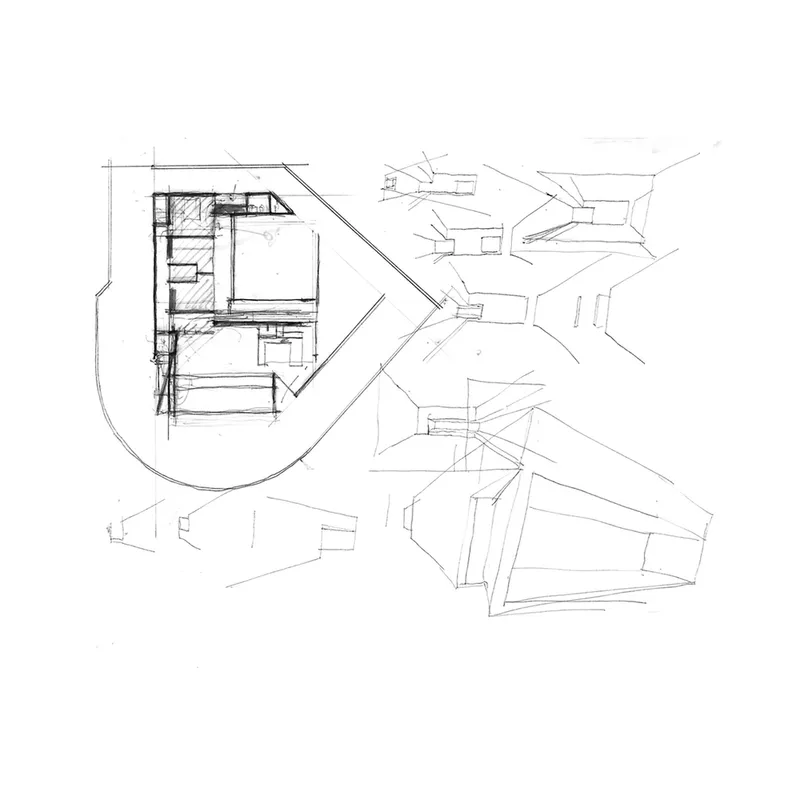
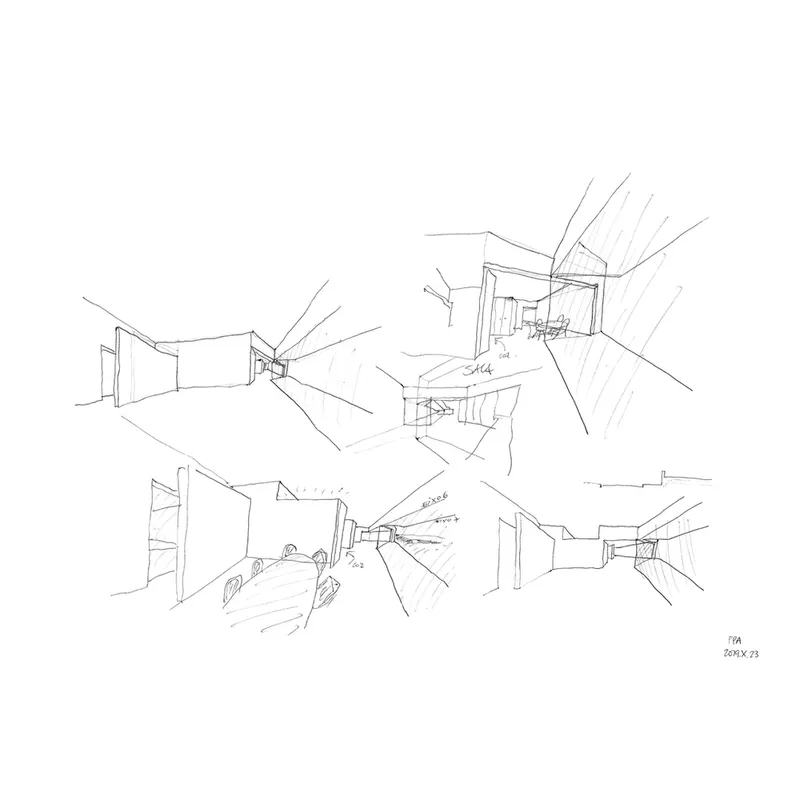
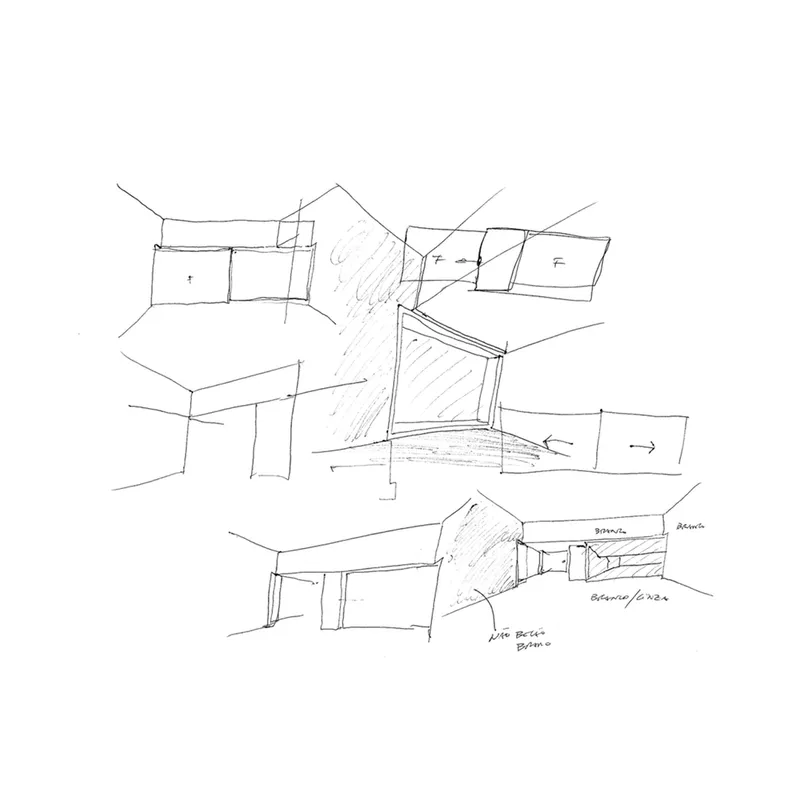
The site plan makes the wedge-shaped geometry immediately legible, with the building filling most of the plot and orienting its courtyard away from both streets. The ground floor plan reveals the L-shaped envelope wrapping the courtyard, with the social wing occupying the wider southwestern corner and the bedrooms extending along the northern edge. Longitudinal and transverse sections show how the sloping site is absorbed by the building's base, with roof profiles varying from flat overhangs to gentle peaks that create the vaulted ceilings visible in the interior. Construction details confirm the layered wall assembly: concrete structure, ETICS insulation, and rendered finish. The early sketches are particularly instructive, showing how NØ ARQ tested pyramidal roof forms and angular volumes radiating from a central spine before arriving at the final plan.
Why This Project Matters
PPA House is not a trophy house disguised as austerity, nor is it a concrete box posing as architecture. It is a carefully reasoned response to a specific set of conditions: an awkward plot, a landscape in transition, a climate that rewards passive strategies, and a culture that values privacy without isolation. NØ ARQ's decision to organize everything around a courtyard is as old as the Mediterranean itself, but the execution here is sharp, disciplined, and contemporary. The angular plan, the exposed concrete structure, the endemic planting, and the calibrated relationship between opacity on the street and transparency on the interior all work in concert.
At a moment when residential architecture frequently oscillates between performative sustainability and uncritical luxury, PPA House occupies useful middle ground. Its sustainability is not a checklist of certifications but a set of material and spatial decisions, fewer finishes, passive ventilation, underfloor heating, a long-life structural system, that add up to a house built to last without demanding excessive resources to maintain. For architects working on constrained suburban sites, it offers a clear lesson: the courtyard is still one of the most powerful tools available, provided you have the discipline to build the entire project around it.
PPA House by NØ ARQ, Trofa, Portugal. Site area: 931 m². Built area: 384 m². Completed 2023.
About the Studio
Share Your Own Work on uni.xyz
If projects like this are the kind of work you want to make, uni.xyz is a place to publish your own, find collaborators, and enter design competitions.


Popular Articles
Popular articles from the community


David Ortega Stacks a Two-Story Mexico City Penthouse Around a Steel Stair and a Pergola-Shaded Roof Terrace
In Colonia Roma, a 300 m² penthouse uses oak joinery, a planted steel stair and a slatted roof pergola to make a new-build apartment feel like a house.

Jaramillo Van Sluys Arquitectura and Urbanismo Turn a Demolished Registry Lot in Quito into an Orchard Plaza
In Quito's Centro Histórico, a 2,800 m² plaza exposes the San Agustín convent wall and redraws its lost Augustinian orchard in volcanic stone.

U.GA Architects Wraps an Oval Rooftop Pool in Curved Board-Formed Concrete on Busan's Jeollidan-gil
In Busan's Jeonpo-dong, a 454 m² mixed-use block stacks a neighborhood facility, guest rooms and an oval rooftop pool inside spiraling concrete walls.

Architekt Andreas Gruber Scatters 23 Dark Timber Chalets Across a South Tyrolean Forest Edge
In Molini di Tures, Amonti Chalets breaks a resort into a hamlet of gabled timber houses, with parking, storage and services pushed into the slope.

Similar Reads
You might also enjoy these articles

Bamboo Housing Challenge 2026: Design Affordable, Sustainable Homes Using Bamboo
An international design competition by Bamboo U and IBUKU inviting architects and designers to reimagine affordable housing using bamboo — with the winning design built full-scale in Bali.

Computational Design & Education: Beegraphy Design Awards Introduces 7th Category (Featuring Jiyun's Innovative Approach)
Dive into Beegraphy’s 7th Design Awards category, where computational design meets education to create immersive, interactive learning tools, inspired by Jiyun’s work.

From Parametric Lighting to Urban Furniture: Join the 2nd Workshop in Beegraphy’s Computational Design Series
Dive into Cutting-Edge Design Techniques and Practical Applications with Industry Experts

Last Call: Unleash Your Architectural Genius in SHAK's Kindergarten Design Competition
Urgent call for architects to join SHAK's kindergarten design competition before the looming deadline

Explore Architecture Competitions
Discover active competitions in this discipline

Challenge to reimagine the Iron Throne

Photograph architecture without architects

Illustrate the lost glory of Angkor Wat - Render Challenge

Design challenge to reuse E-waste
Comments (0)
Please login or sign up to add comments
No comments yet. Be the first to comment!