

More Than a Building-Designing a Living System
More Than a Building-Designing a Living System

NET ZERO ENERGY OFFICE BUILDING
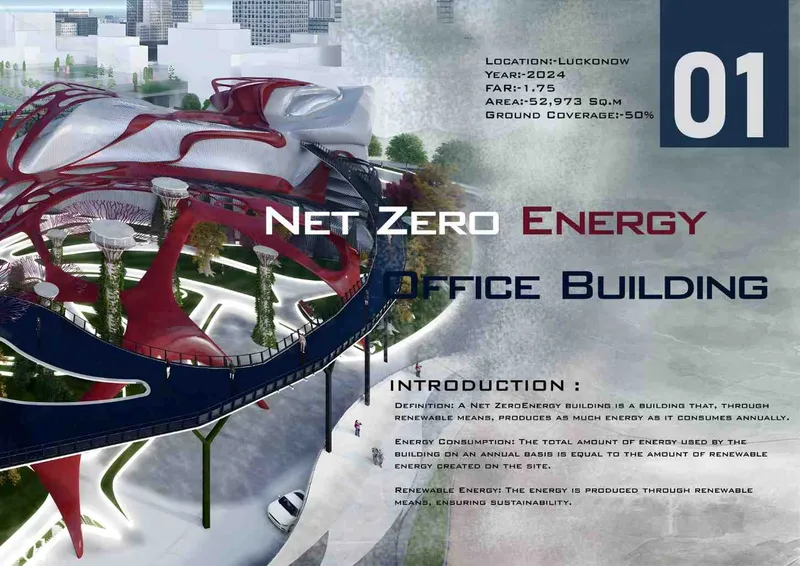

When I first explored the concept of net-zero buildings, it sounded like a technical goal — reduce energy, cut carbon. But I wanted to design something more than efficient walls and smart meters. I wanted to create a building that felt alive. That’s when the idea struck me: nature doesn’t just survive — it sustains itself. Why can’t architecture do the same?
That thought led me to the electric eel — a species that generates its own power. It became a metaphor, a starting point. From there, I shaped the building as a self-sufficient system, one that responds to its environment, generates energy, and supports both people and nature.
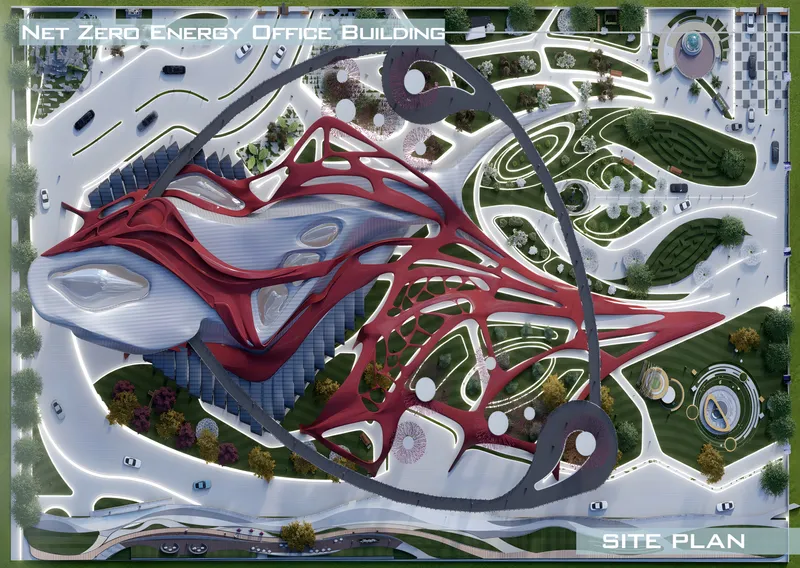
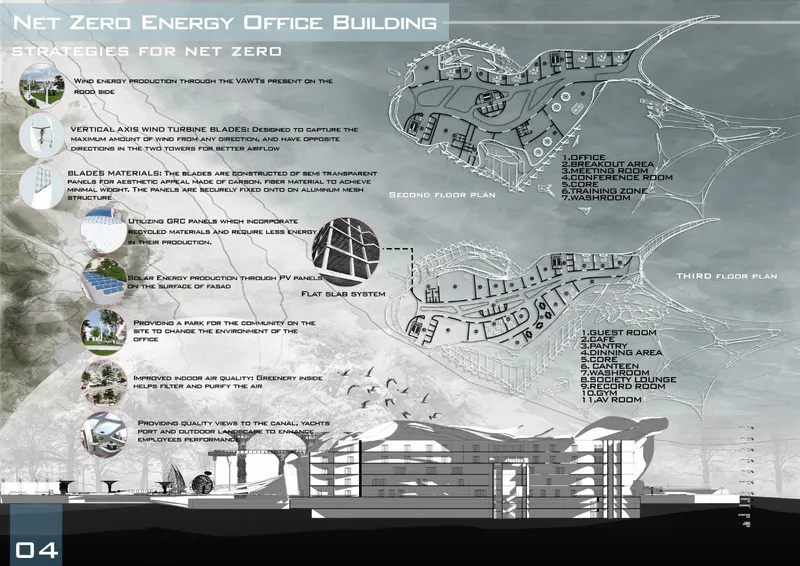
The form of the building was inspired by fluid movement, like waves flowing through space. These curves weren’t just aesthetic — they guided wind, opened spaces for light, and shaped user movement. The façade uses solar-integrated panels and vertical-axis wind turbines that generate clean energy throughout the day. Materials like recycled GRC panels were selected to reduce embodied carbon and offer long-term durability.
Internally, I imagined more than just a workspace. This office includes community spaces, parks, green zones, and open corridors — blurring the line between inside and outside. Every design decision revolved around energy consciousness, human comfort, and environmental balance.
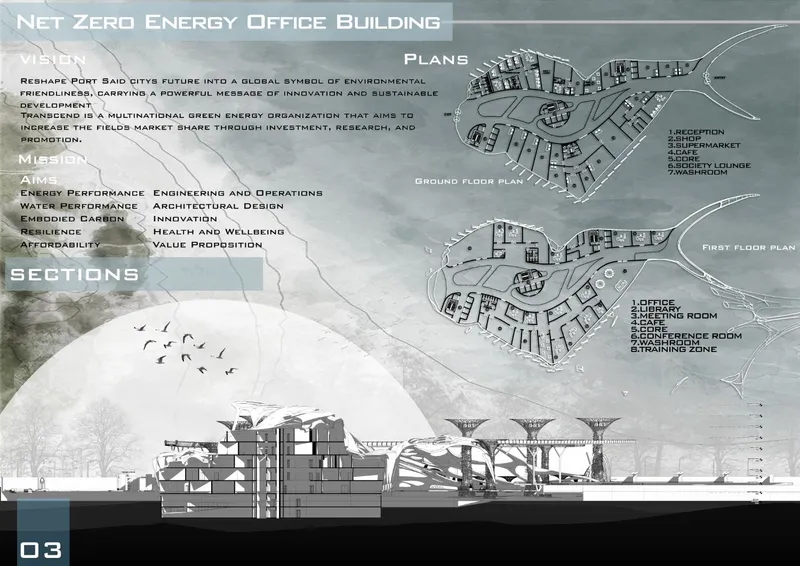
At its core, this project is not just a single building—it’s a prototype for future urban infrastructure. I envisioned it as a micro energy node that connects to the city’s larger grid. It produces clean energy and even has the potential to distribute surplus back to the community. Through this model, offices become not just consumers but contributors—an idea that could scale across the urban fabric.
I also saw this project as a tool for public awareness. The park, the open walkways, and the exposed turbines are all meant to educate, not just function. I believe infrastructure can be visible, engaging, and inclusive—design that people experience, not just pass by.
Designing Urban Pulse taught me that sustainability isn’t just a checkbox — it’s a mindset. It pushed me to think beyond aesthetics and question how architecture can take responsibility for the future. This project helped me understand that the real beauty of a building lies in what it gives back: to the people, the environment, and the city around it.
I hope this project starts a conversation — that buildings can become living systems, and that design can help us imagine a better way forward.


Popular Articles
Popular articles from the community


Architekt Andreas Gruber Scatters 23 Dark Timber Chalets Across a South Tyrolean Forest Edge
In Molini di Tures, Amonti Chalets breaks a resort into a hamlet of gabled timber houses, with parking, storage and services pushed into the slope.

Jaramillo Van Sluys Arquitectura and Urbanismo Turn a Demolished Registry Lot in Quito into an Orchard Plaza
In Quito's Centro Histórico, a 2,800 m² plaza exposes the San Agustín convent wall and redraws its lost Augustinian orchard in volcanic stone.

David Ortega Stacks a Two-Story Mexico City Penthouse Around a Steel Stair and a Pergola-Shaded Roof Terrace
In Colonia Roma, a 300 m² penthouse uses oak joinery, a planted steel stair and a slatted roof pergola to make a new-build apartment feel like a house.

LT2A and OPEN Architectes Thread a Brick and Glass High School Through a Wooded Belgian Campus
In Braine-l'Alleud, a 3,000 m² wing for Collège Cardinal Mercier pairs pale brick with a glazed colonnade, deferring to a small chapel and a dense wood.

Similar Reads
You might also enjoy these articles

The Rhythm of Seasons
A Farmers' Market Connecting Nature and the City
Base Beyond
DESERT COMPOUND ARID: TOURISM OF ABSENCE AND ABUNDANCE


From Myth to Matter
Rejuvenating the flowing sanctity of panatirtha: Enhancing the natural and cultural tourism of panatirtha, tahirpur through architectural and planning intervention

Explore Smart Buildings Competitions
Discover active competitions in this discipline


Challenge to design mud housing for contemporary communities

Challenge to reimagine the Iron Throne

Photograph architecture without architects

Illustrate the lost glory of Angkor Wat - Render Challenge
Comments (0)
Please login or sign up to add comments
No comments yet. Be the first to comment!