
Museum of the Mundane
„We live in an era of trash. We produce trash and we become trash and we, the majority, are always treated like trash.” Peter Weibel, 2006
The quote illustrates the condition of modern society. Life based only on material goods that are collected and thrown away in the highest frequency ever, leads to degradation of both values and World we live in. We, as a whole society, irresponsibly use, exploit and explore every place on the globe, in the name of evolution. Have you ever wondered what the price will we have to pay for so-called ‘development’? The answers from the Earth become more and more clear and firm. Huge fires, floods, hurricanes are only some of messages we receive and, unfortunately, ignore.
As many different research and statistics show, the possible ending seems to be only one and, at least for now, almost unavoidable, it will be the self-destruction. The designed building, and the whole story it tells, was supposed to be some kind of warning, a terrifying eye-opening clear message – IT IS ALREADY TOO LATE. We are running out of time, there is no more time for empty words, we have to act and act right now. In the rush of everyday live we may not notice how harmful to the world we have become and not doing anything to fix it.
Museum of the Mundane is a place that draws inspiration from art, but focuses on objects seemingly unimportant, temporal, mundane. Through prosaic items and waste produced by us, we can discover hidden information about society, culture, its history and, what is the most important, about ourselves. We are surrounded by many objects, things, items. Shoes, mobile phones, cars, bikes, pencils, toothbrushes, glasses, books, … try to count how many of them you have. Try to count how many of them you do not use. Try to count how many of them you thrown away, despite being still usable.
That is exactly the main purpose of the building – to spotlight world’s degradation through artistic installations and everyday utility objects, the things which we all possess but elude us in the rush of everyday life. Proposed localisation is a “peak” of Wroclaw, the most elevated point in the city, Maslickie Hill, which is nothing other than closed landfill. Hasn’t being used since 2001, it became green, inconspicuous hill, with surprisingly different history. Located in unspoiled areas on the outskirts of Wroclaw, at some point was the only landfill in the city with population over 500,000 and now it is completely unused and forgotten.
The building is designed is based on book or theatre-like narration, consisting of several different and successive chapters. Urban plan and main theme, based on basic architectural geometry is supposed to surprise the visitor from the very beginning and gradually increase emotions. The main axis of symmetry is centreline of two main views from the top – urban one (city centre), and rural one (Mount Sleza).
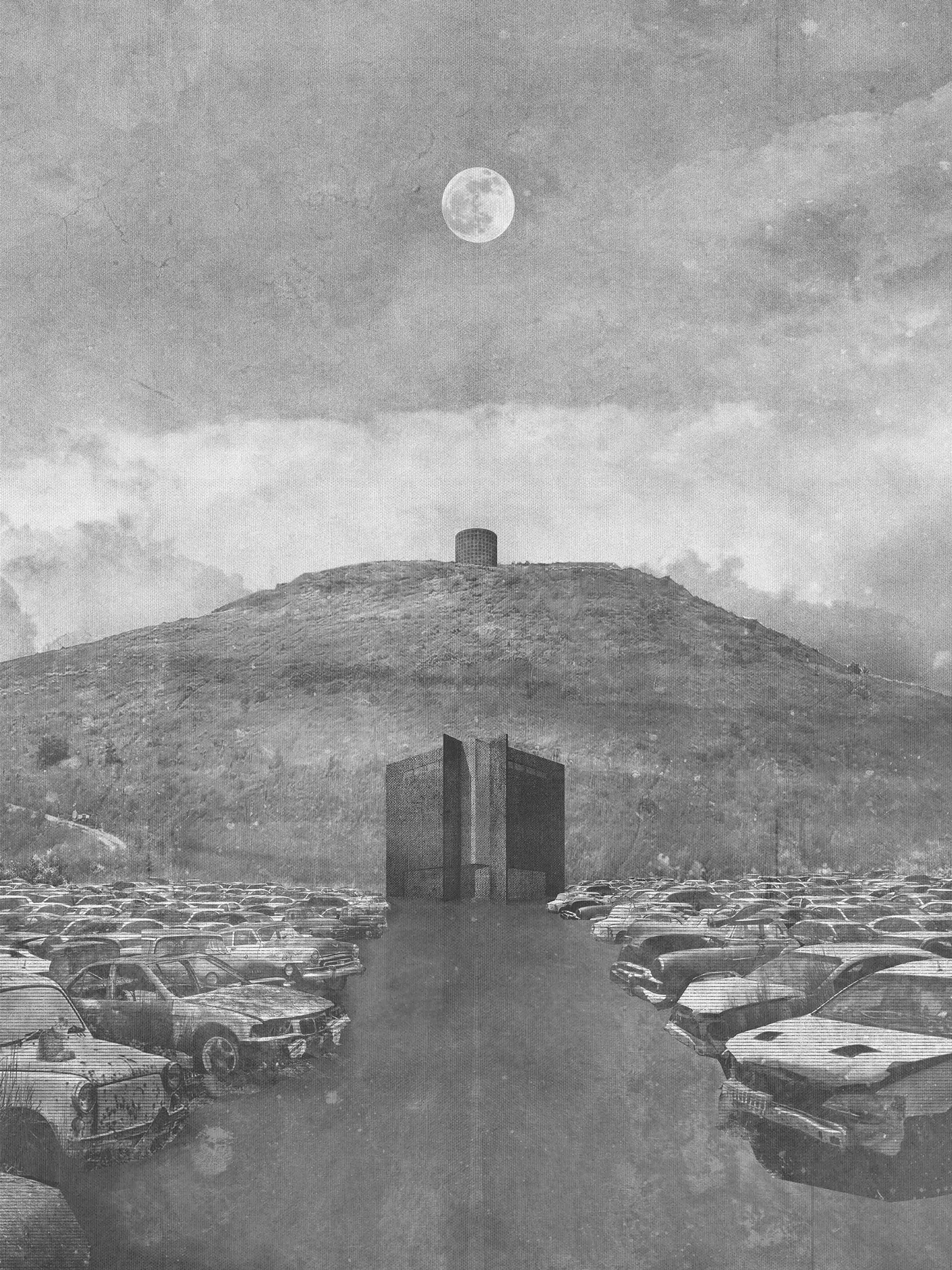
First from the ‘acts’ begins even before entering the site. The visitor makes his way through narrow gate, cut in existing smaller hill near road from the south. Then is brought into the parking lot – the asphalt desert, where wrecked cars are part of an exposition. Free and public parking spots are hidden between car wrecks, forcing visitors to interact. It is also an allegory of car’s role in the modern world - which went from a decent, dream product to ordinary one, bought and thrown away every few years.
In the middle, behind the monumental gates is located the entrance building, with temporary exhibition. Triangle-based in plan, resembles some object from outer space, black, introverted, dangerously pointing its sharp corner. Ground floor is public space, with basic functions, like ticket office, book store and cloakroom. Upper floors are exhibition ones, with top floor used as administrations and workshops.
Next step is the permanent exhibition, located entirely underground. It is consist of numerous exhibition rooms, regular and spacious at the beginning, becoming more chaotic, tight and filled with objects, the deeper we go into the hill. The visitor is confronted with an overwhelming number of objects that he owns himself, realizing what it really has or had.
Reaching the cylindrical tower is a way out of the claustrophobic and tight space. looking up, you can see an open staircase leading to the very top and notice the scale of the Hill, built entirely from products of our consumption. Walking up we meet interactive exposition, explaining and teaching appropriate behaviour. It is also possible to the matter of the hill, see what it is made of, how it smells and what the unstoppable development leads to. The exit is at the top, where struck by light, we go out as if ‘newly born’, richer in gained knowledge.
The Last act is going down the peak – the time for contemplation and drawing conclusions, with admiring the views - the city that led to the creation of the hill and a symbol of purity and nature. It only depends on us which direction we will choose and which way the world will go.



Popular Articles
Popular articles from the community


Lunar Spiral: Space Architecture Shaped by the Mathematics of the Universe
Lunar Spiral reimagines space architecture through Fibonacci geometry, lunar regolith, levitating habitats, and self-sustaining Moon living.

The Musturak Paradise: Senior Living Architecture for a Connected Future in Temara, Morocco
The Musturak Paradise reimagines senior living architecture in Temara via private homes, social spaces, culture, community, and shared care.

The Earth Pod: 3D Printed Homes for Resilient Refugee Communities
The Earth Pod reimagines refugee housing through 3D printed homes made from clay, combining resilience, self-sufficiency, and rapid shelter.

Hill & Cross Opera: Sculptural Opera House Architecture Shaped by Tallinn’s Landscape and Identity
Hill & Cross Opera reimagines opera house architecture in Tallinn through its sculptural hill, civic plaza, glass wave and a luminous cross.
Similar Reads
You might also enjoy these articles

Day and Night Park: A Time-Based Urban Newsstand in Beijing
A temporary urban newsstand in Beijing blending travel, light, and reading through poetic colors, compact form, and community-focused design.

Modernist Patio Renovation in El Masnou, Barcelona by Oliver Segura Arquitectura + Cebrià Arquitectura
Modernist patio renovation blending tradition and innovation with a movable pool, leveled floors, and Catalan materials in El Masnou.

Alto Residencial Coop: Cooperative Housing Development in Santiago de Compostela by Carbajo Barrios Arquitectos
A linear cooperative housing complex blending white volumes and perforated metal façades, enhancing community living, natural light, privacy, and urban integration.

Vil Genis School by BPA ARCHITECTURE – Massy, France
Vil Genis School in Massy, France, features sustainable design, south-facing classrooms, community integration, accessible spaces, and modern educational architecture.
Explore Architecture Competitions
Discover active competitions in this discipline




Challenge to reimagine the Iron Throne


Photograph architecture without architects


Illustrate the lost glory of Angkor Wat - Render Challenge


Design challenge to reuse E-waste
Comments (0)
Please login or sign up to add comments
No comments yet. Be the first to comment!