
MYCOMARS
Mars Housing Colony Design Challenge

CONCEPT
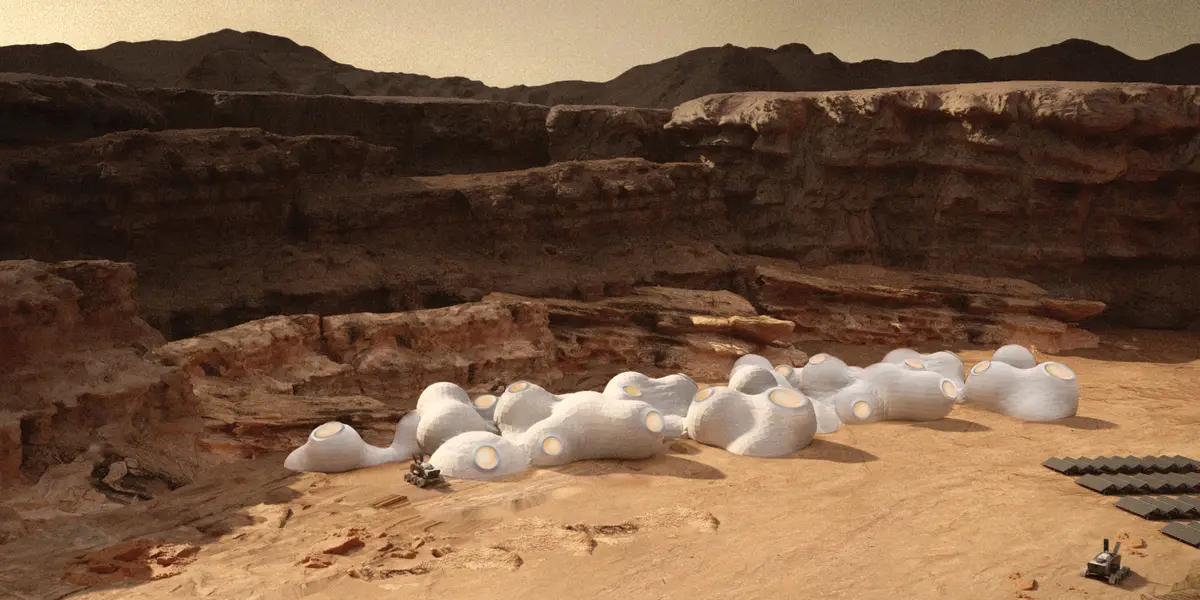
The requirements of habitat for human Mars mission have always been extreme and efficiency-oriented, but recently the human-centric experience is being highlighted. This is the part where architects and designers are needed to get involved. The main concept of this project is a novel autonomous construction method which not only protects the inhabitants from Martian extreme environment, but also considers human comfort.
CHALLENGES
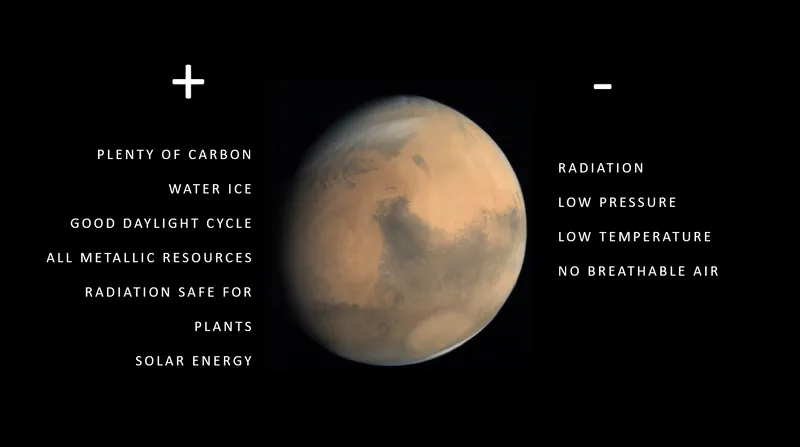
Although Mars is inhospitable, it has quite many things in common with Earth. The area of Mars is 145 million km2, which is approximately the area of the Earth's land mass. Mars has almost the same 24-hour cycle, which means that all biological species that have accustomed to Earth’s cycle are going to function fine on Mars.
But there are a lot of challenges to overcome: too much radiation for humans, very low pressure, low temperatures, no breathable air.
The distance between the planets is 57,6 million kilometers. This distance brings really big issues, because that it makes space travel really expensive.
The cost is directly related to the mass and the volume you are bringing. So, when designing the Mars habitat there are three principles:
- The habitat should be built autonomously
- It should be compact
- It should be low in mass to avoid economic imbalance in transportation
But Mars has quite extreme conditions: the habitat should protect from radiation, extreme temperatures, dust, and the surrounding (non) existing atmosphere.
So, the mass is needed to protect from these extreme environments. And as it is not practical to bring all the mass from Earth, we can use the Martian local materials, like soil and water.
DESIGN PROCESS
I started looking for the most optimal construction method for the Martian habitats. A material that would be strong, lightweight and protect from meteorites and radiation, but also provide enough sunlight, which I considered to be one of the most important qualifications. I studied the possibilities of using regolith and ice as building materials but they had many drawbacks.
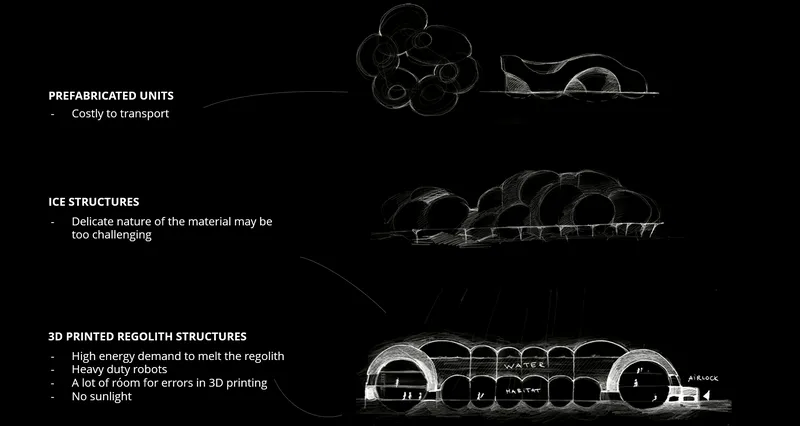
Taking these drawbacks into consideration I started looking more into different types of inflatable structures. They are easy to install, strong and lightweight, so the cost of the transportation will not be as drastic. I thought that Martian water could be used to inflate the units, as it is also great for radiation protection, being high in hydrogen.
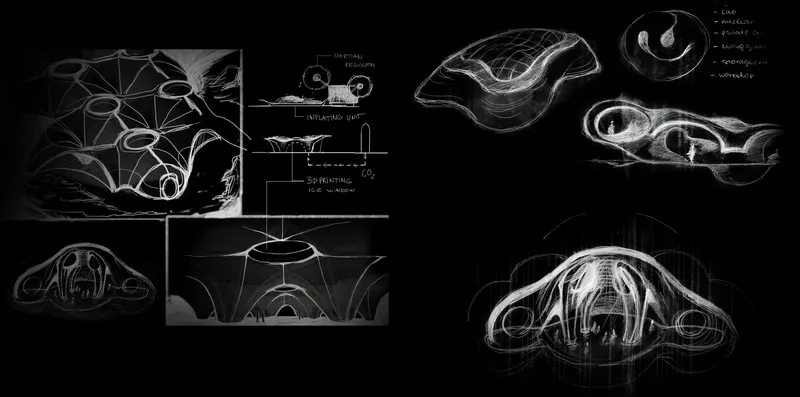
I also learned that the topic of atmospheric pressure on Mars is very important and often underappreciated. Pressure is one of the biggest forces that influences how structures will look and work. Martian atmosphere is very thin and mostly consist of CO2. It’s low density also influences a very low atmospheric pressure.
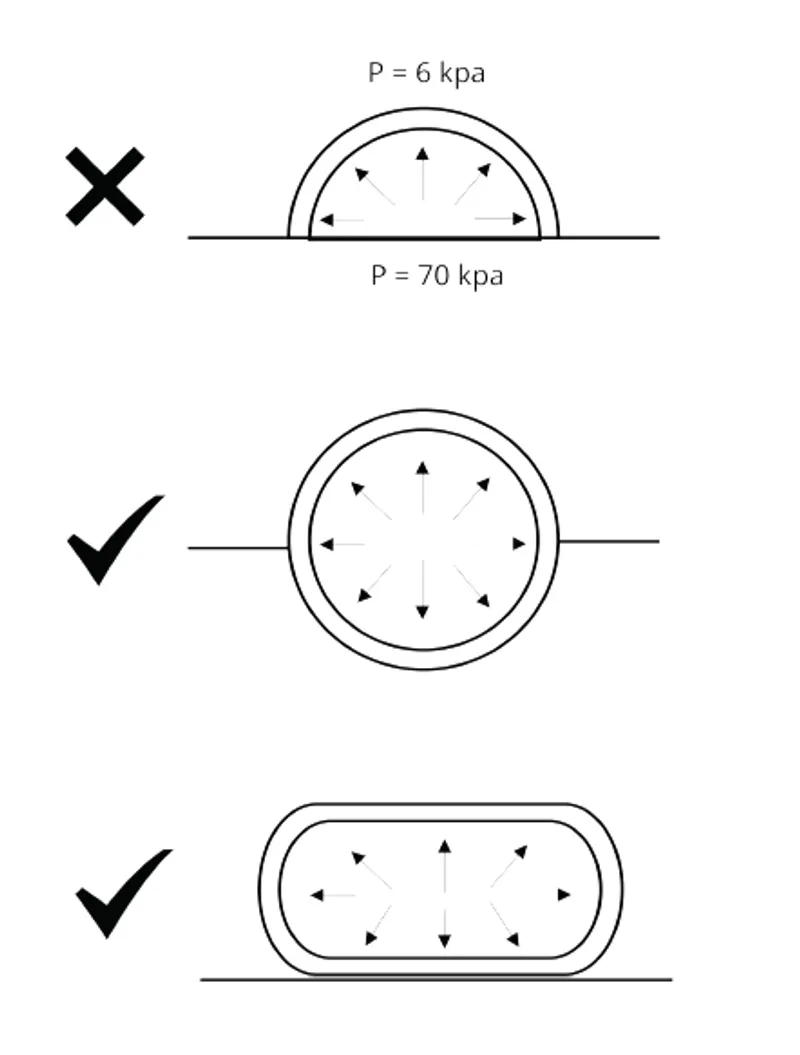
So the artificial atmosphere that is suitable for humans should be created inside of the habitat. It will be pressurized, and to balance this internal pressure all the shapes should be smooth. But the internal forces push against all surfaces, not only walls, so structures with flat bottoms are just going to shoot upwards. That is why domes should not have flat bottoms, but be round altogether. They can also be fused together.
FINALISED CONSTRUCTION METHOD
So I have analyzed different possible solutions and proposed a novel construction method which is based on a research by Nasa*.
This research stated that in theory it is possible to grow structures on Mars using the process of growth of mycelium and cyanobacteria. Mycelium in basic terms, is the threads that fungi use to build themselves. And cyanobacteria would be used as a feedstock to mycelia.
According to the research, mycelia are more flexible and ductile than regolith. The water, which would be used to help mycelium grow, will also serve as a protection from radiation. According to the NASA research, the 900 mm thick wall is enough to provide every protection needed.
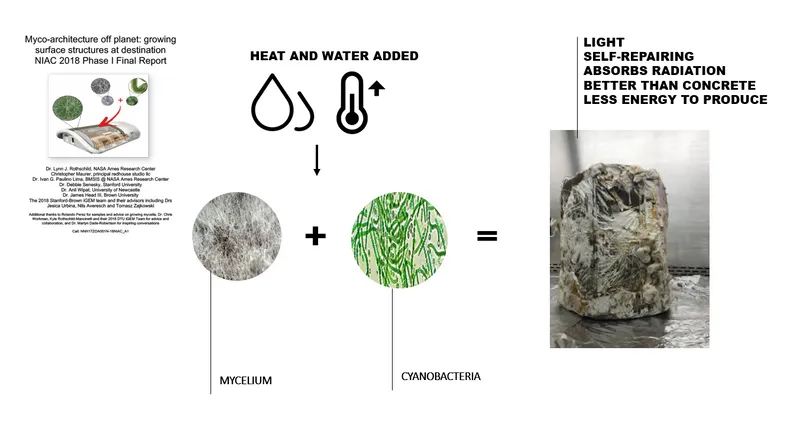
This research is still in early stages of development and the prototype with mycelia and deploy has yet to be produced. So I decided to use this study as a base and advance it.
So, the construction concept I propose is following.
The habitation pods are produced on Earth. The mycelia and feedstock are placed inside the folded bag. When arriving to Mars robots will deliver it on the site.
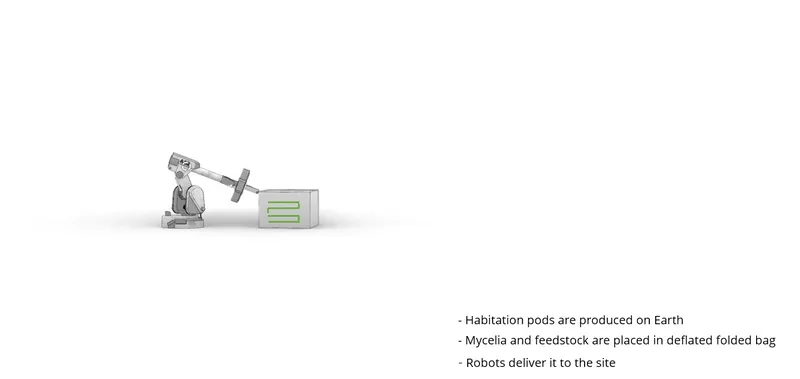
The bag is placed on the lower point of the site and as it inflates it adjusts for the shape of the terrain.
Then the bag starts to unfold which activates the expanding form.

The structure grows on its own, using the process of growth of mycelium and cyanobacteria. When the structure is done, the plastic will be tight and the heating removed. If additions or repairs are needed, additional water, heat and feedstock can reactivate growth. So, in the end the whole base constructs itself autonomously.
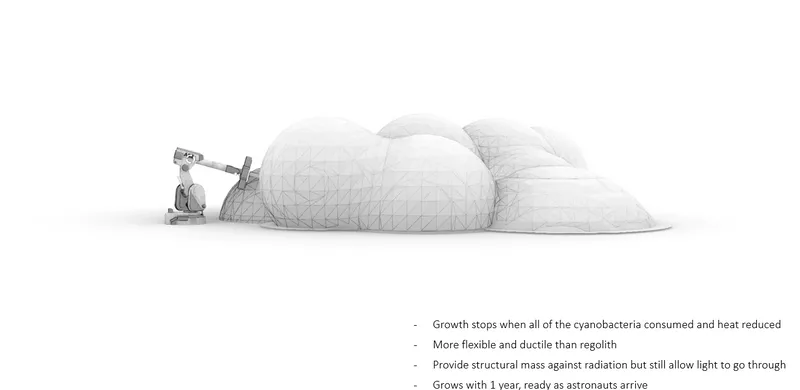
This concept allow the construction process to be easier by having the protection implemented to the living unit itself. Few robots and folded prefabricated units will be needed to assemble the base. The big advantage of this method is that the whole base constructs itself using the process of mycelium growth. The base layer of the habitat can be supplemented with translucent skylights and thus allows natural light to flow through the structure without needing structural cuts. This construction method also requires significantly less energy to produce.
LANDING SITE
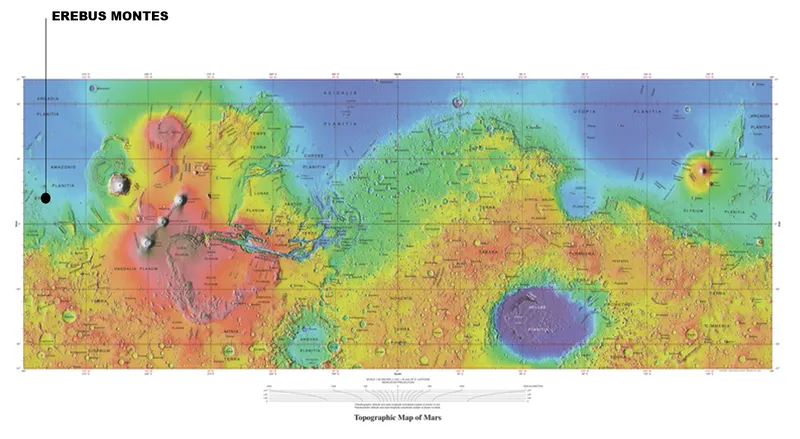
Because, the water is needed for construction method to supply the mycelium growth, it is needed to choose a landing site which has it. Traditionally the landing sites for rovers are chosen to be in the equator, but for the colony I decided to choose Erebus Montes as a landing site. In this location the ice water is right below the surface. The location has flat surface on lower elevation, which means higher pressure and easier landing.
FORM AND SPACE
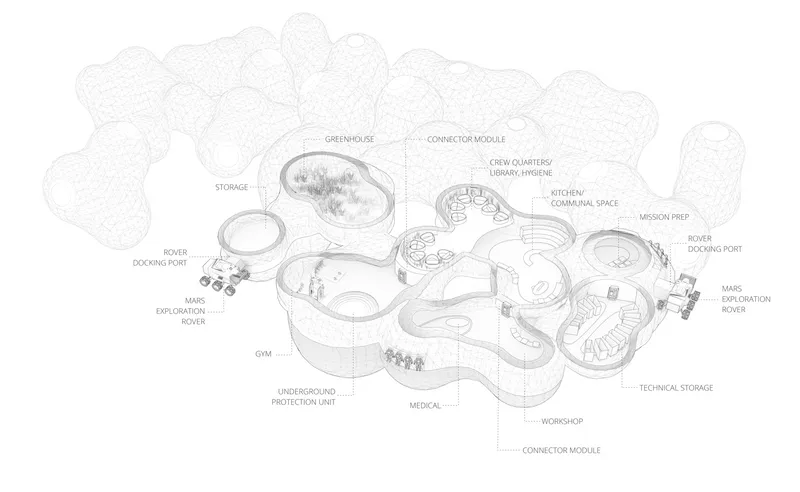
The housing colony is designed for the total of 40 inhabitants. In the first stages of Mars mission astronauts will arrive in smaller groups and live in smaller units, the section is showed below.
It includes, greenhouse, communal spaces, workshop, mission preparation room, underground protection unit for occasional solar flares. All of the units are linked through connector modules, in which various life support systems are placed. They deliver essential services such as data, electricity, water and oxygen to all of the units. The colony is remotely powered by two nuclear kylo-power reactors, located a safe distance from the habitat. The CO2 from the atmosphere can be repurposed for the greenhouse. No-waste circular systems are employed.
The enterance to the habitat has its own solution. Because The particles of dust on Mars are dry and electrostatic, it means that they will stick to everything. It would be dangerous to get it inside the technical equipment and human lungs. This problem is solved by having spacesuits always connected to the outside of the habitat.
In futher stages of the mission, additional modules will be installed for the arrival of the next crew.
INTERIOR
The shape allows for new method of moving inside the Martian habitat. Because the gravity on Mars is only 1/3 of Earth’s people will be able to jump much higher, so no stairs are needed, only support trusses.
As the interior walls are smooth and clear, I thought that it would be good to implement a projector that can bring images to the walls. Like ancient caveman were painting inside the habitats, the first crew on Mars can bring images from home on the walls of the habitat.
CONCLUSION
In this project the existig researches of the mycelial-based construction material are advanced with windows, solving several problems consering human comfort.
Although Mars is inhospitable, it still has much to offer in the scientific field. Developing a viable architectural solution for the Martian habitat is a challenge because of the extreme conditions. Existing design proposals may work in theory, but they are largely untested in harsh environments. The proposed new design idea helps in finding new solutions as innovation happens when looking at things from different angles.
References (1)


Popular Articles
Popular articles from the community


Cube Design Draws an Ecological Corridor Between Two Shenzhen Hills with the Nankai Building
Beside Shenzhen's container docks, the Nankai Building pairs stacked balconies with a climbing green screen to connect two hillsides across its height.

ETEH Reworks the Shared Spaces of São Domingos School in Brazil Around Timber, Color and Hanging Plants
At São Domingos School in Brazil, 436 m² of hall, refectory and library are recast with timber joinery, a yellow and blue code and trailing greenery.


The Amber Palace Opera: A Geological Fiction Surfaces on Tallinn's Baltic Waterfront
Pierre Brillard reimagines a Baltic legend as a public landscape, opera house, and waterfront promenade rooted in Tallinn's coastal identity.

David Ortega Stacks a Two-Story Mexico City Penthouse Around a Steel Stair and a Pergola-Shaded Roof Terrace
In Colonia Roma, a 300 m² penthouse uses oak joinery, a planted steel stair and a slatted roof pergola to make a new-build apartment feel like a house.

Similar Reads
You might also enjoy these articles

The Rhythm of Seasons
A Farmers' Market Connecting Nature and the City

More Than a Building-Designing a Living System
More Than a Building-Designing a Living System
Base Beyond
DESERT COMPOUND ARID: TOURISM OF ABSENCE AND ABUNDANCE


Comments (0)
Please login or sign up to add comments
No comments yet. Be the first to comment!