

Nano Nest: A Multi-Generational Home Carved from Bangalore's Shrinking Urban Plots
Laterite stone, jali screens, and split-level planning turn a compact site into a climate-responsive sanctuary for a family of six.


Fitting three generations under one roof is hard enough before you factor in a tight urban plot, a tropical climate, and the need for every family member to have their own breathing room. Nano Nest takes all of those constraints and treats them as generative forces, stacking six people across multiple split levels connected by open timber staircases, skylights, and perforated brick screens that filter Bangalore's intense sunlight into soft, shifting patterns. The result is a compact house that feels neither cramped nor provisional, but genuinely calibrated to the rhythms of a multigenerational Indian household.
Designed by Supreetha S and Sooraj Suresh, the project responds to a familiar pressure in Indian metros: land scarcity that forces families onto ever-smaller footprints while cultural expectations of shared domestic life remain strong. Set in Bangalore's tropical savannah climate and surrounded by neighboring buildings on most sides, the house deploys passive cooling strategies and locally sourced materials to create a home that is both affordable and ecologically responsible.
Stacking Generations Without Stacking Tension
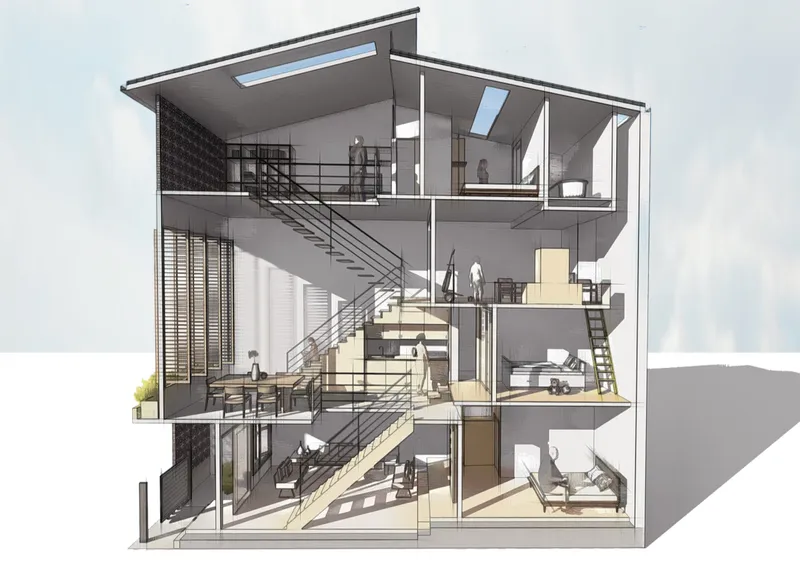
The sectional drawing reveals the project's organizing logic: grandparents on the lower levels with direct access to living, dining, and kitchen zones; children's rooms separated by age on intermediate floors; and the parents' quarters at the top, where privacy is greatest. Rather than isolating these zones behind closed corridors, the designers link them through open-tread timber staircases and double-height voids that keep sight lines and airflow moving vertically through the house. A double-height kitchen and dining space sits at the heart of the section, acting as the gravitational center where meals and conversations pull the family together.
Sliding panels replace fixed internal walls wherever possible, allowing rooms to expand or contract as daily routines shift. A grandchild's study zone can open to a shared play area; a guest can be accommodated without a dedicated room standing empty the rest of the year. The architecture anticipates change rather than resisting it.
Light Wells and Skylights as Vertical Infrastructure
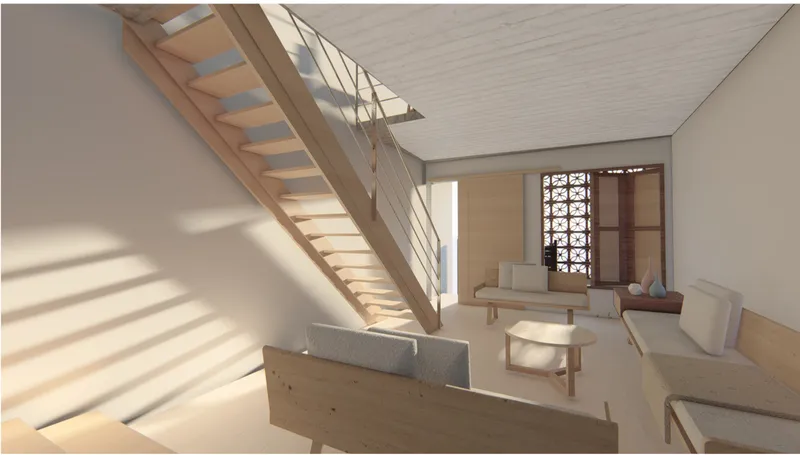
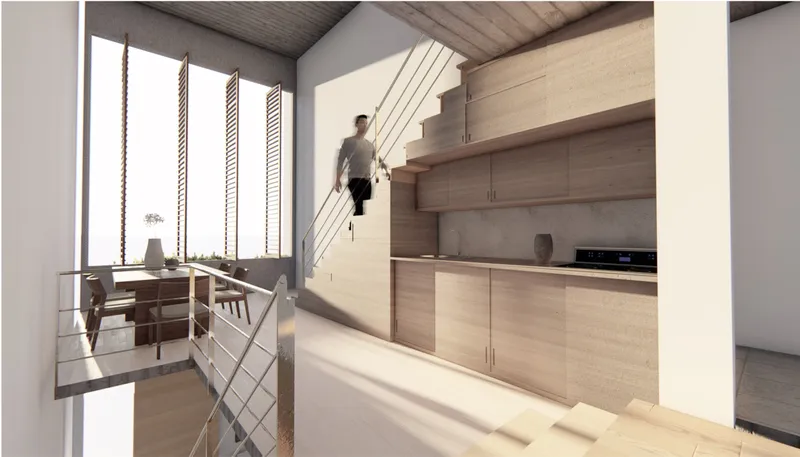
On a hemmed-in urban plot, natural light cannot arrive only from the perimeter. Nano Nest treats skylights and light wells as structural commitments, not afterthoughts. The staircase zone doubles as a light shaft: a skylight overhead sends diagonal beams down through open treads, illuminating pale wood furnishings and white walls on every level. The effect is especially clear beneath the cantilevered staircase in the kitchen, where light-wood cabinetry glows without a single downlight in sight.
By concentrating circulation and daylighting into the same vertical core, the designers free the floor plates for habitable space rather than sacrificing it to dark hallways. Lower floors, which would normally suffer from being overshadowed by neighboring structures, receive enough bounced light to remain bright and comfortable through most of the day.
Jali Screens That Work for Climate and Culture
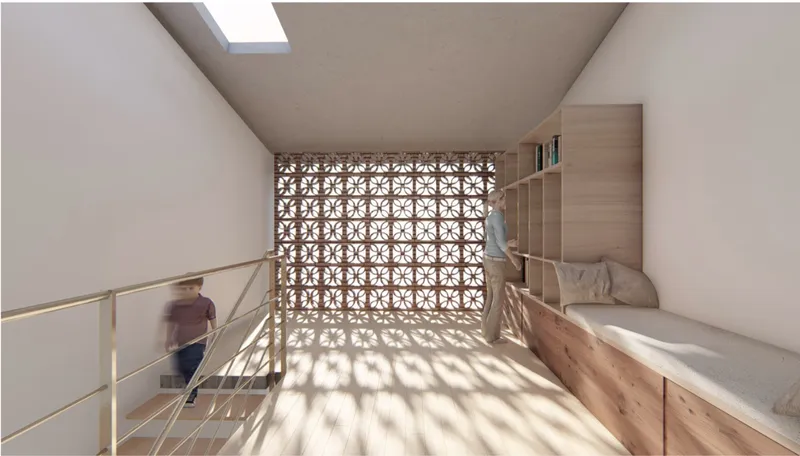
The patterned breeze-block screen wall is more than decoration. Jali walls, a longstanding element in South Asian architecture, simultaneously filter sunlight, promote cross-ventilation, and maintain visual privacy from the street and neighbors. Here the screen casts a field of dappled light across a landing fitted with timber built-in seating and shelving, turning a transitional zone into a usable alcove for reading or quiet conversation. Pivot louvers elsewhere in the envelope give residents manual control over airflow and solar gain, complementing the passive filtration of the jali.
These strategies directly address Bangalore's tropical savannah conditions. By managing heat and glare passively, the house reduces its dependence on mechanical cooling, an outcome reinforced by the 15-degree-tilted solar roof tiles that generate energy on site. The material palette, laterite stone and composite bricks sourced locally, keeps embodied energy and transportation costs low.
A Dining Core That Holds the House Together

The dining area, anchored by a live-edge wood table, looks out toward the split-level staircase and the layered spaces beyond. It is the spatial equivalent of the family gathering point the architects describe: a place where grandparents descending from their bedroom, parents arriving from the upper floor, and children drifting in from adjacent rooms all converge. The open timber-and-metal staircase remains visible in the background, reinforcing the sense that every floor of the house is only a few steps away from this shared center.
An entrance garden buffers the house from the street, introducing planting that absorbs noise and softens the transition from Bangalore's congested roads to the calm interior. The south-facing orientation captures solar benefits while the jali walls and louvers temper excess heat, a balance of openness and protection that runs through every design decision.
Why This Project Matters
Nano Nest confronts a reality that millions of Indian families face: the desire to live together across generations on plots that keep getting smaller and more expensive. Instead of treating compact housing as a problem to be tolerated, the designers demonstrate that tight constraints can produce richer spatial relationships. The split-level section creates distinct territories for each generation without sealing them off from one another, and the passive climate strategies prove that sustainability does not require exotic technology when local materials and traditional building elements are deployed intelligently.
What makes the project compelling beyond its immediate context is its replicability. Laterite stone, composite bricks, jali screens, and operable louvers are all readily available across southern India. The organizational principles, vertical daylighting, flexible partitions, and age-stratified floor planning, could adapt to other climates and family structures. As Indian cities continue to densify, Nano Nest offers a legible, buildable template for housing that refuses to sacrifice dignity for density.
View the Full Project
About the Designers
Designers: Supreetha S, Sooraj Suresh, UNI
Enter a Design Competition on uni.xyz
uni.xyz runs architecture and design competitions year-round that reward proposals with spatial conviction and real site intelligence.
Project credits: Nano Nest by Supreetha S, Sooraj Suresh, UNI.


Popular Articles
Popular articles from the community

Cloaked Colonization: A Mobile Underwater Habitat That Moves Like a Fish
Micah Abaya's shortlisted EHC Pacific entry reimagines ocean settlement as a dispersed network of self-sustaining architectural organisms.

Manzana Morphosis: Stretching Barcelona's Grid into a Living Landscape for 2050
A radical reworking of the Eixample manzana turns density into a tool for generous public space, vertical ecology, and environmental performance.

The Amber Palace Opera: A Geological Fiction Surfaces on Tallinn's Baltic Waterfront
Pierre Brillard reimagines a Baltic legend as a public landscape, opera house, and waterfront promenade rooted in Tallinn's coastal identity.

Opera on the Sea: Driftwood Logic Shapes a Timber Opera House on Estonia's Coast
Trevor Orgill's opera house translates the entangled drift of floating timber into a civic building where wood, water, and music converge.

Similar Reads
You might also enjoy these articles

Bao Huynh Watercolor Atelier: A Serene Art Retreat in Hội An
Bao Huynh Watercolor Atelier in Hội An blends multifunctional art spaces, sustainable design, local materials, and family-friendly living in a serene environment.

Atelier Macri Concept Store Interior Design by CASE-REAL
Atelier Macri store features a "ko" counter, walnut wood details, cork displays, blending retail, gallery, and seamless customer experiences.

Manuel Vargas Izquierdo Stadium and High-Performance Sports Center: Architectural Excellence in Jalpa de Méndez
The Manuel Vargas Izquierdo Stadium blends sustainable design, inclusive sports facilities, and cultural-inspired architecture, revitalizing Jalpa de Méndez’s public spaces.
KAKR Buluh Awar Hall: Revitalizing Community and Ecology Through Bamboo Architecture
Community built bamboo hall revitalizes Buluh Awar village, empowering youth, restoring ecology, celebrating vernacular craftsmanship through sustainable architecture and culture.

Comments (0)
Please login or sign up to add comments
No comments yet. Be the first to comment!