
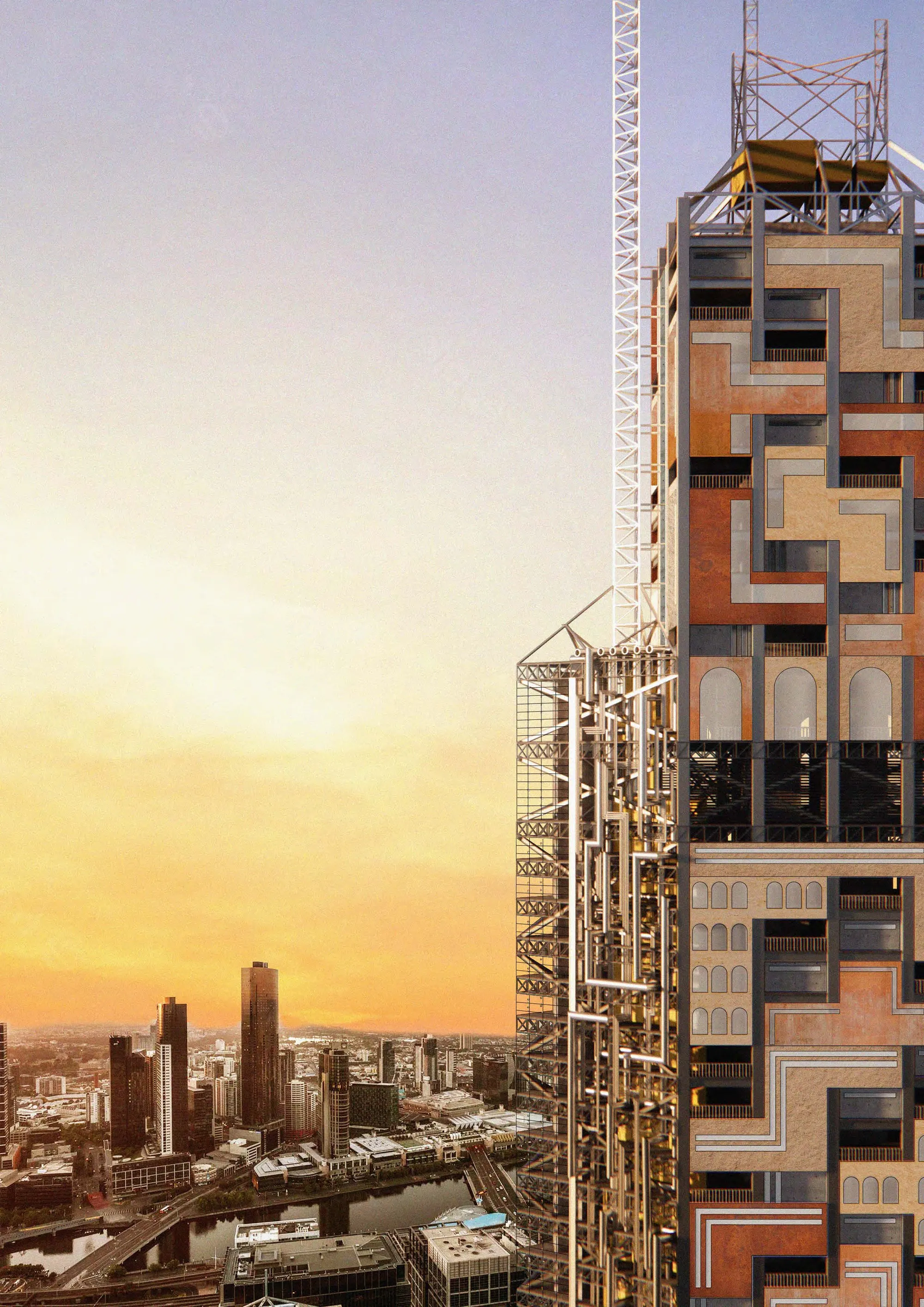
New Metabolism Tower
Dealing with the crisis of Melbourne city in the future
Since Mies incorporated his minimalist architectural aesthetic into the design of skyscrapers, all kinds of skyscrapers have sprung up worldwide. The skyscraper becomes a vanity than an actual need. This is also the case in Melbourne; the whole city will be covered in the shadow of towers and the capital in not too long. In these enormous, international-style buildings, which are out of proportion to the street, the human being appears to be hiding in a hidden corner, and there is no place on the main street. In this city center, monopolized by the capital and the power, the refugee, their background and origin appear to be just as invisible as their identity.
Of the 2 percent annual growth in Melbourne's population, 7 percent are so-referred to as refugees. And where he came from and how he got there seems to me to be a mystery. We don’t even know what jobs they could do, if they felt lonely, having left their home, and there's no news in mainstream media about them. Now, because of the increasing global geo-politics conflicts and pandemics, the relocation of refugees appears to be in a stalemate. A large number of newly-arrived refugees were placed in vacant student apartments in a nearby city center, awaiting the next steps. This is both an opportunity and a challenging challenge to use an architectural language to solve the problem of accommodation of refugees and overcrowded city areas in Melbourne.
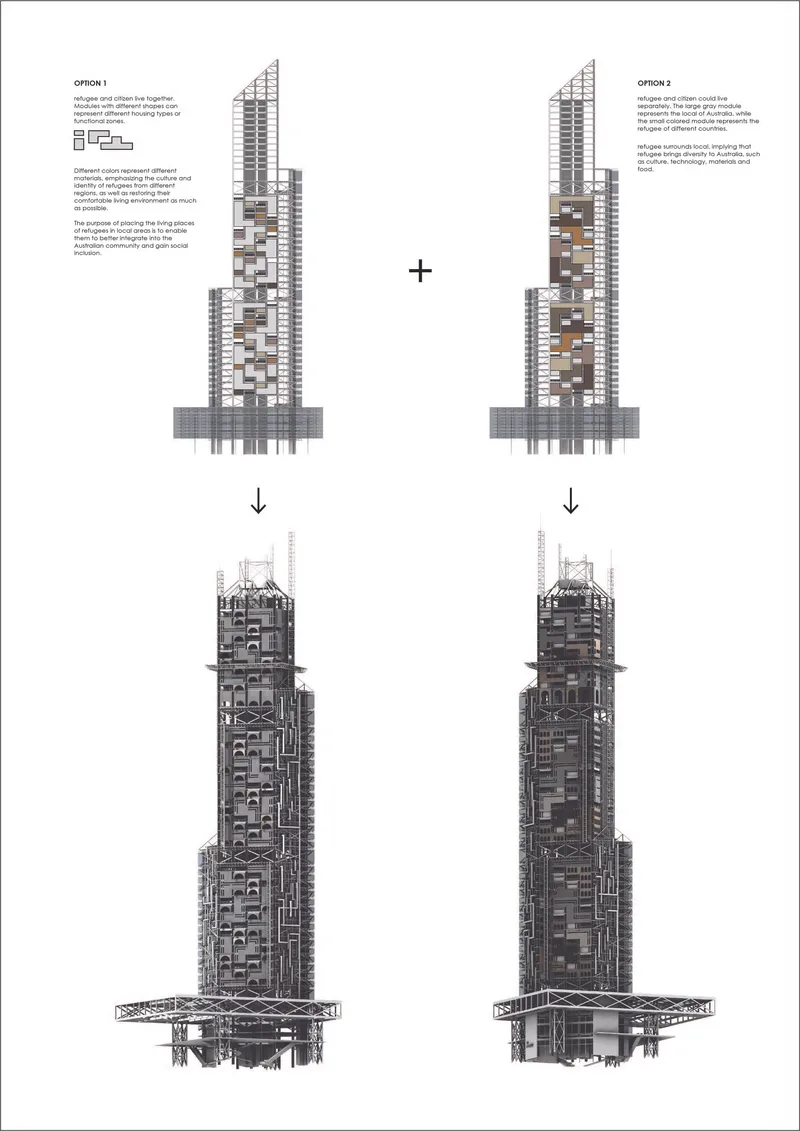
Metabolism, as a main concept, is a key to communication between people and buildings. It not only reflects a building’s appearance but also its functions. In terms of the selection of materials, the façade of the buildings should be distinguished from other internationalist buildings, using the local natural resources of Melbourne to express the local culture to restore humanistic emotions in the center of Melbourne. Therefore, on the façade of a building, traditional materials, such as stone and sand, are used. In terms of architecture, the building must not only provide comfortable living spaces that are not replicated but must also provide different functions, so residents can better integrate themselves into Melbourne's community. In addition, the multi-functional rooms provide a place for locals and refugees in contact, allowing them to better understand one another. When we design the building, we have to consider that the building must meet different requirements at different points. Therefore, as the design progresses, the structure has been changed from one central core into three different centers to distribute the movement of the traffic flow of the building. Furthermore, at the side cores on both sides, the originally built-in pipes, ventilation, and drainage will be re-arranged outside as part of the overall facade, which can release more interior space and provide residents with more. It emphasizes the functionality of the side cores on both sides, forming a contrast with the facade.
To enable refugees to better integrate into the Australian community, we imagined some schemes to make the two groups interact, and selected the most representative two schemes to design the facade. We use contemporary materials such as concrete to represent local Australians, and natural materials such as rammed earth to represent refugees of different ethnic groups. In the north, there are more contemporary materials, just as native Australians surround the refugees, providing protection and support. In the south, natural materials are used more, just like refugees surrounding the local people, which brings a more diversified culture and technology to Australia. This contrast and contradiction reflect Australia's current situation and what it needs.
During the design process, many attempts have been made the design the facade of the building, such as how to balance the relationship between nature and industrialization in the overall arrangement. This is not just in the form but in the whole logic of the design. The design of a facade should not only consider the way in which the materials represent natural regional components in a building with strong industrial and machinery elements, but it should also consider the creation of a more breathable facade, rather than a curtain wall.
The process of metabolism is gradual rather than a radical movement. This process symbolizes that the declaration of the physical and spiritual aspects of the entire Melbourne city center is not radical but gentle. Melbourne's high-rise buildings have been described as "time bombs" because of the difficulty and cost of demolishing them. Therefore, this project is more of a demonstrative example, modifying a building to adapt to the changing environment, making it more suitable for the needs of different periods. The purpose of this is to simultaneously reduce carbon dioxide emissions during demolition and construction, making cities more livable with minimal environmental damage. And buildings change over time to become more livable.


Popular Articles
Popular articles from the community


Co-Life: Senior Housing Design That Reconnects Older Adults With the City
Co-Life reimagines senior housing design through healing gardens, shared streets, workshops, and a sustainable community across generations.

The Earth Pod: 3D Printed Homes for Resilient Refugee Communities
The Earth Pod reimagines refugee housing through 3D printed homes made from clay, combining resilience, self-sufficiency, and rapid shelter.

Co-life: Sustainable Architecture for Age-Friendly Community Living
Co-life reimagines sustainable architecture for seniors through courtyards, rammed earth, shared gardens, and spaces designed for belonging.

Play: Fragments of Their World
Familiar architecture becomes modular playground design, creating safe spaces where displaced children can learn, connect, imagine and play.


Similar Reads
You might also enjoy these articles
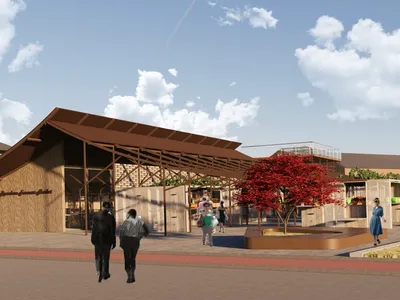
The Rhythm of Seasons
A Farmers' Market Connecting Nature and the City
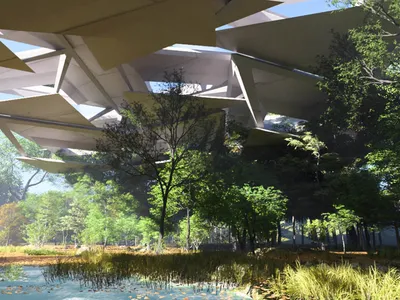

More Than a Building-Designing a Living System
More Than a Building-Designing a Living System
Base Beyond
DESERT COMPOUND ARID: TOURISM OF ABSENCE AND ABUNDANCE

Comments (0)
Please login or sign up to add comments
No comments yet. Be the first to comment!