



Skyscraper
Tall buildings that define urban skylines, exploring structural innovation, sustainability, and vertical living.
A skyscraper is a tall, continuously habitable building of many floors. There is no fixed legal or scientific height at which a building becomes one: the threshold most often used today is 150 metres (about 40 storeys), while some organisations count anything over 100 metres, and the word first described steel-framed buildings of only ten storeys or more in the late nineteenth century.
What is a skyscraper?
The word describes a building that is tall relative to its surroundings and that people live or work in, as opposed to a mast, chimney or observation tower. The Wikipedia entry on skyscrapers defines one as a very tall building or permanently habitable structure, and notes that some organisations set the bar at buildings of at least 150 metres. The same source records that the term was first applied, in the late 1800s, to steel-framed buildings of at least 10 storeys.
So what makes a building a skyscraper? Height alone does not settle it. The reference article on high-rise buildings explains that the old Emporis database classed a structure between 35 and 100 metres, or a building of 12 to 39 floors, as a high-rise, and that a building of forty or more storeys and taller than 150 metres is generally considered a skyscraper. The article also admits there is no clear line between a tower block and a skyscraper. In practice the label depends on the city: a 25-storey tower can read as a skyscraper in a low town and as background in Manhattan or Dubai.
A skyscraper is a specific kind of tall building and the extreme end of the high-rise building family. What sets it apart is that height drives almost every design decision, from structure and lifts to fire escape, wind and the way the base meets the street.

How height is measured: tall, supertall and megatall
The body that keeps the official tallest-building records, the Council on Tall Buildings and Urban Habitat, renamed the Council on Vertical Urbanism in October 2025, measures "height to architectural top": from the lowest significant open-air pedestrian entrance to the top of the building, counting spires but not antennas or flagpoles. Using that kind of measure, towers above 300 metres are called supertall and those above 600 metres megatall. Burj Khalifa in Dubai, at 828 metres, is currently the tallest.
A short history of the skyscraper
Tall masonry buildings existed long before the word. Their limit was the wall itself: every extra floor needed thicker walls at the base, eating the rentable space the extra height was meant to create. Two inventions broke that limit in nineteenth-century America.
The first was the safe passenger lift. Elisha Otis introduced his safety elevator, which stops if the hoisting rope breaks, at the E. V. Haughwout Building in New York in 1857. Without it, nobody would pay to climb twenty flights of stairs. The second was the metal frame. Chicago's Home Insurance Building by William Le Baron Jenney, completed in 1885 and demolished in 1931, carried its weight on an internal metal frame instead of load-bearing walls, and is widely counted among the first skyscrapers.

Chicago architects then had to decide what such a building should look like. Louis Sullivan answered in his 1896 essay on the tall office building, arguing that height itself should be the subject of the design.
"It must be every inch a proud and soaring thing, rising in sheer exultation that from bottom to top it is a unit without a single dissenting line."
Louis Sullivan, The Tall Office Building Artistically Considered (1896)
New York took the lead in the race for height. Cass Gilbert's neo-Gothic Woolworth Building, opened in 1913 on a steel frame and nicknamed the "Cathedral of Commerce", was the world's tallest building until 1929. The Empire State Building followed in 1931 and held that title for forty years. In the decades since, the record has moved from North America to Asia and the Middle East, ending for now at Burj Khalifa.
Key principles of skyscraper design
Every tower solves the same handful of problems. The answers below are standard engineering practice; the member projects show how designers on uni.xyz push each one.
The core
Most towers are organised around a central core that holds lifts, stairs, shafts and toilets and usually doubles as the main stiffening element. Vertical supports typically combine steel frames, concrete cores, tube-within-tube systems and shear walls. The core decides how deep and how flexible the floor plates can be.

The tube and the outrigger
In 1963 the engineer Fazlur Rahman Khan developed the framed tube, which moves stiffness to the perimeter so the whole facade behaves like one hollow beam fixed into the ground. Variations followed: the trussed tube, tube-in-tube and the bundled tube, which gives the Willis Tower in Chicago its nine tubes of different heights. In an outrigger system, stiff arms at certain floors tie the outer structure back to the core so the two resist sideways load together.

Wind before weight
For very tall buildings, the sideways push of wind, not gravity, generally governs the structural design. Designers respond by tapering, twisting or setting back the form so wind cannot build up regular vortices, and by adding mass dampers that counter sway. Comfort matters as much as safety: occupants feel movement long before the structure is at risk.

Vertical movement
Lifts take a growing share of each floor as a building rises. Very tall towers use sky lobbies, where people change from express to local lifts, so shafts do not run the full height.
The base and the street
A tower meets the city at its first few floors. Podiums, plazas, arcades and through-routes decide whether a skyscraper adds life to a block or turns it into a windy forecourt.
Skyscrapers on uni.xyz
Skyscraper briefs are among the most popular on uni.xyz, and entries tend to treat the tower less as an office stack and more as a piece of city turned on end. A few stand out.
The Pyshield Tower by Maurice Samen and Fritz Djoumaleu won a People's Choice Award in the CityScraper competition. At 480 metres it would sit firmly in the supertall class, and the team packs housing, offices, green spaces, shops, recreation areas, parking and waste treatment into a single mixed programme.

Port Tower by Civgin Cumbul and Deniz Yalcinkaya, another People's Choice Award winner in CityScraper, gathers the functions of the Beirut container port into one public structure, framing the tower as civic space rather than private floor area. Breathing Tower by Jannatun Nayeem Nowshin and team, a People's Choice Award winner in the CityScraper 2020 competition, is a prototype meant for the world's most polluted cities, with the stated aim of tackling air pollution beyond its own site.

Our editors' feature on CityScraper by Alexander Malyshev, an Editor's Choice entry in CityScraper 2020, reads the tower as a municipal viaduct: serpentine roads, terraced streets and small gabled houses wrapped around a tapering stack of planted rings. The essay opens with the trade-off every residential tower makes.
"Most towers ask their residents to accept a trade: more height, less street."
UNI Editorial, CityScraper journal feature

The Twisting Tower by Eugenio Evaso and Matteo D'Ambrosio, a winning entry in the Greenward competition, rises 160 metres in Manhattan with no conventional perimeter walls, so light, rain and wind pass through every planted level. RainFlow Tower, a winning entry in the Alter competition, routes Singapore's rainfall through every floor and stores the surplus in a reservoir that also works as a damper.
GROW, a 48-storey tower by Alessandro Cece, Zainab Khadim and Asmaa Ebrahim Rashed Ali Alhosani shortlisted in the Hybrid Futures '19 - Work x Fly competition, models its structure on plant vascular networks, with radial tubular members carrying both loads and building services. In Mountain, a People's Choice Award winner in the Di - Generic Cities: Shanghai competition, Suoao Wang stacks staggered slabs like peaks in a Chinese landscape painting. And TAHAN by Kyle Babst shows how far the type can stretch: a timber-clad vertical cemetery with civic floors below the burial gardens.
Challenges and future directions
The skyscraper's biggest open problem is carbon. Steel, concrete and glass carry heavy embodied emissions, and a sealed glass tower can use a lot of energy for cooling and lifts. Current research and many student entries respond with mass timber hybrids, mixed-mode ventilation, planted terraces and towers that generate part of their own power, ideas that overlap with sustainable architecture and the vertical garden.
The second problem is social. A tower can concentrate housing near transport, but it can also cut residents off from the ground. The vertical city idea, with sky streets, shared terraces and public floors high up, tries to rebuild neighbourhood life in section. Mixed-use programming helps towers stay busy at all hours instead of emptying at six.

Finally there is the question of whether to build up at all. Cliffscraper by Meltem Yılmaz and Aylin Yıldırım turns the type inside out, using existing topography so the project adds no new mark to the silhouette and narrows the gap between tower and human scale.
Skyscraper design for students and designers
A skyscraper thesis is strongest when it picks one problem and follows it through the whole section. Good angles include a tower that adds public ground instead of taking it, a timber or hybrid structure tested against wind, a residential tower that keeps a street at every tenth floor, or the conversion of an empty office tower into homes. Draw the structure and the lift strategy early: they shape every floor plate. Related reading on uni.xyz includes vertical urbanism and mixed-use design, and you can test ideas against open briefs on our architecture competitions page.
Frequently asked questions
What is the minimum height of a skyscraper?
There is no single official minimum. The most common threshold is 150 metres, and some databases have used 100 metres. Below that, a building is usually called a high-rise. Above 300 metres it is supertall, and above 600 metres megatall.
How many floors does a skyscraper have?
No fixed number. In the late nineteenth century a building of 10 storeys counted as a skyscraper. Today a building of about forty or more storeys, over 150 metres, is generally considered one, while 12 to 39 floors is usually classed as a high-rise.
What makes a building a skyscraper?
It must be habitable, much taller than its surroundings and designed around its height: a structural frame or core rather than load-bearing walls, passenger lifts and a structure that resists wind. A tall mast or tower you cannot live or work in does not count.
What was the first skyscraper?
The Home Insurance Building in Chicago, completed in 1885 to a design by William Le Baron Jenney, is the building most often given that title because its weight was carried by a metal frame rather than by its walls.
What is the tallest skyscraper in the world?
Burj Khalifa in Dubai, at 828 metres, which places it in the megatall category.
References and further reading
- Skyscraper, Wikipedia
- High-rise building, Wikipedia
- Council on Tall Buildings and Urban Habitat (Council on Vertical Urbanism), Wikipedia
- Home Insurance Building, Chicago Architecture Center
- Louis Sullivan, The Tall Office Building Artistically Considered (1896), MIT OpenCourseWare
- Woolworth Building, Wikipedia




Popular projects
View all 70 projects















Latest journals
View all 70 journals
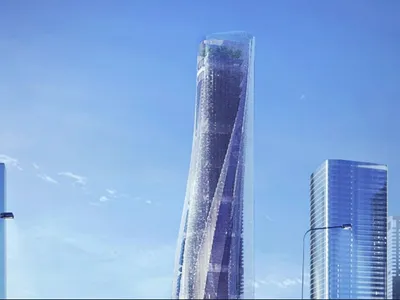
The Veil: A Fabric-Wrapped Tower That Turns a Beijing CBD Skyscraper into an Ecological Machine
Marco Livorno's CityScraper 2020 shortlisted tower wraps a microalgae facade around a public podium, pairing skyline drama with ground-level repair.
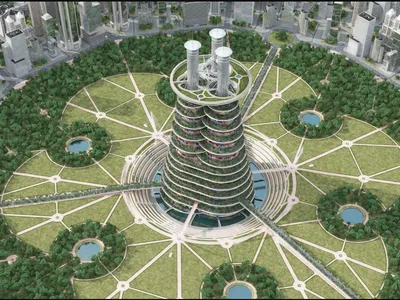
CityScraper: A Skyscraper Rebuilt as a Municipal Viaduct of Streets, Townhouses and Spiralling Roads
Alexander Malyshev wraps serpentine roads, terraced streets and small gabled houses around a tower, testing whether density can keep a domestic scale.

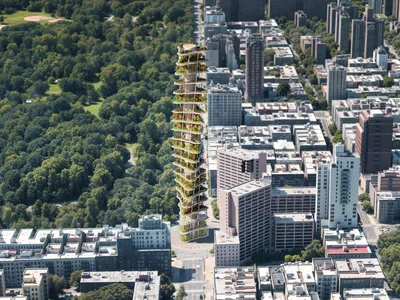
Twisting Tower: A 160-Meter Vertical Garden Rising Above Manhattan
Twenty rotating floor plates spiral around a central core, stacking biodiverse terraces into a living skyscraper for a greener city.
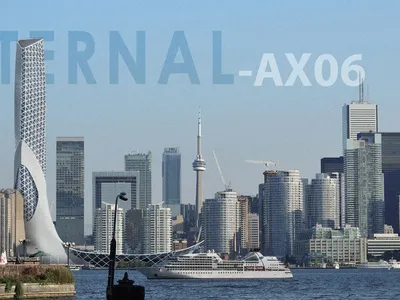
Eternal-AX06: A 120-Storey Skyscraper That Breathes, Filters, and Regenerates the City
Gourab Das proposes a kinetic tower with a shape-shifting façade, vertical air filtration, and renewable energy systems woven into its structure.


