
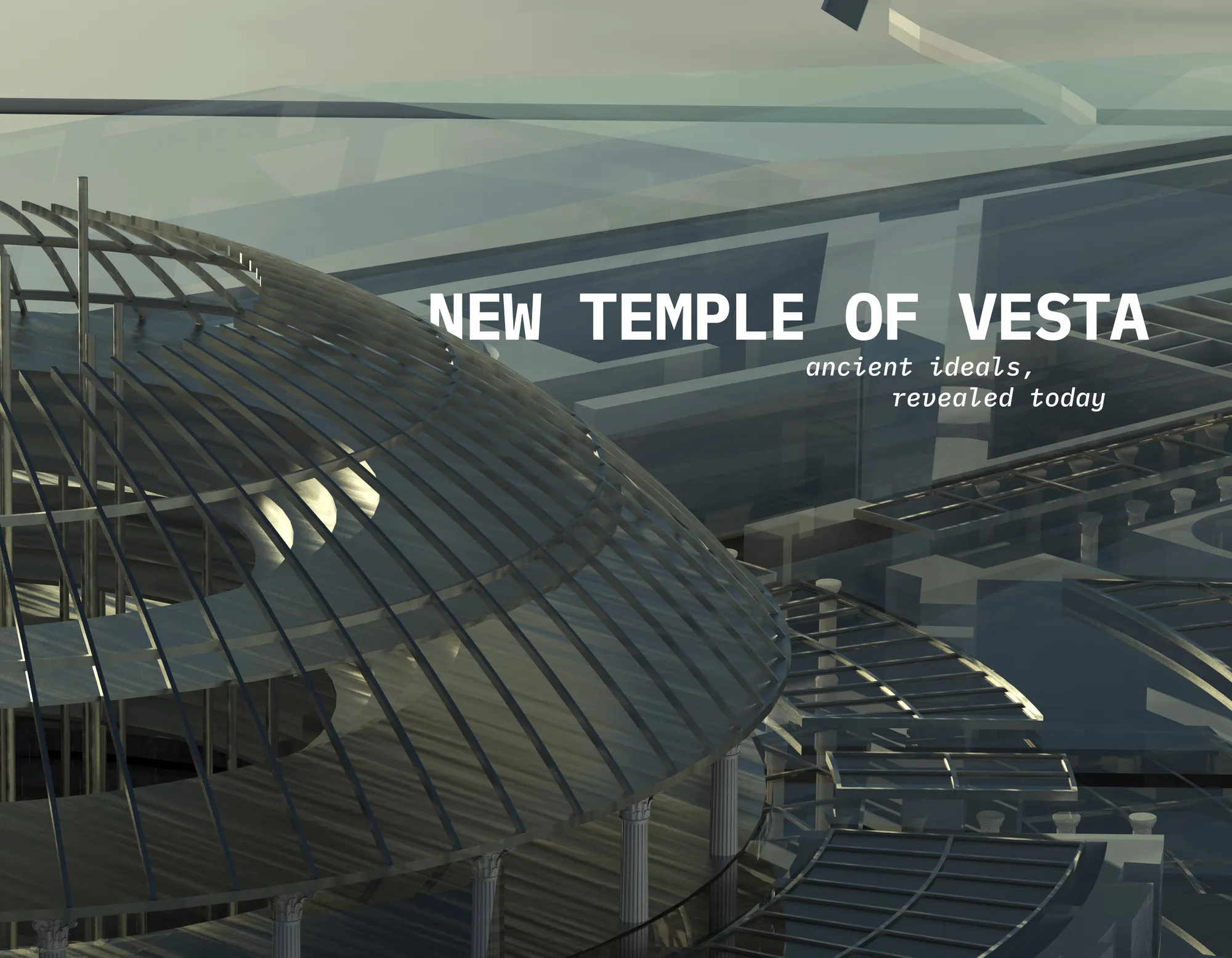
New Temple of Vesta
Ancient Ideals, Revealed Today.
CONCEPT
The idea of public living room, in London as distinctly multicultural place, requires a search for an essential, almost archetypal element that connects homes of all world’s civilizations and cultures – home hearth. This ancient symbol took central place in ancient Greek and Roman understanding of society, government and statehood itself, through the archetype of Hestia / Vesta and her temple. This circular building, one of the oldest on Roman Forum, was the reminder of the humble beginnings of roman society – primitive, circular ground hut with hearth in its centre as the symbol of the family. Vesta’s temple, with its ever-burning flame, was considered the home of all Romans, and the symbol and guarantor of general security and prosperity. The idea of public living room is not new – it is ancient.
The concept of the pavilion is the reinterpretation of Vesta’s temple, that is, what it represents in the 21st century, in London as world metropolis, where multiculturalism erases local boundaries, in a time when magical and divine understandings of the world are mostly overcome and abandoned.
Thus, the question is – what is fire today? We no longer believe in the divine or symbolic reasons behind the security and prosperity of the community to some magical, divine or abstract entity of force. Ancient ideals and understandings are lost in the rationality of today’s world. It is time to point out that the responsibility for the general well-being and progress of society lies in the hands of the government – the people’s representatives, decision-makers, and elected leaders. Instead of the ancient flame as a guarantor and symbol of a consistent nation, today here (in centre, figuratively and literally) are the representatives of the government. Power, just like fire, must be controlled in order to benefit people.
Genius Loci: The British Parliament
Long tradition of parliamentarism in the United Kingdom has determined its democratic development by strongly limiting monarch’s power, so that voice of the people, through chosen representatives, could be publicly expressed and heard.
Strong traditional division of parliament into the House of Lords and the House of Commons has divided participants by their social status, and therefore the power and position they hold. Their position is not just figurative - lords are placed in the upper house, above the representatives of “ordinary” people. In addition, positions of these representatives (in the House of Commons) are determined by their political views (left for liberals or right for conservatives), that is, the party they represent.
In other words, spatial position of the participants in the British Parliament strictly defines their status, power, role, political beliefs and a job they are given. This idea of spatial position defining who you are is going to be explored and questioned through the pavilion.
FORM
Considering the understanding of the Vesta's Temple as the "connection between heaven and earth", the spatial structure of the pavilion is developed through the stratification of movement and the creation of different levels or layers. In this sense, the relationship with the terrain plays a crucial role — through excavation or elevation of the terrain, a framework for complex social dynamics is created, determined by the position of the participants. Openings & cuts in pavilion’s form are carefully designed to fit into Hyde Park’s existing paths and directions of movement, being complementary, and never invasive.
These three levels or layers are entirely different in form and function, following the development of civilization and society:
1) the Dungeons,
2) the New Forum,
3) the Ground Surface.
Instead of the usual placement of authority, figuratively and literally, above the people, the pavilion aims to invert this arrangement by positioning the authority below the people. To be closer to power, one needs to descend deeper into the earth.
The Dungeons represents the lowest layer, and its form draws inspiration from medieval dungeons, cave and cavern architecture. Dungeons, typically the lowest and darkest point of ruler’s palace or castle, were very common in medieval and renaissance England. They usually contained prisons, and were used for punishing people of lower status. That is why the government representatives and officials will now be placed here. All the light reaching this level comes from the upper levels. Except for the representatives of authority, dungeons are also intended for people who want to come into the closest contact with them. By descending into the Dungeons, citizens can listen to speeches intended for a smaller group of supporters or seek help directly from the authorities. From the Dungeons, one gets onto the stage positioned significantly lower than the amphitheatre and audience, aiming to make the representatives of authority feel humbled and sense the weight of the people observing them from above. However, the stage itself can move in the vertical plane, questioning and changing the dynamics between the participants and spectators with the positioning of the representatives of authority. The position of the stage is determined by the people.
The New Forum is integrated into the elevated terrain, accessible through strong cuttings in the terrain leading to the central amphitheatre. Forum was the central space of political and social life in ancient Rome. This layer consists of various contents and activities, designed to explore what does “forum” mean today and how can a public space become a tool for social changes. Inspired by the Roman forum, with its porticos and colonnades, the layer of antiquity is designed for those who want to participate in discussions and therefore contains very diverse content — media representations, non-governmental organizations, civic associations, and political parties, as well as a cafe bar with a lounge and a small exhibition on the political history of the United Kingdom. Its goal is to inform the people from diverse sources, exchange views, and freely spread their own ideas. Exploration is the key word —by entering this layer from different sides, one will experience completely different content, with every path eventually leading to the central amphitheatre.



Popular Articles
Popular articles from the community


The Ocean Hive: Sustainable Architecture for a Self-Sufficient Civilization at Sea
The Ocean Hive imagines sustainable architecture at sea, where modular habitats, algae, wave power and ocean waste sustain a growing colony.

Hill & Cross Opera: Sculptural Opera House Architecture Shaped by Tallinn’s Landscape and Identity
Hill & Cross Opera reimagines opera house architecture in Tallinn through its sculptural hill, civic plaza, glass wave and a luminous cross.

Co-Life: Senior Housing Design That Reconnects Older Adults With the City
Co-Life reimagines senior housing design through healing gardens, shared streets, workshops, and a sustainable community across generations.

Lunar Spiral: Space Architecture Shaped by the Mathematics of the Universe
Lunar Spiral reimagines space architecture through Fibonacci geometry, lunar regolith, levitating habitats, and self-sustaining Moon living.


Similar Reads
You might also enjoy these articles
Lunar Spiral: Space Architecture Shaped by the Mathematics of the Universe
Lunar Spiral reimagines space architecture through Fibonacci geometry, lunar regolith, levitating habitats, and self-sustaining Moon living.
The Main Dream: Modular Architecture for Play, Learning, and Community
A modular playground turns recycled plastic into adaptable spaces where refugee children can play, build, learn, and reconnect.

Play: Fragments of Their World
Familiar architecture becomes modular playground design, creating safe spaces where displaced children can learn, connect, imagine and play.

Wadi Rum Observatory: Desert Architecture Designed for the Night Sky
Wadi Rum Observatory turns desert architecture into a quiet instrument for astronomy, hiding research spaces under Jordan's starlit terrain.

Explore Temple Competitions
Discover active competitions in this discipline




Challenge to reimagine the Iron Throne


Photograph architecture without architects


Illustrate the lost glory of Angkor Wat - Render Challenge


Design challenge to reuse E-waste
Comments (0)
Please login or sign up to add comments
No comments yet. Be the first to comment!