

Office x Tohme Wraps a Modular Textile Workspace in Corrugated Metal on the Outskirts of Quito
A 170-square-meter shed pavilion for a textile company tests whether rural Ecuador can host a new kind of office architecture.


On the periphery of Quito, Ecuador, a textile company needed more room. Rather than extend its existing warehouse, it called in Office x Tohme to build something separate: a 170-square-meter pavilion that would function as a proper office while staying in conversation with the corrugated metal volumes already on the site. Completed in 2022, the result is a shed in the most precise sense of the word: a stripped-down, structurally legible enclosure that treats repetition and modularity not as compromises but as the entire design method.
What makes the project worth studying is the contract it proposes between the domestic and the industrial. The building is a workspace, but it contains kitchens, dining areas, and rest spaces. It is clad in the same corrugated metal as the warehouse beside it, but its glazed walls dissolve any fortress mentality. The grid that governs everything, 2.5 meters in one direction and 5 meters in the other, is strict enough to feel systemic yet loose enough to absorb a garden courtyard, a covered walkway, and a series of service volumes without strain. The building argues, quietly, that rural and peripheral sites deserve the same spatial ambition as downtown offices.
A White Frame Against a Grey Shell
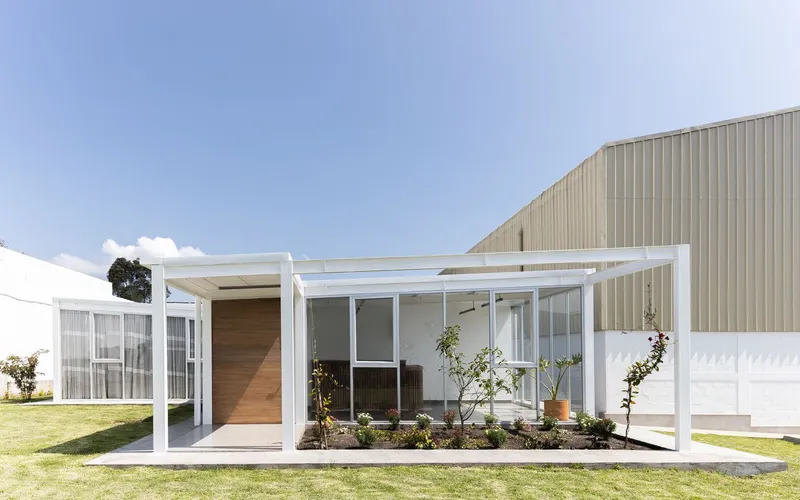
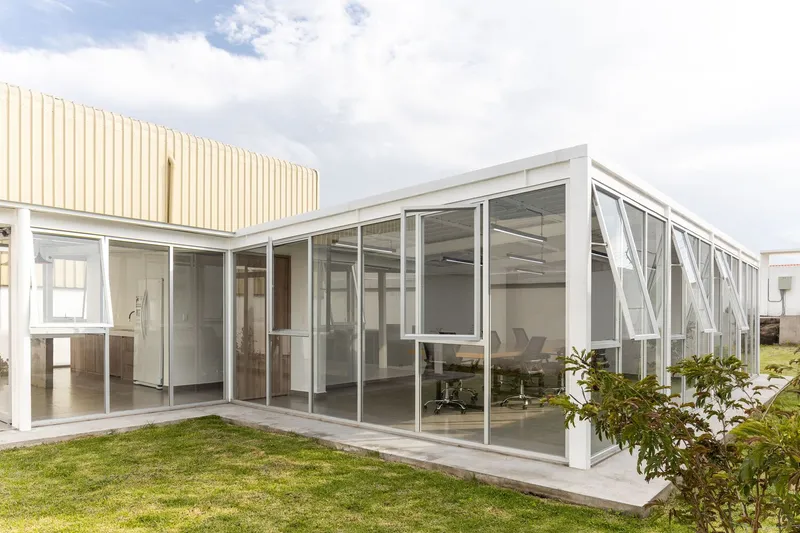
The pavilion reads as two materials in dialogue. Corrugated metal sheeting wraps the primary volume in the same industrial language as the adjacent warehouse, grounding the new building in its production-oriented context. But every time the metal shell opens, a white steel frame appears, slender and precise, holding full-height glass panels that flood the interior with diffused equatorial light. Diagonal bracing in the glazed sections is left exposed, turning structural necessity into ornament.
The effect is a building that oscillates between opacity and transparency depending on which face you approach. From above, it is almost entirely roof. From the garden side, it is almost entirely glass. That oscillation is not accidental; it calibrates privacy and openness room by room, so that service areas like bathrooms stay enclosed while dining and leisure zones project outward into the landscape.
Courtyards That Organize the Plan
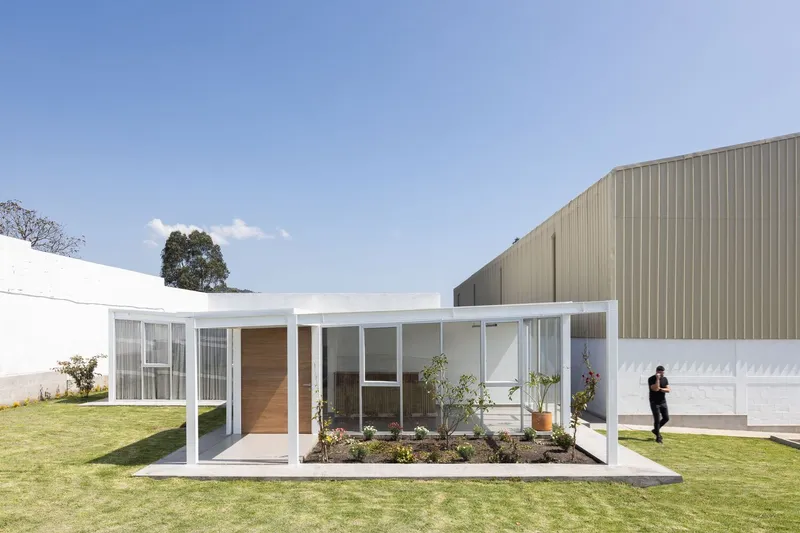
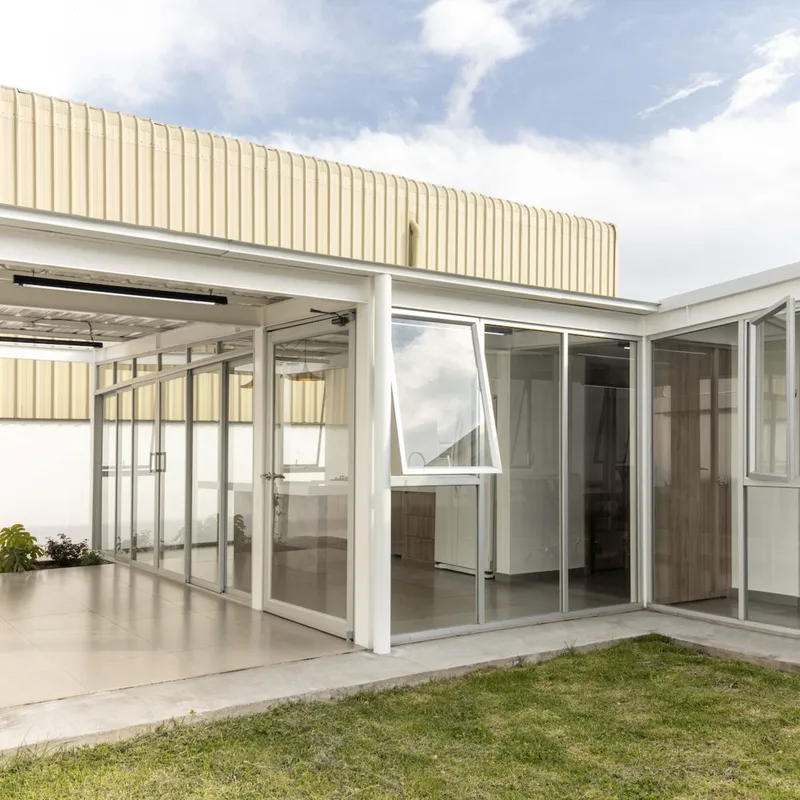
Rather than a single open floor plate, Office x Tohme fragments the program across linked volumes separated by covered walkways and framed courtyard spaces. A figure passing through the corrugated metal volume catches daylight from multiple directions because the plan folds around planted beds and concrete patios rather than running in a straight line. The corridors are generous enough to serve as transitional gathering space, not mere circulation.
Sliding glass doors along the covered walkway mean that on a temperate Quito afternoon, the boundary between inside and outside effectively disappears. Each interior room maintains at least one relationship with the immediate context, whether that means a view into the garden or a sightline toward the existing warehouse. The building never lets you forget where you are.
Domestic Interiors Inside an Industrial Envelope
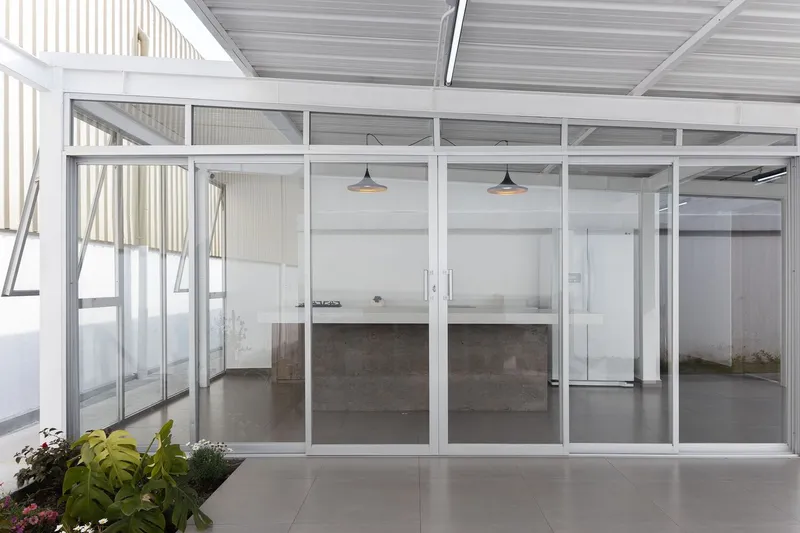
Through a glazed courtyard wall, you can see a kitchen island lit by pendant fixtures, polished concrete underfoot, and the kind of spatial warmth you would expect in a well-designed house. This is the crux of the project's argument: that a workspace for a textile company on the edge of Quito does not need to look or feel like a warehouse annex. Service spaces, including bathrooms and kitchens, are treated as isolated geometric figures inserted into the grid, legible enough to read on a plan and compact enough to leave the remaining floor area open and adaptable.
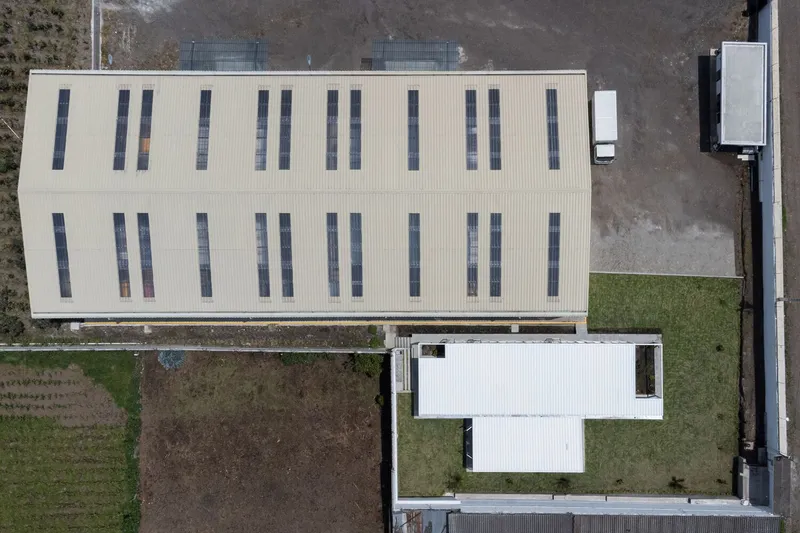
The aerial view confirms how tightly the corrugated roof wraps the whole composition, with vertical window strips punched at a regular cadence. Fixed glazing alternates with operable ventilation panels in the vertical direction, establishing a rhythm that regulates both light and airflow without resorting to mechanical systems. It is a deliberately low-tech climate strategy suited to a region where passive ventilation can do most of the heavy lifting.
Plans and Drawings
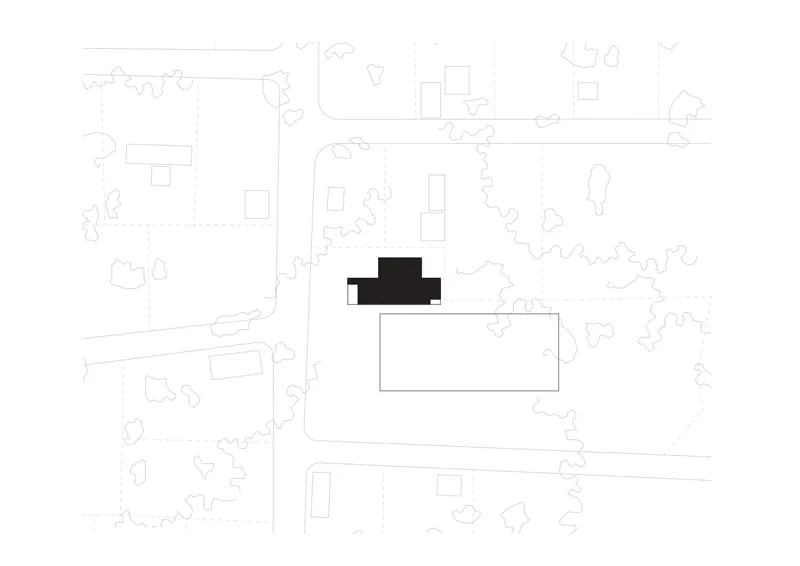
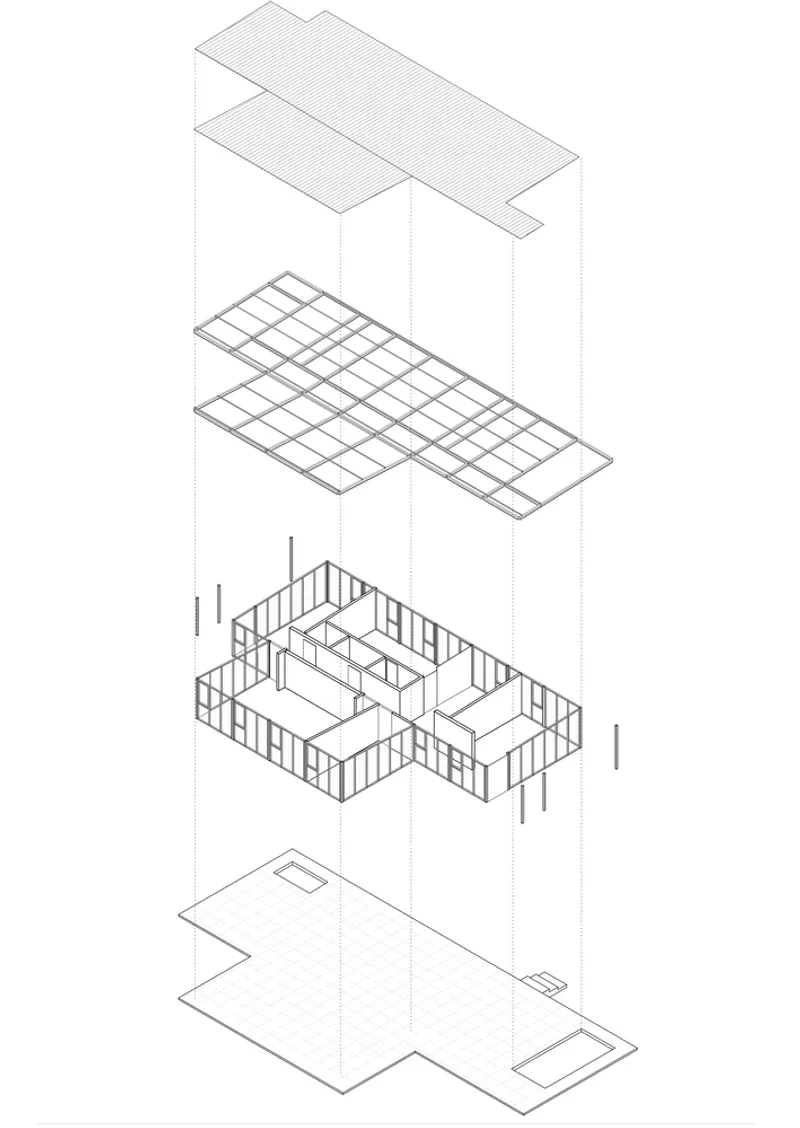
The site plan reveals how the new pavilion negotiates an irregular plot surrounded by organic tree canopies and neighboring structures. The compact footprint sits at a deliberate distance from the existing warehouse, close enough to read as part of the same campus but separated enough to claim its own identity. The exploded axonometric is the more instructive drawing: it peels apart angled roof planes, the white gridded frame, and interior partition walls to show how a small number of repeated components generate the entire building. Every partition, every service core, every piece of glazing locks into the 2.5-by-5-meter grid, which means the system could, in principle, extend or replicate without redesign.
Why This Project Matters
The Office Shed is a quiet provocation. It takes a building type that Latin American cities overwhelmingly relegate to steel-and-drywall pragmatism, the peripheral office annex, and treats it with the same spatial care that usually goes to urban headquarters. The modular grid is not an aesthetic choice; it is an economic one, allowing a small firm to control costs and construction tolerances on a site far from centralized building supply chains. That the result also happens to feel generous and light is the real achievement.
More broadly, the project tests a proposition that feels increasingly urgent as remote and hybrid work redistributes demand beyond city centers. If workspaces are going to migrate to rural and peripheral locations, they need a design language that respects those settings rather than importing urban typologies wholesale. Office x Tohme's answer, a pavilion that borrows the warehouse's material palette while insisting on transparency, gardens, and domestic comfort, is a credible model. It does not pretend the shed is a villa. It simply insists the shed can be more.
Office Shed by Office x Tohme. Quito, Ecuador. 170 m². 2022. Photography by Nicolás Provoste.
About the Studio
Share Your Own Work on uni.xyz
If projects like this are the kind of work you want to make, uni.xyz is a place to publish your own, find collaborators, and enter design competitions.


Popular Articles
Popular articles from the community


Singing Woman: An Opera House That Performs Before the Curtain Rises
Ovidiu Cristian Pavel's conceptual opera house translates Estonia's choral identity into a sculpted waterfront landmark facing the Baltic Sea.

The Amber Palace Opera: A Geological Fiction Surfaces on Tallinn's Baltic Waterfront
Pierre Brillard reimagines a Baltic legend as a public landscape, opera house, and waterfront promenade rooted in Tallinn's coastal identity.

Opera by the Sea Estonia: Three Shells Dissolving Architecture into Tallinn's Coastline
A winning opera house proposal replaces monumental form with interconnected shells that blur the boundary between building, park and Baltic Sea.

Manzana Morphosis: Stretching Barcelona's Grid into a Living Landscape for 2050
A radical reworking of the Eixample manzana turns density into a tool for generous public space, vertical ecology, and environmental performance.

Similar Reads
You might also enjoy these articles


Hodi-Mandai Geram
Project Function: Preservation and revitalization of the Intangible heritage and socio-spatial identity of the Hodi by Housing, Cultural Memory Center, Sacred Grove, landscape, local tourism economy


Olio Towers: A Mid-Rise for Performers That Fuses Housing, Rehearsal, and Stage
Located blocks from Houston's Theater District, this modular tower stacks living units around a central performance atrium.

Oasis: Modular Green Housing Carved into Dhaka's Urban Fabric
A shortlisted Plugin Housing entry reclaims unauthorized settlements in Dhaka with stepped concrete volumes, green roofs, and ventilation-driven design.

Black Hole: A Floating Megastructure for the Post-Physical Era
Emiliano Mazzarotto envisions a spherical, self-scaling arena where e-sports, digital hotels, and holographic stadiums replace traditional public space.

Explore Office Building Competitions
Discover active competitions in this discipline

Challenge to reimagine the Iron Throne

Photograph architecture without architects

Illustrate the lost glory of Angkor Wat - Render Challenge

Design challenge to reuse E-waste
Comments (0)
Please login or sign up to add comments
No comments yet. Be the first to comment!