
Origins of The Chin-Chini project
A transition from culture to architecture

The word “Chin-Chini” represents an intersection between Farsi and indigenous local languages of Ghana. The first part, “Chin”, is a synonym for wrinkle or folding in Farsi. With the second part added and making the full adjective of “Chin-Chini”, the definition changes to “an object with many folds or wrinkles”, hence the name of the structure which seems to have been folded many times from its sides. However, this name was not chosen only based on the folded appearance, but also on the main designing concept, which stems from the layouts found on Chin-chini or Kente clothes, a type of silk and cotton fabric made of interwoven cloth strips. A project designed for a location with a rich cultural and historical past needs to have been inspired by the indigenous culture, contributing to the Akan tribe and the Ashanti Empire, Known as ancient nations of this region.
Graphic layouts on Kente Cloths were indeed mesmerizing for the project designers, but what mainly stood out were diagonal lines intertwined with each other in form of zigzags. This minimal form of a chevron or zigzags is mostly reminiscent of natural sites such as mountains, peaks, or valleys, but as a more simplified form, it resembles children’s paintings or prehistoric cave drawings.
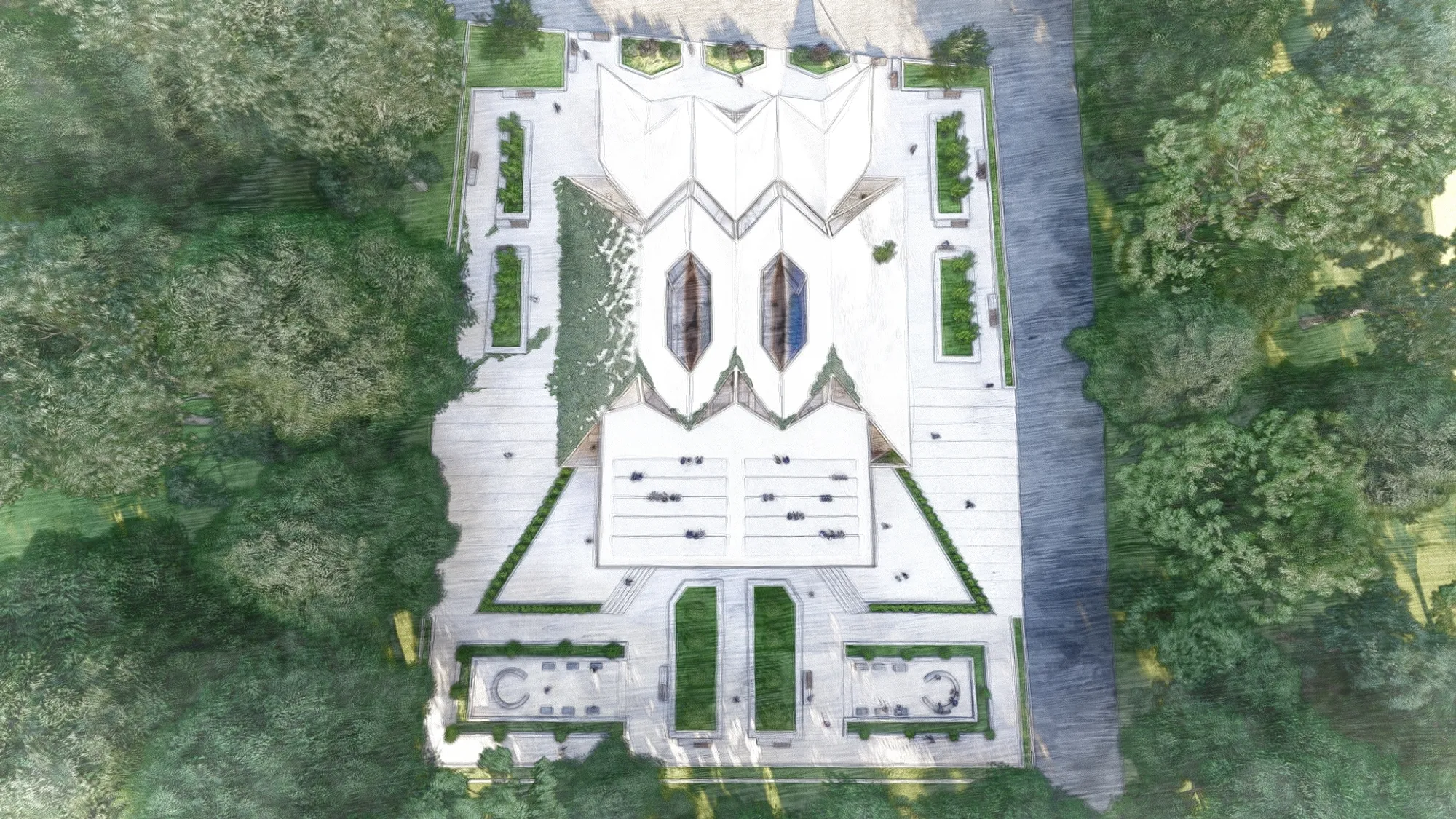
The structure was preliminary designed to rise inconspicuously from the ground, not to be interpreted as an excess, for it belongs to the land. On the other hand, an eye-catching focal point in the area was also required. Therefore, the idea of an artificial mountain range was developed, whose peaks and valleys raise the possibility of transmission between different levels. The peaks resemble the internal ceiling and the starry night sky acts as the roof of both the outdoor amphitheater stage and the modernized courtyards through the buildings. Various entrances alongside the building were designed to match the concept. They not only enable a public or private access to a specific, but also act as gateways similar to entrances of ancient natural underground caves. Both the north side entrances from under raised roof fins and southern entrances with stairways to the underground level radiate with the mystical feeling of of entering an undiscovered zone
Initially the mass and form of the structure were envisioned after the first encounter with the art from Ghana’s rich ancient culture with artefacts such as Akrafena, the Ashanti sword, Ashanti golden stool, and more contemporary Ghanaian textile, made of either handwoven cloth or strips of silk and cotton, known as Kente in Akan traditional language or Chinchini in Dagbani. Nowadays, people all around the world link clothes with colorful patterns to African people and African culture. One should keep in mind that once, this kind of clothes was only worn by the royal family in the Ashanti, Akan, and Dagbon Empires. There exist hundreds of different kinds of Kente patterns varying in complexity, each holding a name or message by the weaver.
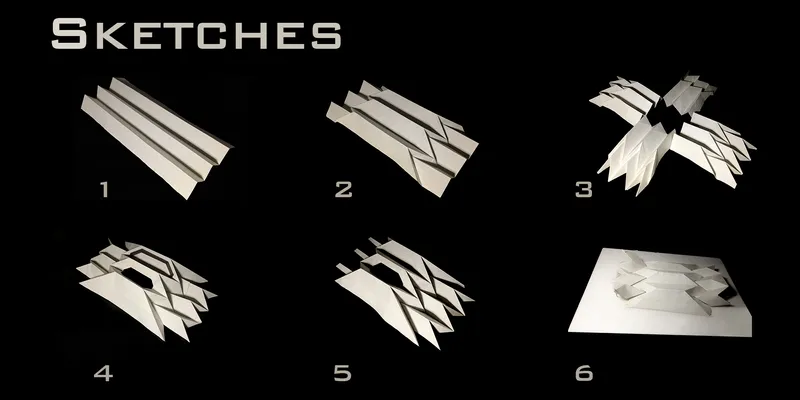
Finding zigzags among these patterns led immediately to the idea of a folding structure. In the pre-design phase, sheets of paper were somewhat like Origamis folded, but with the aim of finding similarities to Kente patterns. Right after the first maquette, the final design was decided to include at least two different levels by overlapping and repeating triangular folds across the structure. This preliminary design might have looked like a long industrial shed with some modern triangular forms on its roof, but the design was even further improved.
In the second sketch, the long shed was cut in half. By repeating this another time, four smaller pieces were created. By rotating them around a square base, they turned into four gable-shaped structures around a square courtyard, which reminds us of traditional house architecture in Ghana. Finally, even though there was no further discussion about the central courtyard, it was still unsettled whether the main structure should be cut into four or even two separate buildings. An atrium was also decided to be included in the design.
In the third attempt, we considered again our very initial idea, but this time with a more polished look and more accurate scales. To be more realistic, the replica was put on a topographic model of the site plan to see how the structure reacts to its plane and how it can be formed to attach more to the ground. This better clarified that some parts of the main structure might go under the ground due to height differences. A solution was to pull out the corners of the structure from under the ground to form a triangular ceiling similar to shark fins. This then provided the opportunity to design entrances such as the main North entrance and a few additional South entrances with stairways right to the lower levels of the building. As the final touch, the courtyard was located. The skylights could then be located on two valleys on the roof, which later acted as central atriums reminiscent of old central courtyards. In the end, we envisioned a multipurpose stage for gatherings, shows, and talks on the exterior south side of the roof.
The next step after designing the whole mass and exterior form of the structure, was designing the interiors and specifying the use of each space.
We believe that by using native and organic materials not only do we support the current local economy but also erosion would after a while benefit the project by camouflaging it to its environment, resembling natural plant-covered hills. In the long term, this can also help the recycling and upcycling process to be more efficient with less waste and environmental damage.
“Chin-Chini” is a modular expandable structure with many opportunities and potential. Its features include not only multipurpose outdoor spaces such as the amphitheater stage or the open landscape around the structure, but also multipurpose interiors such as workshop, class spaces for kids and teenagers, or even commercial spaces suitable for different types of shops, restaurants, or coffee houses.


Popular Articles
Popular articles from the community


Hill & Cross Opera: Sculptural Opera House Architecture Shaped by Tallinn’s Landscape and Identity
Hill & Cross Opera reimagines opera house architecture in Tallinn through its sculptural hill, civic plaza, glass wave and a luminous cross.

The Musturak Paradise: Senior Living Architecture for a Connected Future in Temara, Morocco
The Musturak Paradise reimagines senior living architecture in Temara via private homes, social spaces, culture, community, and shared care.

Conexión: Biophilic Design Reimagines High-Rise Living in Hong Kong
Conexión reimagines high-rise living in Hong Kong through biophilic design, green facades, shared spaces, daylight, water and nature within.

Play: Fragments of Their World
Familiar architecture becomes modular playground design, creating safe spaces where displaced children can learn, connect, imagine and play.

Similar Reads
You might also enjoy these articles
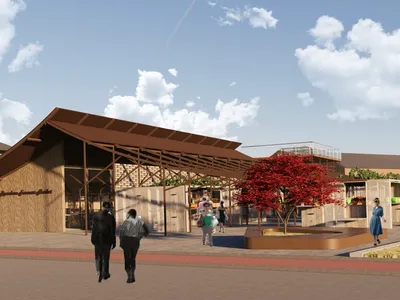
The Rhythm of Seasons
A Farmers' Market Connecting Nature and the City
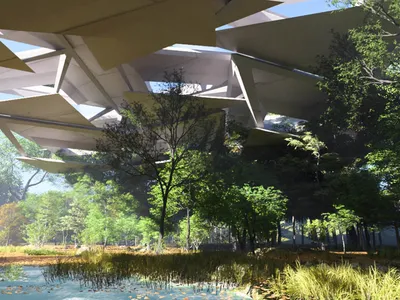

More Than a Building-Designing a Living System
More Than a Building-Designing a Living System
Base Beyond
DESERT COMPOUND ARID: TOURISM OF ABSENCE AND ABUNDANCE
Explore Chinese Small Scale Architecture Competitions
Discover active competitions in this discipline




Challenge to reimagine the Iron Throne


Photograph architecture without architects


Illustrate the lost glory of Angkor Wat - Render Challenge


Design challenge to reuse E-waste
Comments (0)
Please login or sign up to add comments
No comments yet. Be the first to comment!