ORIGYN GAIA — Advancing Space Habitat Architecture for the Next Era
A self-expanding space habitat redefining the future of cosmic living and industrial architecture.


Earth remains humanity’s only permanent home, but the accelerating challenges of our cosmic environment—gamma-ray bursts, supernova events, orbital debris, and satellite congestion—demand new architectural solutions beyond our planet. As the space industry evolves from isolated missions into full-scale commercial ventures, a critical gap persists: the absence of sustainable, large-scale, habitable manufacturing environments in orbit.
ORIGYN GAIA, conceptualized by Adam Hoehne, Jack Hooper, and Ricardo Miguel, emerges as a visionary leap in space habitat architecture. Designed by a multidisciplinary group of master’s students in Space Science and Technology, the project blends architectural intelligence with scientific rigor to imagine a self-expanding orbital station capable of supporting industry, habitation, and research at unprecedented scales.
This article explores ORIGYN GAIA as a landmark proposal in space architecture, demonstrating how thoughtful design can unlock long-term human presence in low Earth orbit (LEO) while enabling new economic and technological frontiers.
1. Rethinking the Future of Orbital Living
Human presence in space has historically been constrained by small capsules or the limited, microgravity environment of the ISS. These constraints hinder long-term health, reduce productivity, and limit the scope of in-space manufacturing.
ORIGYN GAIA challenges this paradigm through a radical architectural proposition: a large-scale station with rotational gravity, modular expansion capacity, and industrial processing systems built around asteroid‑derived materials.
The vision is anchored in two architectural priorities:
- Sustainability through in‑situ resource utilization (ISRU) — reducing launch costs by harvesting asteroid metals and volatiles.
- Self-expansion as a core spatial strategy — allowing the station to physically grow in stages as resources and industrial capabilities increase.
These principles position GAIA as a pioneering example of what high‑ranking SEO research calls “sustainable space architecture.”
2. The Missing Link in the Space Industry
Telecommunications and satellite networks have defined the modern era of space activity. However, the industry suffers from profound limitations:
- High launch costs inhibit large-scale construction.
- Orbital debris threatens satellites and crewed missions.
- Lack of orbital manufacturing prevents companies from using non‑precious asteroid materials.
- Tourism‑driven models cannot support long-term space expansion.
GAIA fills this void by serving as an orbital manufacturing hub, a transportation node, and a permanent, scalable living environment. It is designed not merely as infrastructure but as architecture—a system shaped to support human presence, interaction, and productivity.
3. Asteroid Processing as Architectural Foundation
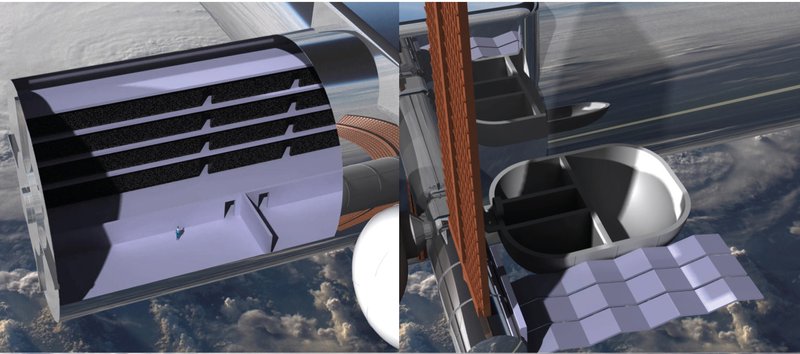
A defining innovation of ORIGYN GAIA is its integration of asteroid processing directly into the station’s ecosystem.
Key processes include:
- Crushing and magnetic separation of asteroid material
- Conversion of metals into powders, sheets, and structural components
- Refinement of volatiles into water, oxygen, and CO₂ scrubbers
- Production of polymers and composites for modular expansion
This transforms GAIA into a closed-loop architectural ecosystem, where material sourcing, fabrication, and spatial expansion occur in the same orbital environment.
Such a system reduces reliance on Earth launches and allows the station to scale through three major construction stages.
4. Stage 0 — The Architectural Seed
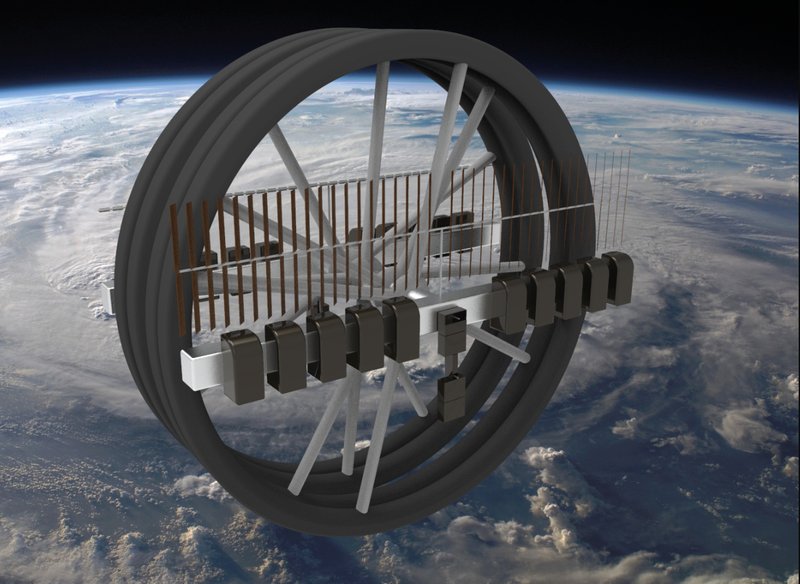
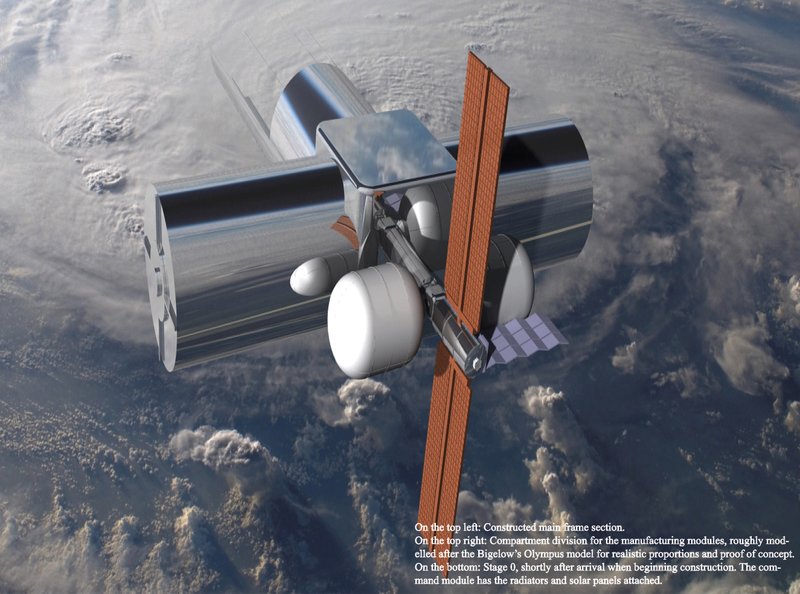
The initial configuration of GAIA centers on a compact, well‑balanced frame that remains structurally coherent as modules attach and expand. Wheels designed for future gravitational rotation remain unassembled but prepared.
The precursor module includes:
- Command center (ISS-derived)
- Power systems
- Life support
- Early manufacturing compartments
- Solar panel arrays
This stage lays the architectural and mechanical groundwork for later expansion—much like a foundation in terrestrial architecture.
5. Stage 1 — Beginning the Expansion
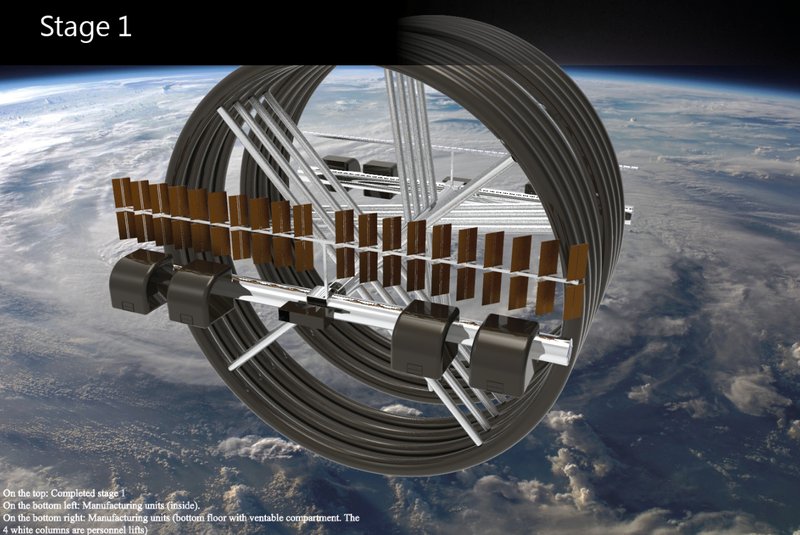
The station begins to assemble its primary gravity wheels, essential for simulating Earth gravity via rotation.
Key architectural achievements of Stage 1:
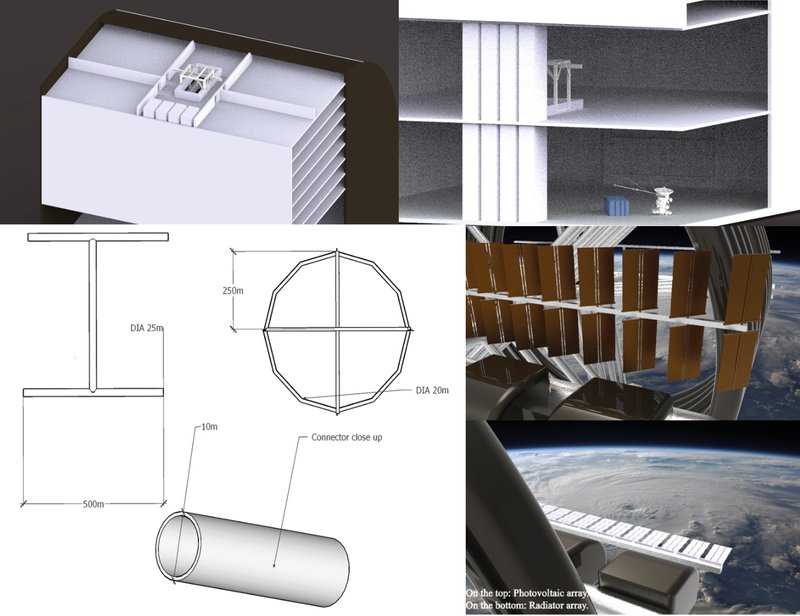
- Construction of eight 20-meter-diameter wheels
- Integration of walkways, solar arrays, radiators, and industrial wings
- Establishment of continuous manufacturing floors for materials processing
- Structural reinforcement to support future expansion
From this point onward, the architecture becomes self-reliant—using parts fabricated in orbit to build subsequent sections.
6. Stage 2 — A Growing Orbital City
During Stage 2, GAIA evolves from an outpost into a settlement-scale habitat.
Defining features:
- Wheels extended to 50 meters in radius
- Residential modules constructed along the inner wheel edge
- Multi-level housing and commercial zones
- New hangars for spacecraft docking and crew transport
- Expanded solar arrays and industrial infrastructure
At this scale, the architectural logic shifts from functional engineering to urban planning. GAIA develops roads, neighborhoods, logistics hubs, and public circulation spaces—mirroring the growth of a terrestrial city.
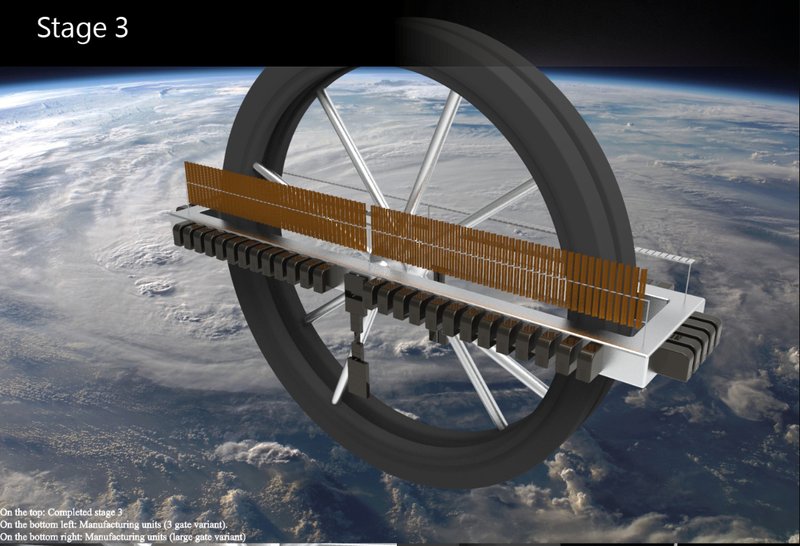
7. Stage 3 — A Fully Realized Spaceborne Architecture
Stage 3 culminates in a breathtaking expansion: wheels extending to 1000-meter radius, creating an immense habitable ring capable of hosting tens of thousands of people.
Stage 3 features include:
- Multilevel residential towers
- Continuous commercial districts
- Agricultural zones for food production
- Internal transportation networks
- Advanced translucent composite windows
- Massive photovoltaic farms generating over 100 MW
At this scale, GAIA functions as a self-sufficient orbital civilization—a pinnacle achievement in sustainable space architecture.
8. Architecture Meets Engineering: A Symbiotic Vision
ORIGYN GAIA stands apart for its seamless union of architectural design theory with aerospace engineering.
The project demonstrates:
- How gravity‑simulating structures enable long-term human health
- How modular design ensures continuous scalability
- How resource processing in orbit transforms construction economics
- How architecture shapes the lived experience of future space inhabitants
This synthesis of disciplines embodies the project’s core ambition: to redefine what human habitats can be beyond Earth.
9. A Leap Toward Humanity’s Next Frontier
As humanity faces increasing planetary challenges, projects like ORIGYN GAIA pave the way toward resilient, self-supporting futures in space.
The proposal does more than present diagrams or structural logic—it offers a narrative of hope, ingenuity, and ambition. It imagines a future where architecture extends its domain into orbit, shaping new forms of urbanism and new ways of living.
In the words that close its final panel:
“One giant leap for mankind.”
ORIGYN GAIA is not simply a space station. It is a blueprint for the architectural future of humanity—bold, expansive, and profoundly possible.