
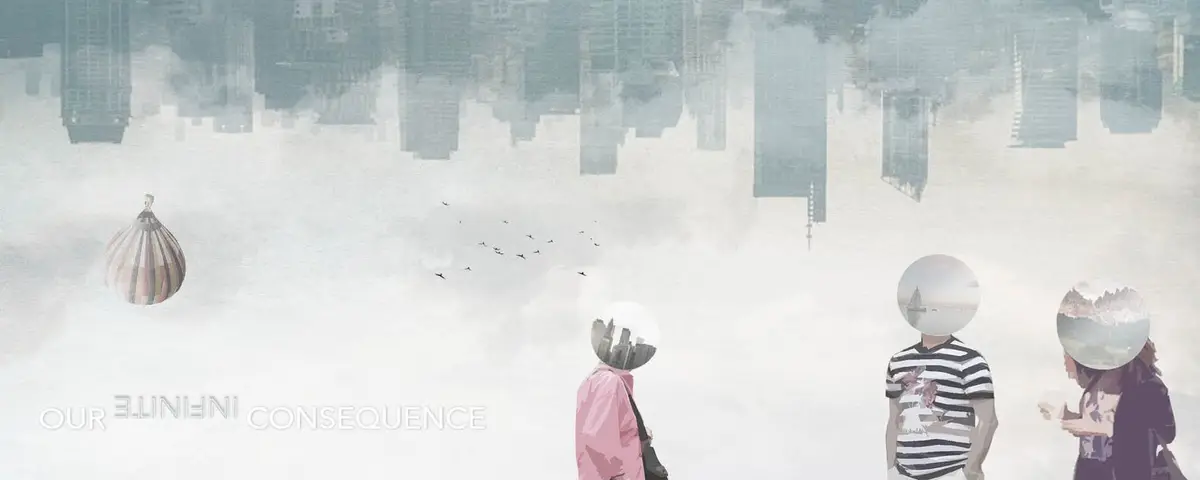
Our Infinite Consequence: Mirrored Voids That Force a City to Look at Itself
A vertical installation of reflective surfaces and helicoidal stairs reframes urban disconnection as a spatial problem with an architectural answer.


Two mirrored planes, one pressed to the ground and one hovering above, trap the city between its own reflections. Visitors step into this void and find themselves suspended between sky and pavement, between the infinite and the inverted, confronted not by a screen but by the physical fact of other people. "Our Infinite Consequence" is a public space installation that treats disconnection as a spatial condition and proposes architecture, not another app, as the remedy.
Designed by Roberta Sinesio and Veronica Vacaro, the project was runner-up in the Elevate 2019 competition. The brief asked designers to rethink the role of urban public space, and Sinesio and Vacaro responded with a provocation: in cities overwhelmed by digital isolation and fragmented interactions, what physical intervention can make people actually look up from their devices and at each other?
A Rooftop That Doubles as a Mirror
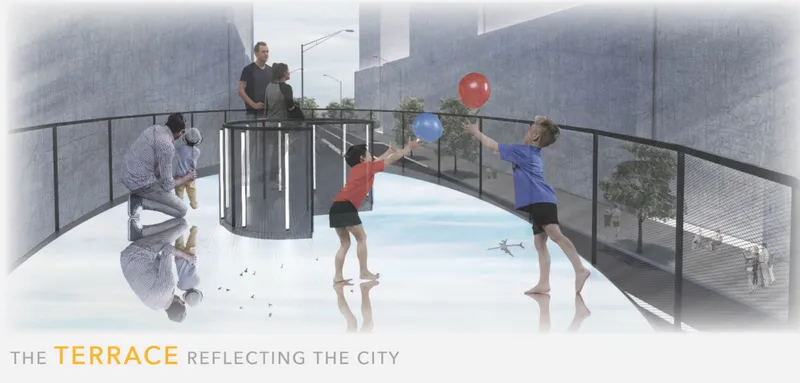
At the top of the intervention, a shallow reflecting pool stretches across a rooftop terrace bounded by black metal railings. Children chase balloons across its surface, their figures doubled in the water below and the sky above. The image is deceptively simple: a public terrace occupied by play. But the reflecting pool is the upper half of the installation's core mechanism, a mirrored surface that collapses the boundary between ground and atmosphere. Standing here, visitors are simultaneously on a roof and inside a reflection of the city.
The Spiral Staircase as Vertical Commons

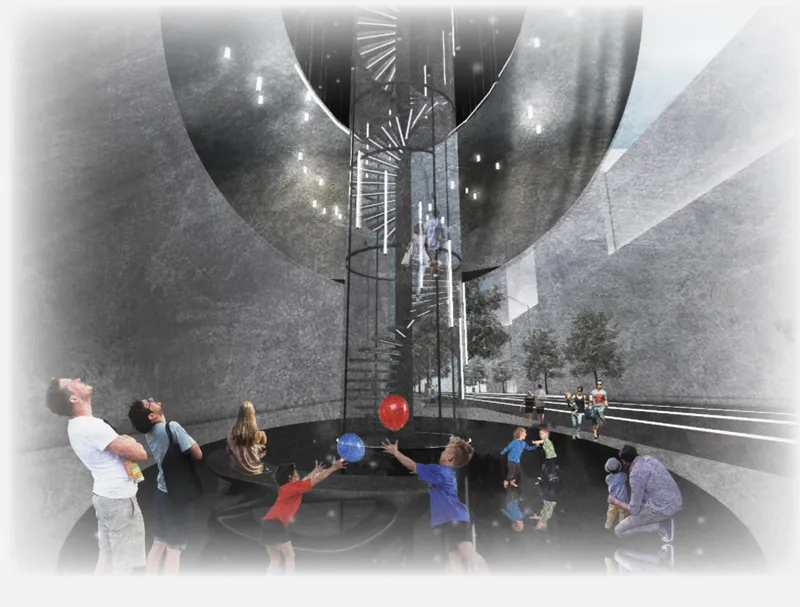
Seen from above, the circular atrium reveals a helicoidal staircase spiraling through multiple floor plates. People gather on the polished dark floor below, their movements visible from every level. The staircase is more than circulation; it is the connective tissue of the entire installation, threading together the distinct experiential layers the designers describe: ground level, urban mass, voids, and landscape. Each turn on the stair reframes the visitor's relationship to the space and to the other bodies moving through it.
From inside the atrium, the effect intensifies. Balloons fall through the circular apertures between floors, tracing the vertical distance and making it tangible. Visitors on different levels can see, hear, and respond to one another. The staircase forces proximity and eye contact in a way that flat, open plazas rarely do. It transforms vertical movement into a social act.
Illuminated Voids and the Sensation of Being Seen
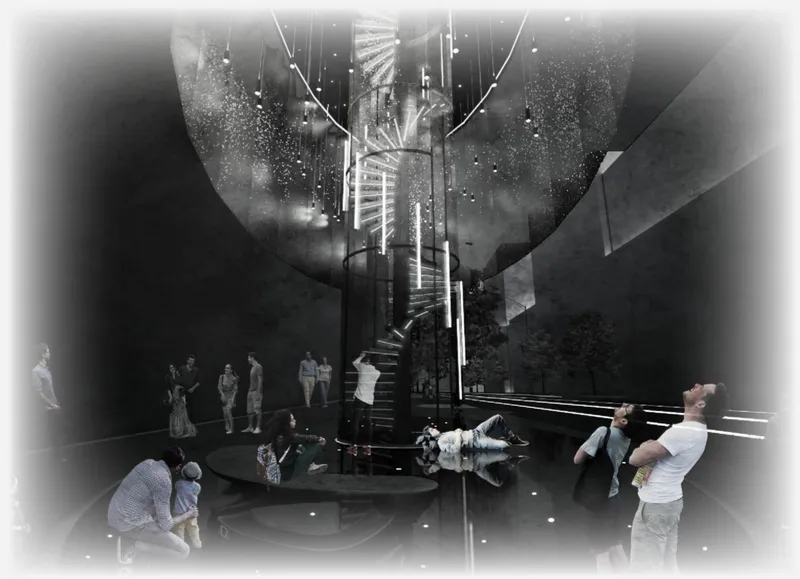
The vertical atrium section captures the installation's most compelling spatial quality: visitors moving through stacked, illuminated voids with full visual transparency between levels. Reflective materials on the floor and ceiling surfaces multiply figures and light, dissolving the sense of enclosure. The designers describe these zones as breaks in "the routine continuum," moments of awe engineered into the daily path through the city. The effect is less about spectacle and more about awareness. You cannot walk through this space without registering the presence of strangers, which is precisely the point.
Reading the Section: Architecture as Metaphor
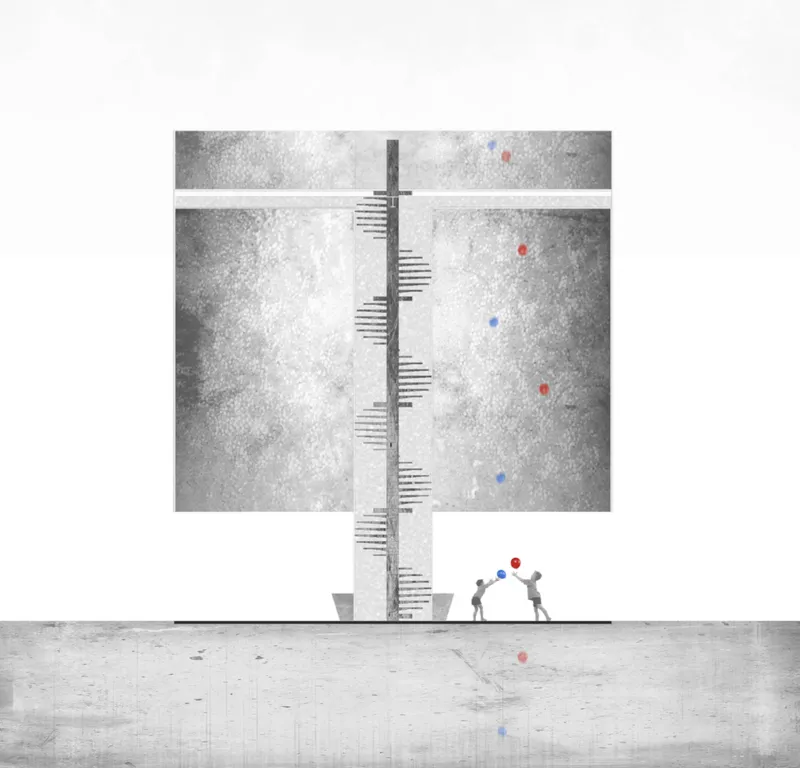
The elevation drawing strips the installation to its structural logic: a vertical staircase threading through horizontal floor plates, with human figures and floating balloons marking the scale. The drawing makes clear how the layered spatial strategy works. Each floor plate is punctured by the central void, ensuring that no level is isolated. The balloons, whimsical as they appear, serve as spatial indicators, tracing paths through air that the eye follows instinctively. The section reads as a diagram of the project's thesis: every action in a shared space echoes through the whole, an infinite consequence of collective presence.
Why This Project Matters
"Our Infinite Consequence" operates at the intersection of installation art and urban design, but it avoids the trap of being merely symbolic. The helicoidal stair, the reflective surfaces, and the layered voids are not gestures toward some abstract idea of togetherness. They are spatial mechanisms that physically reconfigure how people move, where they look, and who they encounter. The project demonstrates that the crisis of digital disconnection is not just a behavioral problem; it is a spatial one, and it demands spatial solutions.
Sinesio and Vacaro's proposal repositions public space as an active participant in civic life rather than a passive backdrop for transit. In an era when most public realm discussions default to placemaking checklists and street furniture catalogs, this project insists on something more ambitious: architecture that makes you aware of your own body, your reflection, and the people standing next to you. That insistence alone makes it worth studying.
View the Full Project
About the Designers
Designers: Roberta Sinesio, Veronica Vacaro
Enter a Design Competition on uni.xyz
uni.xyz runs architecture and design competitions year-round that reward proposals with spatial conviction and real site intelligence.
Project credits: Our Infinite Consequence by Roberta Sinesio, Veronica Vacaro Elevate 2019 (uni.xyz).


Popular Articles
Popular articles from the community


Singing Woman: An Opera House That Performs Before the Curtain Rises
Ovidiu Cristian Pavel's conceptual opera house translates Estonia's choral identity into a sculpted waterfront landmark facing the Baltic Sea.


Cube Design Draws an Ecological Corridor Between Two Shenzhen Hills with the Nankai Building
Beside Shenzhen's container docks, the Nankai Building pairs stacked balconies with a climbing green screen to connect two hillsides across its height.

David Ortega Stacks a Two-Story Mexico City Penthouse Around a Steel Stair and a Pergola-Shaded Roof Terrace
In Colonia Roma, a 300 m² penthouse uses oak joinery, a planted steel stair and a slatted roof pergola to make a new-build apartment feel like a house.

The Amber Palace Opera: A Geological Fiction Surfaces on Tallinn's Baltic Waterfront
Pierre Brillard reimagines a Baltic legend as a public landscape, opera house, and waterfront promenade rooted in Tallinn's coastal identity.

Similar Reads
You might also enjoy these articles
Cube Design Draws an Ecological Corridor Between Two Shenzhen Hills with the Nankai Building
Beside Shenzhen's container docks, the Nankai Building pairs stacked balconies with a climbing green screen to connect two hillsides across its height.

Praksis A and Studio Sted Bend a Red Timber Cabin Across the Granite of Norway's Southern Coast
On the southern Norwegian coast, a 105 m² cabin follows the rock on slender posts, pairing red cladding outside with pine, brick and plywood within.
David Ortega Stacks a Two-Story Mexico City Penthouse Around a Steel Stair and a Pergola-Shaded Roof Terrace
In Colonia Roma, a 300 m² penthouse uses oak joinery, a planted steel stair and a slatted roof pergola to make a new-build apartment feel like a house.

PARALELA and LB2 Thread a Public Walkway Through the Base of a Las Condes Residential Tower
In Las Condes, Santiago, the Hamlet Building gives its fenceless ground floor to a 70-metre wooded passage linking two streets and the metro.

Comments (0)
Please login or sign up to add comments
No comments yet. Be the first to comment!