Per Aspera Ad Astra
Stargazing Pavilion

Walking outside at night and gazing into the glowing darkness of space is a very special experience. But this does not capture the true splendor of space and everything it contains. Light pollution, atmospheric degradation and our limited vision; prevents us from truly exploring the universe and its limits.
According to the Bortle scale that rates the light pollution between 1 and 10, there is almost no light pollution in Cherry Springs State Park. Thus, it was prioritized to prevent light pollution in the project.
Plato's allegory of the cave is considered as the project concept. In this allegory, cave reflects society, chained people represent the members of the society, shadows on the wall illustrate illusions, and the person who breaks the chain expresses the questioners. With the observations to be made in our stargazing observatory design, it is aimed that sky observers reach reality like people coming out of cave.
This idea was reflected in the form of the project in terms of designing the building underground as a cave abstraction which also prevents the buildings from closing the view angle. Modules consist of parts that can be attached and removed from each other. When any part is removed, the remaining parts define a closed module volume.
While the inner panels of the module move up and down; the outer panels move to the right and left. The modules generate their own energy from solar panels located on its green roof. Rain water is stored with the drainage systems.
Lighting elements on the roofs, which we designed as light chimneys, offer different experiences in spaces and indoor spaces benefit from daylight during the day, the moon and star lights at night. 196 miniature light chimneys were used on the roof of each module. Transparent wood is used in these light chimneys and a red OLED light source is used in the center. Thus, energy saving is achieved by illuminating both the interior and the exterior with a single source.
The project area is quite sloping. There is a car and bicycle parking lot in the Northwest of the project. The wind poles in the area provide the energy needs of the project. Access to lower elevations is provided by stairs and elevators. When the entrance level is reached, the users are welcomed by the consultation and the amphitheater. Inner gardens, on the other hand, create a connection between spaces.
Accommodation modules, technical rooms and public WC can be accessed from the south of the inner garden at the entrance level. The bunk beds in the accommodation modules are specially designed and the modules have their own bathrooms. In order to provide simple access to the entrance level and to unload loads, 2 elevators were used in the area.
Other functions in the entrance level are staff room, kitchen and bar area. The amphitheater, which follows the entrance axis, provides opportunities for various activities. The ceiling covers of the observatory module have a mechanically collapsible system. The upper floor of this module is placed on rails that allow 360 degrees rotation. A spiral staircase leads to the upper floor of the observatory.
Another function in the basement is the multi-purpose event space. In this area various seminars, training, talks, digital exhibitions and light shows are held. Both spatial and social flexibility are provided with the flexible structure of the modules.
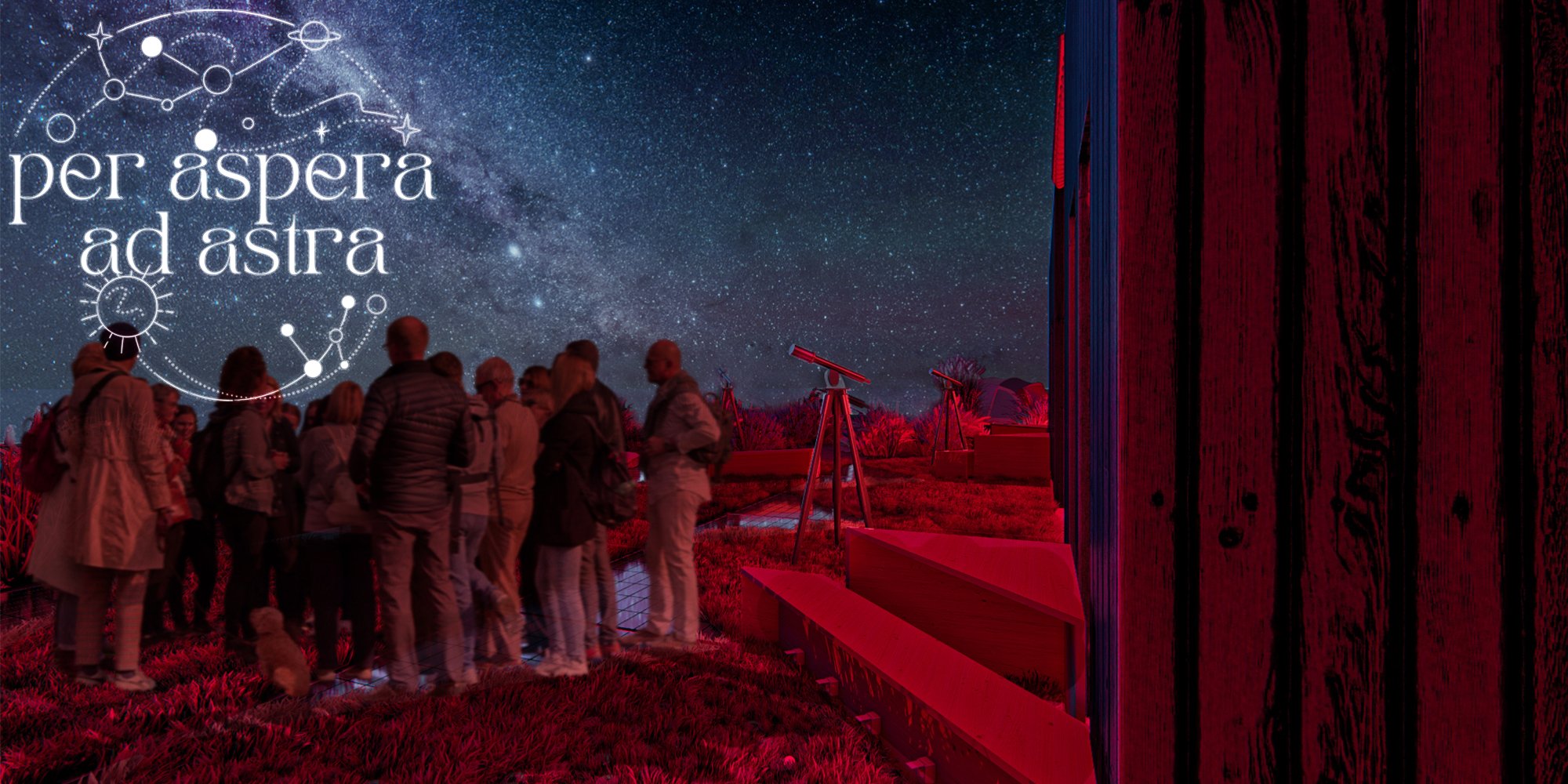
Various outdoor activities are carried out on the roofs of the modules which allow activities such as star parties, astrophotography, sun and planetary observations. Urban furniture designed properly for the area serves the activities. The electrical sockets fixed to the urban furniture ensure uninterrupted observations.
While deciding on the materials of the modules, factors such as accessibility to the material and ease of production were also considered. Natural and innovative materials were preferred for this reason. CLT, being the main material of the modules, is charred with the Sugi Ban technique, so the wood becomes resistant to fire, rot, moisture and insects and the modules last longer. The dark color of the material absorbs light, providing an advantage in terms of stargazing.
Rain gardens purify rainwater and mixes it into the soil for reuse. At the same time it was designed to form a natural barrier around the project area. The plants used in the rain gardens were selected accordingly for the region. By accelerating the absorption of water by the soil, it prevents moisture formation that may hinder observation.
In order to maintain the temperature difference in the observatory, heat insulation is not used on the upper floor. Zinc roof is preferred to prevent moisture formation. Since there is an astronomy library and reading rooms on the lower floor of the observatory, thermal insulation has been made on this floor. In order to preserve the temperature difference between the two floors, the end of the stairs is closed with an aluminum cover.
Airgel, which is used in many areas from spaceships to firefighting suits due to its lightness and insulator, has been suggested as the insulation material of modules. For an ecological design, Tesla Smooth Glass solar panels, which can generate energy from the sun and moonlight, are used on the roof of the modules and the reflection of light is prevented by opaque textures of these panels.
Hammock furniture is designed both to ensure the continuity of circulation on the roofs and to offer a pleasant area for observations made with the naked eye. Many observation opportunities are offered to visitors in the area. One of the most important opportunities offered to the visitors is the professional observation telescope which is designed with a mirror width of 100 centimeters.
Starting from the question “how would these systems be controlled?” If this smart campus actually existed, a website has been designed. Prototype application has been developed on this website so that users can control the lights of their modules.