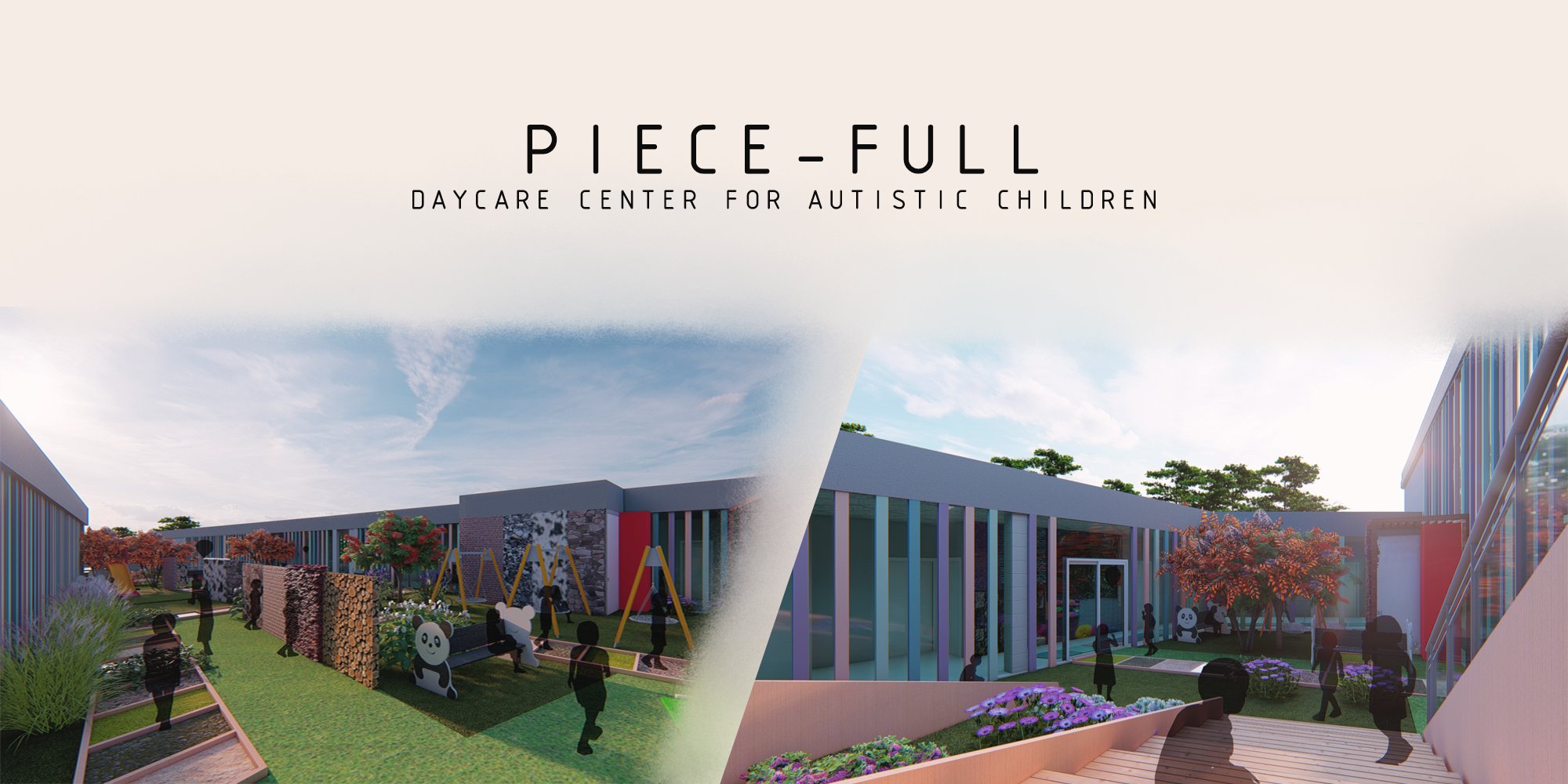
PIECE-FULL
DAYCARE CENTER FOR AUTISTIC CHILDREN


The subject of our competition is to design a play and care center for 30 children aged 0-6 with autism spectrum disorder.
Individuals with autism are seen as different from the society due to their retardation mental compared to their peers in learning and comprehension, but each individual is a part of the society and constitutes an indivisible whole. Based on this theory, we named our design Piece-Full, which we created with the integration of the spaces shaped in pieces around the open playgrounds, which we generally define as the sensory garden. At the same time, we aimed to be mentioned in this way by creating an image of a safe and peaceful place in people's minds as it is homonym with peacefull.
In order to create a more productive environment by taking into account the needs of the users in the age group and their behaviors towards the more pronounced spectrum disorders that appear as their age progresses, we have discussed our design under 2 theme as 0-2 and 3-6 age groups. Since ASD is a very diverse disease, we aimed to construct environments that offer versatile, variable and different options with a flexible approach while designing our spaces. Considering the diversity in spectrum disorders, spaces with the same function are offered with both natural and unnatural lighting options, and it is aimed to design a suitable variety of spaces for users. We aimed to keep the light under control by using colored sunshade panels in the openings of the spaces that offer natural lighting. Likewise, it was desired to construct indoor-outdoor spaces that can be transformed into each other by making a sliding wall system in versatile usage areas, including individual and shared classrooms. In these spaces, which are functioned as classrooms, indoor playgrounds are designed, taking into account the age ranges of the users. In this way, it is aimed to create a field setup where educational activities for the development of children can be done while playing games.
While aiming to facilitate access by positioning the 0-2 age group section on the ground floor, we also aimed to strengthen the safety of the children by limiting the passage of children between spaces by placing the spaces for the 3-6 age group on an upper level by taking advantage of the slope of the land. In addition, by designing the designed sensory gardens to be between two parts as inner gardens, it was desired to create a safer and more comfortable environment by preventing possible damages that children may encounter in the external environment when they move more freely during the development of their motor skills.
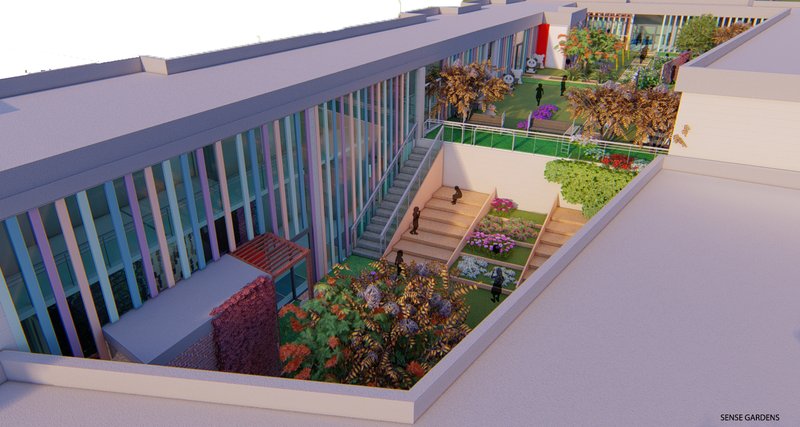
The flora of the sensory garden areas defined in the inner gardens was chosen considering the climatic conditions, and these selected plants were categorized according to the senses and included in the design of the sensory garden. The sensory areas are positioned to address the frequency of use and to minimize the discomfort of children. E.g; Since the sections that appeal to the auditory sense do not appeal to the majority of users in general, they are designed as a whole and away from the main circulation axis of the garden.
Individuals with autism are known for their differences in perception. For this reason, sensory paths, sensory walls and sponge-supported elements were used in interior design. In addition, polyurethane flooring and tatami matte, which are preferred as flooring materials, and materials have been chosen in accordance with the fact that children do not slip during their circulation and are not damaged in possible situations such as falling. In color arrangements, colors that do not disturb them and help them calm down were used by taking reference from the results of studies and research on individuals with autism.
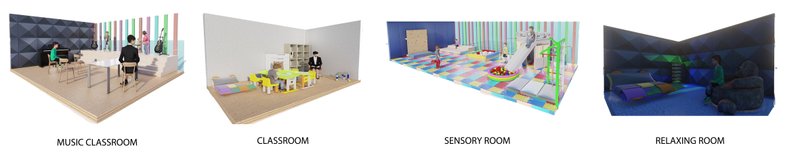
By placing the sensory paths on a successive axis along their circulation, it is aimed to facilitate the transitions between spaces, finding place-direction, and children's experiencing the environments. In order to prevent them from feeling pressure and panicking in the empty spaces created by introversion during their transition to the spaces, empty transitional areas are designed where they can come to their senses and rest. At the same time, besides the calming corners located inside the customized common areas such as sensory rooms, the calming rooms where they can isolate themselves from the crowd and relax in times of sudden crisis are designed and positioned at the intersections of the common areas. Thus, it was desired to provide easy access. The interiors of the defined sensory rooms are arranged with toy units that support their development in a way suitable for the use of age groups. With the additional music and art classes in the 3-6 age group unit, various space setups have been designed where different need groups and users of different levels can express themselves comfortably and develop themselves while having fun. The sleeping rooms are placed on the farthest side of the building from the road and at the end of the common areas. At the same time, a comfortable space is created by getting away from noise and sound with the acoustic panels used on the walls. The spaces, which are placed at the intersections of the sleeping rooms and whose walls facing the rooms are designed with glass, function as observation rooms to create the opportunity to control the children without disturbing them.
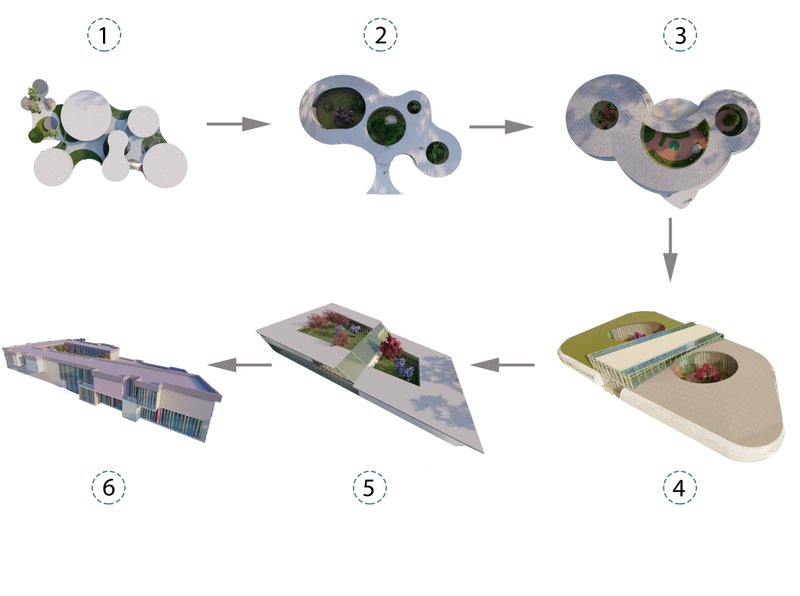
In the process of finalizing the design, many forms were tried, as indicated in the image above. In these form studies, the aim has always been to keep the orientation and circulation of the users functional. However, as a result of the studies, since the main goal is to leave the children free with a safer space design without opening them outside, a form oriented according to the land and the entrance was preferred and it was decided to construct the open spaces as an axis within the form.