POR LA GENTE
Reviving Nature...Restoring Community

Introduction: Designing for Crisis and Community
In the coastal province of Puntarenas, Costa Rica, the delicate ecosystems of mangrove forests face an ever-growing threat—not just from rising tides or climate change, but from the hands of those who depend on them for survival. The fragility of the local economy has led to unsustainable practices, including overfishing and deforestation, placing immense pressure on the mangroves.
Our design, Por la Gente—meaning For the People—responds to this challenge with a clear and hopeful objective: to build a space that rebalances the relationship between community and nature, conservation and livelihood. By creating a hub for education, commerce, research, and cultural activity, the project is envisioned not just as a structure but as a strategy—a sustainable thread weaving together ecological preservation with social empowerment.
The Site: Where the City Meets the Mangroves
The chosen site sits at the threshold between urban Puntarenas and its expansive coastal mangroves. This tension between development and ecology, consumption and regeneration, forms the conceptual and physical base of our intervention. The project does not treat the mangroves as background scenery or a resource to be fenced off; instead, it treats them as co-inhabitants of the space, with the built environment respectfully positioned to acknowledge and protect their presence.
Understanding this dual context—urban pressure from one side, ecological urgency from the other—our team proposed a spatial framework that doesn’t isolate conservation, but integrates it into everyday civic life.
Concept and Urban Strategy: Threads of Connection
At the heart of Por la Gente lies a spatial and urban strategy that envisions new connections. The city of Puntarenas is shaped by a strong horizontal axis—long, linear developments hugging the coastline. Our concept introduces a perpendicular thread: a vertical green corridor of pedestrian-friendly paths that stitch together the urban fabric with ecological nodes.
These pathways culminate in a series of “hubs for conservation,” one of which is realized in our project site. This main hub serves as an anchor point where education, commerce, research, and culture intersect, reconnecting the local community to the mangroves through structured, sustainable engagement.
Program: A Platform for Possibility
The project hosts a carefully composed program rooted in flexibility, accessibility, and relevance to local life. Each program element has a dual function: immediate economic benefit and long-term environmental value. The core spaces include:
• Market Area: A flexible indoor-outdoor marketplace for local fishers, farmers, and artisans.
• Workshop Spaces: For crafts, food processing, and agricultural training, including sustainable aquaculture techniques.
• Research and Conservation Labs: Located on the upper floor, these spaces are intended for environmental scientists, students, and NGOs working on mangrove preservation.
• Multipurpose Hall & Amphitheater: Hosting community events, lectures, performances, and educational programs.
• Dock Access: A newly designed dock provides structured, ecological access to the mangroves—both for tourism and scientific observation.
This hybrid program turns the building into a living organism—always active, responsive to local rhythms, and open to evolution.
Form and Spatial Organization: Opening to Nature, Enclosing the Civic
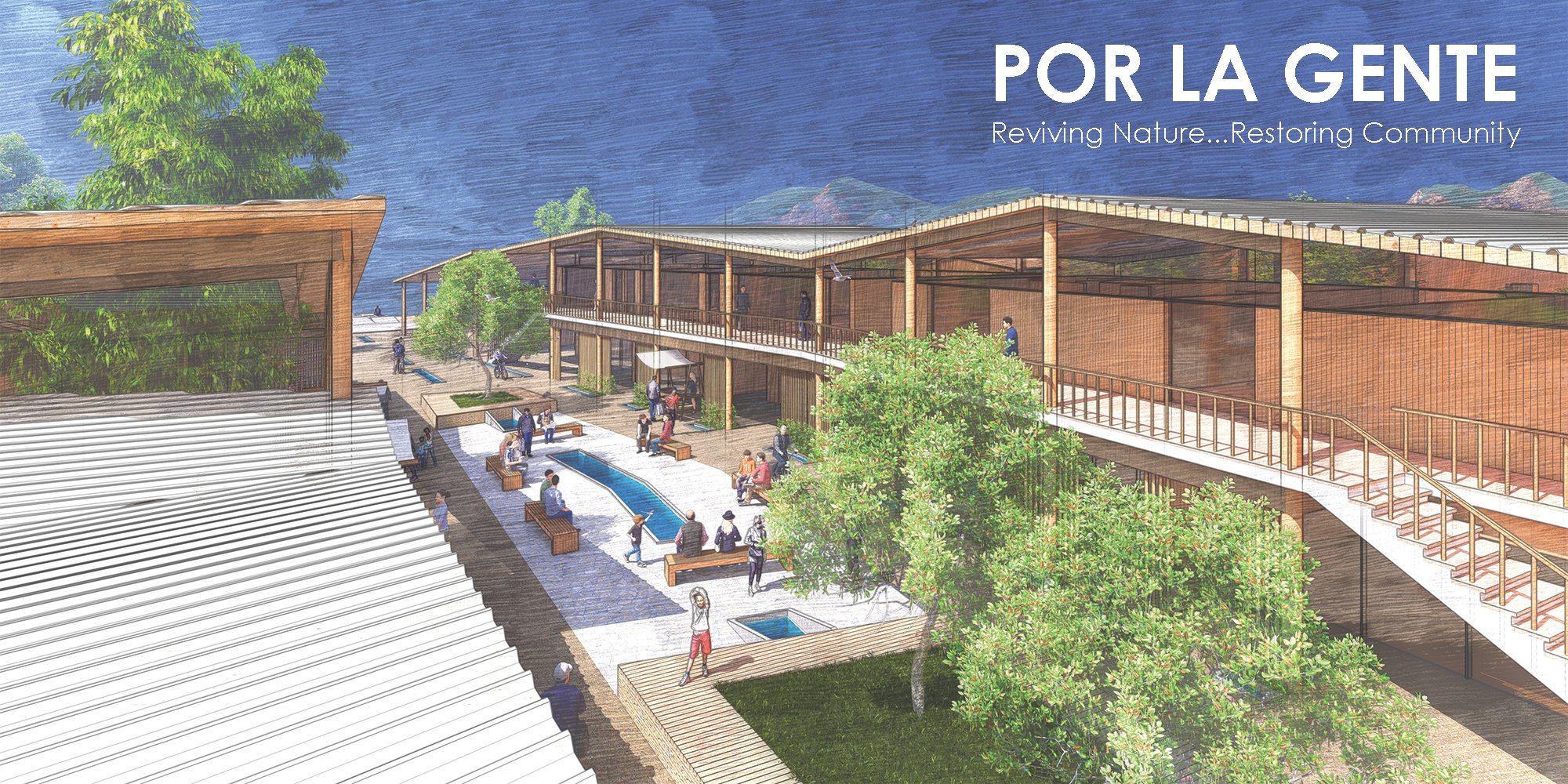
Our design strategy focused on balancing openness to the environment with the need to create protected, usable civic space. The site is occupied by two main building volumes, each following a fragmented ground floor logic:
1. The First Mass (Two Stories): Positioned toward the back of the site, this building houses the workshops at ground level and the more private research labs and offices on the upper floor. The lower level is fragmented into smaller components, encouraging open-air circulation and informal gathering. This creates shaded pockets for activity while allowing airflow and permeability throughout.
2. The Second Mass (Single Story): This volume contains the market area and amphitheater, again divided into smaller interlocking parts. This fragmentation encloses a central civic space while maintaining direct views of the mangroves. Corridors and outdoor paths between the units foster a sense of openness, blending built form with the natural surroundings.
Together, these two masses generate a layered spatial experience—part village, part civic campus—where programs and people flow between shaded, semi-outdoor courtyards connected by breezeways and visual corridors.
Materiality and Construction: Local, Practical, Sustainable
To root the project in its context both aesthetically and technically, we turned to local construction logic and vernacular materials. The primary wall structures are built using sustainably sourced local wood, chosen for its familiarity, availability, and environmental performance.
Covering both building volumes is a continuous corrugated metal shell, a material widely used in Puntarenas due to its affordability, weather resilience, and lightness. We used this humble material in a strategic way: angling the shell surfaces to respond to sun angles, wind flows, and the existing city grid. These sloped roofs also act as rainwater harvesting surfaces, channeling water toward integrated collection systems to be reused in workshop agriculture and sanitation.
The use of simple, recognizable materials ensures that the building is easy to construct, repair, and replicate. It doesn’t attempt to impress through foreign language—it speaks in the architectural dialect of its place.
Passive Design and Sustainability Strategies
Our environmental design approach integrates passive principles with site-responsive planning:
• Ventilation: The fragmented layout across both buildings promotes natural ventilation and reduces dependency on mechanical systems.
• Shading: Roof overhangs and vegetation provide shade to outdoor circulation paths and gathering spaces.
• Water Management: Sloped corrugated roofs direct rainfall into underground cisterns, feeding irrigation systems for community gardens and workshop agriculture.
• Material Lifecycle: All primary materials (wood, metal, stone) are recyclable or biodegradable, selected with low carbon footprint considerations.
Public Space and Social Impact
Public space is not treated as leftover space, but as the essential core of the project. Shaded walkways connect all zones, creating a porous civic spine that can be walked, lingered in, and used for informal gatherings. The amphitheater bleeds into the landscape, visually tied to the lower roof shell and extending community functions outdoors.
Importantly, Por la Gente is not just a physical intervention—it is a social tool. It offers new ways of making income, new platforms for local pride, and new opportunities to educate the next generation about the value of the mangroves not just as an ecosystem, but as a shared heritage.
Conclusion: A New Ecology of Coexistence
Por la Gente proposes a new typology of environmental infrastructure—one that doesn’t isolate conservation from community, but instead binds them together. It demonstrates that architecture, when sensitive to both site and society, can do more than house activity: it can regenerate relationships.
In a region where the economy has long been seen as at odds with the environment, this project turns that opposition into opportunity. It builds a civic home for sustainability, and in doing so, proves that conservation can be for the people—so long as it is by the people as well.