

Protective Structure Above Transept Basil: Hovering Vaults Over Justinian Ruins
A lightweight steel canopy of double-curved planes shelters a sixth-century basilica and Roman thermal spa in southern Serbia.


How do you protect a ruin without burying it twice? The usual answers tend toward glass boxes or open-air canopies that treat archaeological sites as display cases. This project takes a different route: a system of double-curved steel vaults that float above the stone foundations of a sixth-century basilica, retracing the spatial hierarchy of nave, transept, and apse without ever touching the ancient remains. The result is not reconstruction but reinterpretation, a contemporary tectonic layer that makes the original building legible again while keeping weather, UV, and foot traffic at a safe distance.
Designed by Marta Adamovic, the project was submitted as a Graduation Projects entry in UnIATA '20, where it earned a Best Institution distinction. The site is the imperial settlement of Justinian I near Lebane in southern Serbia, a fortified hilltop city whose street network once converged on the Transept Basil, the most significant sacral building of Justinian's era. Alongside the basilica, Adamovic also proposes a complementary protective envelope for an adjacent Roman thermal spa, extending the same design logic across two distinct programmes and spatial typologies.
Reading a Basilica Through Exploded Geometry


The composite drawings lay bare the project's structural logic. Plans, sections, and exploded axonometrics show how elliptical arches generate a family of interlocking double-curved roof planes, each one calibrated to mark a zone of the original basilica: narthex, nave, bema, transept, apse. The arches repeat with precise geometric rhythm, echoing the cadence of the vanished stone pillars below. What comes through most clearly is the structural independence of the new work: every element hovers above the archaeological layer, carried on slender steel frameworks that transfer loads to new foundations outside the ruin's footprint.
The second sheet pairs technical diagrams with an interior photograph of timber vaulting, revealing the project's material and spatial references. Adamovic draws on the tradition of ribbed and lamella vaults, abstracting their curvature into lightweight steel and perforated panels rather than heavy masonry. The isometric breakdowns make the assembly sequence readable: arches first, then longitudinal ribs, then the perforated skin. Each layer adds structural capacity while filtering light down to the ruins.
Cascading Peaks and Perforated Screens


Seen from outside, the protective structure reads as a landscape of stepped, perforated white panels rising in cascading peaks. The form is unmistakably modern, yet it recalls the volumetric massing of a basilican section: a tall central ridge flanked by lower side planes. The perforations do double duty, admitting diffused daylight while shedding wind load. Against a cloudy Serbian sky, the structure appears almost textile, a woven canopy rather than a solid enclosure.
The three-quarter view confirms that contrast is the governing principle. Where the original building was heavy, opaque, and gravitational, the new shell is light, translucent, and tensile. Adamovic avoids any historicist gesture: no pointed arches copied from the ruin, no stone cladding, no colour matching. The deliberate gap between old and new is itself a form of preservation, because it keeps the visitor's eye trained on the authentic material below rather than on a simulated past.
Light, Shadow, and the Experience Below the Vaults


The most compelling images are taken from inside. Standing beneath the arched vaults, a visitor looks out through a pointed opening to see masonry wall ruins bathed in bright sunlight. The protective structure frames the archaeological evidence the way a museum vitrine frames an artifact, except here the scale is architectural and the vitrine is inhabited. The perforated skin filters direct sun into a soft, even wash that reduces UV damage to exposed stone while maintaining the emotional weight of an open-air site.
The close view through a ribbed arch is perhaps the strongest single image. Sunlight passes through the structural ribs and casts a precise lattice of shadows on the ground, a moving sundial that shifts through the day. The effect is unmistakably sacred: light, structure, and rhythm working together in exactly the way a basilica's clerestory once did. Adamovic does not reconstruct the original atmosphere, but she conjures an analogy to it, letting contemporary visitors feel the spatial intention of a building they can no longer enter.
Why This Project Matters
Heritage protection is often caught between two extremes: invisible interventions that leave ruins exposed to the elements, and heavy enclosures that turn archaeological sites into warehouses. Adamovic's project charts a productive middle ground. By deriving the new structure's geometry from the basilica's own spatial hierarchy, she ensures that the protective envelope is also an interpretive device. Visitors do not need a guidebook to understand where the nave ended and the transept began; the cascading vaults tell them.
Equally significant is the dual programme. Extending the same design logic from the Transept Basil to the adjacent Roman thermal spa, with its sequence of apodyterium, frigidarium, and hypocaust, demonstrates that the approach is a transferable system rather than a one-off formal exercise. For a graduation project, the level of tectonic resolution is striking: every joint, every perforation pattern, every arch profile is dimensioned and justified. It is the kind of work that deserves to move from competition board to construction site.
View the Full Project
About the Designers
Designer: Marta Adamovic
Enter a Design Competition on uni.xyz
uni.xyz runs architecture and design competitions year-round that reward proposals with spatial conviction and real site intelligence.
Project credits: PROTECTIVE STRUCTURE ABOVE TRANSEPT BASIL by Marta Adamovic Graduation Projects entry of UnIATA '20 (uni.xyz).


Popular Articles
Popular articles from the community


LT2A and OPEN Architectes Thread a Brick and Glass High School Through a Wooded Belgian Campus
In Braine-l'Alleud, a 3,000 m² wing for Collège Cardinal Mercier pairs pale brick with a glazed colonnade, deferring to a small chapel and a dense wood.

longwave studio Reorganizes a 112 m² Tainan Apartment Around the Daily Routines of a Family and Two Cats
In Tainan, Taiwan, birch plywood, rust-red furniture and a freestanding plaster wall link arrival, storage, work and family life in one apartment.

U.GA Architects Wraps an Oval Rooftop Pool in Curved Board-Formed Concrete on Busan's Jeollidan-gil
In Busan's Jeonpo-dong, a 454 m² mixed-use block stacks a neighborhood facility, guest rooms and an oval rooftop pool inside spiraling concrete walls.

Jaramillo Van Sluys Arquitectura and Urbanismo Turn a Demolished Registry Lot in Quito into an Orchard Plaza
In Quito's Centro Histórico, a 2,800 m² plaza exposes the San Agustín convent wall and redraws its lost Augustinian orchard in volcanic stone.

Similar Reads
You might also enjoy these articles


Aquadapt: An Underwater Habitat That Rewrites Its Rooms by the Hour
Curved modules ring the seabed while one shell shifts from breakfast room to cinema, farm and football pitch as residents' needs change.

Play: Fragments of Their World: Remembered Architecture Rebuilt as a Modular Playground for Refugee Camps
Tom Gardner abstracts domes, arches and towers from the homelands of displaced families into a kit of child-scaled play parts for camp settlements.
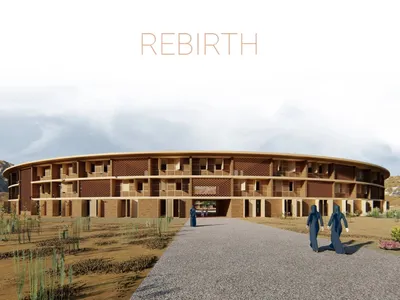
REBIRTH: A Circular Settlement Where Afghan Widows and Their Children Rebuild Life Together
A shortlisted Resile entry turns the circle into a protective ring of timber and brick, gathering homes, classrooms and gardens around a shared landscape.
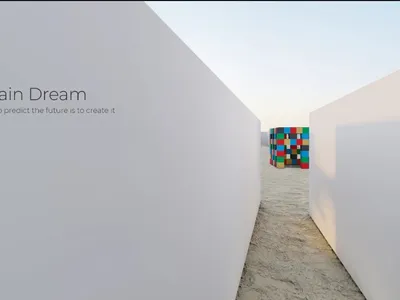
The Main Dream: A Recycled Plastic Kit That Lets Refugee Children Build Their Own Playground
Thirty-centimetre interlocking cubes that connect on three axes turn play into construction, letting children author the spaces they occupy.


Comments (0)
Please login or sign up to add comments
No comments yet. Be the first to comment!