
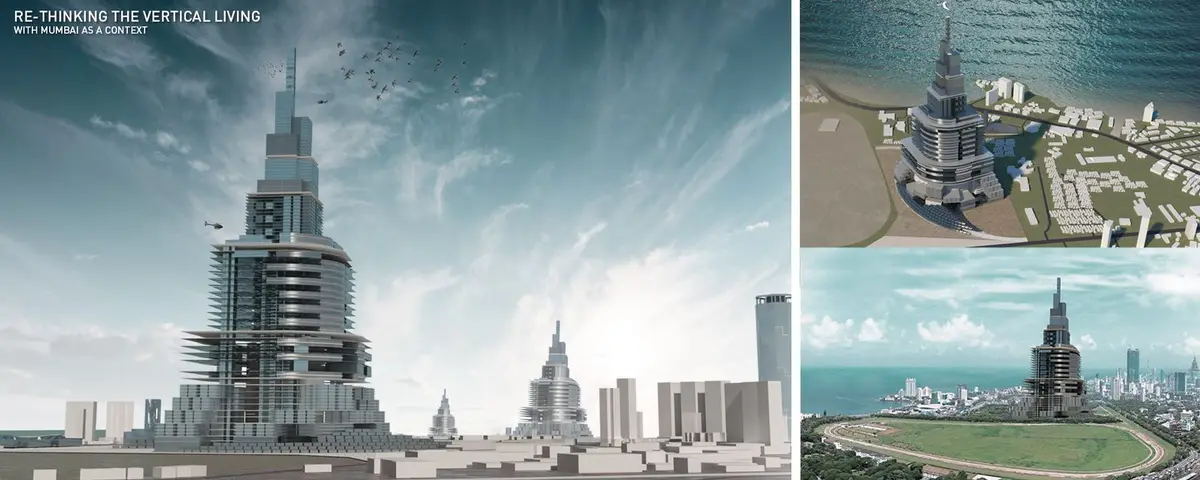
Re-Thinking the Vertical Living: Sustainable High-Rise Architecture in Mumbai
Reimagining vertical living in Mumbai through sustainable high-rise architecture that integrates ecology, density, and future urban growth.


India’s rapid urbanization has triggered an unprecedented demand for land, housing, and infrastructure. Metropolitan cities like Mumbai sit at the epicenter of this transformation, where population growth, land scarcity, and environmental pressure collide. Re-Thinking the Vertical Living is a thesis project that explores sustainable high-rise architecture as a strategic response to Mumbai’s spatial and ecological constraints. The project "Re-Thinking the Vertical Living with Mumbai as context" by SHiBiLi TkT investigates how vertical urbanism can conserve land, reduce sprawl, and support future population growth without compromising environmental balance.
Conceived as a speculative yet pragmatic architectural proposal, the project redefines skyscrapers not as isolated icons, but as integrated vertical ecosystems that combine housing, workspaces, public amenities, food production, and transportation.
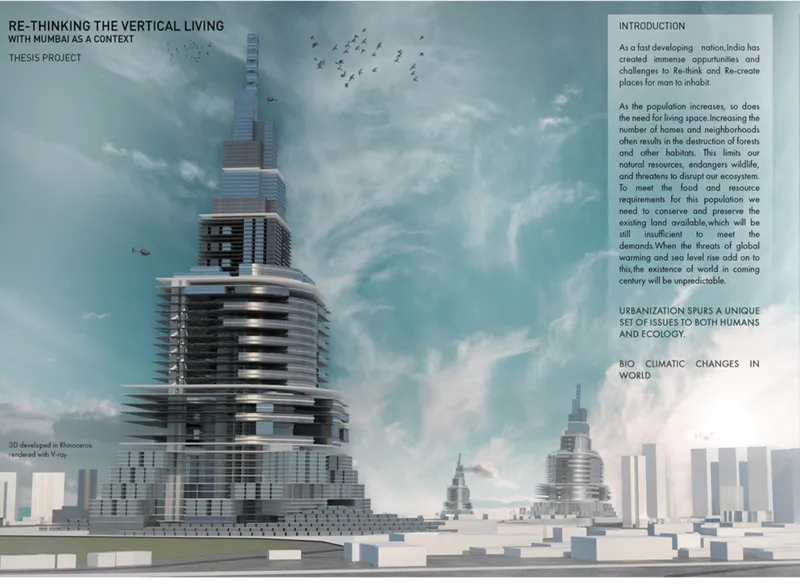
Urbanisation and the Crisis of Horizontal Expansion
Mumbai’s continuous horizontal expansion has resulted in the destruction of natural ecosystems, loss of wetlands, and increased pressure on infrastructure. As population density rises, the traditional low-rise urban model proves unsustainable. Urban sprawl increases commute times, energy consumption, and dependence on road-based transportation, while simultaneously consuming valuable land resources.
This project positions vertical living as a necessary evolution of urban form: one that responds to climate change, land scarcity, and social fragmentation. By intensifying land use vertically, the city can preserve open spaces, protect ecological systems, and accommodate growth more efficiently.
Mumbai as Context
Mumbai was selected as the primary context due to its extreme population density, limited developable land, and ongoing construction of high-rise residential and commercial towers. The city’s geography, bounded by the sea and protected ecological zones, further intensifies the need for vertical solutions.
Through mapping and data analysis, the project identifies potential growth centres across the Mumbai Metropolitan Region. Excess population projections are distributed strategically into these centres, forming a network of vertical urban nodes connected through public transportation systems. This decentralised yet connected approach reduces pressure on the city core while enabling sustainable growth.
Concept: Vertical Living as an Urban Ecosystem
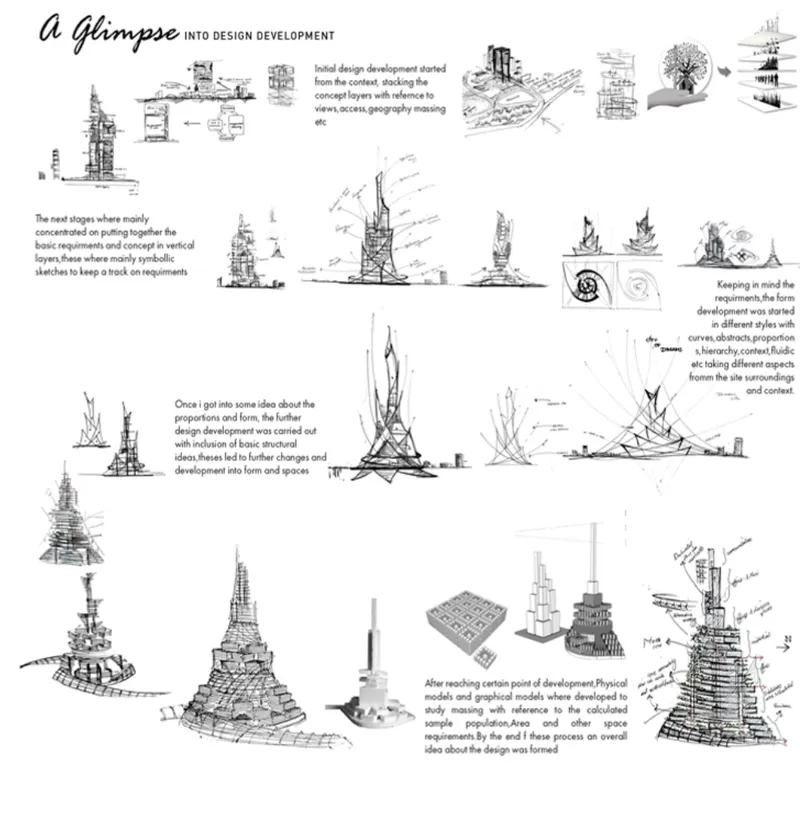
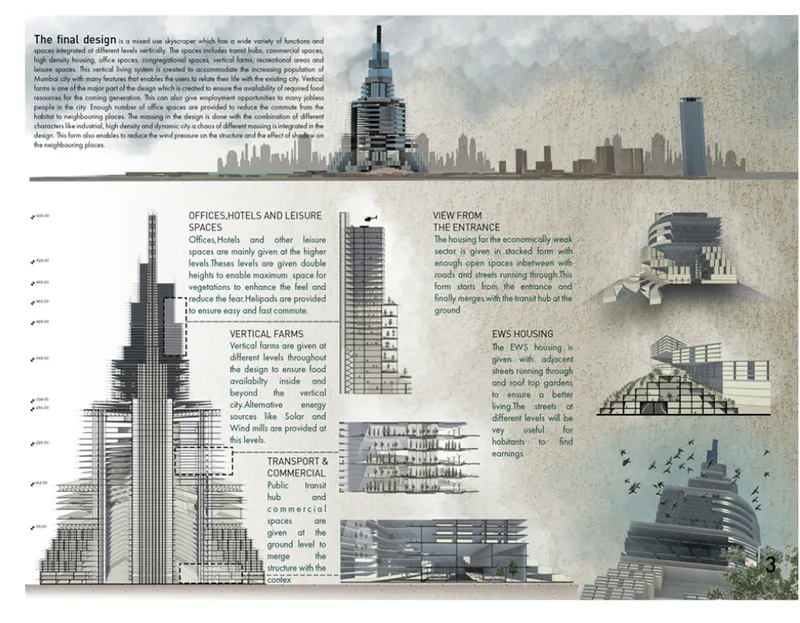
At the heart of the proposal is the idea of a mixed-use vertical city, a skyscraper that functions as a self-sustaining organism. Instead of segregating functions horizontally across the city, the tower layers them vertically, creating proximity between living, working, recreation, and food production.
Key programmatic components include:
- Residential zones for diverse income groups
- Offices, hotels, and commercial spaces
- Vertical farms integrated at multiple levels
- Public and semi-public recreational platforms
- Transport and transit hubs at ground and lower levels
This integration reduces daily travel distances, lowers energy consumption, and fosters social interaction within the vertical community.
Sustainable High-Rise Architecture Strategies
The project employs multiple sustainability strategies aligned with the principles of sustainable high-rise architecture:
- Land Conservation: Vertical density minimizes horizontal land consumption, preserving green and open spaces.
- Energy Efficiency: Reduced travel distances, integration of renewable energy sources such as solar and wind, and passive climatic design lower overall energy demand.
- Vertical Agriculture: Food production within the tower enhances food security and reduces dependence on long supply chains.
- Public Transport Integration: Vertical growth centers are connected through transit networks, reducing reliance on private vehicles.
- Climate Responsiveness: Building form and orientation are designed to optimize daylight, ventilation, and thermal comfort.
Architectural Form and Spatial Organisation
The architectural language of the tower evolves from its programmatic logic. A strong central core houses primary structural and service elements, while secondary cores and floor plates adapt to different functional requirements. Floor plates expand and contract vertically, responding to program density, structural needs, and environmental conditions.
Public and communal spaces are distributed throughout the height of the building, breaking the monotony of vertical isolation and ensuring continuous social engagement. The form gradually transitions from a dense base to lighter upper levels, visually anchoring the structure within the city skyline.
Social Integration and Inclusive Living
A critical aspect of the project is its focus on social inclusivity. Housing typologies cater to economically diverse populations, including EWS housing integrated within the vertical framework. Public streets, plazas, and gardens are reinterpreted as elevated communal platforms, ensuring that social life is not confined to ground level.
By stacking urban functions vertically, the project challenges conventional notions of neighborhoods and redefines community living in high-density environments.
Re-Thinking the Vertical Living proposes a future-ready model for Mumbai that balances density, ecology, and social life. Through sustainable high-rise architecture, the project demonstrates how vertical urbanism can become a tool for land conservation, environmental responsibility, and inclusive growth.
Rather than viewing skyscrapers as symbols of congestion, the project reframes them as vertical cities: capable of supporting human life, ecological systems, and urban resilience within a single architectural framework.


Popular Articles
Popular articles from the community


Conexión: Biophilic Design Reimagines High-Rise Living in Hong Kong
Conexión reimagines high-rise living in Hong Kong through biophilic design, green facades, shared spaces, daylight, water and nature within.

Co-Life: Senior Housing Design That Reconnects Older Adults With the City
Co-Life reimagines senior housing design through healing gardens, shared streets, workshops, and a sustainable community across generations.

The Ocean Hive: Sustainable Architecture for a Self-Sufficient Civilization at Sea
The Ocean Hive imagines sustainable architecture at sea, where modular habitats, algae, wave power and ocean waste sustain a growing colony.

Lunar Spiral: Space Architecture Shaped by the Mathematics of the Universe
Lunar Spiral reimagines space architecture through Fibonacci geometry, lunar regolith, levitating habitats, and self-sustaining Moon living.

Similar Reads
You might also enjoy these articles

Eco Chapel: A Green Architecture Pavilion Designed in Symbiosis with the Forest
Eco Chapel uses green architecture to weave prayer, learning and reuse into a forest pavilion shaped by modular hexagonal canopies for life.
Kaffeebühnen: Coffee Shop Architecture Designed as a Civic Stage Between Vienna’s City and Park
Kaffeebühnen turns coffee shop architecture into a civic stage, linking Vienna’s park edge, urban life, warm timber yards, and coffee craft.
Healing Façade: Sustainable Architecture for Reforestation, Community, and Sacred Ecology in Ethiopia
Healing Façade reimagines sustainable architecture as a living wall that restores soil, catches water and renews Ethiopia's forest churches.


Urban Forest: A Vertical Ecosystem for 5,000 Workers in Singapore's Changi Business Park
Radially stacked pods and layered green decks turn a 7-acre plot into 47 acres of ecological workspace projected for 2040.

Comments (0)
Please login or sign up to add comments
No comments yet. Be the first to comment!