
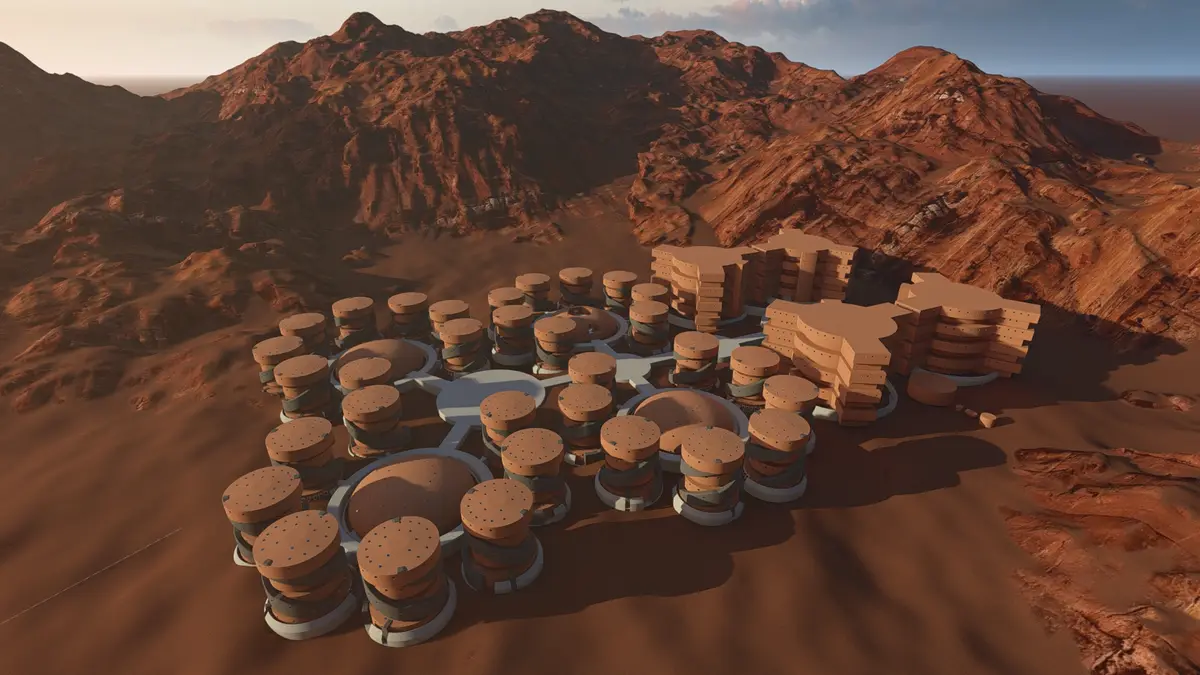
Red Planet Renaissance
The project aims to create sustainable Martian habitats using innovative materials and construction methods, focusing on human-centric design for well-being and integrating ethical architecture to add

1. Introduction
The "Red Planet Renaissance" design thesis project aims to create sustainable habitats on Mars, incorporating space science, engineering, and environmental psychology, promoting sustainability and enhancing Martian settlers' quality of life.
2. Background of the Project
The "Red Planet Renaissance" design thesis project aims to create a sustainable, human-centered architectural framework for Mars habitation, integrating advanced materials, sustainable practices, and biophilic design principles to promote long-term sustainability.
3. Scope and Limitation
The project aims to create innovative Martian habitats using advanced technology, sustainability, and ecological considerations. It integrates historical insights and contemporary advancements, addressing challenges beyond Earth's boundaries. However, it faces challenges in balancing earth architectural insights with modern advancements.
4. Thrust Area
The project focuses on developing sustainable Martian habitats, utilizing innovative materials and construction methods for resilience and efficiency in the unique environment. It also prioritizes human-centric design for well-being, enhancing the psychological and physical well-being of Martian residents. The project also integrates ethical architecture in an extra-terrestrial context, addressing environmental impact and fostering responsible human presence on Mars.
4.1. Material Science
Figure 9.1 – Material Science Mapping
4.2. Minimalism
Figure 9.2 – Minimalism Mapping
4.3. Environmental Conditions
Figure 9.3 – Environmental Conditions Mapping
5. Site
5.1. Hellas Planitia – South Pole Site
Hellas Planitia offers architects a strategic opportunity to utilize the expansive impact basin, but must navigate environmental challenges and limited resources for feasibility and sustainability.
Pros: Large Impact Crater; Low Elevations; Space for Infrastructure; Terraforming Potential
Cons: Limited Natural Resources; Communication; Challenges; Gravity Differences; Transportation Challenges
Figure 12.4 – Hellas Planitia
5.2. Elysium Planitia – Equator Site
Elysium Planitia, Mars' second-largest volcanic region, spans 1,700 by 2,400 km and is influenced by its unique water and lava flows, creating a captivating plain.
Pros: Water Resource Potential; Flat Terrain; Potential for Geological Studies, Strategic Location
Cons: Limited Atmospheric Conditions; Remote Location; Transportation Challenges
Figure 12.5 – Elysium Planitia
5.3. Arcadia Planitia – North Pole Site
Arcadia Planitia, near Mars' North Pole, offers level terrain for habitat construction and access to water ice deposits for long-term habitation due to its proximity.
Pros: Resource Utilization; Abundant Energy: Radiation Protection
Cons: Limited Human Adaptability: Communication Lag; Extreme Environmental Conditions
Figure 12.6 – Arcadia Planitia
6. Concept
The Tensegrity design concept is a pioneering approach for Mars human habitation, utilizing a balance of tension and compression elements to create resilient and adaptive frameworks. Drawing inspiration from cellular structures, it provides stability and flexibility.
Tensegrity’s potential for Martian habitats lies in its ability to address the unique challenges of the Red Planet, creating lightweight yet robust structures capable of withstanding Mars’ harsh conditions.
This concept aligns with ongoing research, such as NASA’s exploration of tensegrity approaches for in-space growable habitat construction.
Figure 13.1 – Tensegrity Structure
Tensegrity design, a versatile architectural approach, has practical applications in building structures on Earth and Mars. It addresses structural requirements, sustainability, efficiency, and adaptability, aligning with the goals of future human endeavors on the Martian frontier.
A 3D printing process has been developed to create tensegrity structures using smart materials. These structures consist of monolithic tendon networks and struts, with twisted prisms forming tower tensegrity. The structure-level mechanics can be programmed using different hexagonal prisms. Tensegrity structures, including icosahedrons, auxetics, and cylindrical tensegrity, contain 30% magnetic particles, allowing them to deform under a magnetic field.
Tensegrity structures, composed of stiff struts and flexible tendons, offer high stiffness-to-mass ratio, controllability, reliability, structural flexibility, and large deployment.
Figure 13.2 - Fabrication process of the tensegrity structure and mechanical features of its elements
Figure 13.3 - Transformation and mechanical properties of cylindrical tower tensegrity structures with different design parameters
Architects are designing Martian habitats using the golden ratio principle, a geometric design that combines functionality and aesthetics. This approach aims to create habitats that integrate with the Martian environment, incorporating the golden ratio's inherent harmony and incorporating mathematical elegance to create visually appealing structures.
Figure 13.4 – Shell
The Fibonacci sequence and golden ratio are crucial principles for architects in Martian habitat design. They aim to achieve structural integrity, aesthetic finesse, balance, efficiency, and proportionality. This approach aligns with golden ratio applications in arts, mathematics, and interplanetary habitation, creating visually captivating and functional structures.
Figure 13.5 – Golden Ratio
Figure 13.6 – Shell Structure Exploded
The plan involves selecting materials suitable for Mars' conditions, processing them into 3D printing-compatible forms, setting up robotic 3D printers, layering the 3D printer in Martian soil, and post-processing and inspection to refine the shell structure, inspect for imperfections, and implement additional measures for resilience against Mars' harsh conditions.
This comprehensive process addresses the intricacies of 3D printing shell structures on Mars, emphasizing adaptability and robustness to create sustainable habitats.
The Luban Lock, inspired by Luban puzzles, is a Martian habitat design that combines traditional craftsmanship with modularity. The interlocking habitat units allow for easy assembly, disassembly, and reconfiguration, overcoming logistical challenges and accommodating changing Martian landscape needs, thereby creating functional living spaces.
Figure 13.7 – Luban Lock
Luban Lock, a Martian habitat, prioritizes structural resilience and human-centric design. Its interlocking design provides stability and strength, withstands low gravity and temperature extremes.The design also promotes ergonomic, comfortable spaces for Martian inhabitants, fostering a sense of community and promoting social interaction.
Figure 13.8 – Types of Tenon Joints
The Luban Lock, a design concept for Martian habitats, is adapted to suit the unique Martian environment, using in-situ Martian regolith for 3D printing. The structures feature interlocking designs for efficient assembly, promoting rapid construction and adaptability to diverse landscape conditions. This low-cost, structurally resilient, and environmentally friendly construction solution offers a sustainable living space.
7. Conclusion
The Red Planet Renaissance Design Thesis Project aims to create sustainable, resilient habitats for Martian colonization, incorporating advanced technologies like 3D printing and autonomous construction systems. It focuses on community and psychological well-being, inspiring future architects and transforming Mars into a new civilization frontier.


Popular Articles
Popular articles from the community


Jaramillo Van Sluys Arquitectura and Urbanismo Turn a Demolished Registry Lot in Quito into an Orchard Plaza
In Quito's Centro Histórico, a 2,800 m² plaza exposes the San Agustín convent wall and redraws its lost Augustinian orchard in volcanic stone.

U.GA Architects Wraps an Oval Rooftop Pool in Curved Board-Formed Concrete on Busan's Jeollidan-gil
In Busan's Jeonpo-dong, a 454 m² mixed-use block stacks a neighborhood facility, guest rooms and an oval rooftop pool inside spiraling concrete walls.

Cube Design Draws an Ecological Corridor Between Two Shenzhen Hills with the Nankai Building
Beside Shenzhen's container docks, the Nankai Building pairs stacked balconies with a climbing green screen to connect two hillsides across its height.

Architekt Andreas Gruber Scatters 23 Dark Timber Chalets Across a South Tyrolean Forest Edge
In Molini di Tures, Amonti Chalets breaks a resort into a hamlet of gabled timber houses, with parking, storage and services pushed into the slope.

Similar Reads
You might also enjoy these articles
The Rhythm of Seasons
A Farmers' Market Connecting Nature and the City

More Than a Building-Designing a Living System
More Than a Building-Designing a Living System
Base Beyond
DESERT COMPOUND ARID: TOURISM OF ABSENCE AND ABUNDANCE

Explore Mars Competitions
Discover active competitions in this discipline


Challenge to reimagine the Iron Throne

Photograph architecture without architects

Illustrate the lost glory of Angkor Wat - Render Challenge

Design challenge to reuse E-waste
Comments (0)
Please login or sign up to add comments
No comments yet. Be the first to comment!