Reforest.comm
Community reintegrate with amazon forest.

The starting point in shaping the idea was inspiration from three archetypes of Brazilian architecture: maloca, stilt house and favela.
Maloca as a housing unit where indigenous people lived and as an example of sharing space between several families
Stilt houses as an example of adaptation to ground and topographic conditions
Favelas as a growing and adapting structure and an example of vibrant communities with strong interpersonal ties.
The form and construction of the unit give the possibility of adding or removing residential modules, as well as changing the level of the co-living space. For example, to enable people with disabilities to access the apartments and kitchens from the ground floor.
The skeletal structure of the building allows adaptation to the topography of the area in the case of a residential complex consisting of several units
Individual living units are arranged around the common kitchens.
One module is designed for a family of 4 people, while when two modules are connected vertically, a module for a family of 8 people can be created.
A compact residential complex
- Coliving as an answer to the limited area of land - common spaces for the inhabitants of a given "nest" - common kitchen and dining room
- compact terraced houses with 3 residential floors
Context - forest
- tall trees
- vegetation climbing up the façade
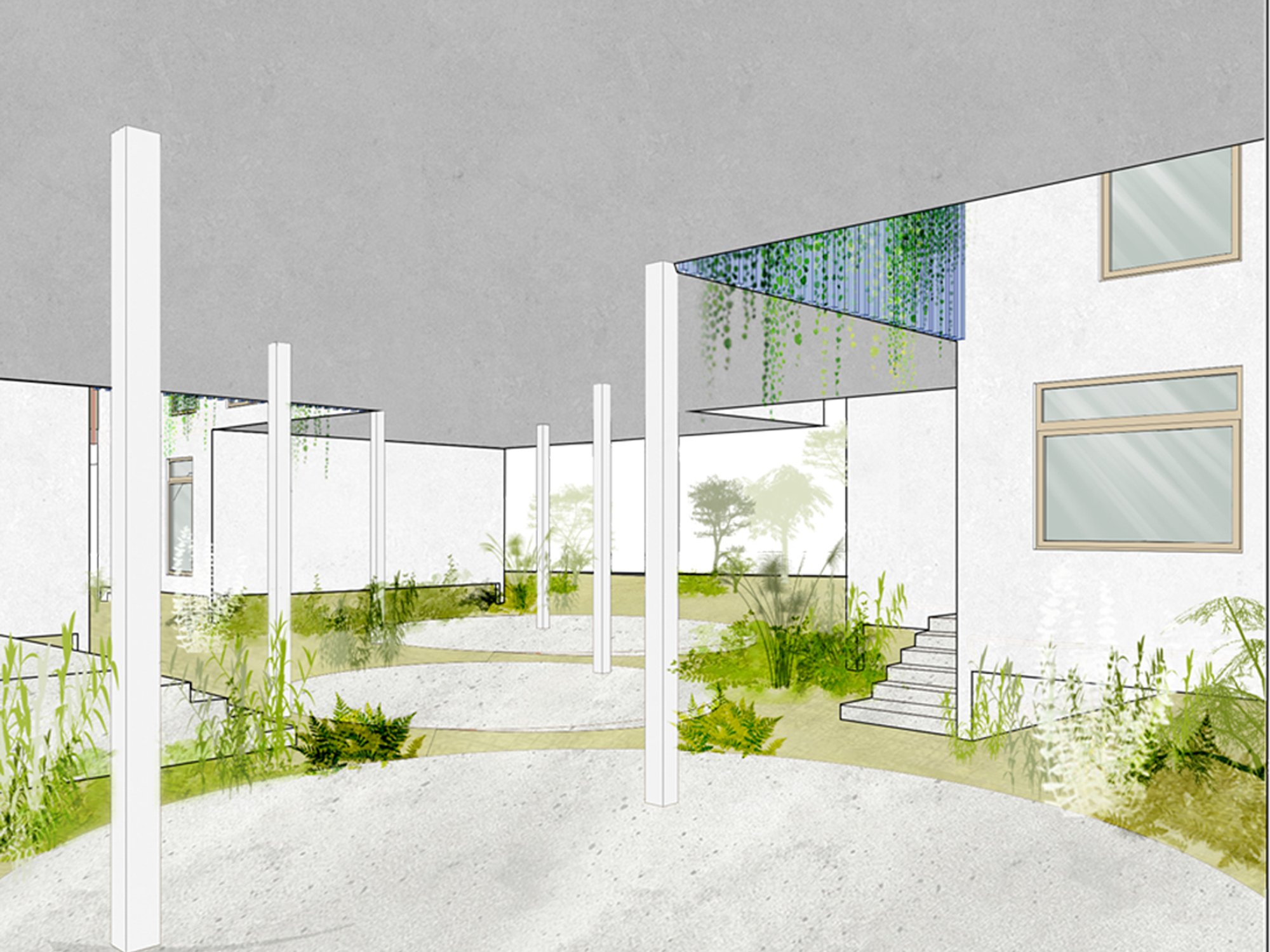
- vegetation extending under buildings raised on poles, which does not require much sunlight
- land for cultivation of residents
Response to climatic factors
- tall canopy trees growing above the structure of the building, shading the surfaces of walls and roofs
- spaces protected from the sun and rain in the central part of the structure thanks to raised kitchen sections and removed dwelling modules on the ground floor
- The removed modules in the ground floor are intended to create open spaces and passages, improve the natural ventilation of the area, increase the biologically active area and create shaded spaces where residents can rest and spend time
Social aspect
- By creating a co-living space, not only does it save space that can be used for more green areas, but also close communities are created within the unit. Families can support each other in terms of caring for children or the elderly or any kind of neighborhood activities