
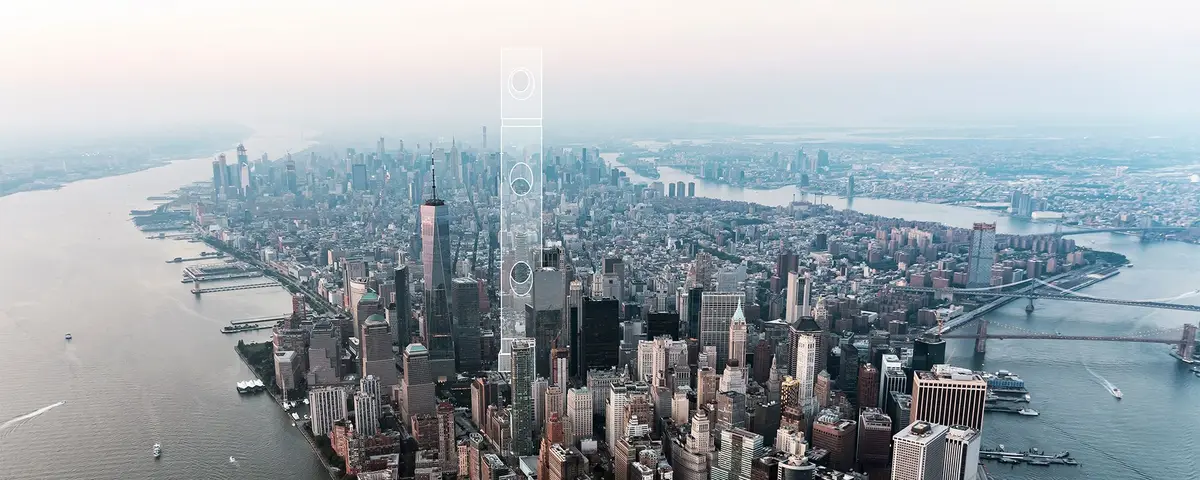
Federal Office Tower: Re-Architecture for Manhattan
A supertall built on top of a preserved historic building in Manhattan, with oval sky forests, fly hubs, and a re-architecture philosophy.


The most provocative idea in this project is not the flying cars. It is the base. The Federal Office Tower, designed by Poulpe Studio (Amanda Suriz, Arthur Chrysostomo, and Luka Bader), begins with an existing building: the historic Federal Office Building in Manhattan. Instead of demolishing it, the project preserves it and builds a supertall tower on top. Re-architecture, not new architecture.
Shortlisted in the Hybrid Futures '19: Work x Fly competition on uni.xyz, the project proposes a tower that dwarfs One World Trade Center, integrates fly hubs for drones and flying vehicles, and carves oval sky forests into its facade. It is one of the most architecturally complete entries in the competition because it starts from a real building and works upward.
Re-Architecture: Building on What Exists
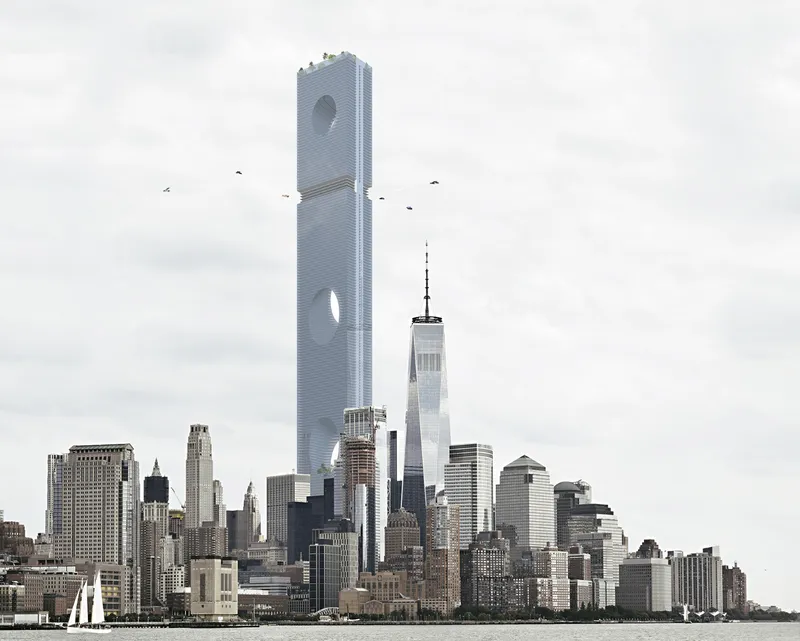
The tower sits on top of the existing Federal Office Building in Lower Manhattan. The historic structure is preserved: its columns, vaulted ceilings, and public spaces remain intact at ground level. The new tower grows from this base, rising in phases from the original footprint to a supertall that redefines the skyline.
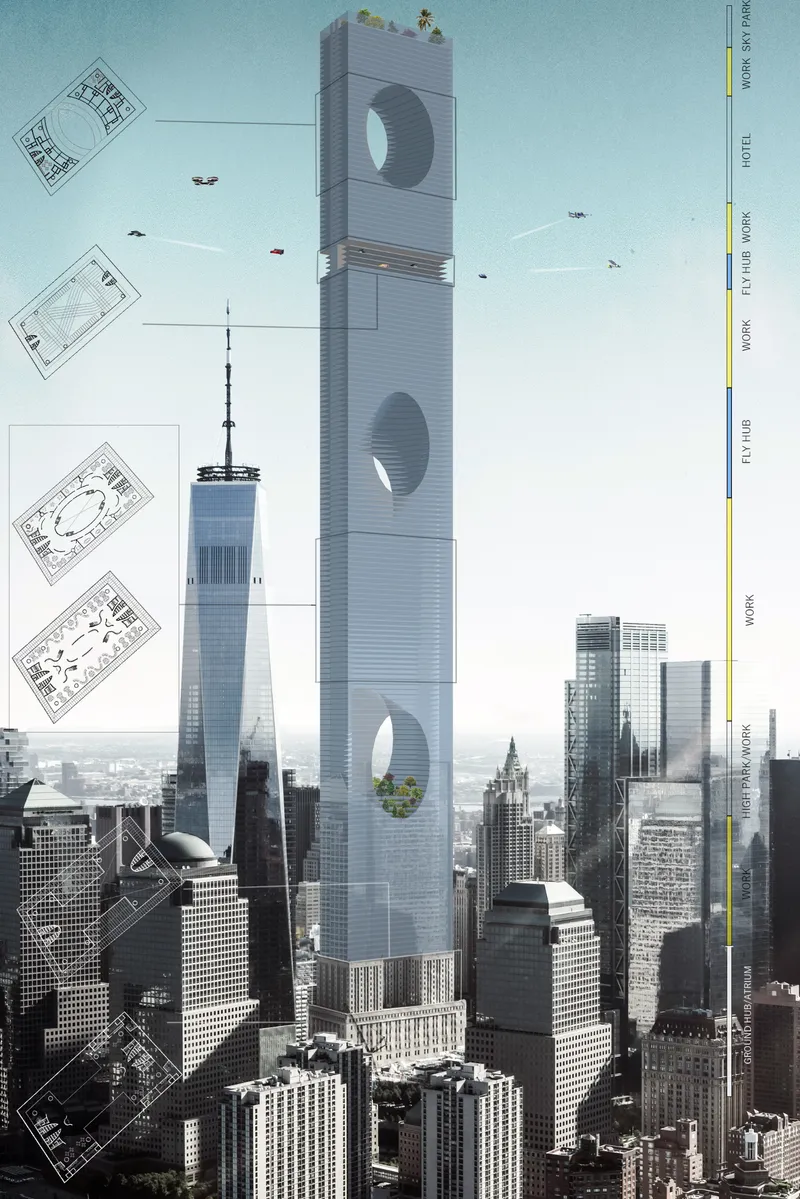
The annotated elevation shows how programme stacks vertically: the historic base at the bottom, then a fly hub for short-range air mobility, work floors, a second fly hub for long-range travel, a hotel, more work floors, and sky parks at the top. Floor plans at each level show how the programme adapts: some floors are open offices, others are double-height fly hubs, others are landscaped voids.
The Assembly: How the Tower Is Built
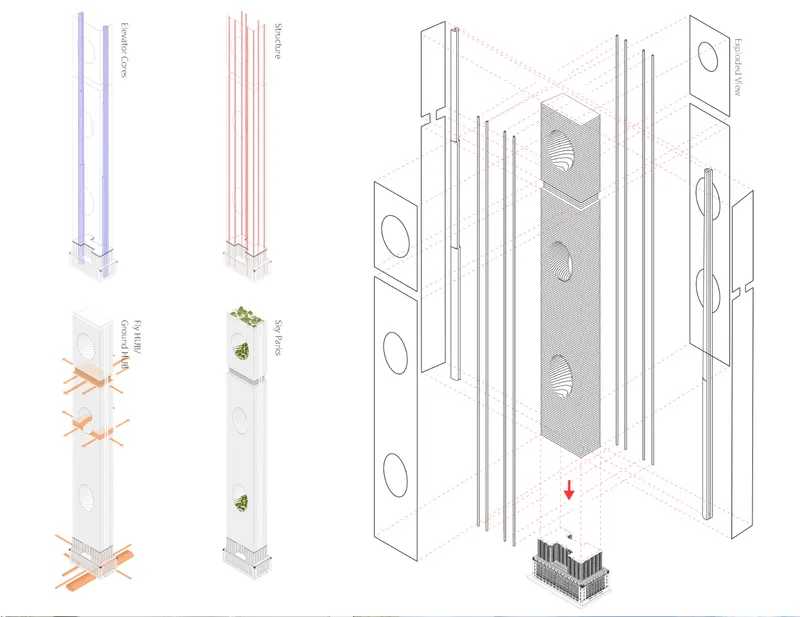

The exploded axonometric reveals the construction logic. Transit cores provide the vertical spine. Fly hub platforms cantilever from the cores. Sky forest levels are inserted at intervals, each one an oval void carved through the building's mass. Facade panels wrap the exterior. And at the very bottom, the historic Federal Office Building sits as the foundation.
The growth phases show how this works in practice. The existing building is retained as Phase 1. The tower core is built in Phase 2. Programme floors are added in Phase 3. Sky forests are inserted in Phase 4. The building is never demolished and rebuilt. It grows, which is the definition of re-architecture.
Sky Forests: Green Voids in the Mass
The oval voids are the tower's most distinctive feature. They are not windows. They are outdoor spaces: full sky forests with trees, planting, and open-air terraces, carved through the building's volume at several points along its height. The skyline view shows these voids as dark ellipses in the pale facade, with vegetation visible inside.
The sky forests serve three purposes. They provide daylight and fresh air to the floors adjacent to them. They reduce wind loading by allowing air to pass through the building rather than around it. And they give the tower a visual identity that no amount of facade treatment could achieve. The voids are the architecture.
Fly Hubs and the Future Office
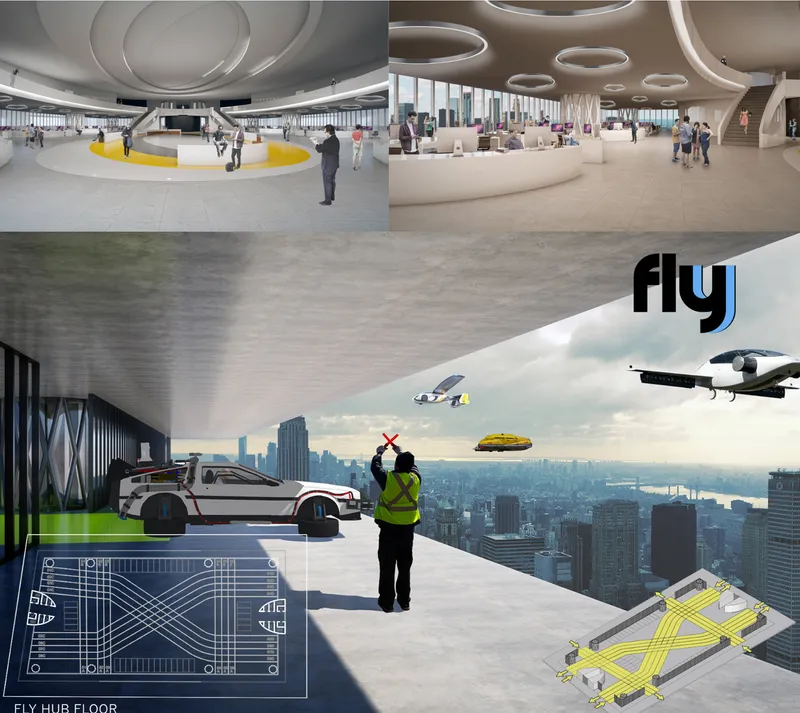
The interior renders show two spatial conditions. The office floors have oval ceiling openings, curved furniture, and a bright, open atmosphere. The fly hub level is something else entirely: a hangar-like space where vehicles park, a runway marshall directs incoming drones, and a landing platform sits at the building's edge with the Manhattan skyline behind.
The fly hub is not a helipad. It is a floor. It has a plan, a section, and a programme. Vehicles arrive, park, and are serviced. Passengers transit to offices or hotels above. The hub is integrated into the building's vertical circulation the way a parking garage is integrated into a conventional tower. This normalisation of air mobility within the building section is the project's most practical contribution.
Why This Project Matters
Most competition entries for Hybrid Futures started from scratch: new sites, new buildings, new technologies. The Federal Office Tower starts from a real building in a real place and asks how it can grow to accommodate a future that includes flying vehicles. This is a more useful question than building from zero because it applies to every existing city, not just to blank sites.
The re-architecture philosophy is the project's lasting contribution. Cities are full of buildings that work but are not enough. The Federal Office Tower proposes that the answer is not demolition but growth: preserve what exists, build on top, and insert new programme where the old structure cannot provide it. This is speculative, but it is also pragmatic.
View the Full Project
About the Designers
Studio: Poulpe Studio (Amanda Suriz, Arthur Chrysostomo, Luka Bader)
Enter a Design Competition on uni.xyz
If re-architecture, adaptive reuse, or hybrid building typologies are the kind of work you want to explore, uni.xyz runs competitions year-round that reward projects grounded in real sites and real questions.
Project credits: The Federal Office Tower by Poulpe Studio (Amanda Suriz, Arthur Chrysostomo, Luka Bader). Shortlisted, Hybrid Futures '19: Work x Fly (uni.xyz).


Popular Articles
Popular articles from the community


Co-life: Sustainable Architecture for Age-Friendly Community Living
Co-life reimagines sustainable architecture for seniors through courtyards, rammed earth, shared gardens, and spaces designed for belonging.

Conexión: Biophilic Design Reimagines High-Rise Living in Hong Kong
Conexión reimagines high-rise living in Hong Kong through biophilic design, green facades, shared spaces, daylight, water and nature within.

Little Red Riding Hood: Architectural Design as a Journey Through Fear, Light, and Storytelling
Little Red Riding Hood reimagines the fairy tale through architectural design shaped by fear, light, scale, memory, uncertainty, and choice.

Co-Life: Senior Housing Design That Reconnects Older Adults With the City
Co-Life reimagines senior housing design through healing gardens, shared streets, workshops, and a sustainable community across generations.

Similar Reads
You might also enjoy these articles

Day and Night Park: A Time-Based Urban Newsstand in Beijing
A temporary urban newsstand in Beijing blending travel, light, and reading through poetic colors, compact form, and community-focused design.

Modernist Patio Renovation in El Masnou, Barcelona by Oliver Segura Arquitectura + Cebrià Arquitectura
Modernist patio renovation blending tradition and innovation with a movable pool, leveled floors, and Catalan materials in El Masnou.

Alto Residencial Coop: Cooperative Housing Development in Santiago de Compostela by Carbajo Barrios Arquitectos
A linear cooperative housing complex blending white volumes and perforated metal façades, enhancing community living, natural light, privacy, and urban integration.

Vil Genis School by BPA ARCHITECTURE – Massy, France
Vil Genis School in Massy, France, features sustainable design, south-facing classrooms, community integration, accessible spaces, and modern educational architecture.

Explore High Rise Building Competitions
Discover active competitions in this discipline

Challenge to design locus for the upliftment of human rights

Design challenge to reuse E-waste
Comments (0)
Please login or sign up to add comments
No comments yet. Be the first to comment!