
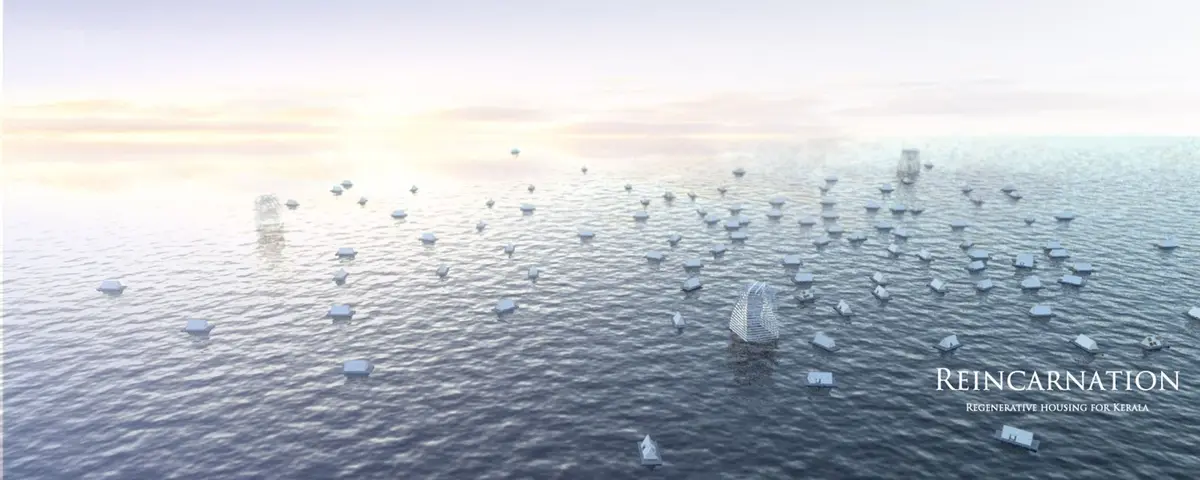
Reincarnation: Floating Bamboo Housing That Dissolves and Reforms with Kerala's Floods
A modular bamboo architecture system that disperses during floods and regroups after, merging drone rescue technology with cultural refuge.


What if a house could behave like a magnet ball: scatter under force, drift with the current, then snap back together and reform stronger than before? That is the premise behind Reincarnation, a floating architecture proposal for flood-prone Kerala that treats rising water not as a destructive enemy but as a medium for regeneration. The project replaces the conventional logic of resistance with one of dissolution and reassembly, proposing bamboo-framed modular homes lifted on buoyant oil-barrel foundations that rotate, drift, and regroup as floodwaters recede.
Designed by Hose Q and shortlisted in the HEAL+ competition, Reincarnation folds together bamboo construction, drone-enabled rescue logistics, and the spiritual anchoring of Kerala's cultural identity into a single system. It is a proposal that refuses to separate the material facts of disaster resilience from the emotional and communal dimensions of surviving one.
Dispersal and Reassembly as a Building Cycle
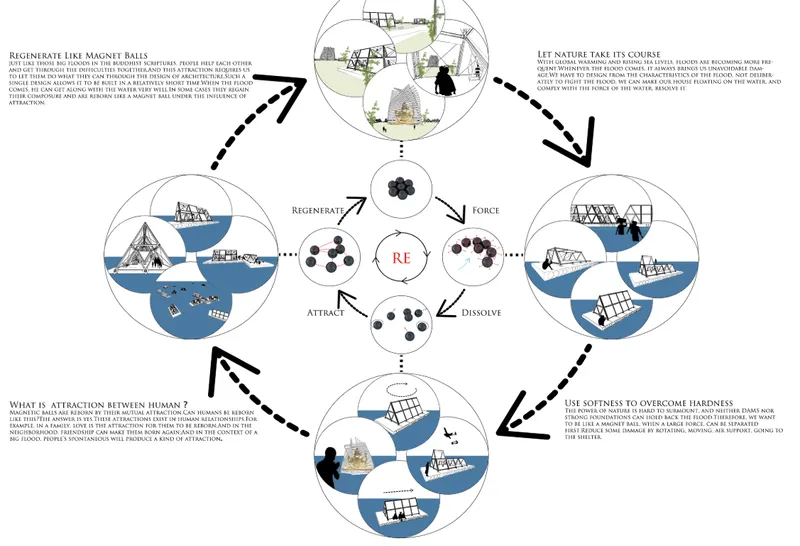
The regenerative cycle diagram reveals the central logic of the project: housing is not a fixed object but a living system. Circular nodes map the process from flood dispersal through natural drift, individual unit survival, and eventual community regrouping. The metaphor of magnet balls is literal here. Individual floating units separate under hydrological pressure, each maintaining its own buoyancy and habitability, then attract and reconnect post-flood to reconstitute neighborhoods. It is a deliberate inversion of conventional disaster response, which typically treats displacement as failure. Here, displacement is designed into the system as a survival mechanism.
Philosophically, the project draws from ecological and Buddhist principles, framing softness as a strategy to overcome hardness. Floods are not fought; they are absorbed. The architecture regenerates in rhythm with the water's own cycle, giving the project its name: Reincarnation.
Bamboo Modules and Drone Deployment
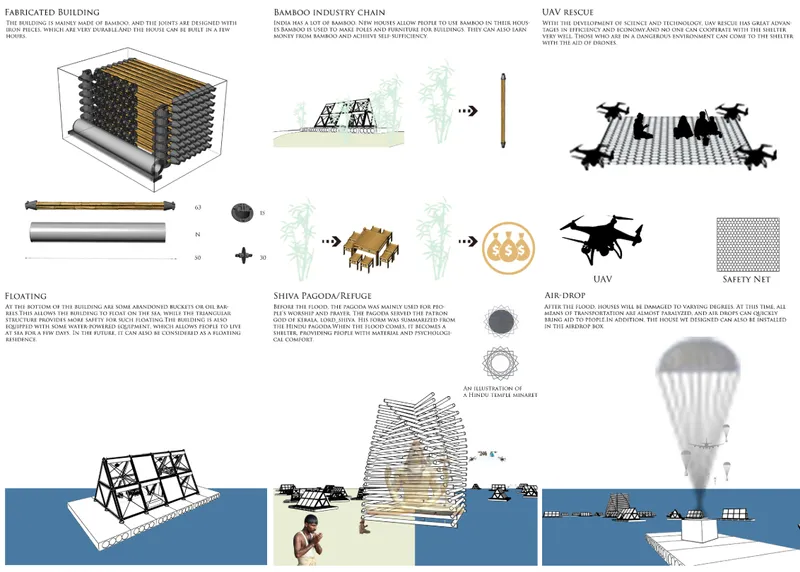
The exploded assembly drawing is where the proposal gets technical. Prefabricated bamboo modules are designed for rapid construction using locally abundant material chosen for its strength, flexibility, and sustainability. The drawing sequences the construction logic from frame to cladding, but it also introduces something unexpected: a UAV deployment protocol integrated directly into the housing system. Drones equipped with safety nets perform rescue operations, while airdrop systems deliver food, medicine, and essential supplies when road infrastructure is submerged.
The pairing of bamboo craftsmanship with drone logistics is not decorative futurism. It addresses a real gap in Kerala's flood response, where blocked transport routes leave communities isolated for days. By embedding the rescue infrastructure within the housing system itself, the project collapses the usual separation between shelter and emergency response into a single operational framework.
A Warm Interior Held Together by Rope and Timber
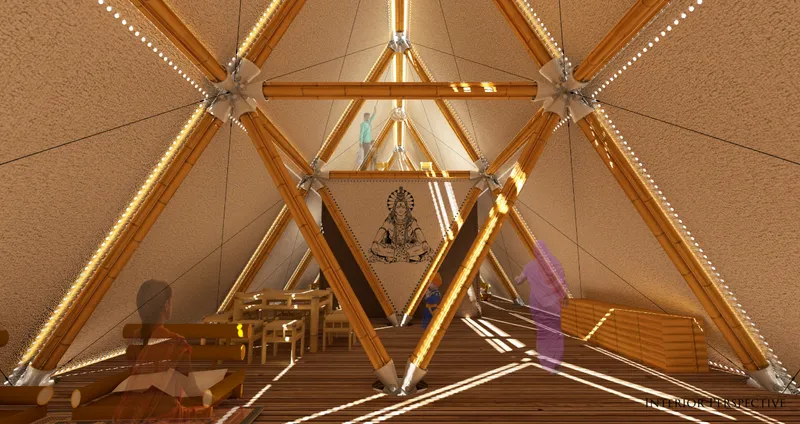
The interior rendering is perhaps the most quietly powerful image in the project. Inside a triangular bamboo-framed space, warm artificial light fills a room held together by rope joints. There is no steel, no concrete, no pretense of permanence. The joinery is visible, honest, and intentionally designed for replaceability: damaged bamboo elements can be swapped out without dismantling the whole structure, extending the building's lifespan through cycles of damage and repair.
This interior also gestures toward the cultural dimension of the proposal. The project includes a Shiva Pagoda Refuge, a structure that functions simultaneously as temple and shelter, providing spiritual grounding and communal gathering space during disasters. Resilience, the project argues, is not only material but emotional. The warmth of this interior is not incidental; it is a design position about what survival should feel like.
Structural Framework and Material Vocabulary
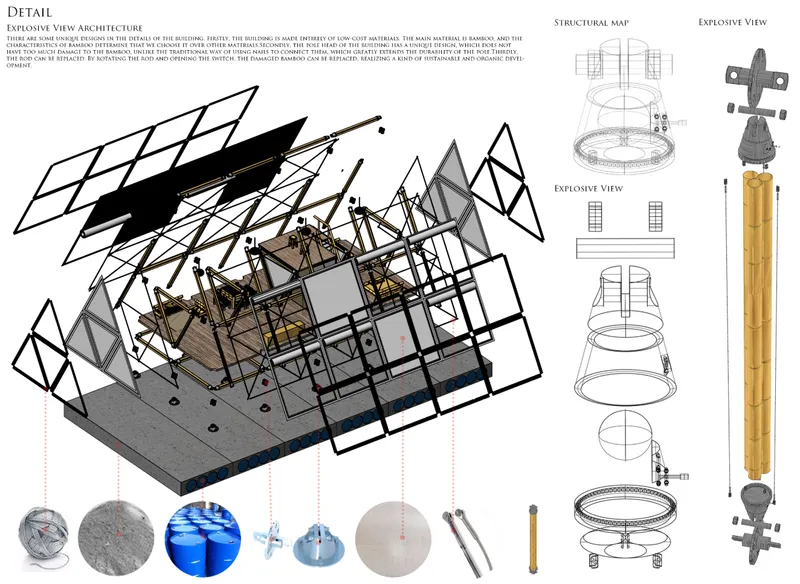
The final axonometric drawing lays bare the structural framework alongside material samples and component details. This is where the bamboo industry chain becomes visible: the project envisions not just housing but an entire economic ecosystem around bamboo production, including furniture, poles, and construction materials. Economic self-sufficiency is baked into the architecture. The community that builds these homes also builds an industry around the material that constitutes them.
The innovative joinery systems detailed here reinforce the logic of replaceability. Rather than designing for a single lifespan, the structure is designed for continuous partial renewal. A damaged joint or fractured member does not condemn the house; it triggers a localized repair. This is regenerative thinking applied at the level of the connection detail.
Why This Project Matters
Reincarnation matters because it reframes the question that disaster-resilient housing usually asks. Instead of "how do we keep water out?" it asks "how do we live with water in?" The answer is a system, not a building: modular, buoyant, culturally grounded, economically generative, and technologically augmented. It is a proposal that treats community dispersal as a designed feature rather than a catastrophic outcome, and that sees reassembly as an act of architectural regeneration.
For flood-prone regions across South and Southeast Asia, the implications are significant. Hose Q's proposal suggests that the future of resilient housing lies not in harder walls but in softer systems, ones that bend, float, scatter, and reform. It is an architecture of adaptation rather than fortification, and it carries the rare conviction that surviving a disaster should not require abandoning culture, community, or dignity.
View the Full Project
About the Designers
Designer: Hose Q
Enter a Design Competition on uni.xyz
uni.xyz runs architecture and design competitions year-round that reward proposals with spatial conviction and real site intelligence.
Project credits: Reincarnation by Hose Q HEAL+ (uni.xyz).


Popular Articles
Popular articles from the community


ETEH Reworks the Shared Spaces of São Domingos School in Brazil Around Timber, Color and Hanging Plants
At São Domingos School in Brazil, 436 m² of hall, refectory and library are recast with timber joinery, a yellow and blue code and trailing greenery.


Manzana Morphosis: Stretching Barcelona's Grid into a Living Landscape for 2050
A radical reworking of the Eixample manzana turns density into a tool for generous public space, vertical ecology, and environmental performance.

FCC Arquitectura Expands a Portuguese Granite House with a Board-Marked Concrete Wing
In Portugal, JV House pairs a cleaned-up whitewashed and granite dwelling with a timber-shuttered concrete extension, courtyards and a garden pool.

Singing Woman: An Opera House That Performs Before the Curtain Rises
Ovidiu Cristian Pavel's conceptual opera house translates Estonia's choral identity into a sculpted waterfront landmark facing the Baltic Sea.

Similar Reads
You might also enjoy these articles

Aquadapt: An Underwater Habitat That Rewrites Its Rooms by the Hour
Curved modules ring the seabed while one shell shifts from breakfast room to cinema, farm and football pitch as residents' needs change.

Play: Fragments of Their World: Remembered Architecture Rebuilt as a Modular Playground for Refugee Camps
Tom Gardner abstracts domes, arches and towers from the homelands of displaced families into a kit of child-scaled play parts for camp settlements.
REBIRTH: A Circular Settlement Where Afghan Widows and Their Children Rebuild Life Together
A shortlisted Resile entry turns the circle into a protective ring of timber and brick, gathering homes, classrooms and gardens around a shared landscape.
The Main Dream: A Recycled Plastic Kit That Lets Refugee Children Build Their Own Playground
Thirty-centimetre interlocking cubes that connect on three axes turn play into construction, letting children author the spaces they occupy.

Explore Kerala Floods Competitions
Discover active competitions in this discipline

Challenge to reimagine the Iron Throne

Photograph architecture without architects

Illustrate the lost glory of Angkor Wat - Render Challenge

Design challenge to reuse E-waste
Comments (0)
Please login or sign up to add comments
No comments yet. Be the first to comment!