

Peak Resilient Parking: Rethinking Manhattan's Waterfront as a Living System
A flood-resilient corridor on the East River transforms infrastructure into terraced parks, civic space, and ecological habitat.


What if the most vulnerable stretch of Manhattan's coastline became its most adaptive? Rather than fortifying the East River waterfront with static barriers, Peak Resilient Parking proposes a living urban system: a corridor of metallic, ribbon-like pavilions that absorb stormwater during floods, host markets and amphitheaters in fair weather, and weave ecological habitat directly into the city's infrastructure. It is architecture that refuses to sit still.
Designed by Ivan Rodriguez, John A, and Zack Husbands, this shortlisted entry to the Peak competition reimagines the East River site as both laboratory and civic model. At the crossroads of rising seas, aging infrastructure, and social inequality, the proposal positions architecture not as static form but as an organism that breathes with the city, integrating flood resilience, renewable energy, mixed-income housing, and biodiversity into a single interconnected framework.
Metallic Ribbons That Absorb the Storm
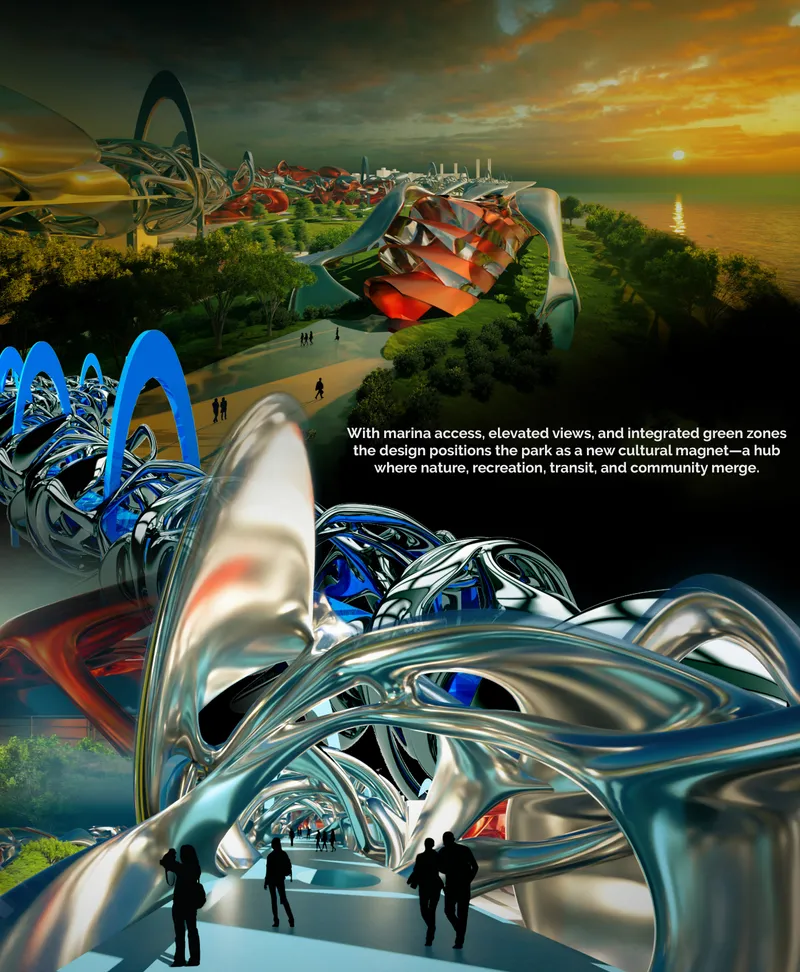
The aerial rendering captures the project's defining gesture: sinuous, metallic pavilion forms that wind through a waterfront park at sunset, their curving profiles echoing the tidal rhythms of the river they border. These are not ornamental sculptures. They house a flood-resilient recreational corridor, a multifunctional landscape where terraced parks and permeable surfaces absorb rainfall during storms, channeling stormwater through bioswales and retention systems that transform a threat into a resource. When the skies clear, the same terraces become amphitheaters, playgrounds, and open-air markets.
The design integrates AI-driven sensors that monitor flood levels, air quality, and structural performance in real time, while solar, wind, and geothermal systems push the neighborhood toward net-zero energy. Mobility is rethought too: autonomous shuttles, shared electric vehicles, and ferry terminals connect residents to the broader city while minimizing emissions. Elevated pathways and waterfront promenades prioritize the pedestrian, merging recreation with resilience at every turn.
Organic Canopies and Terraced Green Infrastructure

At ground level, the project reveals a second spatial logic. Curved organic canopy structures shelter terraced green planting, with pathways threading beneath them to create a pedestrian experience that blurs the boundary between built form and ecosystem. Green corridors, wetlands, and marine habitats reconnect residents with nature while encouraging biodiversity. The planting is not decorative; it is infrastructure, performing stormwater management, air filtration, and urban cooling simultaneously.
Beneath these canopies, the ground floor is populated with community centers, libraries, childcare facilities, and maker spaces, ensuring accessibility to essential services across all demographics. The housing model reflects social equity as an architectural principle: mixed-income clusters integrate affordable, market-rate, and supportive units without spatial segregation. Co-living and co-working typologies introduce flexibility for changing lifestyles, making inclusivity a spatial condition rather than a policy overlay.
Reading the System as a Whole
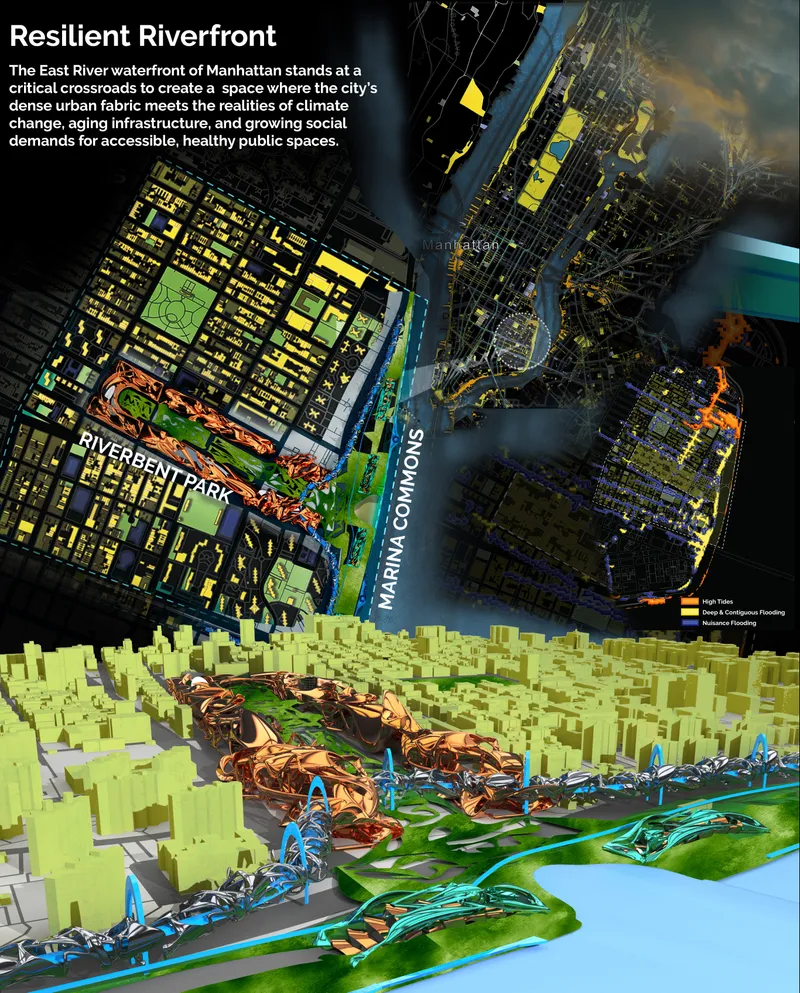
The axonometric diagram pulls apart the project's layers, combining plan view with elevated sculptural forms to reveal how each system, ecological, infrastructural, social, locks into the others. What reads as an expressive waterfront park in the renderings is, in section, a carefully calibrated stack: permeable surfaces on top, retention systems below, smart grids and renewable energy networks threaded through, and circular-economy strategies embedded at the material level. Construction materials are locally sourced, recyclable, and biodegradable, with building systems designed for disassembly and adaptive reuse to reduce waste over the project's lifetime.
Community composting, zero-waste markets, and innovation labs are woven into the civic infrastructure, empowering residents to participate in sustainable living rather than simply consuming it. The diagram makes legible a proposition that is easy to miss in the seductive renderings: every formal decision here is driven by performance, and every performance metric serves human well-being.
Why This Project Matters
Coastal resilience projects too often default to one of two modes: the hard-engineering barrier or the picturesque park. Peak Resilient Parking refuses both. By treating the East River waterfront as an intelligent, interconnected organism, Rodriguez, A, and Husbands propose that flood infrastructure, ecological habitat, social housing, and civic space are not competing programs to be balanced but facets of a single design problem. The ribbon pavilions are simultaneously stormwater buffers, public gathering spaces, and biodiversity corridors. Nothing here does just one thing.
As a shortlisted Peak entry, the project sits within a broader conversation about what 21st-century cities owe their most vulnerable edges. Its ambition is considerable, layering AI-driven monitoring, net-zero energy, circular-economy construction, and mixed-income housing into a cohesive urban vision. Whether or not every technology it invokes is immediately buildable, the core argument is sharp and timely: resilience is not a defensive posture. It is a design opportunity to make cities more generous, more ecological, and more equitable than they were before the flood.
View the Full Project
About the Designers
Designers: Ivan Rodriguez, John A, Zack Husbands
Enter a Design Competition on uni.xyz
uni.xyz runs architecture and design competitions year-round that reward proposals with spatial conviction and real site intelligence.
Project credits: Peak: Resilient Parking by Ivan Rodriguez, John A, Zack Husbands Peak (uni.xyz).


Popular Articles
Popular articles from the community


Opera on the Sea: Driftwood Logic Shapes a Timber Opera House on Estonia's Coast
Trevor Orgill's opera house translates the entangled drift of floating timber into a civic building where wood, water, and music converge.

Opera by the Sea Estonia: Three Shells Dissolving Architecture into Tallinn's Coastline
A winning opera house proposal replaces monumental form with interconnected shells that blur the boundary between building, park and Baltic Sea.
Temporary Home for Dogs: A Reversed Zoo Rethinks Animal Shelter Architecture
In Bucharest, a sinuous corridor and freed landscape flip the logic of containment, designing a shelter that works to make itself unnecessary.

Manzana Morphosis: Stretching Barcelona's Grid into a Living Landscape for 2050
A radical reworking of the Eixample manzana turns density into a tool for generous public space, vertical ecology, and environmental performance.

Similar Reads
You might also enjoy these articles
Sustainable Architecture Design: Embracing Nature and Modernity at Villa Solsidan
The article explores Villa Solsidan by AndrénFogelström, showcasing its sustainable architecture design and integration with the natural surroundings in Saltsjöbaden, Sweden.
Scientific and Educational Monitoring Center of the Yenisei, Krasnoyarsk
Architecture as an instrument for ecological research, education, and environmental awareness along Russia’s largest river.
Development of Andretta Artist’s Village, Palampur, Himachal Pradesh, India
Reimagining Andretta as a living cultural landscape where art, architecture, and community converge to shape a global creative village.
Street Children Rehabilitation Center: A Model of Social Architecture for Community Rehabilitation
An inclusive social architecture project that transforms streets into nurturing environments, restoring dignity, identity, and opportunity for vulnerable children.

Explore Urban Resilience Competitions
Discover active competitions in this discipline

Deconstructivism - Illustration Design Challenge

Challenge to illustrate a Contemporary Castle

Illustrate the lost glory of Angkor Wat - Render Challenge
Comments (0)
Please login or sign up to add comments
No comments yet. Be the first to comment!