
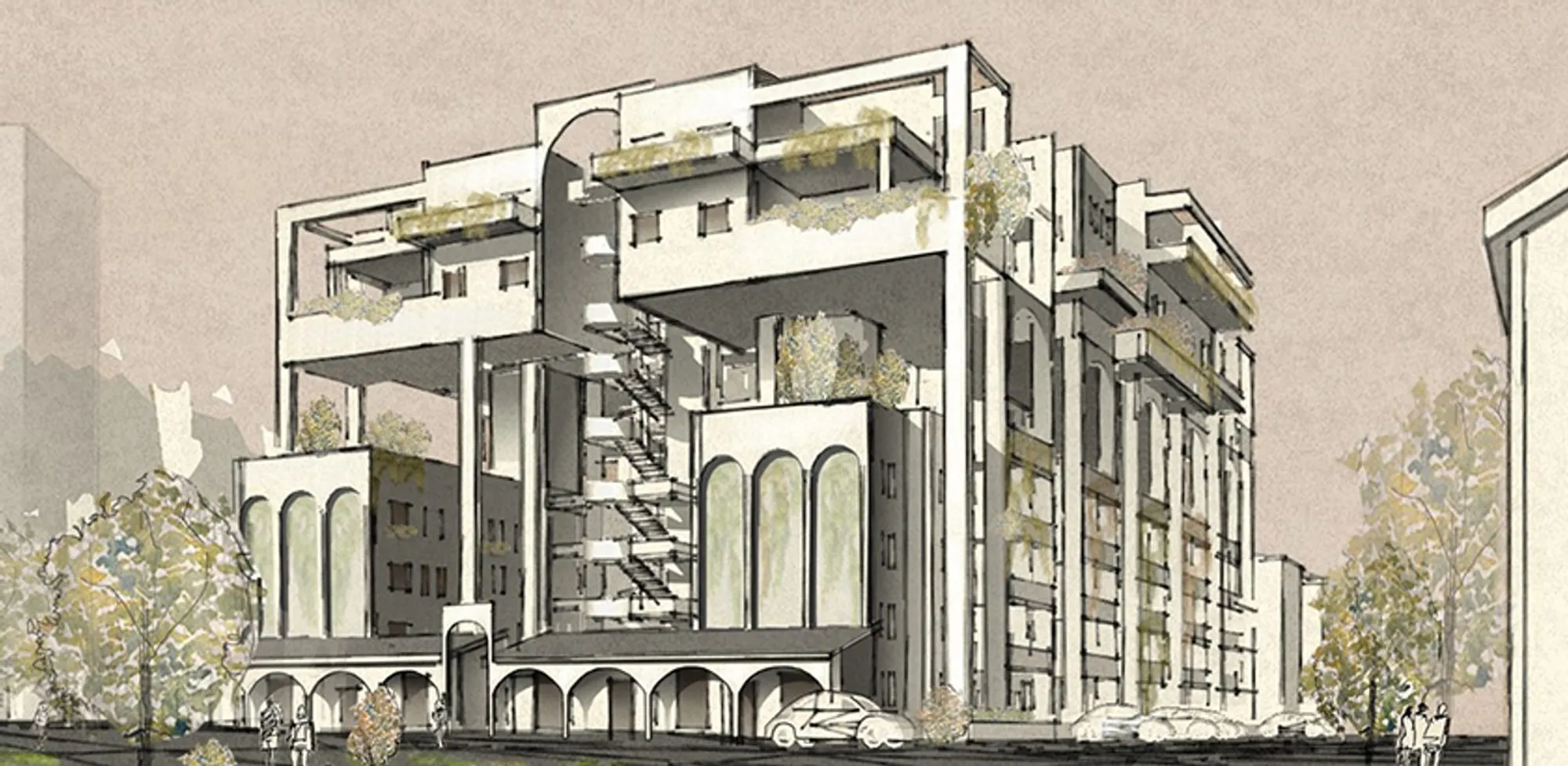
Restoring a Krasnoyarsk Microdistrict: A Nest for Intergenerational Living
A Soviet-era housing block in Siberia is reimagined through vertical extension, shared courtyards, and the protective metaphor of a bird's nest.


Soviet microdistricts were built for efficiency, not affection. Rows of identical housing blocks, underutilized open land, and an almost total absence of spatial identity define these neighborhoods across Russia. In the Oktyabrsky district of Krasnoyarsk, a Siberian city shaped by exactly this model, a design team proposes something rare: not demolition, not replacement, but restoration rooted in emotional logic. The central metaphor is a bird's nest, a protective shell that shelters multiple generations under one architectural idea, turning a tired residential zone into a place people might actually call home.
Designed by Caterina, Nadejda Nadejda, and Elena, the project approaches urban regeneration as a restorative process rather than a clean-slate exercise. The existing structure stays. Social memory stays. What changes is the quality of space between and above the blocks: new upper floors with two-level apartments, a reimagined public courtyard, operable roofs fitted with solar panels, and a carefully zoned ground plane that gives children, the elderly, and families distinct but overlapping territories.
A Protective Shell Around Shared Ground
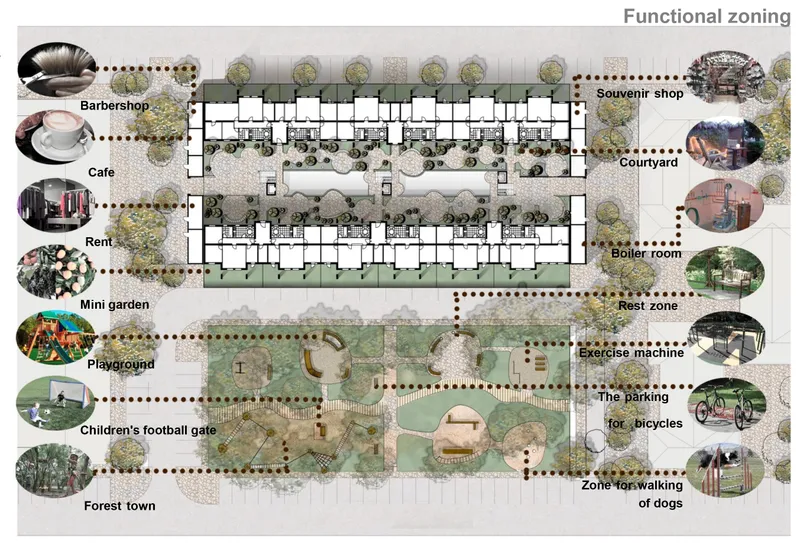
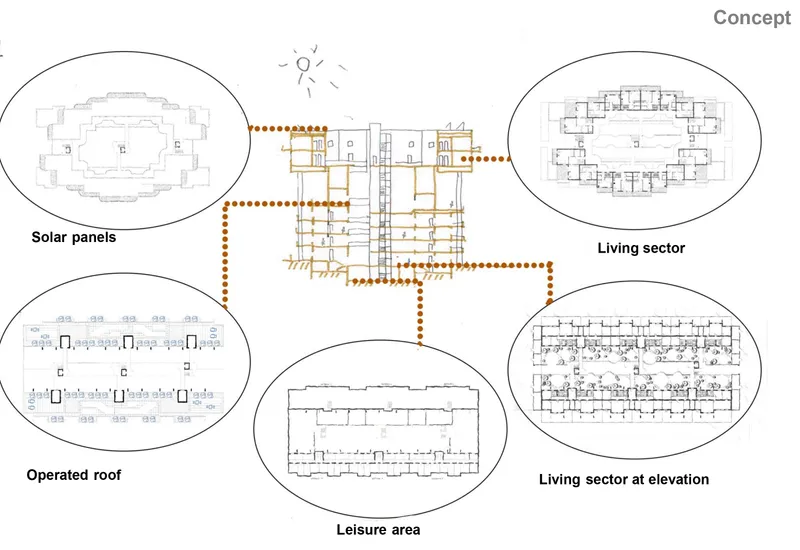
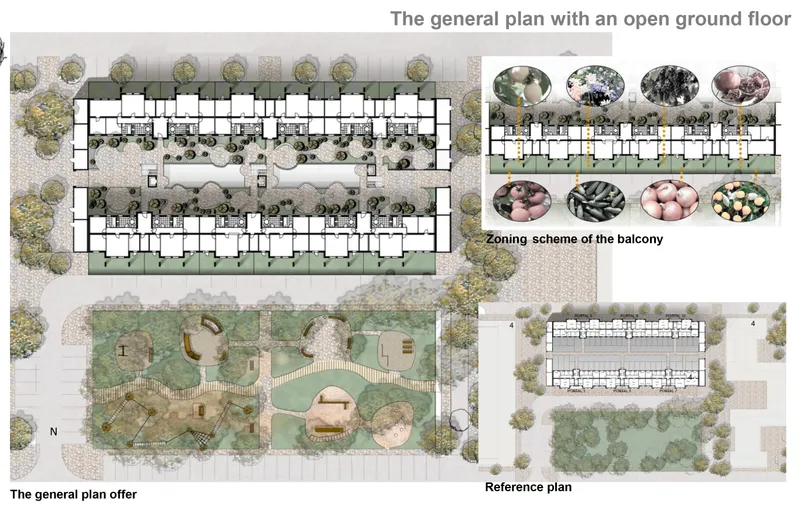
The site plan reveals how the residential building wraps around a central landscape zone, creating a sheltered interior world of playgrounds, gardens, and recreational pockets. Rather than scattering amenities across the block, the designers concentrate social life in this courtyard, making it the heart of the microdistrict. The concept diagram above it maps out how each floor plate is assigned a purpose: solar panels on the roof, operable enclosures for leisure, and residential sectors organized by household type. Every layer of the building contributes to daily life, not just the apartments themselves.
The nest metaphor works because it is structural, not decorative. The building acts as a perimeter enclosure that defines inside from outside, communal from urban, protected from exposed. Open galleries connecting the new upper-level apartments serve as semi-public thresholds where residents encounter each other informally. These galleries are not corridors; they are social infrastructure, designed to encourage the small daily interactions that transform neighbors into a community.
The Emotional Logic of Home, Family, and Care
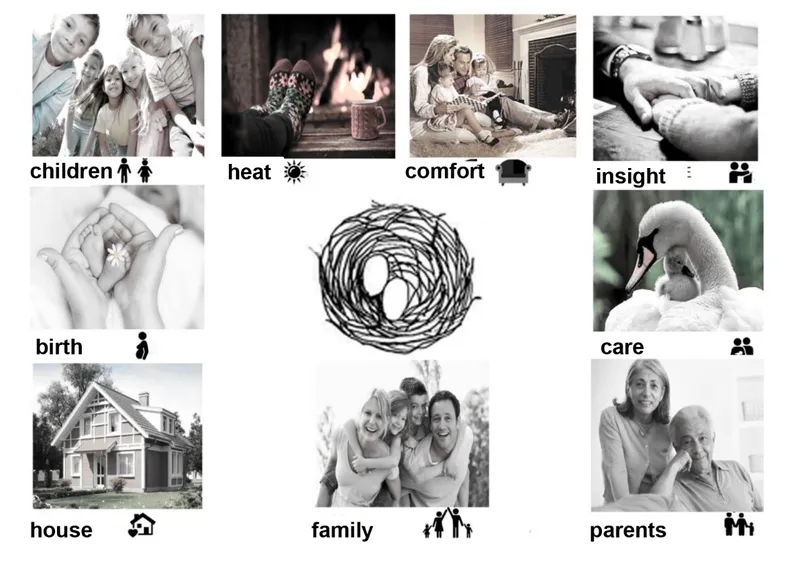
A collage board anchors the project's conceptual foundation in lived experience rather than abstract theory. Photographs cluster around themes of children, warmth, comfort, birth, care, and family, establishing the emotional register the designers are working within. In a field where housing is often reduced to unit counts and floor-area ratios, this board makes an argument for architecture as an extension of domestic feeling. The nest is not just a form; it is a promise of protection and belonging.
The intergenerational emphasis is deliberate. Krasnoyarsk's existing microdistricts were designed for a generic Soviet citizen, not for the layered reality of families with grandparents, toddlers, teenagers, and everyone in between. By foregrounding care as an architectural value, the project positions itself within a growing discourse around age-inclusive design, one that treats the elderly and the very young not as edge cases but as the primary users of shared residential space.
Vertical Extension Without Horizontal Sprawl
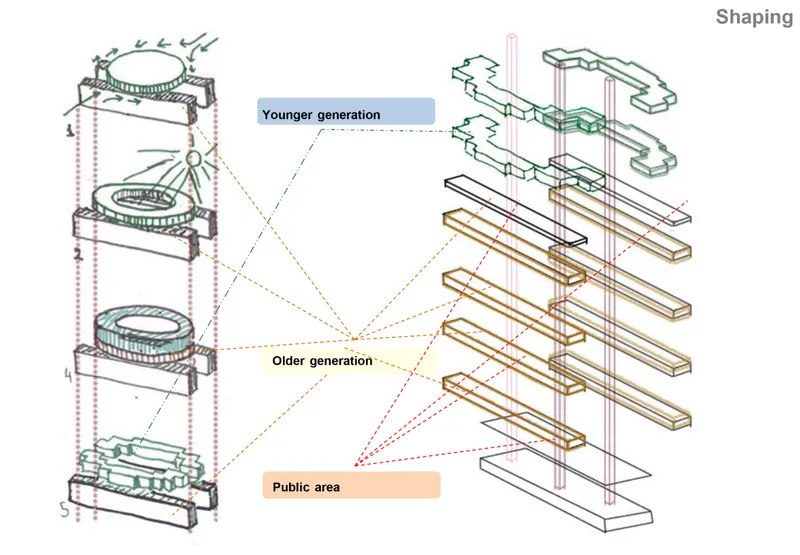
The axonometric diagram is the project's most legible drawing. Stacked floor plates are color-coded to distinguish zones for younger generations, older residents, and public functions. The vertical extension strategy adds density by building upward on the existing block rather than consuming more land, a pragmatic move that preserves the courtyard below while increasing the number of households the site can support. Two-level apartments on the upper floors give residents internal spatial variety, a welcome departure from the flat repetition of typical microdistrict units.
The general plan reinforces this logic at ground level. Balcony zoning callouts indicate where small-scale urban gardening is supported, turning private outdoor space into productive landscape. Reference diagrams map the site organization, showing how pedestrian circulation, vehicular access, and green zones are separated to prioritize the pedestrian experience. The result is a plan that reads as both technically rigorous and spatially generous, a difficult balance in dense urban housing.
Programming the Ground: From Barbershops to Kitchen Gardens
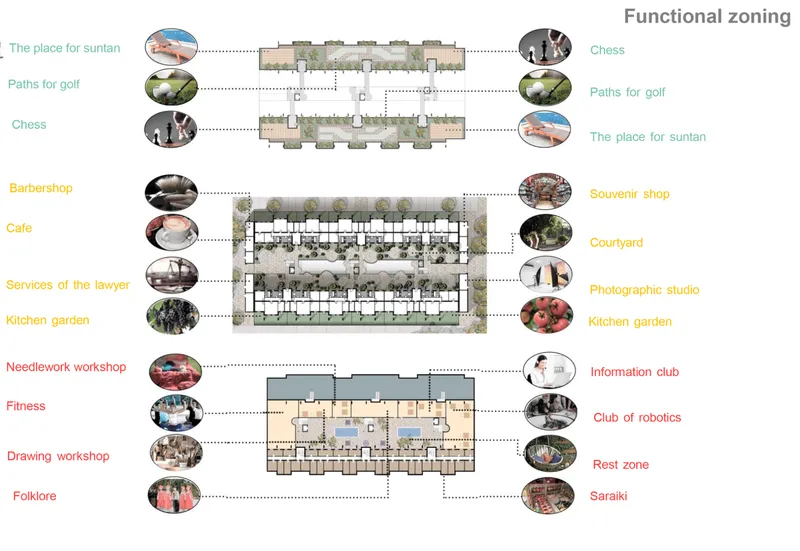
The ground floor plan is where the project's ambitions for community life become most tangible. Functional zones are labeled with specific activities: a barbershop, a café, a kitchen garden, and fitness areas. These are not generic "mixed-use" fillers but targeted programs that respond to the daily routines of a residential neighborhood. A barbershop implies regularity and familiarity; a kitchen garden implies stewardship and seasonal rhythm. Together, they construct a ground plane that serves residents throughout the day, reducing dependence on distant commercial districts.
This granularity of programming is what separates thoughtful urban regeneration from cosmetic renovation. The designers are not simply adding a coat of paint to a Soviet housing block; they are inserting the social infrastructure that was absent from the original model. The courtyard, the galleries, the rooftop leisure zones, and the ground-floor services form a continuous network of shared space, layered vertically through the section and horizontally across the site.
Why This Project Matters
Across Russia and the broader post-Soviet world, millions of people live in microdistricts that were designed for speed and standardization, not for long-term community life. The question of what to do with these neighborhoods is one of the most pressing in contemporary urbanism. Demolition is expensive, disruptive, and wasteful. Preservation without intervention condemns residents to declining conditions. What Caterina, Nadejda Nadejda, and Elena propose is a third path: careful restoration that treats existing structures as foundations rather than obstacles, adding density, sustainability, and social richness without erasing what came before.
The bird's nest metaphor could easily have remained a surface gesture, but the designers embed it into the project's spatial logic: the protective courtyard, the layered vertical zones, the nesting of generations within a single block. Combined with practical interventions like solar panels, operable roofs, and balcony gardens, the project demonstrates that urban regeneration housing does not have to choose between symbolism and performance. It can do both, and in doing so, it can transform the most anonymous of housing typologies into something that feels genuinely inhabited.
View the Full Project
About the Designers
Designers: Caterina, Nadejda Nadejda, Elena
Enter a Design Competition on uni.xyz
uni.xyz runs architecture and design competitions year-round that reward proposals with spatial conviction and real site intelligence.
Project credits: Restoration of the urban environment of the microdistrict in the city Krasnoyarsk(Russia) by Caterina, Nadejda Nadejda, Elena.




Popular Articles
Popular articles from the community


The Ocean Hive: Sustainable Architecture for a Self-Sufficient Civilization at Sea
The Ocean Hive imagines sustainable architecture at sea, where modular habitats, algae, wave power and ocean waste sustain a growing colony.

Play: Fragments of Their World
Familiar architecture becomes modular playground design, creating safe spaces where displaced children can learn, connect, imagine and play.

The Musturak Paradise: Senior Living Architecture for a Connected Future in Temara, Morocco
The Musturak Paradise reimagines senior living architecture in Temara via private homes, social spaces, culture, community, and shared care.

Co-life: Sustainable Architecture for Age-Friendly Community Living
Co-life reimagines sustainable architecture for seniors through courtyards, rammed earth, shared gardens, and spaces designed for belonging.
Similar Reads
You might also enjoy these articles

Lunar Spiral: Space Architecture Shaped by the Mathematics of the Universe
Lunar Spiral reimagines space architecture through Fibonacci geometry, lunar regolith, levitating habitats, and self-sustaining Moon living.
The Main Dream: Modular Architecture for Play, Learning, and Community
A modular playground turns recycled plastic into adaptable spaces where refugee children can play, build, learn, and reconnect.
Play: Fragments of Their World
Familiar architecture becomes modular playground design, creating safe spaces where displaced children can learn, connect, imagine and play.

Wadi Rum Observatory: Desert Architecture Designed for the Night Sky
Wadi Rum Observatory turns desert architecture into a quiet instrument for astronomy, hiding research spaces under Jordan's starlit terrain.


Comments (0)
Please login or sign up to add comments
No comments yet. Be the first to comment!