
Roman Hut: Ancient Thermae Logic Rebuilt for a Wetland Conservation Landscape
A shortlisted WIC entry translates Roman bathhouse typology into a timber and concrete spa embedded within the Tame Valley Wetlands near Birmingham.


Strip a Roman bathhouse down to its core logic and you find a spatial sequence organized around water, temperature gradients, and communal gathering. The Roman Hut takes that sequence and rebuilds it for a wetland site outside Birmingham, producing a country club and spa that treats ancient infrastructure as a living design methodology rather than a stylistic reference. The result is a building in two halves: a heavy, terrain-embedded concrete spa and a lightweight elevated timber visitor center, linked by a footbridge that doubles as a linear colonnade stretched across the Tame Valley Wetlands.
Designed by Aleksa Papic, this shortlisted entry for the WIC competition grounds itself in a specific historical and ecological narrative. Britain's Roman past is not just a thematic layer here; it structures the programme, the material palette, and the relationship between building and ground. The Tame Valley Wetlands, a sensitive conservation landscape, demand minimal intrusion. The project responds by hovering its timber half above the terrain and burying its concrete half within it, leaving the wetland ecology functionally intact beneath and around the architecture.
Timber Structure as Open Framework
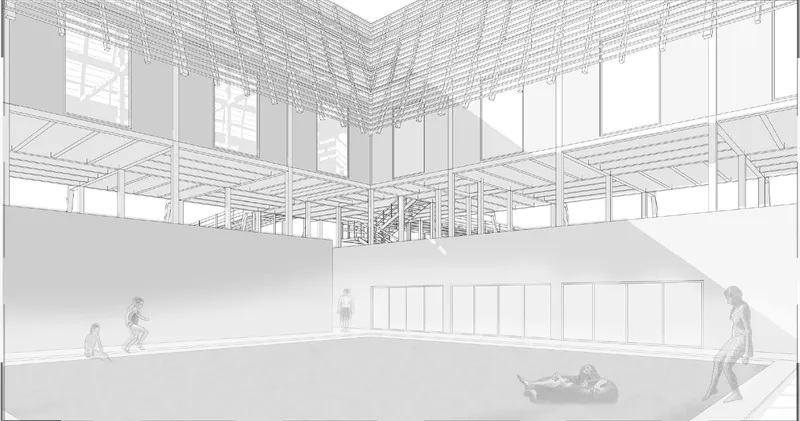
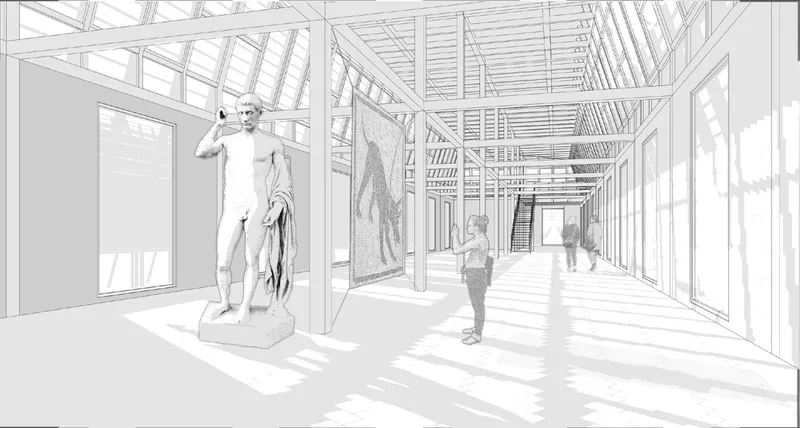
The visitor center's interiors reveal a skeletal timber frame that does serious spatial work. A double-height hall with exposed ceiling trusses creates generous vertical proportions while keeping the material expression honest: every beam, joint, and brace is legible. A gallery corridor extends this language laterally, with timber trusses running overhead and natural light washing in from one side. The effect recalls the processional quality of a Roman palaestra, where movement through space was part of the experience itself. A sculpture positioned along the corridor reinforces the building's ambition to function as a cultural venue, not just a functional one.
The visitor center's programme is deliberately layered. The open ground level serves as a gathering space, workshop hub, and event platform for community interaction. Upper floors house museum exhibits, guest accommodation, a recreational lounge, canteen, and administrative offices. Natural light filters through wooden brise-soleils and glazed facades, reducing energy demand while creating a warm, diffused interior ambiance. The flexibility of the layout supports everything from short visits to extended educational residencies.
The Courtyard as Open-Air Bathhouse
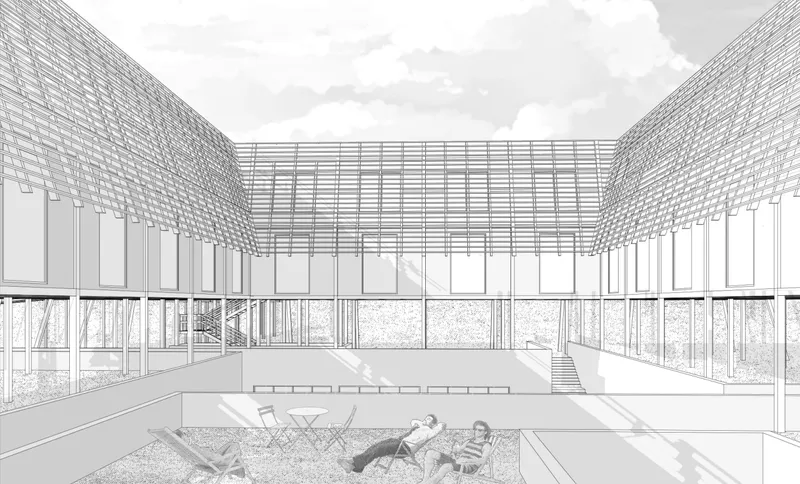
At the heart of the spa zone, a double-height courtyard with glazed walls opens directly onto the surrounding grassland. Two figures recline in the space, and the posture says everything about the intended atmosphere: this is a place for stillness. The open-air pool in this central atrium pays direct homage to the Roman practice of bathing under the sky, while the glazing dissolves the boundary between the thermal interior and the wetland landscape beyond. The spa programme, built in reinforced concrete and embedded into the terrain, includes swimming pools, halotherapy areas, massage rooms, and saunas arranged in orthogonal symmetry around this atrium. Spaces grade from warm to cold, echoing the Roman caldarium, tepidarium, and frigidarium sequence.
Sitting Lightly on a Sensitive Landscape
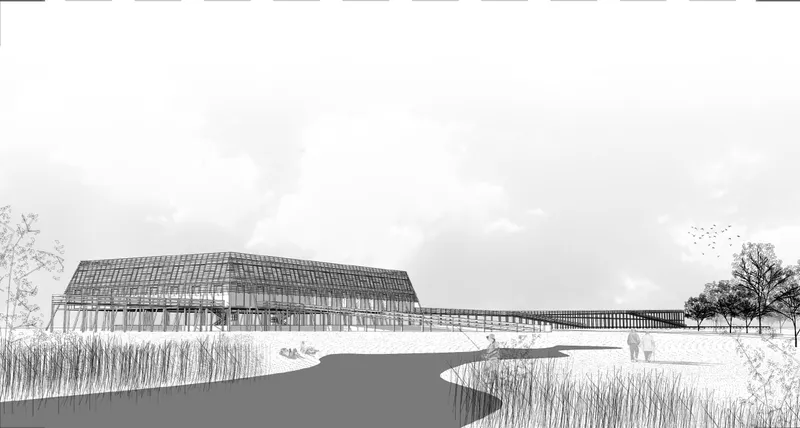
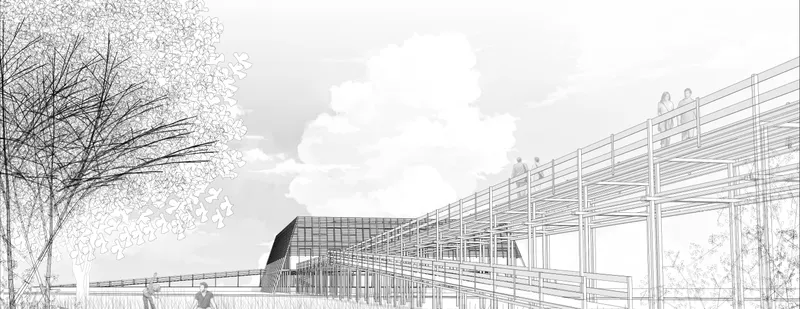
Seen from the outside, the building's relationship to its site becomes clear. An elevation drawing shows the timber lattice structure beside a pond edged with grasses and bare trees. The architecture reads as a permeable screen rather than a solid object, allowing visual and ecological continuity across the wetland. A second perspective reveals a timber gridded facade with a curved roof element, its proportions calibrated to defer to the surrounding tree canopy rather than compete with it. The footbridge connecting the two programme zones is elevated from the landscape, allowing uninterrupted natural growth and preserving sensitive vegetation beneath while offering immersive views outward.
The viewpoints along this bridge are nestled into the embankment's line, keeping the structure visually and physically discreet. The deliberate architectural strategy throughout is to intrude as little as possible while intensifying the visitor's interaction with nature. The contrast between the heavy concrete spa, which accepts the ground, and the light timber visitor center, which refuses it, gives the project a tectonic clarity that reinforces its ecological logic.
Plan Organization: Two Courtyards, Two Programmes
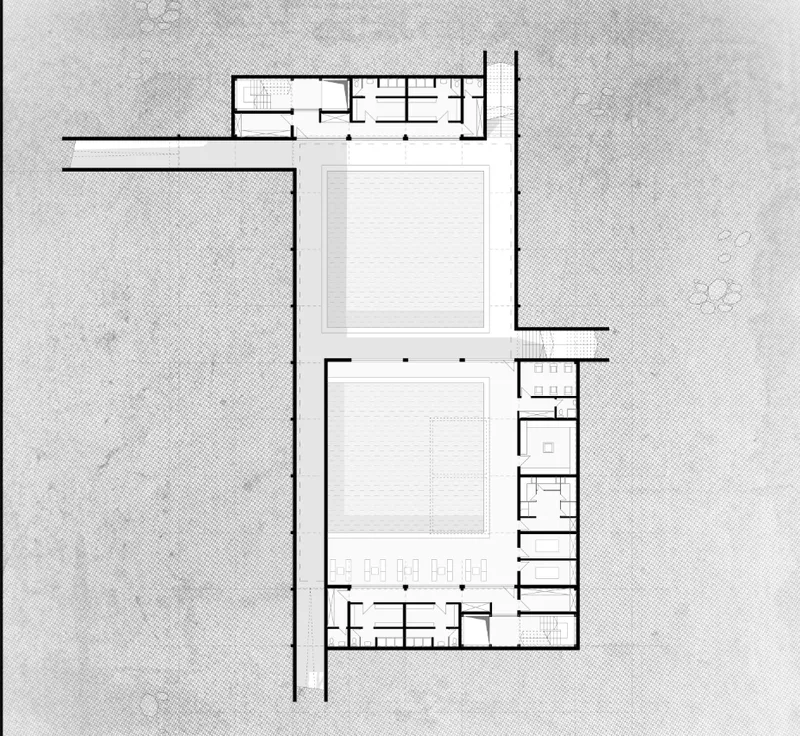
The floor plan lays out the building's dual identity with diagrammatic precision. Rooms are arranged around two central courtyards, each anchoring one of the project's functional halves. The geometric clarity of the Roman atrium is legible in the plan's orthogonal discipline, while the surrounding landscape is drawn in as a third material, shaping circulation paths and framing views. The rectangular atrium building references the spatial order of ancient thermae, and the linear footbridge reads in plan as a Roman colonnade reinterpreted at landscape scale. Programme and site are locked together here; neither the plan nor the ecology would make sense independently.
Why This Project Matters
Historical reference in architecture frequently collapses into pastiche. What distinguishes the Roman Hut is the precision of its translation. Aleksa Papic does not borrow Roman forms; he borrows Roman systems: temperature gradients as spatial organizers, colonnades as connective infrastructure, atriums as communal anchors. Each of these ideas is stress-tested against a real conservation site with genuine ecological constraints, and the design holds up because the logic is structural rather than decorative.
The project also demonstrates that sustainability and monumentality are not opposed. A reinforced concrete spa buried in terrain and a lightweight timber visitor center elevated above it produce two distinct environmental performances from two distinct material cultures. The wetland is not a backdrop; it is an active design partner, shaping building footprints, circulation routes, and sightlines. For a competition entry addressing the future of wetland architecture, the Roman Hut offers a sharp thesis: the most durable ideas in architecture are not formal but operational, and they transfer across millennia when the designer knows what to extract.
View the Full Project
About the Designers
Designer: Aleksa Papic
Enter a Design Competition on uni.xyz
uni.xyz runs architecture and design competitions year-round that reward proposals with spatial conviction and real site intelligence.
Project credits: ROMAN HUT - roman inspired country club & spa by Aleksa Papic WIC (uni.xyz).




Popular Articles
Popular articles from the community


The Musturak Paradise: Senior Living Architecture for a Connected Future in Temara, Morocco
The Musturak Paradise reimagines senior living architecture in Temara via private homes, social spaces, culture, community, and shared care.

The Ocean Hive: Sustainable Architecture for a Self-Sufficient Civilization at Sea
The Ocean Hive imagines sustainable architecture at sea, where modular habitats, algae, wave power and ocean waste sustain a growing colony.

Hill & Cross Opera: Sculptural Opera House Architecture Shaped by Tallinn’s Landscape and Identity
Hill & Cross Opera reimagines opera house architecture in Tallinn through its sculptural hill, civic plaza, glass wave and a luminous cross.

Lunar Spiral: Space Architecture Shaped by the Mathematics of the Universe
Lunar Spiral reimagines space architecture through Fibonacci geometry, lunar regolith, levitating habitats, and self-sustaining Moon living.

Similar Reads
You might also enjoy these articles

Day and Night Park: A Time-Based Urban Newsstand in Beijing
A temporary urban newsstand in Beijing blending travel, light, and reading through poetic colors, compact form, and community-focused design.

Modernist Patio Renovation in El Masnou, Barcelona by Oliver Segura Arquitectura + Cebrià Arquitectura
Modernist patio renovation blending tradition and innovation with a movable pool, leveled floors, and Catalan materials in El Masnou.

Alto Residencial Coop: Cooperative Housing Development in Santiago de Compostela by Carbajo Barrios Arquitectos
A linear cooperative housing complex blending white volumes and perforated metal façades, enhancing community living, natural light, privacy, and urban integration.
Vil Genis School by BPA ARCHITECTURE – Massy, France
Vil Genis School in Massy, France, features sustainable design, south-facing classrooms, community integration, accessible spaces, and modern educational architecture.

Explore Romanian Architecture Competitions
Discover active competitions in this discipline


Challenge to design public laboratory


Bring back Drive In's
Comments (0)
Please login or sign up to add comments
No comments yet. Be the first to comment!