Roman Hut – A Roman-Inspired Wetland Architecture for the Future
A Roman-inspired spa and visitor center that blends water architecture and wetland design with minimal impact and timeless form.


The ROMAN HUT - roman inspired country club & spa, a shortlisted entry by Aleksa Papic for the WIC competition, is a visionary architectural proposal that fuses the elegance of Roman architecture with contemporary ecological design principles. The project is rooted in a historical and environmental narrative, drawing from Britain's Roman past and integrating it with the Tame Valley Wetlands near Birmingham, UK. This sustainable country club and spa reinterprets the Roman thermae into a modern visitor center that is both sensitive to its environment and rich in cultural symbolism. The design celebrates the ingenuity of ancient water architecture while proposing a new paradigm for landscape-sensitive architecture.
Reimagining Roman Water Architecture in a Modern Context
The Roman Empire's engineering legacy, especially in water infrastructure like aqueducts, canals, and bathhouses, laid the foundation for civic life across their territories. These feats of design were essential not only for hygiene but also for public health, leisure, and community building. Thermae—Roman bathhouses—served as dynamic hubs where citizens gathered, relaxed, and engaged in social rituals. The Roman Hut seeks to capture this essence, transforming these typologies into a design suited for contemporary needs. The reinterpretation is not literal but conceptual, emphasizing the functionality, spatial hierarchy, and communal essence of Roman public architecture within a wetland conservation framework.
Merging Typology and Ecology: A Site-Specific Response
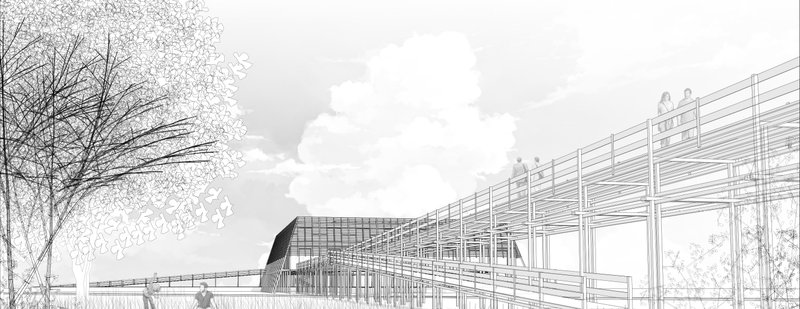
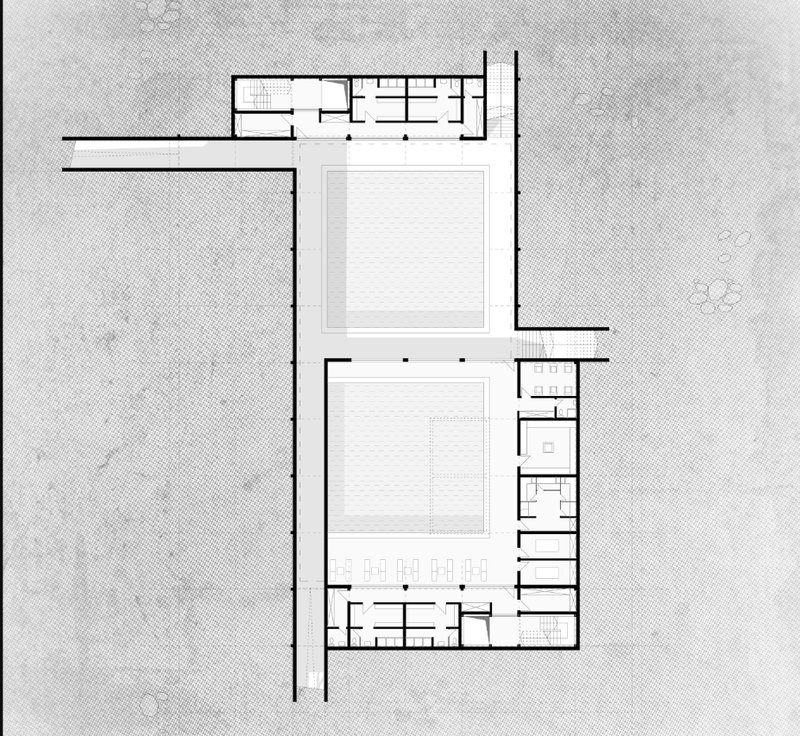
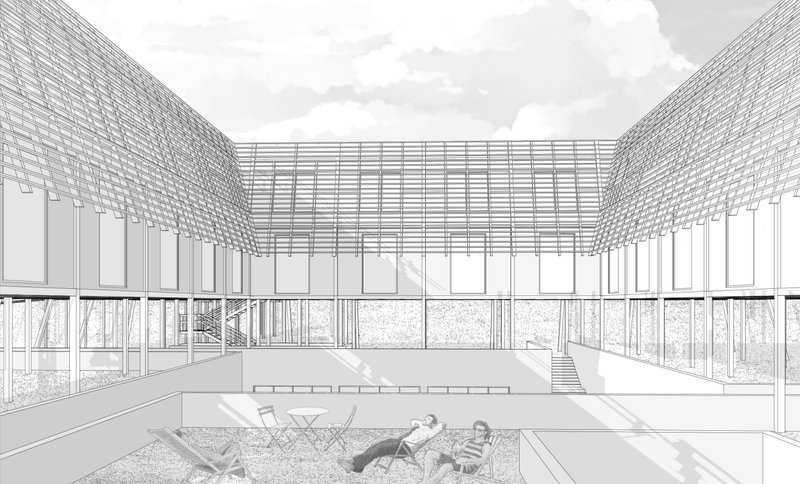
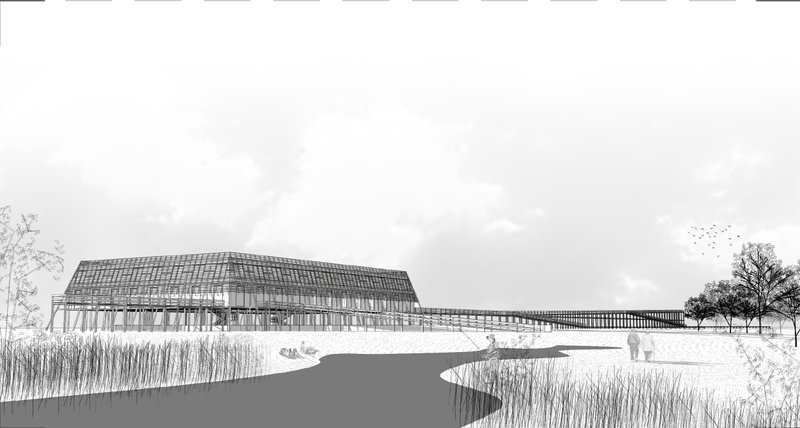
The spatial composition of the Roman Hut is inspired by the geometric clarity of the Roman atrium and the linear nature of the palaestra. This duality manifests in a central rectangular atrium building, referencing the spatial order of ancient thermae, and a timber footbridge, echoing the linearity of Roman colonnades. The footbridge not only guides visitors but becomes a structural metaphor for continuity—connecting vantage points across the wetland while minimizing ecological impact. Elevated from the landscape, it allows uninterrupted natural growth and preserves sensitive vegetation, all while offering immersive views of the surrounding environment.
This approach reflects a deliberate architectural strategy—to intrude as little as possible while enhancing the user's interaction with nature. The orientation of the viewpoints, nestled into the embankment’s line, ensures that the structure remains visually and physically discreet.
Functional Zoning: Wellness, Learning, and Interaction
The project’s program is divided into two primary functional zones:
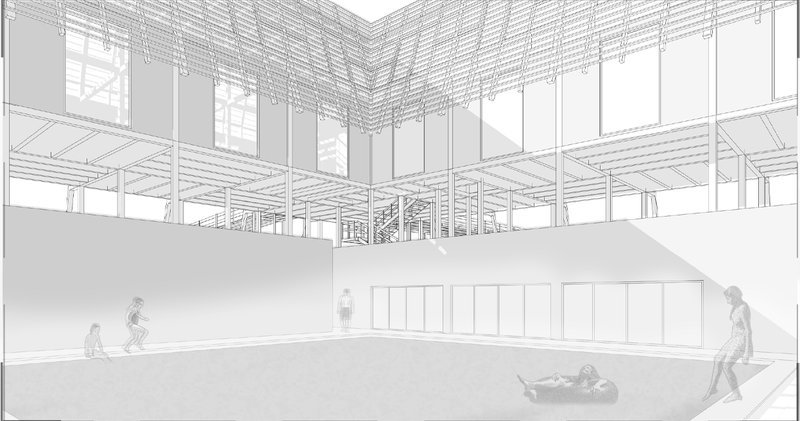
- The Spa/Bathhouse – Embedded into the terrain, the spa is constructed using reinforced concrete, creating a grounded and robust thermal environment. It includes swimming pools, halotherapy areas, massage rooms, and saunas, all arranged in orthogonal symmetry around a central atrium. The open-air pool in the atrium pays homage to the Roman practice of bathing under the sky. Interior spaces offer a gradation from warm to cold, mimicking the Roman sequence of caldarium, tepidarium, and frigidarium. The interplay of interior and exterior elements fosters an atmosphere of serenity and contemplation.
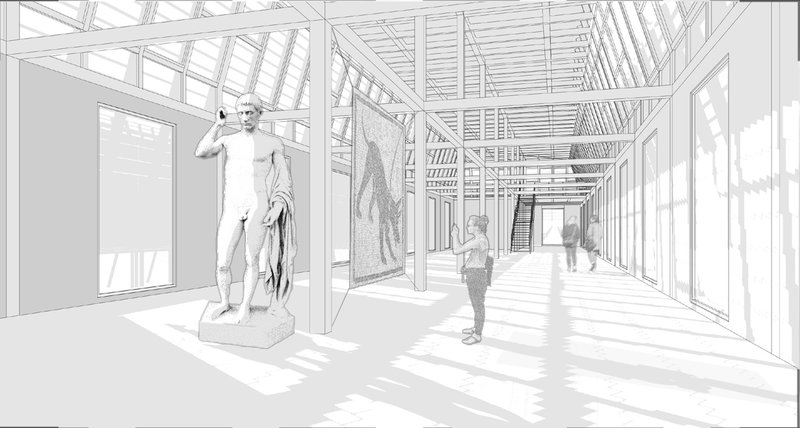
- The Visitor Center – Elevated above the wetland using a skeletal timber frame, the visitor center contrasts the heavy spa zone. Its open ground level supports community interaction and learning activities, serving as a gathering space, workshop hub, and event platform. The upper floors contain museum exhibits, accommodation for guests, a recreational lounge, canteen, and administrative offices. Designed for flexibility, these spaces adapt to both short-term visits and extended educational residencies. Natural light filters through wooden brise-soleils and glazed facades, reducing energy use while creating a warm, diffused interior ambiance.
Architecture as Storytelling: Sustainability and Monumentality
Despite its modest footprint, the Roman Hut presents a monumental character through its architectural clarity and symbolic gestures. The inclined ramps, floating footbridges, and framed vistas act as spatial narratives, guiding the visitor through a journey of discovery. The structure communicates indirectly with the wetland—by hovering above it, framing it, and respecting its contours. Materials were chosen for their low-carbon footprint and compatibility with the surrounding ecosystem, with timber, glass, and concrete carefully detailed for durability and minimal maintenance.
The building embodies eco-conscious monumentality—it stands as a landmark not through size or dominance, but through its philosophical and environmental sensitivity. The Roman Hut achieves a balance between celebrating history and embracing progressive architecture, offering a blueprint for designing in ecologically fragile areas.
A Living Legacy of Sustainable Design
The Roman Hut is not merely a homage to Roman architecture; it is a fully contemporary interpretation that merges historical significance with ecological ethics. This project is a testament to how the reuse of ancient spatial archetypes can inspire new ways of thinking about public space, wellness, and sustainable tourism. Through intelligent zoning, passive design strategies, and sensitive material use, the Roman Hut sets a new standard for building in protected natural landscapes.
By positioning architecture as both a cultural bridge and ecological steward, the Roman Hut stands out as a bold model for wetland architecture that is informed by the past, grounded in the present, and adaptable for the future.