

School of Thought: A Radial Secondary School Where Every Studio Leans Toward a Shared Hub
An Honorable Mention in Toronto's Scarborough, this alternative secondary school swaps corridors for a circular hall ringed by studios and courtyards.


Most schools are organised around the corridor, a device built for moving bodies efficiently from one sealed room to the next. This proposal starts by deleting the corridor. In its place is a circle: a central hall from which learning studios, classrooms and shared facilities extend outward like spokes. The move is simple, almost diagrammatic, but it changes how a school behaves. Every route passes through common ground, and the building's heart is a room for gathering rather than a hallway for transit.
Designed by Ádám Nagy, Anna Harangi and Tamás Brech, the School of Thought Alternative Secondary School received an Honorable Mention in School of Thought 2020. The site sits in Scarborough, Toronto, and the brief posed a pointed question: how can architecture support multiple modes of learning while building community, flexibility and inclusivity? The team's answer is a low-rise campus that treats the whole site, indoors and out, as a teaching instrument.
A Skylit Drum Holds the Centre and the Wings Fall Away From It

The aerial view makes the strategy legible at once. A skylit drum anchors the plan, and grass-roofed wings radiate from it at a deliberately low height, letting the central volume read as the civic core while the teaching spaces stay close to the ground. The green roofs do more than soften the massing from above; they connect to the rooftop gardens the designers describe, turning the fifth elevation into usable landscape. Beside the building, a blue sports court and planted lawns extend the radial logic outward, so the school appears less like an object on a plot and more like a cluster of spaces stitched into its grounds.
The site planning layers public and private zones carefully. A public square at the southern edge acts as the threshold, giving the neighbourhood a place to meet the school without pulling the community straight into the learning clusters. It is a sensible calibration for a building that wants to be open and protected at once, and the radial form helps: the hall is the shared room, and the wings beyond it grow gradually quieter.
Studios Sized for 150, Classrooms Sized for Focus

Instead of a uniform stack of classrooms, the programme sets out a range of room sizes. Larger learning studios hold up to 150 students, while smaller classrooms offer intimate settings for concentrated work. That spread is the project's most practical contribution: it accepts that a lecture, a workshop and a quiet reading session need different rooms, and it refuses to let any single format dominate the timetable. The library rendering shows the softer end of that spectrum, with timber cube shelving, round tables and stools, and figures seated facing the glazing toward a courtyard.
The furniture tells you as much as the walls. Round tables carry no head of the table, and stools invite people to shift and regroup, which suits a pedagogy built on collaboration rather than rows facing a board. The extensive glazing keeps the courtyard in view at all times, a reminder that in this scheme the boundary of the room is never the boundary of the lesson.
Courtyards Between the Spokes Turn Leftover Space Into Classrooms


A radial plan naturally produces wedge-shaped gaps between its arms, and many such schemes leave those gaps as lawn to look at. Here they become protected courtyards set between the learning clusters, semi-open rooms that extend teaching beyond the enclosure. The first rendering shows one at rest: concrete bench blocks scattered across grass, young trees, and timber-clad wings framing a clear sky. The benches are loose and blocky, as easy to perch on for a small seminar as to sprawl on at lunch.
The plaza view shifts toward the public side of the campus, with paved ground, concrete benches, planted beds and a stepped pool, while trees throw dappled shadow toward the glazed rotunda. Together with the outdoor theatre, rooftop gardens and landscaped seating areas named in the programme, these spaces argue that learning is an activity, not a room type. The material palette of concrete, timber and planting stays restrained, which lets the sequence of outdoor rooms, rather than any single gesture, carry the design.
Under the Truss Skylight, the Main Hall Works as the School's Commons

The interior of the drum delivers what the aerial view promises. A steel truss skylight casts patterned light across the circular atrium, a glass-balustraded mezzanine wraps the upper level, and a diagonal staircase cuts across the volume. That stair matters: it turns vertical circulation into an event within the shared space, so moving between floors becomes a moment of seeing and being seen rather than a trip through a closed stairwell.
The designers describe this hall as a dynamic node for interaction, gathering and informal learning, and the section supports that claim. Glass balustrades keep sightlines open between levels, and the round geometry gives no single wall pride of place. In a conventional school, this volume would be the assembly hall used a few times a term. Here it is the room everyone crosses daily, which is precisely why the radial plan works.
Why This Project Matters
The School of Thought proposal is persuasive because its central idea is spatial before it is rhetorical. Trading the corridor for a circular hub minimises hierarchy in plan, and the studio sizes, courtyards and public square follow from that decision instead of being bolted on. The reduction of traditional classrooms in favour of community-oriented space reflects a wider turn toward student-centred school design, and this team has given that turn a clear, buildable shape.
There are open questions a radial scheme always raises, about acoustics in a central hall and the distances to the furthest wings, but the proposal earns its Honorable Mention through clarity. Low volumes, green roofs, generous glazing and a sequence of outdoor rooms produce a campus that feels approachable to its Scarborough neighbours and adaptable to the people inside it. For a competition asking how architecture can host many ways of learning, the answer here is compelling: give everyone a common centre, then let the edges vary.
View the Full Project
About the Designers
Designers: Ádám Nagy, Anna Harangi, Tamás Brech
Enter a Design Competition on uni.xyz
uni.xyz runs architecture and design competitions year-round that reward proposals with spatial conviction and real site intelligence.
Project credits: School of Thought Alternative Secondary School by Ádám Nagy, Anna Harangi, Tamás Brech School of Thought 2020 (uni.xyz).


Popular Articles
Popular articles from the community


Juan García Correa, John González and Claudia Rueda Sink a Circular Amphitheater into a Manizales Engineering Building
On the La Nubia campus in Manizales, Colombia, the S1 Building folds labs and offices into a hillside of ramped lawns that double as a campus route.

longwave studio Reorganizes a 112 m² Tainan Apartment Around the Daily Routines of a Family and Two Cats
In Tainan, Taiwan, birch plywood, rust-red furniture and a freestanding plaster wall link arrival, storage, work and family life in one apartment.

LT2A and OPEN Architectes Thread a Brick and Glass High School Through a Wooded Belgian Campus
In Braine-l'Alleud, a 3,000 m² wing for Collège Cardinal Mercier pairs pale brick with a glazed colonnade, deferring to a small chapel and a dense wood.

Architekt Andreas Gruber Scatters 23 Dark Timber Chalets Across a South Tyrolean Forest Edge
In Molini di Tures, Amonti Chalets breaks a resort into a hamlet of gabled timber houses, with parking, storage and services pushed into the slope.

Similar Reads
You might also enjoy these articles
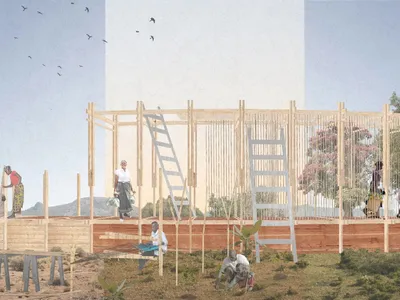
Healing Façade: A Modular Chapel System That Restores Ethiopia's Sacred Forests
Winner of the Eco-Chapel competition, this circular timber façade collects water from air to rebuild soil and reforest degraded Ethiopian landscapes.
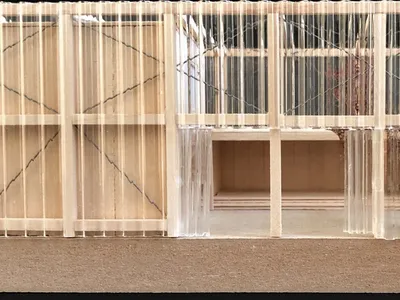
Kaffeebühnen: Where Coffee Shop Architecture Becomes a Civic Stage in Vienna
A linear sequence of timber boxes, transparent shells, and open yards turns the Viennese café tradition into a public performance space.
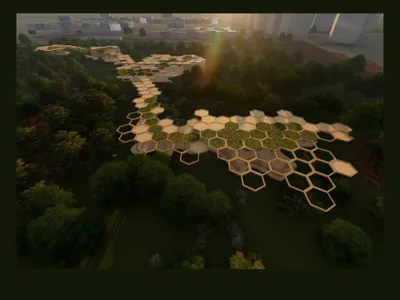
Eco Chapel: A Modular Forest Pavilion That Grows Like the Landscape It Protects
Hexagonal timber modules weave through existing trees, turning a chapel into a living system for prayer, education, and reforestation.


Urban Forest: A Vertical Ecosystem for 5,000 Workers in Singapore's Changi Business Park
Radially stacked pods and layered green decks turn a 7-acre plot into 47 acres of ecological workspace projected for 2040.

Explore Architecture Competitions
Discover active competitions in this discipline

Challenge to reimagine the Iron Throne

Photograph architecture without architects

Illustrate the lost glory of Angkor Wat - Render Challenge

Design challenge to reuse E-waste
Comments (0)
Please login or sign up to add comments
No comments yet. Be the first to comment!