
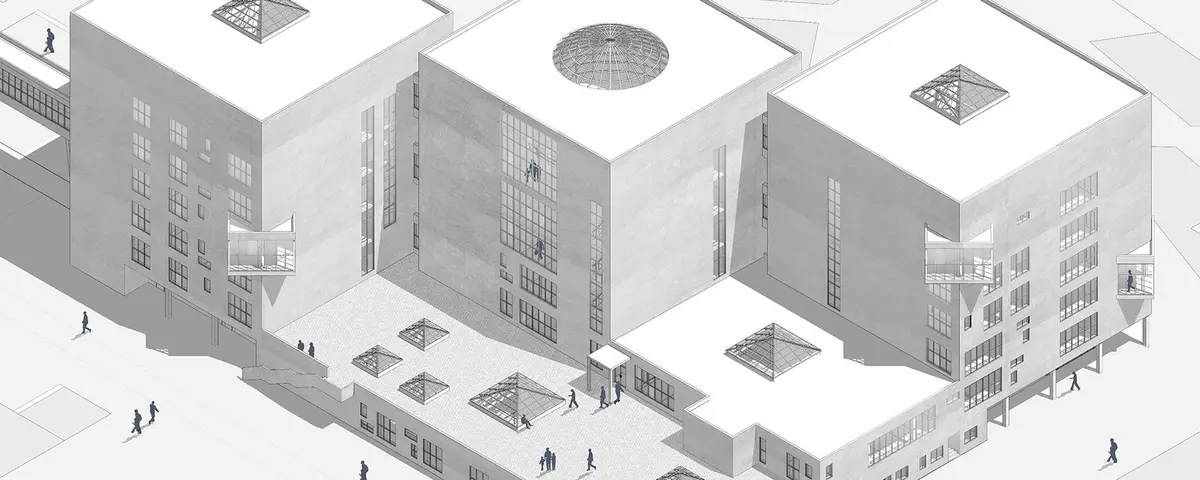
Yenisei Monitoring Center: A Sun-and-Moon Sphere Anchors a Research Campus on Siberia's Great River
In Krasnoyarsk, shifting square blocks, a glazed central sphere and descending window rhythms turn river science into a public spectacle on the Yenisei.


Most research buildings keep their science behind closed doors. This one puts it on the riverbank and lights it up at night. The Scientific and Educational Monitoring Center of the Yenisei treats ecological observation as something a city should be able to watch. Laboratories, classrooms and public viewing zones sit in one complex built around a single glazed sphere, and the architecture becomes a way of teaching people to read the river it studies.
Designed by Дарья Афанасьева and published as a project on uni.xyz, the center sits in Krasnoyarsk on the banks of the Yenisei, the largest river in Russia. Its brief is clear and urgent: to assess the state of the natural environment and support long-term monitoring and forecasting of a complex river ecosystem. The programme combines advanced laboratories for environmental and water research, classrooms and lecture halls, public observation zones, and training and residential components for researchers who stay on site. The aim is an institution that changes alongside the river.
Blocks Pulled Apart to Let the River In
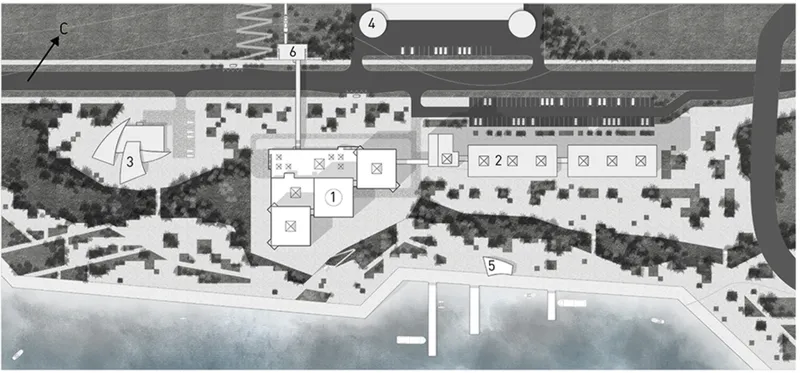
The site plan shows the project's first decision. Afanasyeva does not pack the programme into one sealed mass. She breaks it into interconnected blocks that slide away from each other, with a long linear volume set against a looser cluster. Jetties reach out into the misty shoreline, and parking rows are kept to the landward side. The gaps between the blocks are the point. They keep light, views and movement passing through the complex, and they turn every route back toward the water.
This is a sensible move for a building whose subject is the river outside. Each separation works as a sightline, so the Yenisei stays part of daily life for the scientists, students and visitors moving between the parts of the programme.
A Glazed Sphere Suspended Over the Central Atrium
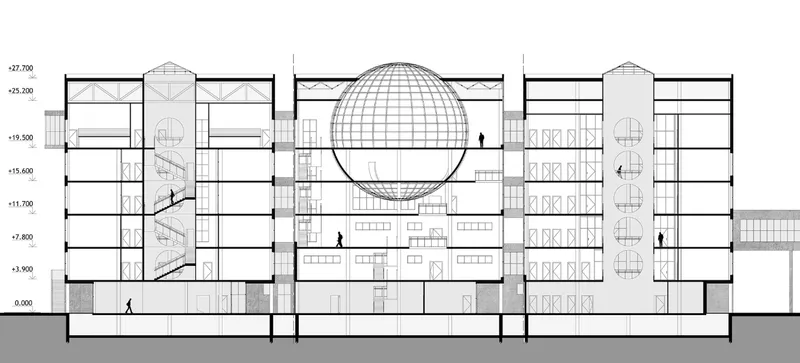
The cross-section shows the project's symbolic core. A large glazed sphere is embedded in the main block and hangs above the central atrium, between side bays that hold the stair cores. The designer reads it as the sun by day and the moon by night, which links celestial cycles to the water cycles the center is built to track. The composition plays square against circle in both plan and elevation. Here the circle wins, and it reads as an expression of scientific order and cyclical natural process rather than decoration.
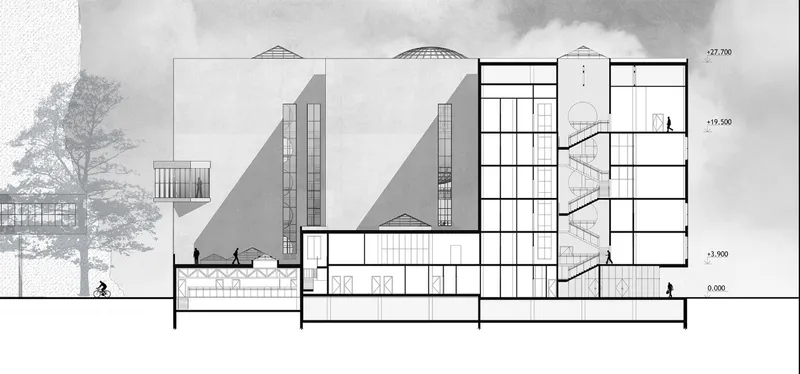
The second section is more restrained. A tall blank wall throws shadow beside a stair core, and a cyclist and a tree at its base give it scale. The vertical organisation does social work. Circulation cores, staircases and transitional platforms are arranged so that scientists, students and visitors cross paths and see one another. The training block adds shared kitchens and dining areas, and a raised platform with an above-ground transition extends the circulation beyond the building edge. Research here is treated as something done in company.
Three Glass Fronts Facing the Water
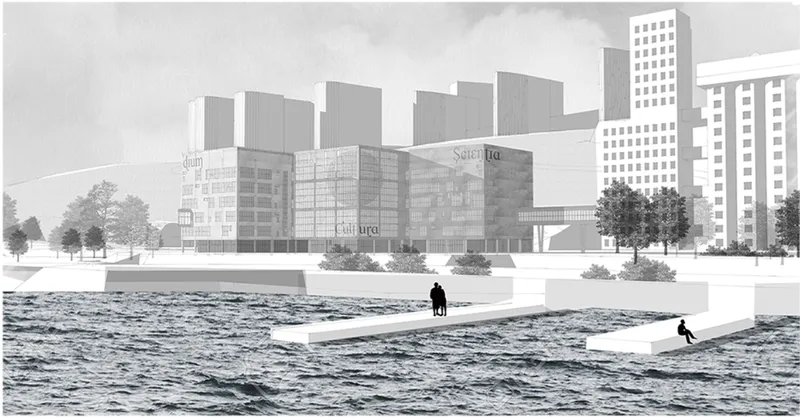
The waterfront rendering moves from diagram to experience. Three glass-fronted blocks with lettered facades stand behind a stone embankment. People sit on the jetties above choppy water, close to the river the labs behind them are measuring. The three-part composition carries meaning. The Yenisei is the natural boundary between western and eastern Siberia, and the tripartite front marks the building as a point of transition between landscapes, climates and ways of knowing.
Descending Windows and a Glowing Circle After Dark

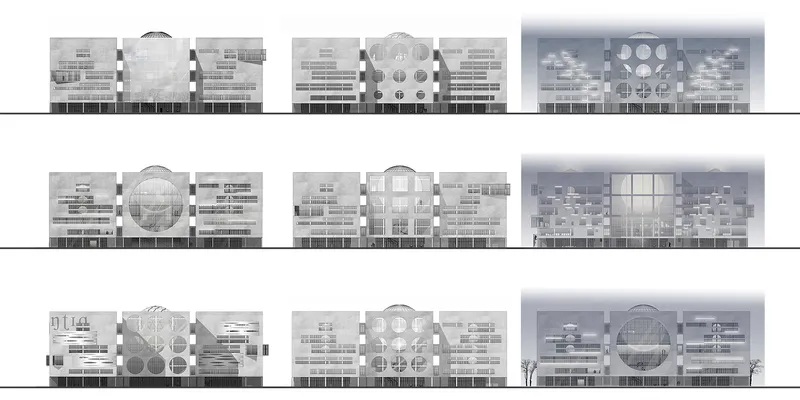
The night elevation shows the facade strategy clearly. A gridded glass centre bay holds a glowing circle, and concrete wings on either side are scattered with lit windows. The openings are arranged symmetrically and step downward toward the centre of each elevation, a slow cascade that echoes the river's flow. Window sizes vary, and with horizontal backlighting this produces a flickering surface. After dark, the work going on inside becomes visible to the city.
The grid of nine elevation studies is the most revealing image in the set. It compares circular openings, glazed grids, and day and night lighting side by side, and it shows a designer testing the facade rather than settling on a first idea. The final rhythm reads as earned because these alternatives were drawn and set aside.
Why This Project Matters
Environmental monitoring is usually invisible: sensors, samples and datasets that the public never sees. Afanasyeva's center rejects that invisibility. By placing observation zones within the programme and giving the building a facade that changes from day to night, the project argues that ecological literacy is an architectural responsibility as well as a scientific one. The sphere is a bold gesture, and it gives an abstract mission a single image that people can remember.
The project's strength is that the symbolism is backed by spatial logic. The separated blocks keep the river in view, the sections bring different user groups together, and the facade studies show careful iteration. As river systems come under growing pressure, a building that lets a city watch its river being studied makes a convincing case for what public research architecture can do.
View the Full Project
About the Designers
Designer: Дарья Афанасьева
Enter a Design Competition on uni.xyz
uni.xyz runs architecture and design competitions year-round that reward proposals with spatial conviction and real site intelligence.
Project credits: Scientific and Educational Monitoring Center of the Yenisei in Krasnoyarsk by Дарья Афанасьева.


Popular Articles
Popular articles from the community


David Ortega Stacks a Two-Story Mexico City Penthouse Around a Steel Stair and a Pergola-Shaded Roof Terrace
In Colonia Roma, a 300 m² penthouse uses oak joinery, a planted steel stair and a slatted roof pergola to make a new-build apartment feel like a house.

Cube Design Draws an Ecological Corridor Between Two Shenzhen Hills with the Nankai Building
Beside Shenzhen's container docks, the Nankai Building pairs stacked balconies with a climbing green screen to connect two hillsides across its height.


Singing Woman: An Opera House That Performs Before the Curtain Rises
Ovidiu Cristian Pavel's conceptual opera house translates Estonia's choral identity into a sculpted waterfront landmark facing the Baltic Sea.

Manzana Morphosis: Stretching Barcelona's Grid into a Living Landscape for 2050
A radical reworking of the Eixample manzana turns density into a tool for generous public space, vertical ecology, and environmental performance.

Similar Reads
You might also enjoy these articles

Maya Harvest: A Cacao Resort Village Rooted in Mayan Tradition and Local Craft
Situated within a Tabasco cacao plantation, this shortlisted resort proposal merges vernacular materials with hands-on cultural immersion.
Harmonia: A River-Shaped Community That Grows Over Decades in Boa Vista
Curved pathways and modular grid structures along the Branco River create a phased settlement designed to evolve from 2030 to 2050.

The Architecture of Bathing: A Mughal Hammam Reimagined Across the Yamuna
Charlotte May's honorable mention entry for The Black Taj reinterprets Agra's bathing rituals through red sandstone, water, and framed views of the Taj Mah
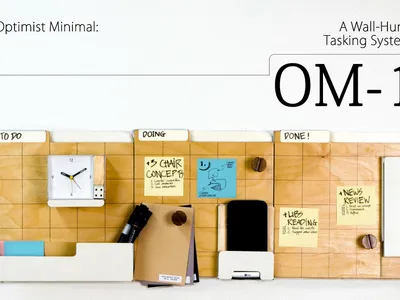
Om-1: A Wall-Hung System That Moves Your Workspace Off the Desk
Modular plywood boards, magnetic pegs, and utility elements migrate clutter from the horizontal surface to the vertical plane.

Comments (0)
Please login or sign up to add comments
No comments yet. Be the first to comment!