Scientific and Educational Monitoring Center of the Yenisei, Krasnoyarsk
Architecture as an instrument for ecological research, education, and environmental awareness along Russia’s largest river.


The Scientific and Educational Monitoring Center of the Yenisei in Krasnoyarsk is conceived as an example of ecological research center architecture, where built form becomes a mediator between scientific observation, education, and the natural environment. Located in Krasnoyarsk, along the banks of the Yenisei—the largest river in Russia—the project addresses a critical ecological challenge: understanding, monitoring, and forecasting changes in complex river ecosystems through a dedicated architectural infrastructure.
As environmental pressures intensify, the role of architecture extends beyond shelter and function. In this project, architecture is positioned as a tool for ecological literacy—supporting scientific research while making environmental processes visible and accessible to the public.
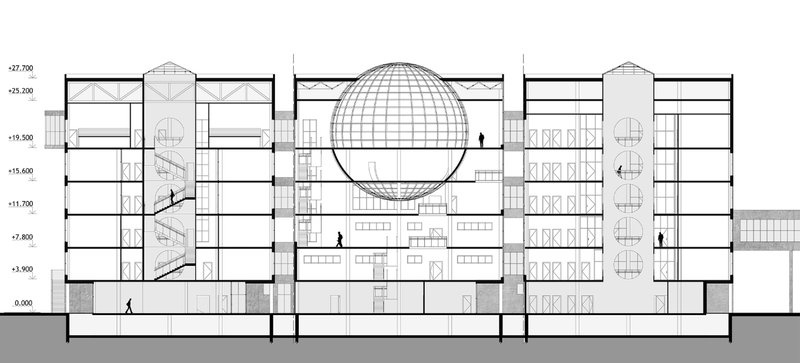
Programmatic Vision: Science, Education, and Public Engagement
The core objective of the center is to assess the state of the natural environment and support long-term ecological monitoring of the Yenisei River. To achieve this, the project integrates multiple functions within a cohesive architectural framework:
- Advanced scientific laboratories for environmental analysis and water research
- Educational spaces, including classrooms and lecture halls for students and researchers
- Public observation zones that allow visitors to understand ongoing scientific work
- Training and residential components that support long-term research activity
This hybrid program transforms the building into a living institution—one that continuously evolves alongside the river it studies.
Spatial Composition and Architectural Language
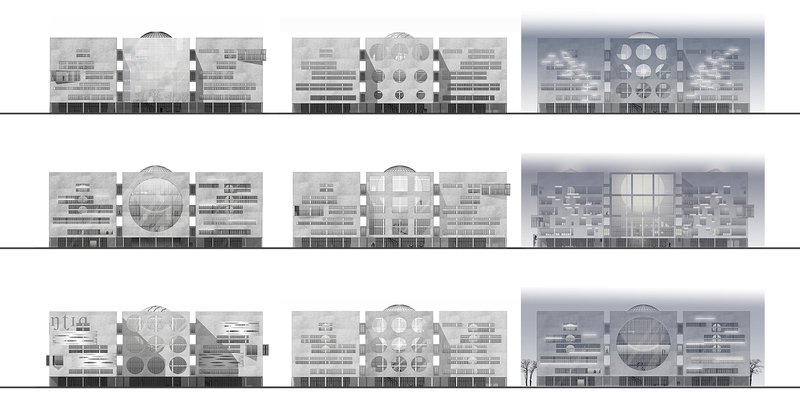
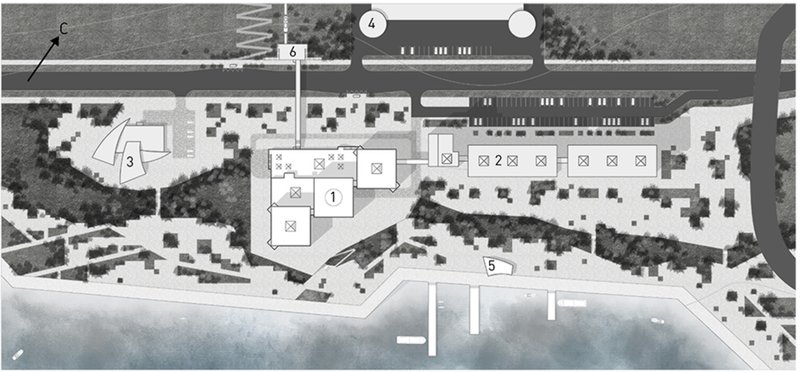
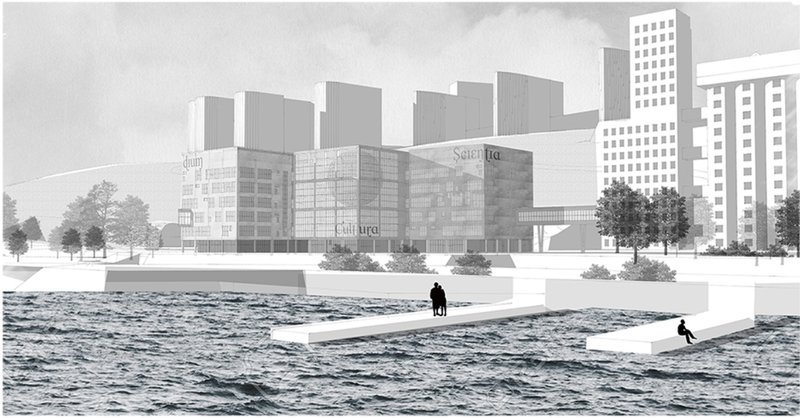
The architectural composition is based on the interaction of square and circular geometries, both in plan and elevation. These elemental forms are not merely aesthetic devices; they reflect scientific order, balance, and cyclical natural processes.
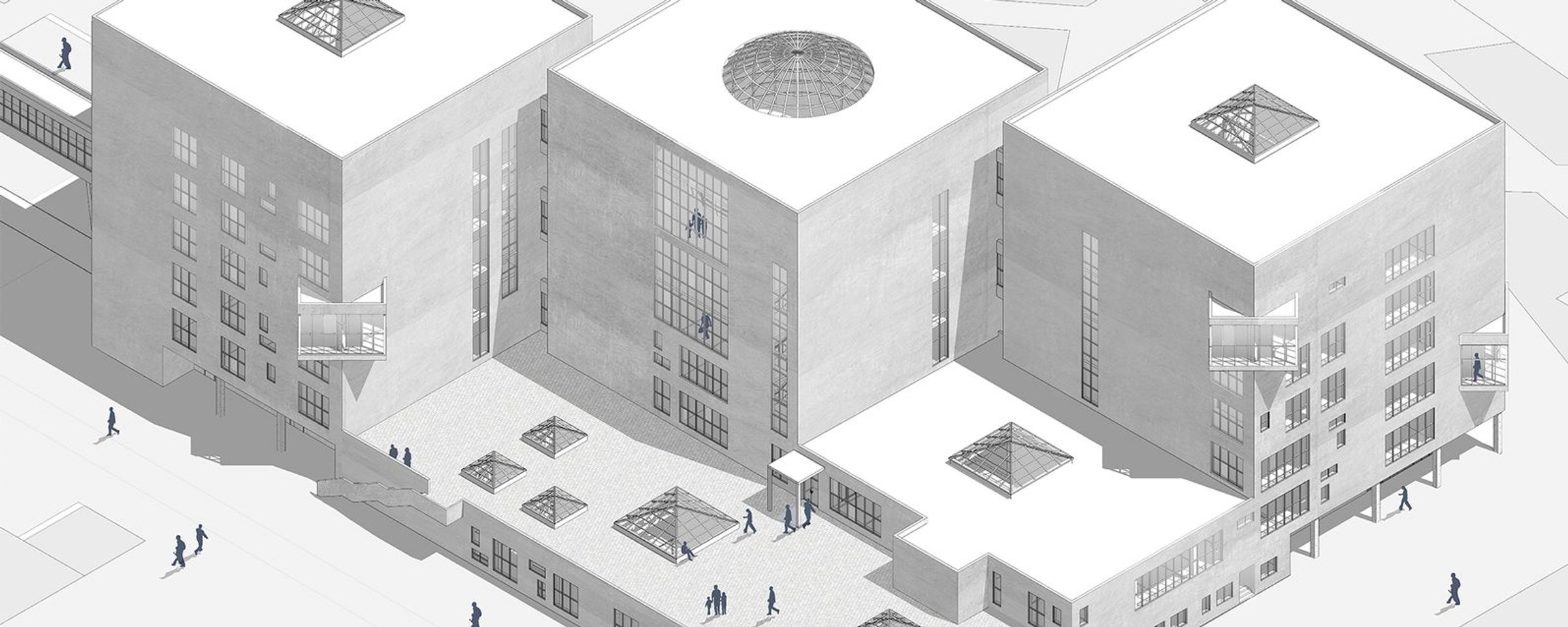
The building mass is divided into interconnected blocks that gradually shift away from one another, maintaining visual permeability and functional clarity. This separation allows light, views, and movement to flow through the complex while reinforcing a sense of orientation toward the river.
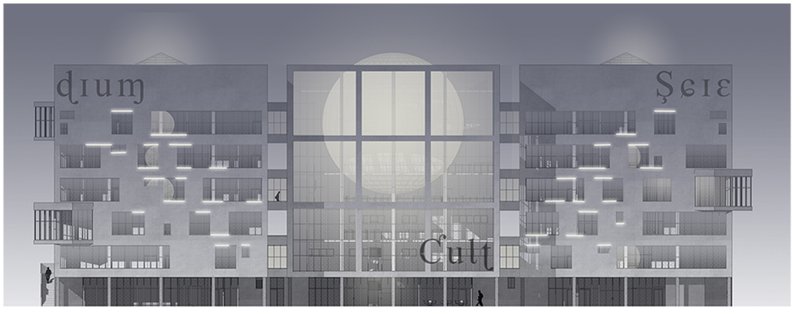
A defining feature of the project is the central spherical volume, embedded within the main block. This sphere functions as both a spatial and symbolic core—referencing the sun during the day and the moon at night. Through this gesture, the architecture establishes a poetic relationship between celestial bodies and water cycles, reinforcing the project’s ecological narrative.
Facade Strategy: Light, Rhythm, and Environmental Expression
The facades play a critical role in expressing the building’s scientific identity. Window compositions are symmetrically organized, with openings gradually descending toward the center of each elevation. This rhythm creates a subtle visual movement, echoing the flow of the Yenisei itself.
Variations in window size generate a flickering effect across the facade, enhanced by horizontal backlighting. This approach allows the building to change character throughout the day and night, transforming scientific activity into a visible urban phenomenon.
The three-part facade composition further reflects the geographical and cultural significance of the Yenisei, which acts as a natural boundary between the western and eastern regions of Siberia. Architecture here becomes a marker of transition—between landscapes, climates, and systems of knowledge.
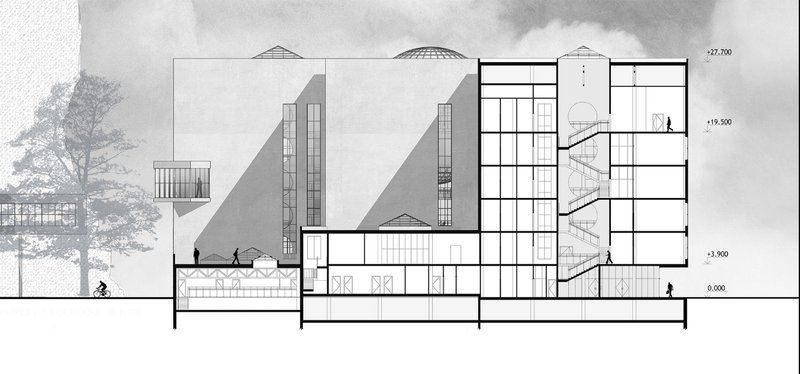
Sectional Logic and Vertical Connectivity
Sectional studies reveal a carefully structured vertical organization. Circulation cores, staircases, and transitional platforms are designed to encourage movement and visual interaction between different user groups—scientists, students, and visitors.
The training block incorporates shared facilities such as kitchens and dining areas, reinforcing the social dimension of research. A raised surface platform, connected through an above-ground transition, enables direct access from upper levels while doubling as a public terrace and observation deck.
Skylights punctuate these platforms, allowing daylight to penetrate deep into the building and offering visitors framed views of scientific activity below. This transparency aligns with the project’s educational mission—demystifying research and inviting public engagement.
Architecture as an Ecological Interface
As an example of ecological research center architecture, the project demonstrates how built form can operate as an interface between natural systems and human knowledge. Rather than isolating science behind closed walls, the building exposes processes, encourages observation, and fosters dialogue between experts and the public.
By aligning scientific infrastructure with architectural clarity and symbolic meaning, the monitoring center becomes more than a functional facility—it becomes a landmark of environmental responsibility and awareness.
The Scientific and Educational Monitoring Center of the Yenisei redefines the role of architecture in environmental research. Through a disciplined geometric language, symbolic spatial elements, and transparent programmatic organization, the project positions architecture as an active participant in ecological understanding.
Designed as a long-term platform for research, education, and public engagement, the project by Дарья Афанасьева illustrates how architecture can respond to ecological urgency while remaining rooted in place, culture, and scientific inquiry.