

Seance: Parametric Modules That Turn Urban Steps into Social Infrastructure
A computational design system fragments timber furniture into adaptive clusters for staircases, plazas, and leftover urban terrain.


Most urban benches sit where they are placed and do nothing else. Seance starts from a different premise: what if a piece of furniture could read the geometry of a staircase, a sloped plaza, or an irregular courtyard and reconfigure itself accordingly? The project uses parametric modeling to generate timber modules whose algorithmic relationships govern form, scale, and arrangement. The result is not a single object but a kit of parts, a modular system that colonizes transitional urban surfaces and converts them into zones of rest, conversation, and informal gathering.
Designed by Sneha Yerunkar and published on uni.xyz as Seance, the project sets out to re-evaluate the relationship between design and construction through computational architecture. Rather than proposing a site-specific installation, Yerunkar frames Seance as a non-site-specific strategy: a scalable, affordable vocabulary of seating clusters that can expand, shrink, rotate, and stack to meet the demands of any given topography.
Clusters, Not Objects: The Logic of Parametric Aggregation
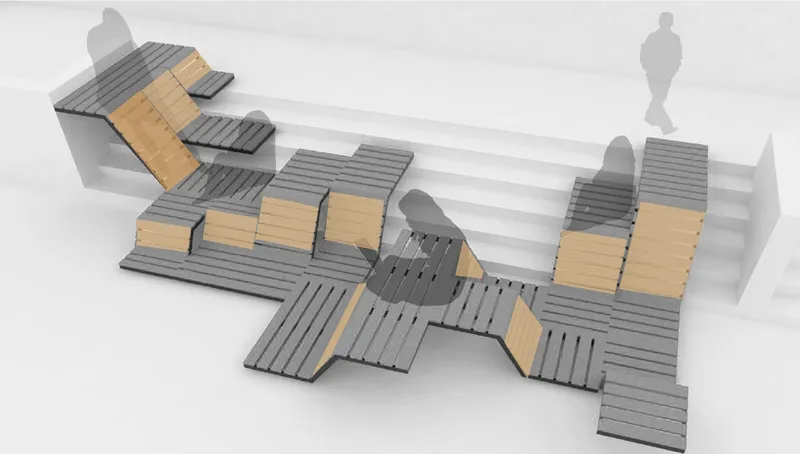
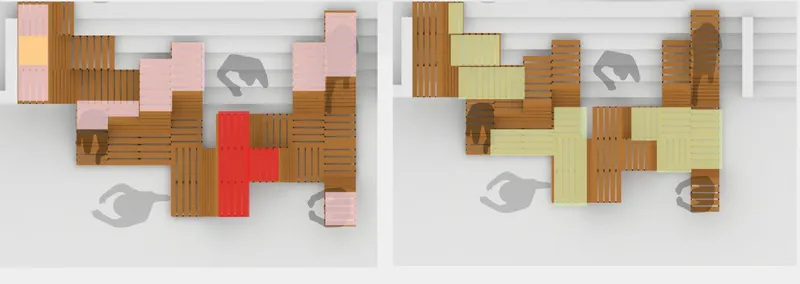
The axonometric and plan views reveal how Seance operates at the level of the cluster rather than the individual bench. Grey and timber-toned slat surfaces aggregate into formations that recall geological strata or terraced landscapes. Each module is a simple proposition: wooden planks on a structural frame, angled to support sitting, lounging, or leaning. But their power lies in combination. Parametric algorithms establish the rules by which modules attach, rotate, and step up or down, producing arrangements that feel organic rather than repetitive.
The varied wood tones visible in the top-down rendering are more than aesthetic choice. They signal distinct module types within the system, each calibrated for a different posture or activity. Darker slats mark deeper seating surfaces; lighter planks indicate narrower perch-style elements. Silhouetted figures scattered across the clusters demonstrate multi-functionality: some sit, some stand in conversation, others pause mid-stride. The design treats social behavior as a variable the algorithm must accommodate.
Negotiating Slope and Step
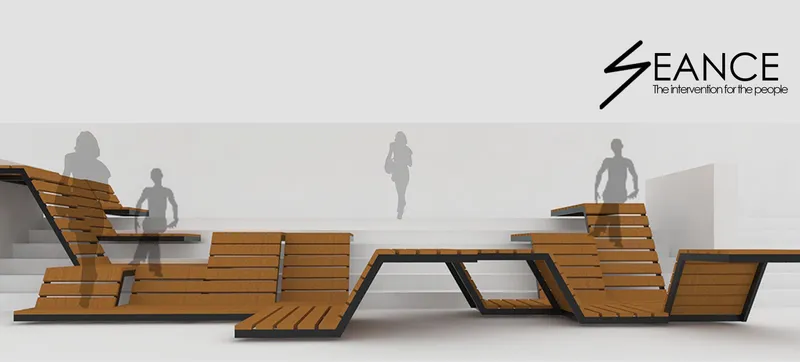
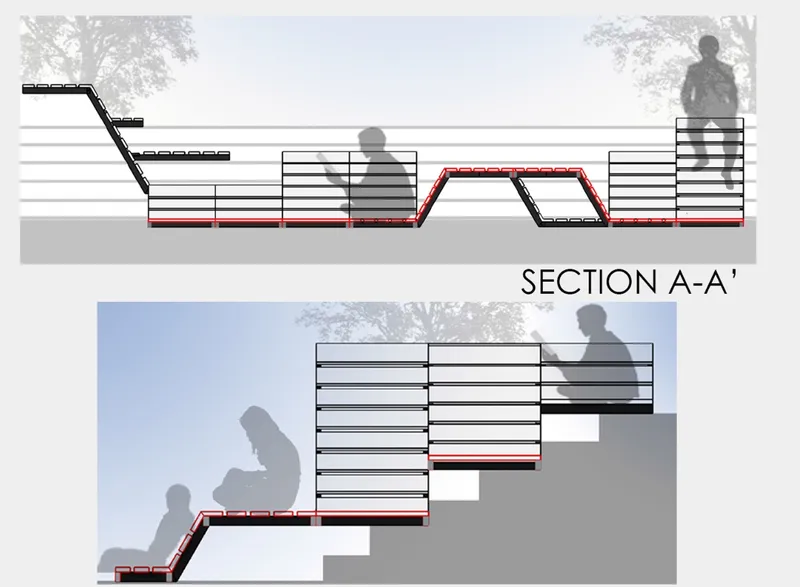
The side elevation and section drawings expose the structural intelligence of the system. Angular timber benches integrate with stepped surfaces, turning what would normally be a passage into a destination. Horizontal slats span between angled frames that follow the gradient of a staircase or ramp, and the sections show how seating profiles shift from sloped lounging surfaces to upright perches within a single assembly. Standing figures alongside seated ones confirm that the modules do not just replace stairs; they layer new programs onto existing vertical circulation.
This is where Seance departs most clearly from conventional urban furniture. A standard bench ignores topography. It demands a flat pad of concrete. Yerunkar's modules embrace level changes as design inputs. The parametric model adjusts member lengths and joint angles to maintain ergonomic seat heights regardless of the underlying slope, which means the same system can populate a gentle amphitheater, a steep hillside stair, or a flat plaza without structural redesign.
From Section to Landscape: Reading the Composite Drawing
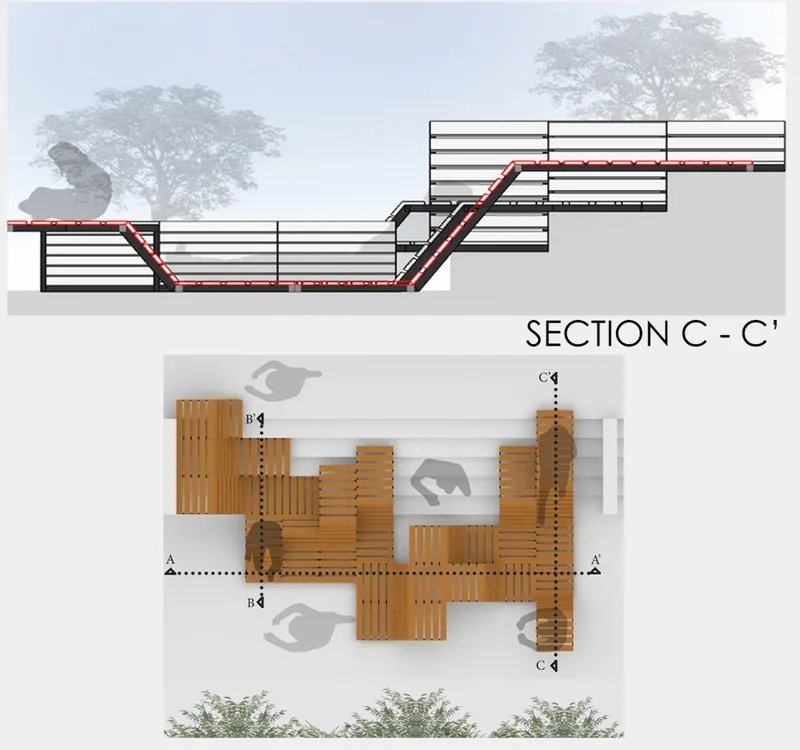
The final drawing pairs a sectional cut with a plan view, anchoring the modular clusters within a landscape that includes tree silhouettes and open ground. It is a critical image because it demonstrates scale. The timber modules are not miniature desktop prototypes; they are full-body architectural elements whose sloped profiles rival the canopy spread of adjacent trees. The drawing also makes the case for affordability through repetition. Identical structural frames recur across the plan, and variation comes from rotation and grouping, not from bespoke fabrication. This is industrial logic applied to public space.
Material Simplicity as a Strategic Choice
Wooden planks paired with structural frames constitute the entire material palette. There is no glass, no tensile membrane, no 3D-printed polymer. The restraint is deliberate. By keeping the material vocabulary to timber and metal framing, Yerunkar ensures that the computational complexity of the parametric model translates into constructable reality. Local carpentry workshops could fabricate modules using standard plank dimensions, making large-scale urban implementation economically viable. The sophistication lives in the algorithm, not in the bill of materials.
Why This Project Matters
Seance sits at a productive intersection: parametric computation on one side, everyday urban utility on the other. Too often, algorithmic design in architecture produces spectacular geometry that is unbuildable or irrelevant to public life. Yerunkar avoids that trap by directing computational power toward a mundane but critical problem: how to make leftover urban terrain socially useful. Steps, ramps, and irregular platforms are among the most common surfaces in any city, and they are almost always treated as pure circulation. Seance argues they can be something more.
The project's real contribution is its framework, not any single configuration. Because the parametric model is non-site-specific and the modules are scalable, Seance could populate a campus courtyard in Pune or a waterfront promenade in Copenhagen with equal plausibility. That portability, combined with material economy and structural clarity, makes it a compelling template for adaptive urban furniture. It is a reminder that responsive architecture does not require sensors or motors; sometimes an algorithm and a plank of timber are enough.
View the Full Project
About the Designers
Designer: Sneha Yerunkar
Enter a Design Competition on uni.xyz
uni.xyz runs architecture and design competitions year-round that reward proposals with spatial conviction and real site intelligence.
Project credits: Seance by Sneha Yerunkar.


Popular Articles
Popular articles from the community


Tsunami Convergenics: Turning Catastrophic Ocean Forces into Underwater Housing Infrastructure
A speculative underwater settlement off the coast of Onagawa, Japan, treats tsunamis and typhoons as energy sources rather than threats.

Faces of the Soviet Avant-Garde: Turning Moscow's Street Names into an Open-Air Museum
A network of sculptural installations across a Moscow residential district transforms forgotten architect names into spatial encounters with cultural memor

Singing Woman: An Opera House That Performs Before the Curtain Rises
Ovidiu Cristian Pavel's conceptual opera house translates Estonia's choral identity into a sculpted waterfront landmark facing the Baltic Sea.

The Amber Palace Opera: A Geological Fiction Surfaces on Tallinn's Baltic Waterfront
Pierre Brillard reimagines a Baltic legend as a public landscape, opera house, and waterfront promenade rooted in Tallinn's coastal identity.

Similar Reads
You might also enjoy these articles

Pixel Gardens: One Repeated Module Stacked Into a Terraced Social Housing Tower for Famagusta
Salem Bader's shortlisted housing tower builds a vertical neighbourhood from one repeated module, offsetting units to carve terraces, light and air.

Bao Huynh Watercolor Atelier: A Serene Art Retreat in Hội An
Bao Huynh Watercolor Atelier in Hội An blends multifunctional art spaces, sustainable design, local materials, and family-friendly living in a serene environment.

Atelier Macri Concept Store Interior Design by CASE-REAL
Atelier Macri store features a "ko" counter, walnut wood details, cork displays, blending retail, gallery, and seamless customer experiences.

Manuel Vargas Izquierdo Stadium and High-Performance Sports Center: Architectural Excellence in Jalpa de Méndez
The Manuel Vargas Izquierdo Stadium blends sustainable design, inclusive sports facilities, and cultural-inspired architecture, revitalizing Jalpa de Méndez’s public spaces.

Explore Modular Furniture Competitions
Discover active competitions in this discipline

Design challenge to equip cities with modern furniture

Competition to design a workstation for architects

Packaging challenge - Design meets sustainability
Comments (0)
Please login or sign up to add comments
No comments yet. Be the first to comment!