

Shubh-Ritu: Climate as Curriculum in a Children's Campus for Bhubaneswar
Laterite, bamboo, and broken massing translate Odisha's cyclonic climate into a sequence of child-scaled courtyards and learning spaces.


What if the harshest forces acting on a building site became the primary generators of its form? In Bhubaneswar, where cyclonic winds, monsoon flooding, intense summer heat, and relentless humidity define daily life, Shubh-Ritu answers that question by refusing to fight the climate and instead allowing it to shape every wall, courtyard, and roofline. The result is a children's campus that reads less like an institution and more like a sequence of sheltered outdoor rooms, each tuned to the sun angle, wind direction, and rainfall pattern of eastern coastal India.
Shortlisted in the Form Follows Climate 2020 competition, the project is the work of Mani Makhija and Meshullam Nongsteng. Their approach starts with forensic environmental analysis of the site's tropical dry-wet climate, then translates each data point into a spatial strategy: orientation, massing, material selection, and passive ventilation all derive directly from measurable climatic forces rather than stylistic preference.
Reading the Site Through Sun Paths and Cyclone Corridors
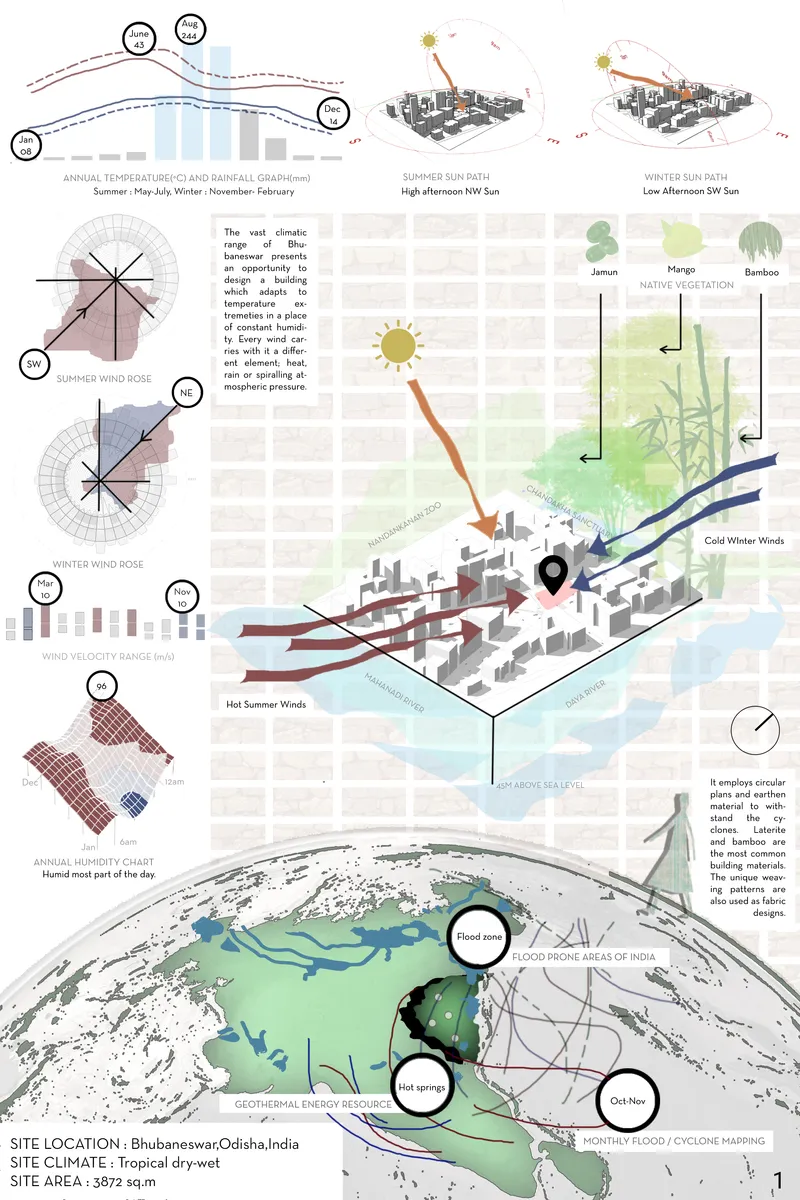
The site analysis diagram lays bare the environmental pressures that informed every subsequent design decision. Wind roses, solar exposure charts, temperature ranges, and geographic context along the Odisha coast are mapped together, revealing a place where prevailing south-west monsoon winds carry both relief and destruction. Rather than treating this data as background research, the designers use it as the project's generative engine. Longer facades are aligned along the north-south axis to minimize punishing east-west solar exposure, while building curves are introduced specifically to diffuse wind pressure during cyclonic events. The diagram makes clear that nothing in the final form is arbitrary.
Broken Massing and Circular Performance Volumes
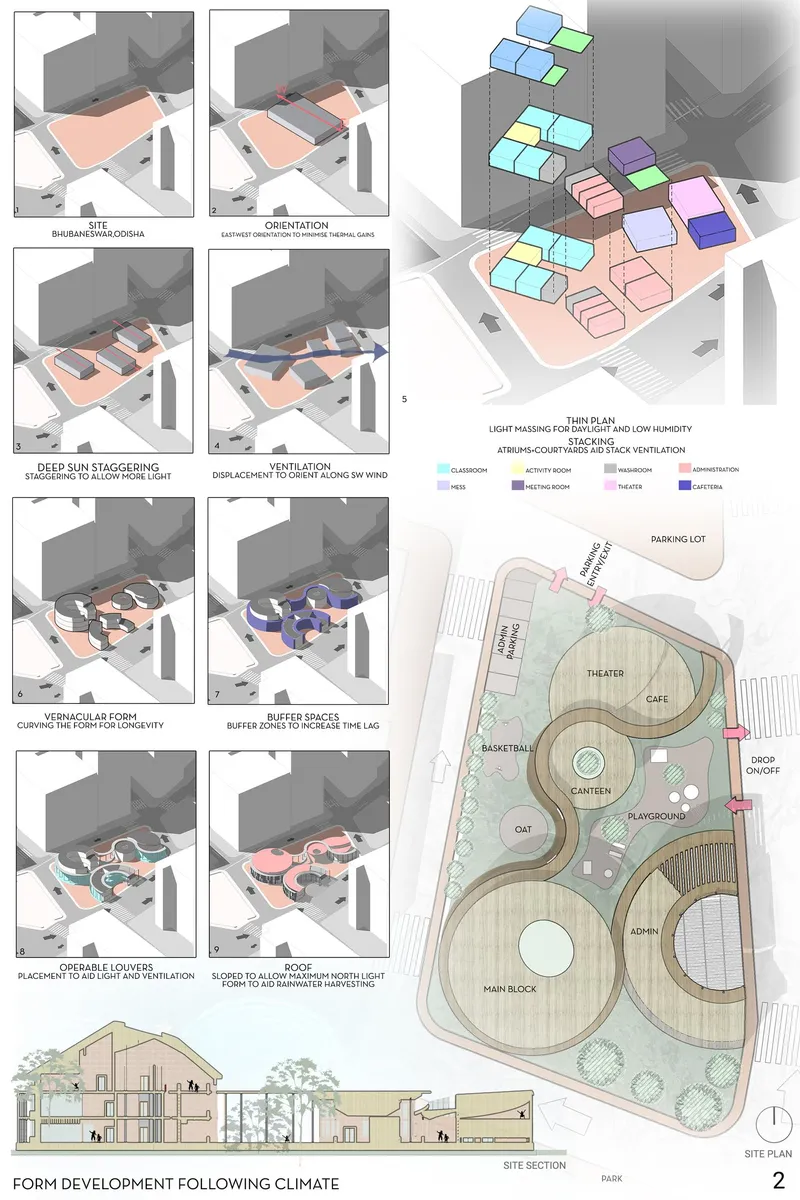
The isometric massing studies and site plan reveal how the campus is intentionally fragmented into human-scaled clusters connected by a continuous internal pathway. Three circular performance spaces anchor the plan, their curved geometries doing double duty: they create aerodynamic profiles that reduce cyclonic wind loads and they give children legible landmarks within the campus. The staggered configuration between volumes opens channels for prevailing south-west winds to filter through shaded buffer zones and courtyards before reaching interior learning spaces.
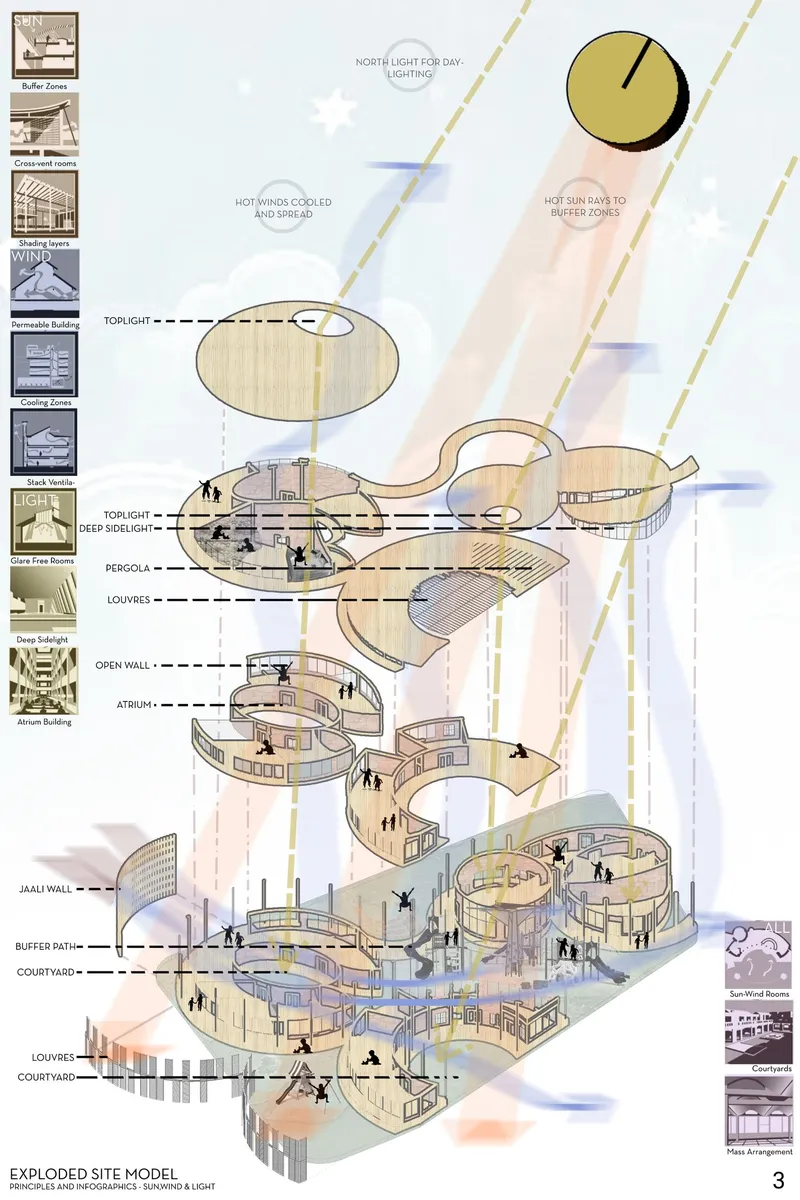
The exploded axonometric peels back the layers of a typical building volume, exposing multilevel interior spaces linked by stairs, double-height courtyards, and curved roof light wells. These light wells are not merely formal gestures; they drive stack ventilation by pulling warm air upward and out, while drawing soft north light deep into classrooms below. The section confirms that every vertical connection in the building serves both a climatic and a pedagogical purpose, giving children a spatial experience that shifts between compression and release, shade and brightness, enclosure and open sky.
Laterite Walls Meet Bamboo Ceilings
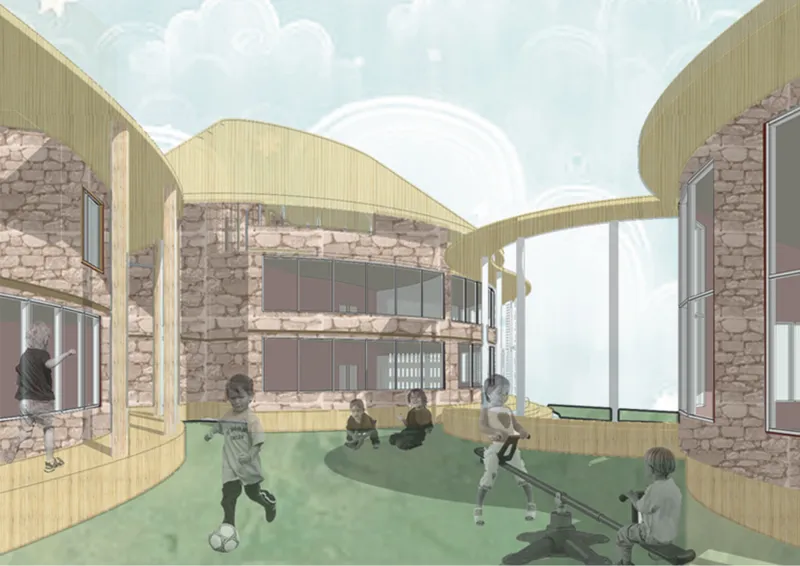
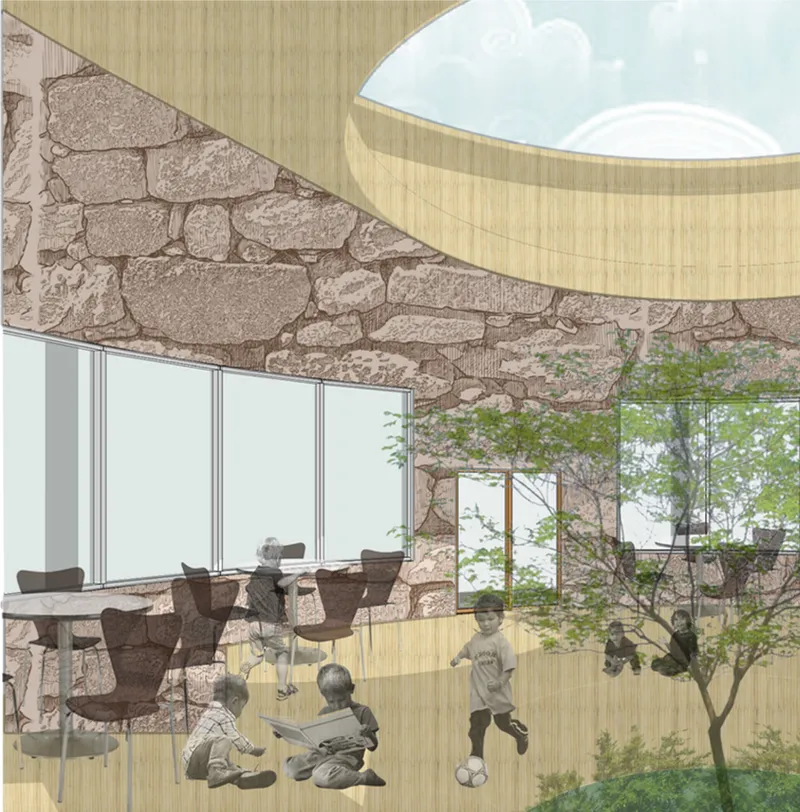
The interior perspective captures children playing in a double-height space bounded by locally sourced laterite stone walls and sheltered by a sweeping curved bamboo ceiling. The material pairing is precise: laterite's thermal mass absorbs and slowly releases heat, moderating indoor temperatures without mechanical cooling, while bamboo's lightness and structural flexibility make it ideal for spanning curved roof forms. Permeable jaali walls, deep louvers, and pergolas layer additional shading, casting dynamic patterns of light and shadow that transform throughout the day. These are not decorative additions; they are calibrated passive cooling devices that reduce reliance on mechanical systems.
The section perspective drives the point home, showing a planted tree growing within an interior courtyard where a thick laterite wall transitions into the bamboo-clad curved ceiling above. Rainwater collected from roof slopes is channeled through vertical columns into courtyard reservoirs, supporting groundwater recharge and future reuse. The courtyard functions simultaneously as social condenser, climate moderator, and water management infrastructure. For children, it is simply a room with a tree and a sky. That simplicity is the project's greatest achievement: complex environmental engineering rendered invisible by architecture that feels intuitive and playful.
Why This Project Matters
Shubh-Ritu demonstrates that climate-responsive design need not result in austere or technically forbidding architecture. By grounding every decision in site-specific environmental data and then expressing those decisions through vernacular materials and child-scaled spatial sequences, Makhija and Nongsteng produce a campus that is simultaneously rigorous and joyful. The building does not lecture its young occupants about sustainability; it simply keeps them cool, dry, safe from cyclones, and surrounded by natural light.
In a broader disciplinary context, the project pushes back against the tendency to treat climate analysis as a compliance exercise appended to a predetermined form. Here, the form is the climate analysis. Sun paths become orientations, wind data becomes massing strategy, rainfall becomes courtyard infrastructure, and thermal performance becomes material selection. It is a convincing argument that the most honest architecture emerges when designers stop imposing shapes on sites and start listening to the forces already acting on them.
View the Full Project
About the Designers
Designers: Mani Makhija, Meshullam Nongsteng
Enter a Design Competition on uni.xyz
uni.xyz runs architecture and design competitions year-round that reward proposals with spatial conviction and real site intelligence.
Project credits: Shubh‑Ritu by Mani Makhija, Meshullam Nongsteng Form Follows Climate 2020 (uni.xyz).


Popular Articles
Popular articles from the community


Opera on the Sea: Driftwood Logic Shapes a Timber Opera House on Estonia's Coast
Trevor Orgill's opera house translates the entangled drift of floating timber into a civic building where wood, water, and music converge.

Singing Woman: An Opera House That Performs Before the Curtain Rises
Ovidiu Cristian Pavel's conceptual opera house translates Estonia's choral identity into a sculpted waterfront landmark facing the Baltic Sea.

Tsunami Convergenics: Turning Catastrophic Ocean Forces into Underwater Housing Infrastructure
A speculative underwater settlement off the coast of Onagawa, Japan, treats tsunamis and typhoons as energy sources rather than threats.

Extended Shell: Retrofitting Kolkata's Balconies as Living Urban Thresholds
A modular retrofit system recovers the social and environmental intelligence of Kolkata's historic verandas for contemporary Park Street residents.

Similar Reads
You might also enjoy these articles

Play: Fragments of Their World: Remembered Architecture Rebuilt as a Modular Playground for Refugee Camps
Tom Gardner abstracts domes, arches and towers from the homelands of displaced families into a kit of child-scaled play parts for camp settlements.
REBIRTH: A Circular Settlement Where Afghan Widows and Their Children Rebuild Life Together
A shortlisted Resile entry turns the circle into a protective ring of timber and brick, gathering homes, classrooms and gardens around a shared landscape.
The Main Dream: A Recycled Plastic Kit That Lets Refugee Children Build Their Own Playground
Thirty-centimetre interlocking cubes that connect on three axes turn play into construction, letting children author the spaces they occupy.

Lunar Spiral: A Fibonacci-Driven Moon Settlement Rising from Shackleton Crater
Golden-spiral geometry organises buried infrastructure and orbiting habitable spheres into a lunar base designed to grow as life on the Moon expands.

Comments (0)
Please login or sign up to add comments
No comments yet. Be the first to comment!