Super Factory·Community·School
We hope to propose a new model between urban and rural areas through this design.
Cities and villages have always been interdependent and increasingly separate, with cities depending on the countryside for food and cities expanding and encroaching on rural land. The income gap between urban and rural people is widening, but for all countries and regions in the world, education is one of the main reasons for the large income gap between urban and rural residents. Education is the most effective and essential means to change the urban-rural gap.
Mali is known as the cradle of West African culture, but its education has been hampered by a long period of colonial rule and civil unrest in recent years. The current situation in Mali is that Mali is a very backward country with poor economy and low quality of life. 54% of Malians are illiterate and the adult illiteracy rate is 76%.We want to improve the situation in Mali through education.
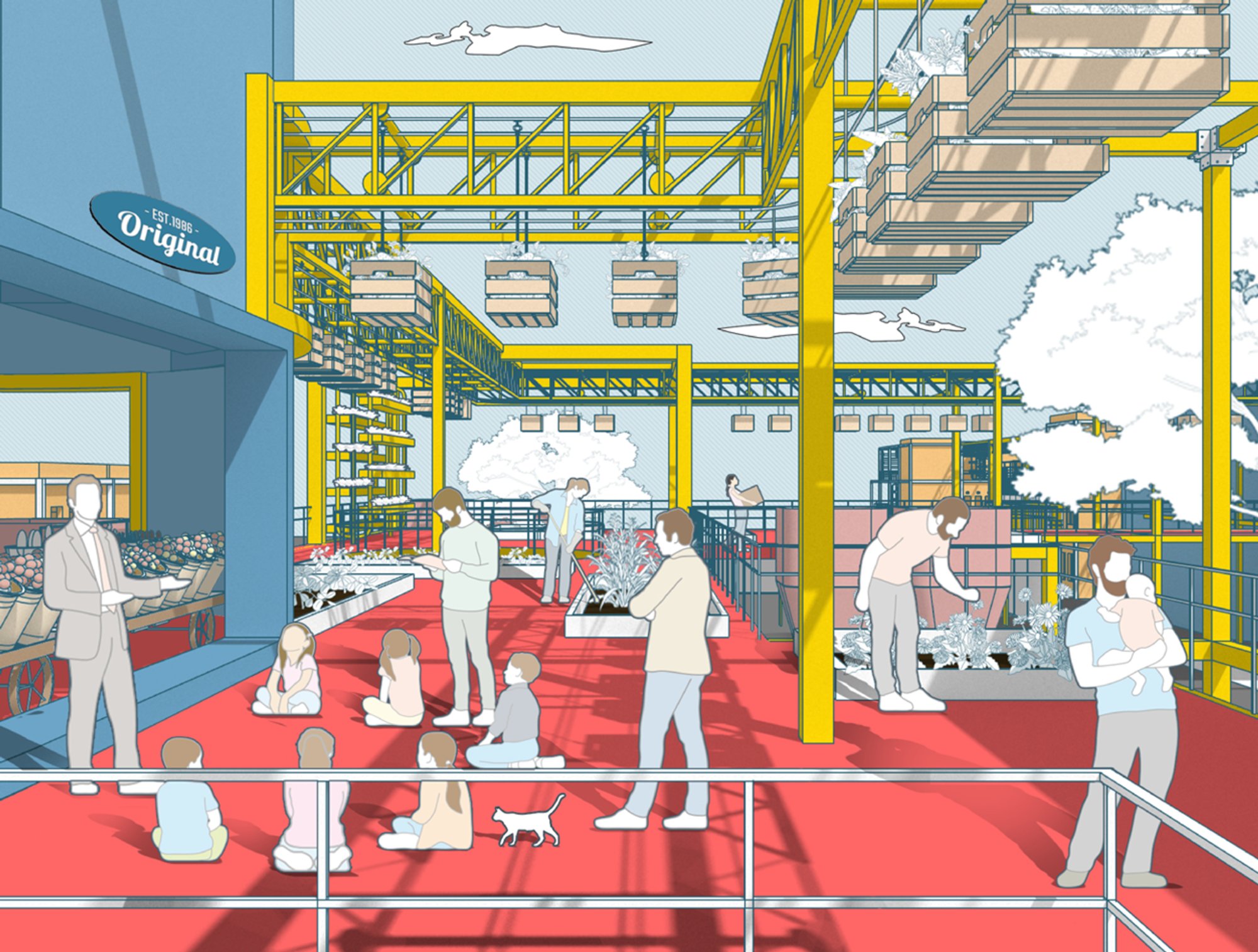
We chose six adjacent plots of 5,000 square meters in the Moray area and tried to integrate them into a larger community. In this community, the country people go to the city to make a living, the city people let the country people in the city on the open space, teach them, teach them about farming, so the country people grow more and better food, the city people eat fresher and richer food. In the constant communication with the city people, the country people received the education imperceptibly. As their skills increase, so does their income. We want to show the connotation of education through this way that people from the city and the country learn from each other.
In terms of operation methods, we adopt the modular strategy to fold the four spaces of residence, commerce, industry and planting into an existing factory and residential and commercial cluster, in which the residential and commercial modules have preset modules of different sizes according to different usage requirements, forming a comprehensive residential and commercial cluster. Then we attached different groups of commercial spaces to the high-line factory, forming a public space within the group, and finally connected different groups with the factory streamline, forming the whole community. It is worth noting that the commercial types of different residential groups form the upper and lower end of the industrial chain with each other, so that the community can form a stable commercial area in the city and realize the sustainable development of the region.
Our folded landscape spawns a new and more dynamic space -- the educational space. In this paradigm, the educational space is no longer a school or classroom in the traditional sense. It's a kind of subtle space that's scattered all over the neighborhood. Education is integrated into People's Daily life and exerts a subtle influence on the education of residents. In particular, the children in this community can maximize the contact, participation and experience of the production process of crops, first-hand experience of the food is not easy to get. In the process of participating in the planting practice, eat healthy food, establish a healthy outlook on life, and learn to live better.