

MUE Atelier, BSAAR, and Erbat SA Nestle a Timber Gymnasium into a Swiss Jura Hillside Garden
A Jura wood pavilion in Sainte-Croix, Switzerland, doubles as a sports hall and youth center while deferring to its parkland setting.


There is a particular challenge in building a gymnasium: the program demands volume, but the best sites demand restraint. In Sainte-Croix, a small town in the canton of Vaud perched above the Swiss Jura, MUE Atelier, BSAAR, and Erbat SA won a 2018 competition by proposing to do both. Their 1,500 m² sports and youth facility sits between an existing school and a remarkable garden that looks out over the mountains. Rather than asserting itself as a civic monument, the building operates as a pavilion: low, timber-clad, and absorbed into the slope so that the park's character remains dominant.
What makes the project genuinely interesting is not just the pastoral camouflage but the structural honesty beneath it. Two distinct load-bearing systems share one envelope: trapezoidal underslung beams span the large sports hall, while solid wooden slabs handle the six-meter spans of the ancillary program on the north side. Every piece of timber comes from the Jura region, processed through a supply chain that links local forest owners, rangers, sawmills, and carpenters. The building is, in a very literal sense, made from the landscape it inhabits.
A Pavilion that Disappears into the Park
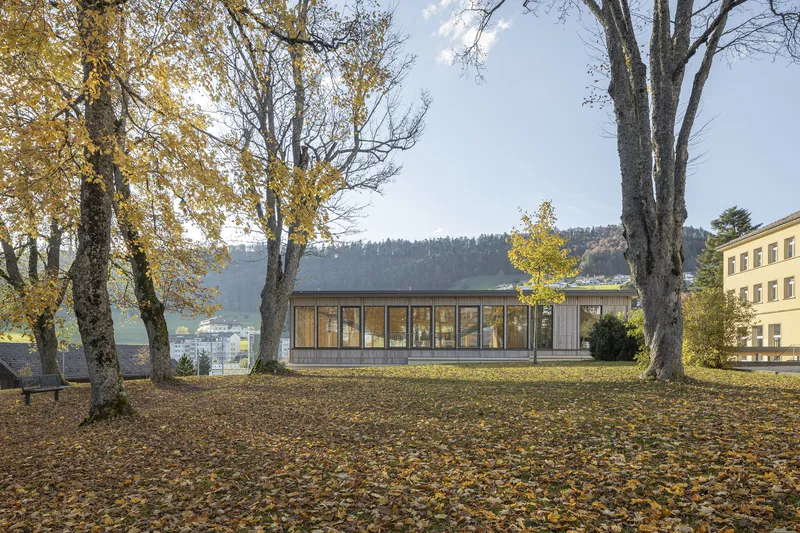
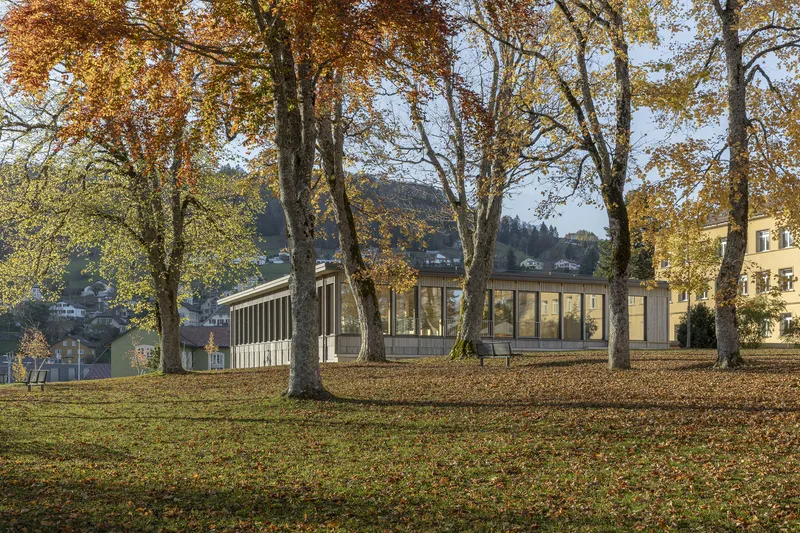
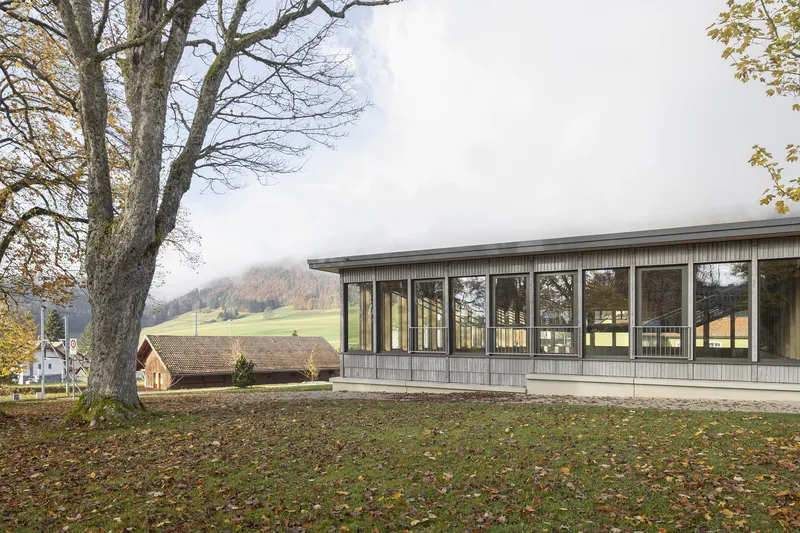
Seen from a distance through autumn foliage, the gymnasium reads as a single-story timber volume floating among mature trees. The architects exploited the natural terrain slope to bury the building's lower levels, so what you perceive from the garden is only the sports hall's crown and its generous glazing. The pre-greyed wood cladding accelerates the visual aging that weather would deliver anyway, giving the facade an immediate kinship with the bark of surrounding trunks. It is a calibrated act of deference: the building is substantial, but the park remains the protagonist.
The Concrete Pedestal and the Street Edge
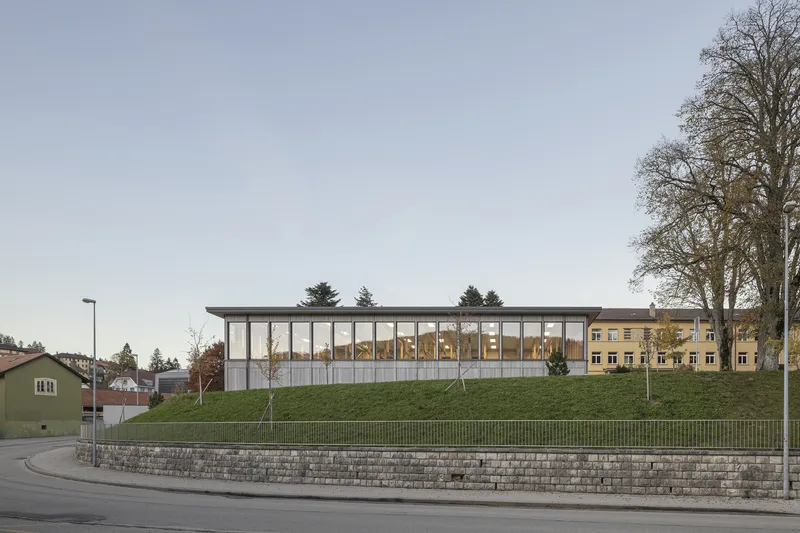

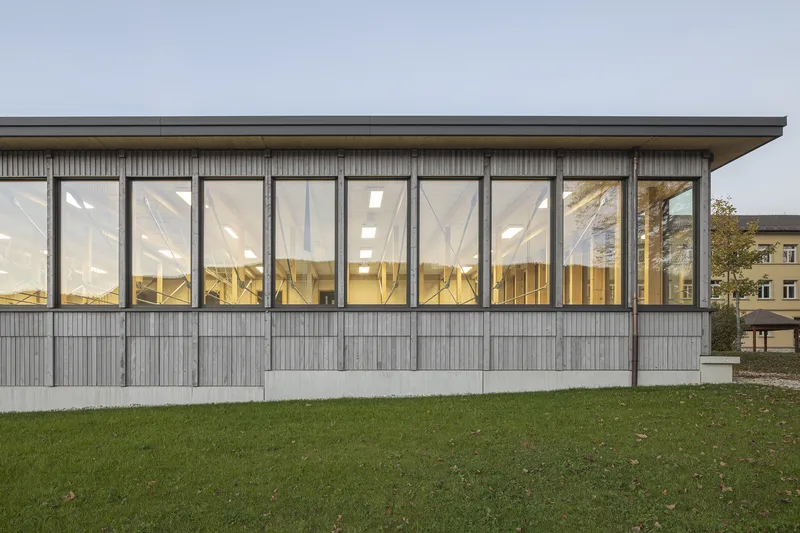
Walk downhill to the public street and the building reveals a second face. A curved concrete retaining wall follows the slope and converts, at its base, into an informal bench for passersby. Above it, the glazed south facade of the sports hall opens onto the lawn. The move is both pragmatic and generous: the concrete pedestal handles the grade change and water management while giving the street a civic gesture that a timber wall alone could not.
At the corner, the detail where vertical timber cladding meets the cantilevered soffit with its slatted panels is worth studying. The architects kept the joinery legible, celebrating the framework's rationality rather than hiding it behind flashy skin. Mountains frame the horizon beyond, reinforcing the sense that every line in the building has been drawn in conversation with the topography.
Timber Structure on Full Display
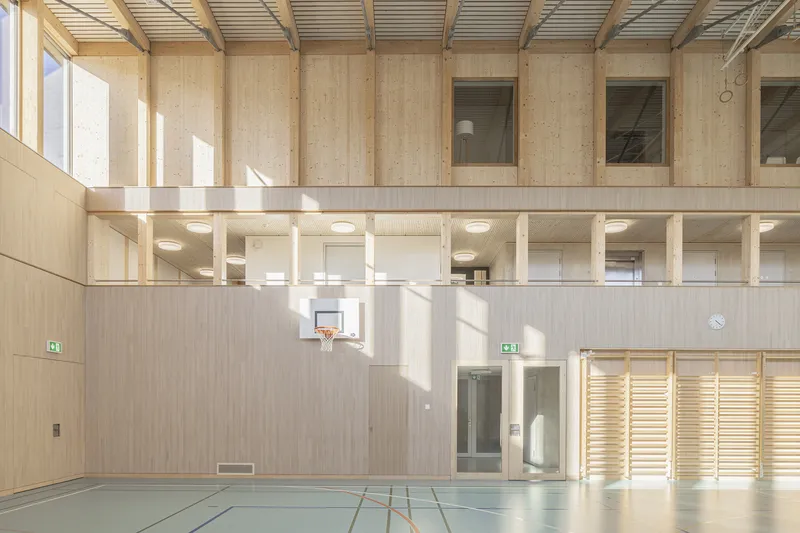


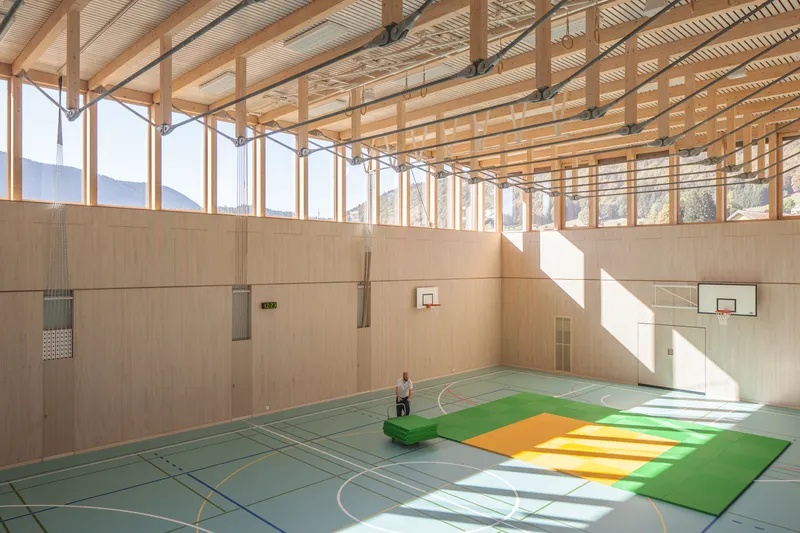
Inside the sports hall, the trapezoidal underslung beams become the room's defining element. They span the full width of the hall, creating a rhythmic grid overhead that filters clerestory light into the space below. Plywood panels line the walls at court level, absorbing ball impacts, while the upper register is left open to the timber structure and windows. The result is a room that feels both robust and luminous, a quality hard to achieve in a building type that usually settles for one or the other.
The triple orientation of the south-facing hall brings in daylight from three sides. On a clear afternoon, sunlight rakes across the floor mats in long, warm bands. The architects clearly understood that a gymnasium lit by natural light is not just more energy-efficient; it is more pleasant to be in. That matters when the building serves schoolchildren every weekday and community sports groups on evenings and weekends.
The North Volume: Locker Rooms, Storage, and a Youth Facility
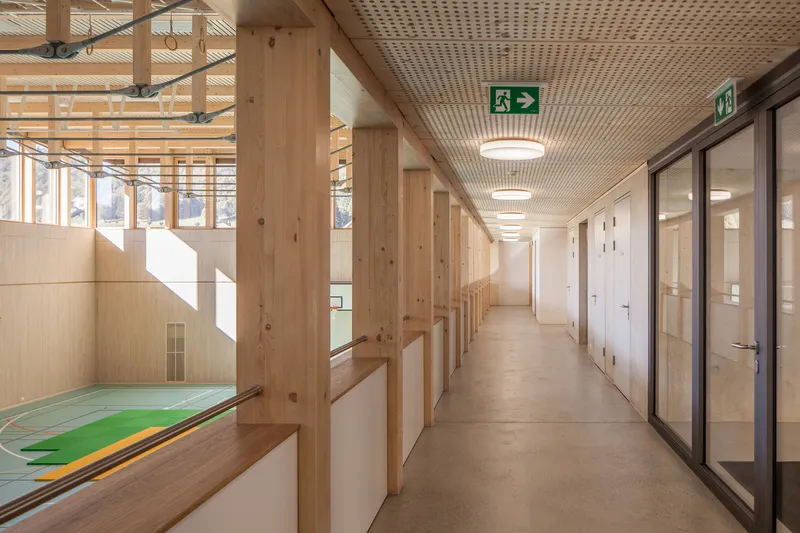
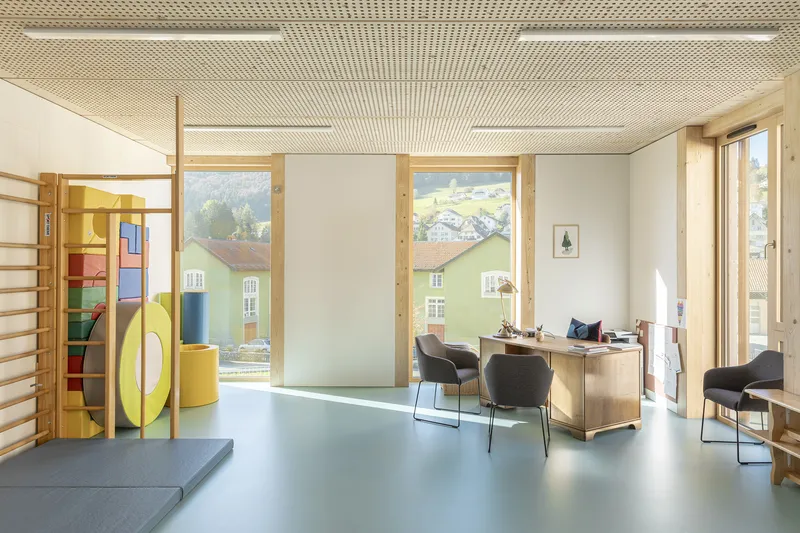

A six-meter-deep volume on the north side of the building stacks the support program: locker rooms and storage at the lower level, a youth development and learning facility on the upper floor. The corridor that connects these spaces doubles as a mezzanine overlooking the sports hall, its perforated timber ceiling providing acoustic absorption while maintaining visual continuity with the main volume.
The classrooms and offices up here face south through windows that frame the yellow-rendered school building across the courtyard. It is a quiet, well-proportioned space where the timber ceiling and polished concrete floor do most of the atmospheric work. No applied finishes, no accent walls. The material palette is the design.
Back of House with Dignity

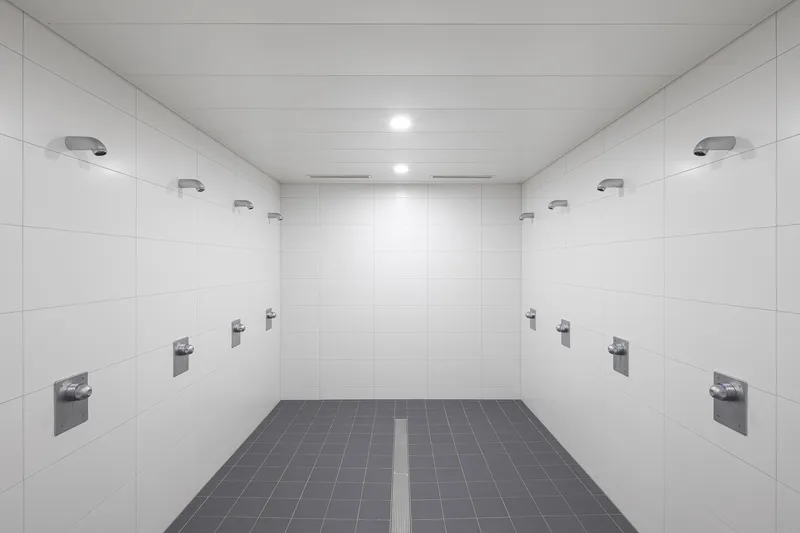
Changing rooms and showers are the spaces architects tend to abandon to specification sheets. Here, the plywood bench running along the concrete wall, the simple timber hooks, and the dark tile floor compose a changing room that feels considered rather than clinical. The shower room is spartan but clean in its geometry: white wall tiles, chrome fixtures, a central drain. No excess, no apology.
Back in the sports hall, a lone figure sits on colored floor mats under a wash of afternoon light. The image captures the building at its most convincing: a space that is clearly functional, clearly structured, and quietly beautiful without trying to impress.
Courtyard and Context
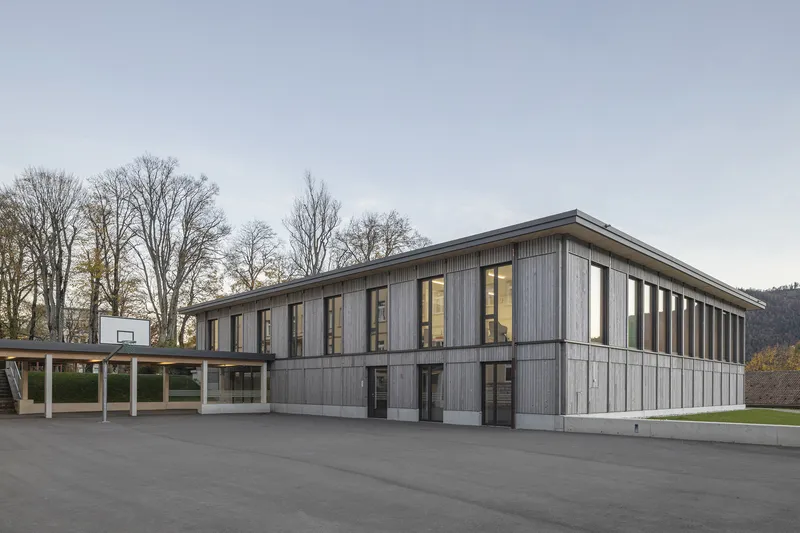
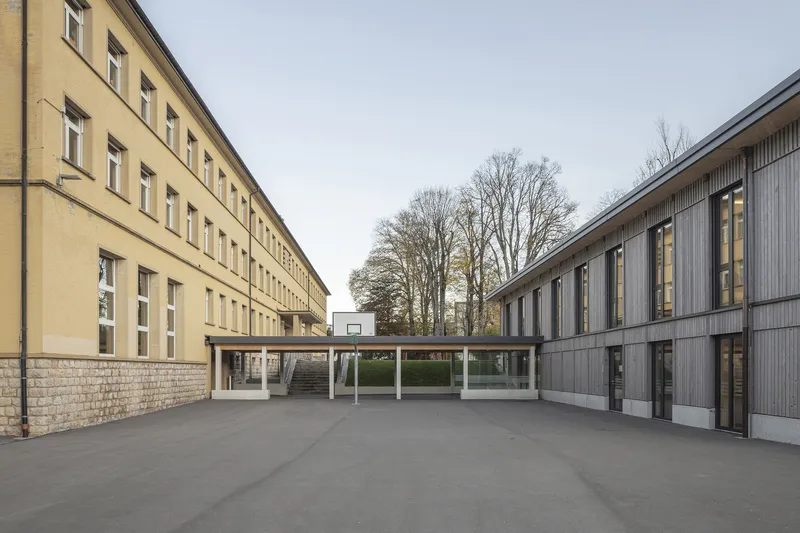
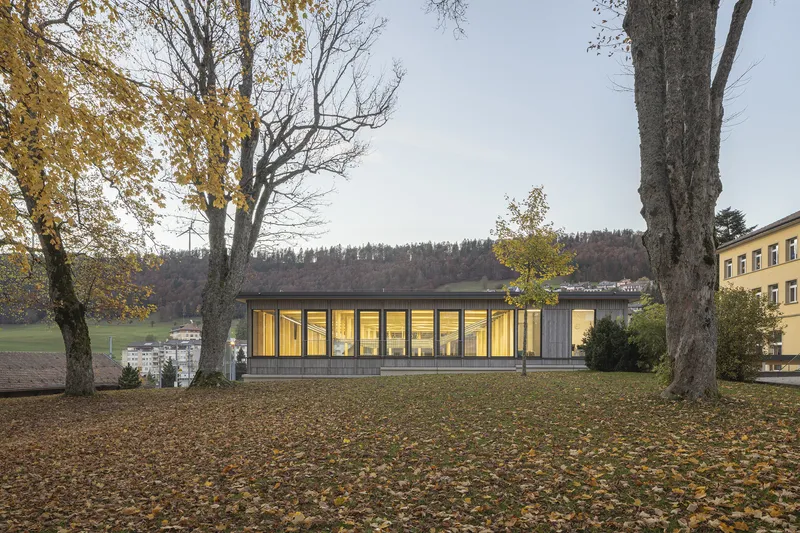
The relationship between the gymnasium and the existing school building is mediated by an asphalt courtyard that serves as a shared playground and arrival sequence. The grey timber cladding of the new building is deliberately restrained next to the school's bright yellow render, establishing a dialogue of contrast rather than mimicry. At dusk, the glazed pavilion glows among bare trees, and the proportional modesty of the building becomes even more apparent. It is not trying to be a landmark; it is trying to be a good neighbor.
Construction: Jura Wood from Forest to Frame
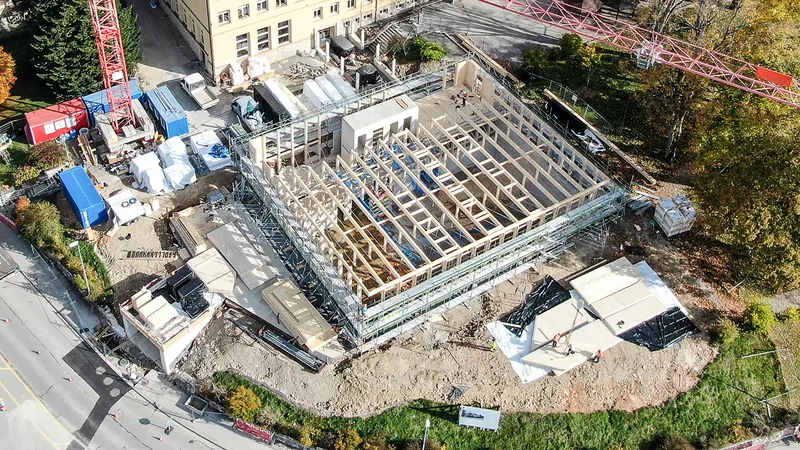

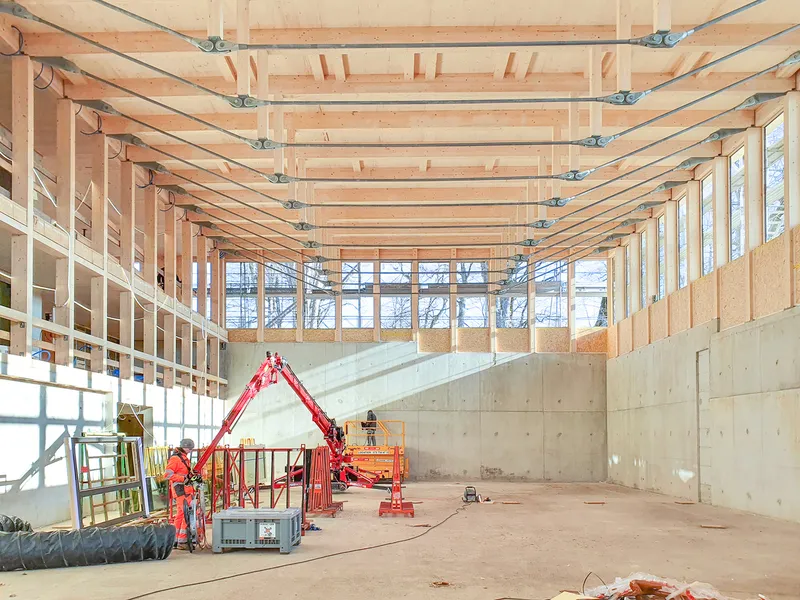
The construction photographs reveal the scale of the timber operation. An aerial view shows the exposed frame with a crane positioning beams, while material stacks on site testify to the volume of Jura wood involved. Inside, workers on scissor lifts fit beams against poured concrete walls. The project's supply chain, linking forest owners, rangers, the timber industry, and carpenters, is not just a sustainability narrative; it is an economic strategy that keeps value within the region. The vertical orientation of the exterior cladding was chosen for its efficiency given the performance characteristics of available local tree species, a detail that reveals how tightly material logic and design expression are intertwined.
Plans and Drawings
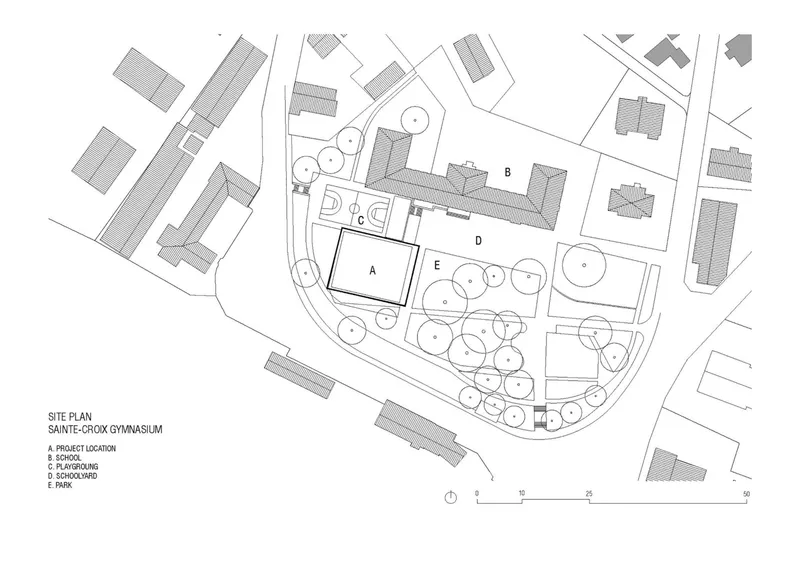


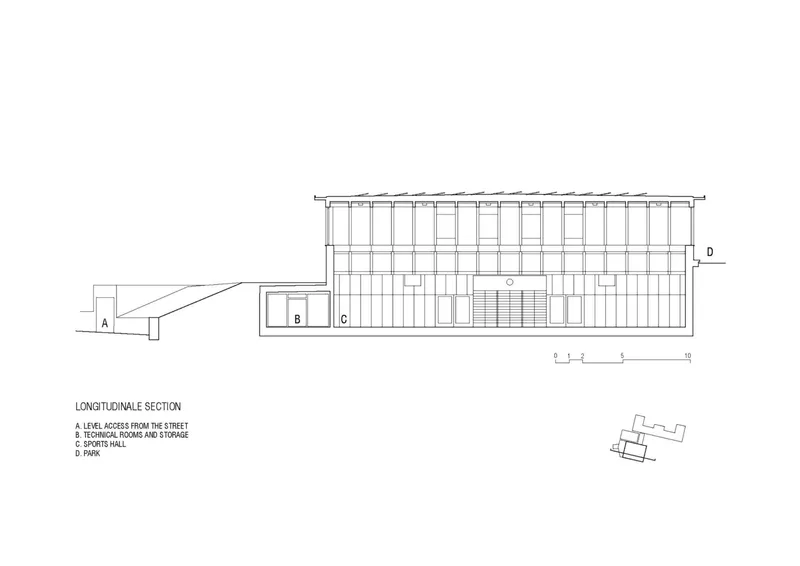
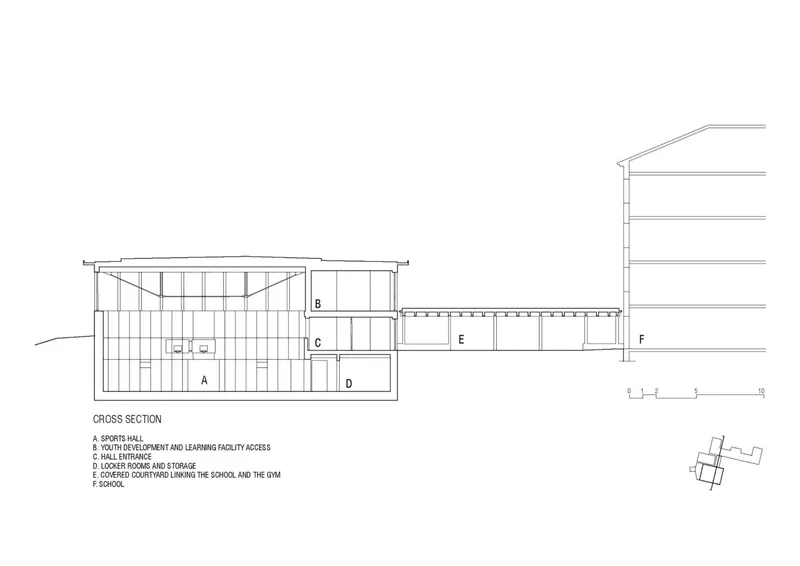
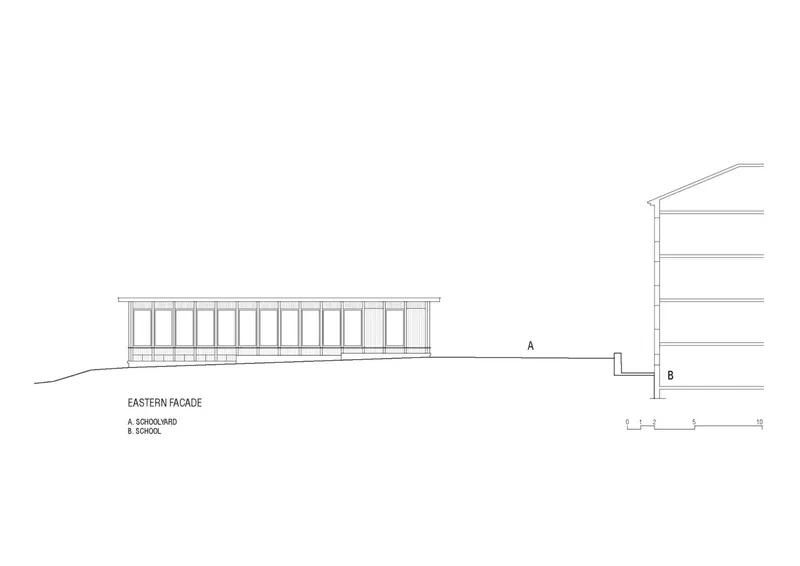
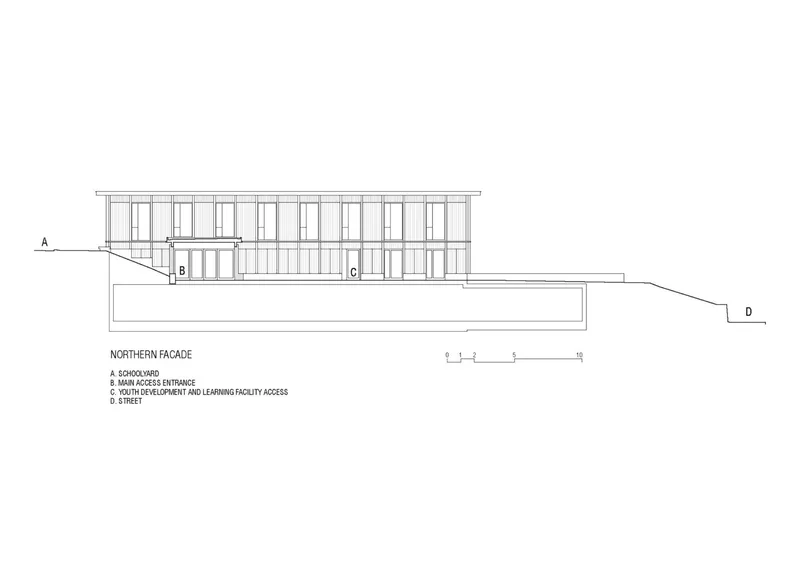


The site plan confirms how precisely the building is threaded between the school and the garden, occupying the leftover geometry without sacrificing functional clarity. The basement plan shows the basketball court and its supporting rooms cut into the slope, while the ground and upper floor plans illustrate the north-south division between the sports hall and its ancillary program. Sections are perhaps the most revealing drawings: the longitudinal cut exposes the trapezoidal beam structure in its full profile, and the cross section shows how the service volume's two stories tuck under the sports hall's soaring roof. Facade elevations demonstrate the vertical rhythm of the cladding and the proportional care given to window placement. The final sectional drawing, depicting a sloped canopy against the park terrain, shows how the architects calibrated the roofline to echo the hillside gradient.
Why This Project Matters
Gymnasiums are among the most programmatically rigid building types: regulated court dimensions, minimum clear heights, acoustic requirements, impact-resistant surfaces. The temptation is to treat them as sheds and move on. What MUE Atelier, BSAAR, and Erbat SA have done in Sainte-Croix is refuse that temptation without indulging in formal heroics. The building is compelling because every decision, from the dual structural system to the pre-greyed cladding, serves both function and atmosphere simultaneously. Nothing is decorative; everything is working.
The project also offers a credible model for local material economies. Using Jura wood is not a marketing gesture here; it is a construction strategy that shaped the cladding orientation, the beam profiles, and the slab spans. The forest-to-frame pipeline engaged an entire regional supply chain, demonstrating that sustainable sourcing can be rigorous and architecturally productive at the same time. For a small Swiss town, that is not just a good building. It is an investment in the landscape and the community that surrounds it.
Sainte-Croix Gymnasium, Sainte-Croix, Switzerland. Designed by MUE Atelier, BSAAR, and Erbat SA. 1,500 m². Competition won 2018, completed 2023. Photography by Cyrille Lallement and Arnaud Schelstraete.
About the Studio
BSAAR
Share Your Own Work on uni.xyz
If projects like this are the kind of work you want to make, uni.xyz is a place to publish your own, find collaborators, and enter design competitions.




Popular Articles
Popular articles from the community


The Musturak Paradise: Senior Living Architecture for a Connected Future in Temara, Morocco
The Musturak Paradise reimagines senior living architecture in Temara via private homes, social spaces, culture, community, and shared care.

AL-JANNAH: Sustainable Architecture and Permaculture for Afghan Widows
AL-JANNAH uses sustainable architecture and permaculture to create resilient oasis of housing, learning, work and renewal for Afghan widows.

Co-Life: Senior Housing Design That Reconnects Older Adults With the City
Co-Life reimagines senior housing design through healing gardens, shared streets, workshops, and a sustainable community across generations.

Conexión: Biophilic Design Reimagines High-Rise Living in Hong Kong
Conexión reimagines high-rise living in Hong Kong through biophilic design, green facades, shared spaces, daylight, water and nature within.


Similar Reads
You might also enjoy these articles


Hodi-Mandai Geram
Project Function: Preservation and revitalization of the Intangible heritage and socio-spatial identity of the Hodi by Housing, Cultural Memory Center, Sacred Grove, landscape, local tourism economy


Olio Towers: A Mid-Rise for Performers That Fuses Housing, Rehearsal, and Stage
Located blocks from Houston's Theater District, this modular tower stacks living units around a central performance atrium.

Oasis: Modular Green Housing Carved into Dhaka's Urban Fabric
A shortlisted Plugin Housing entry reclaims unauthorized settlements in Dhaka with stepped concrete volumes, green roofs, and ventilation-driven design.

Black Hole: A Floating Megastructure for the Post-Physical Era
Emiliano Mazzarotto envisions a spherical, self-scaling arena where e-sports, digital hotels, and holographic stadiums replace traditional public space.

Explore Architecture Competitions
Discover active competitions in this discipline



Challenge to reimagine the Iron Throne


Photograph architecture without architects


Illustrate the lost glory of Angkor Wat - Render Challenge


Design challenge to reuse E-waste
Comments (0)
Please login or sign up to add comments
No comments yet. Be the first to comment!