
ROAR Architects Adds a Prefabricated Oak Extension to a Grade II Listed Victorian Home in London
A 30-square-metre timber pavilion in Chislehurst replaces pastiche with honest materiality, contrast, and a 2,000-bottle wine cellar.


When you own a Grade II Listed house designed by the Victorian architect Ernest Newton, the temptation is to extend it with something that looks like it was always there. That is exactly what happened in 2007, and the result, by all accounts, was forgettable. When the current owner approached ROAR Architects, the brief called for a brick extension with Crittall windows, the default London move. ROAR pushed back. Instead of imitation, they proposed a 30-square-metre oak-framed pavilion that would harmonize through contrast: frankly modern, materially warm, and legible as a new chapter rather than a footnote to the original house.
What makes Newton Park Place worth studying is not the timber itself but the intelligence of its deployment. The frame was fabricated by specialist joiner Tim Gaudin in a Devon workshop, dismantled, shipped to South East London, and reassembled on site. That sequence, workshop precision followed by careful on-site erection, allowed ROAR to achieve the kind of exposed joinery that would be prohibitively slow to cut in the chaos of a live residential build. The result is an extension that reads as furniture at the scale of architecture, every joint visible and deliberate, sitting against the Vernacular Revival brickwork of its host without pretending to be anything other than what it is.
Contrast as Conversation
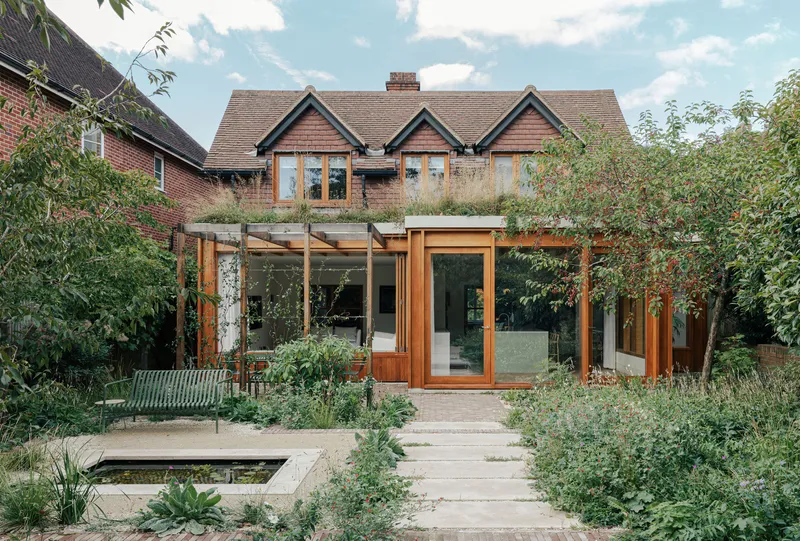
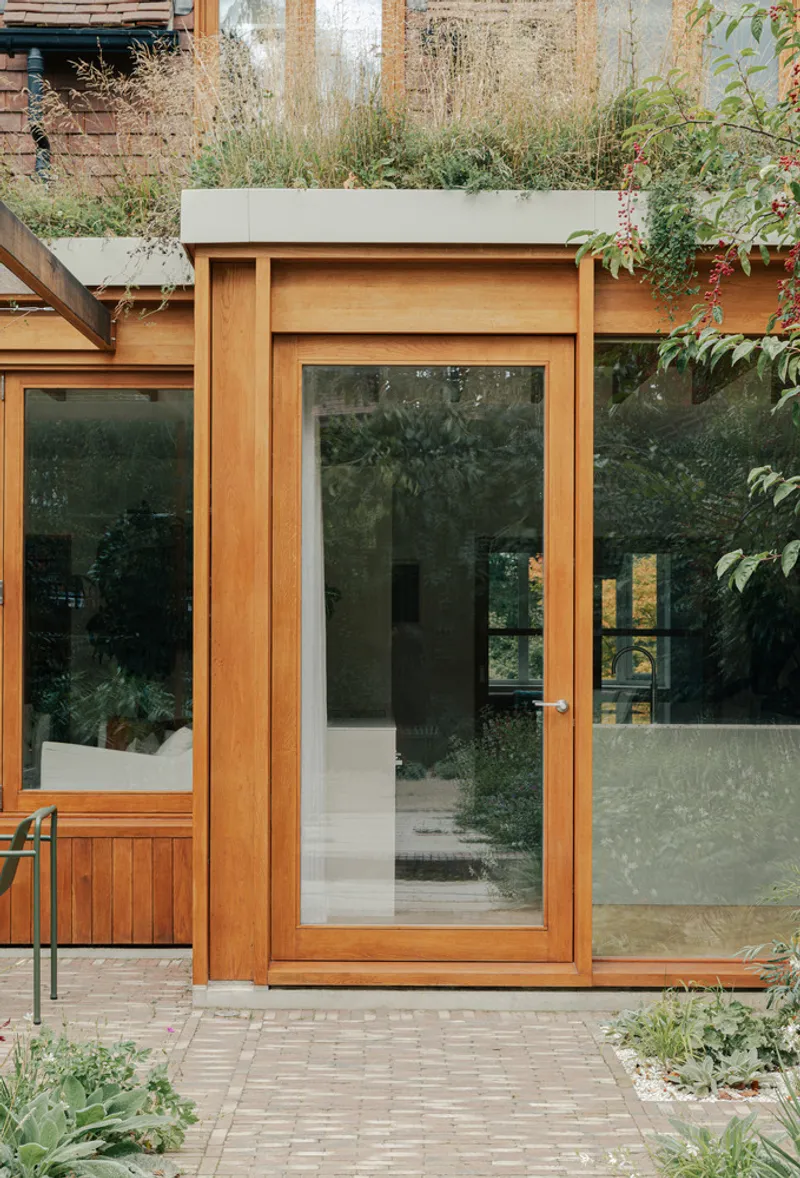
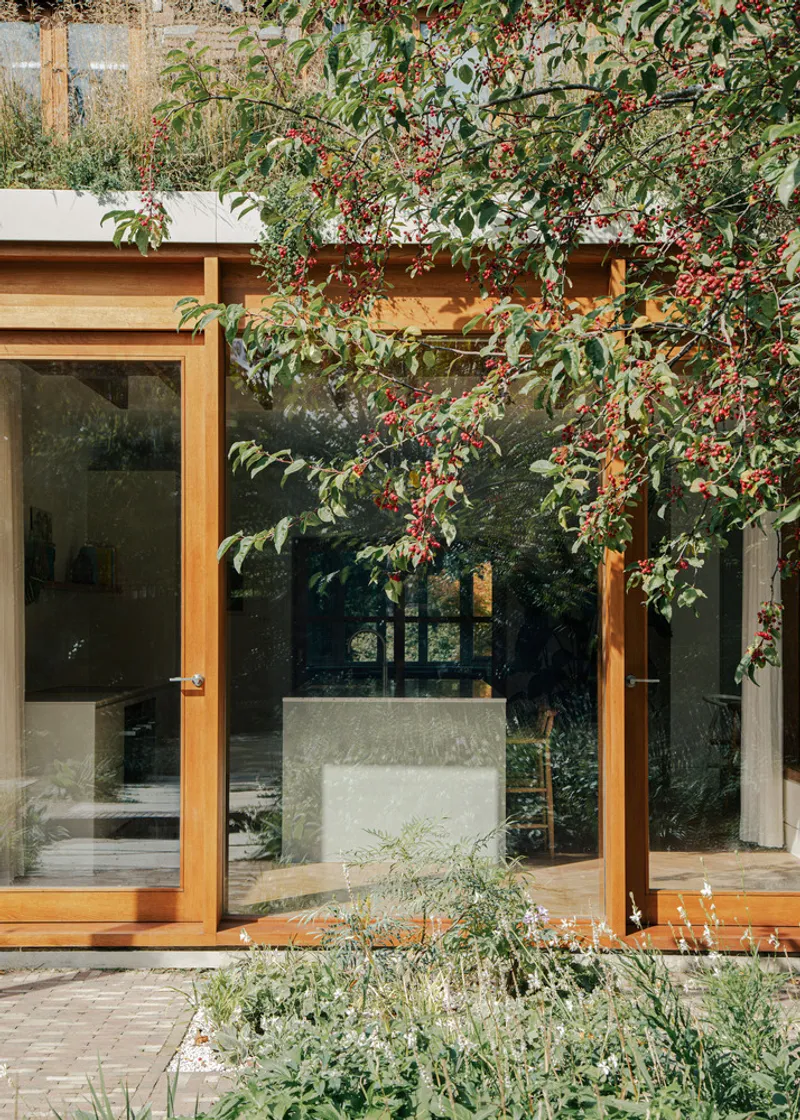
From the garden, the extension announces itself plainly. The oak frame, vertical timber cladding, and wildflower green roof form a composition that is deliberately lightweight against the mass of the Victorian brick behind it. The pergola, created by oak joists that simply continue past the building line, stretches toward the garden as a transitional threshold: not quite inside, not quite out. Over time, climbing plants will colonize the structure, providing solar screening and turning the pergola into a living envelope. It is a strategy that treats architecture as a scaffold for nature rather than a barrier to it.
The planted green roof serves a dual purpose. It improves local biodiversity in a conservation area already valued for its ecological character, and it conceals solar panels on the main roof from view, a requirement when working with listed buildings. The approach is pragmatic environmentalism: low embodied carbon in the oak, wood fibre insulation in the walls, and renewable energy generation hidden from heritage sight lines.
Rooms, Not a Room
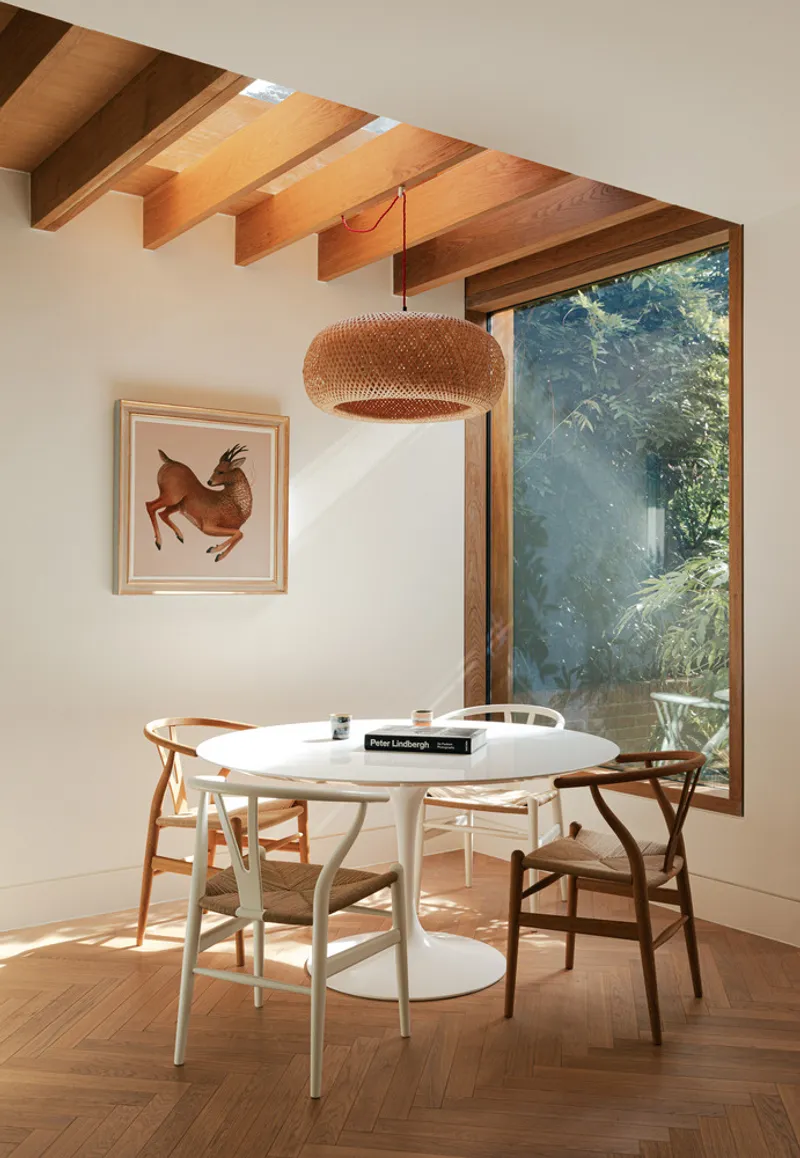
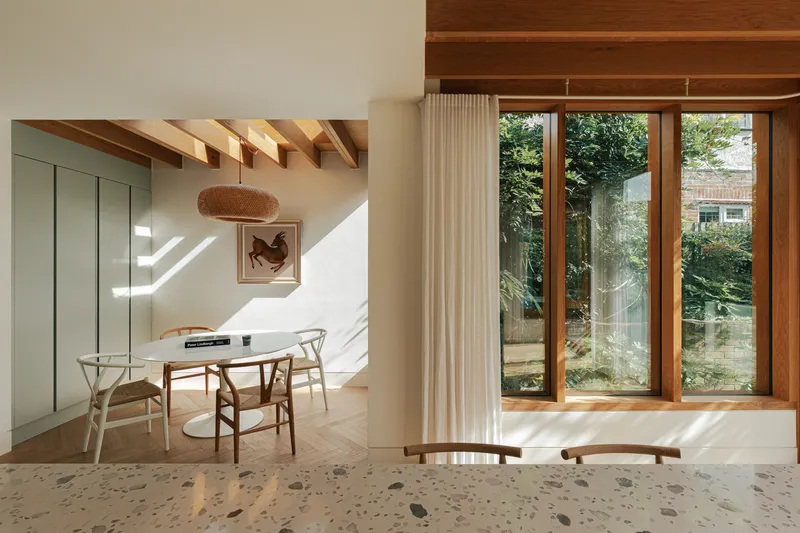
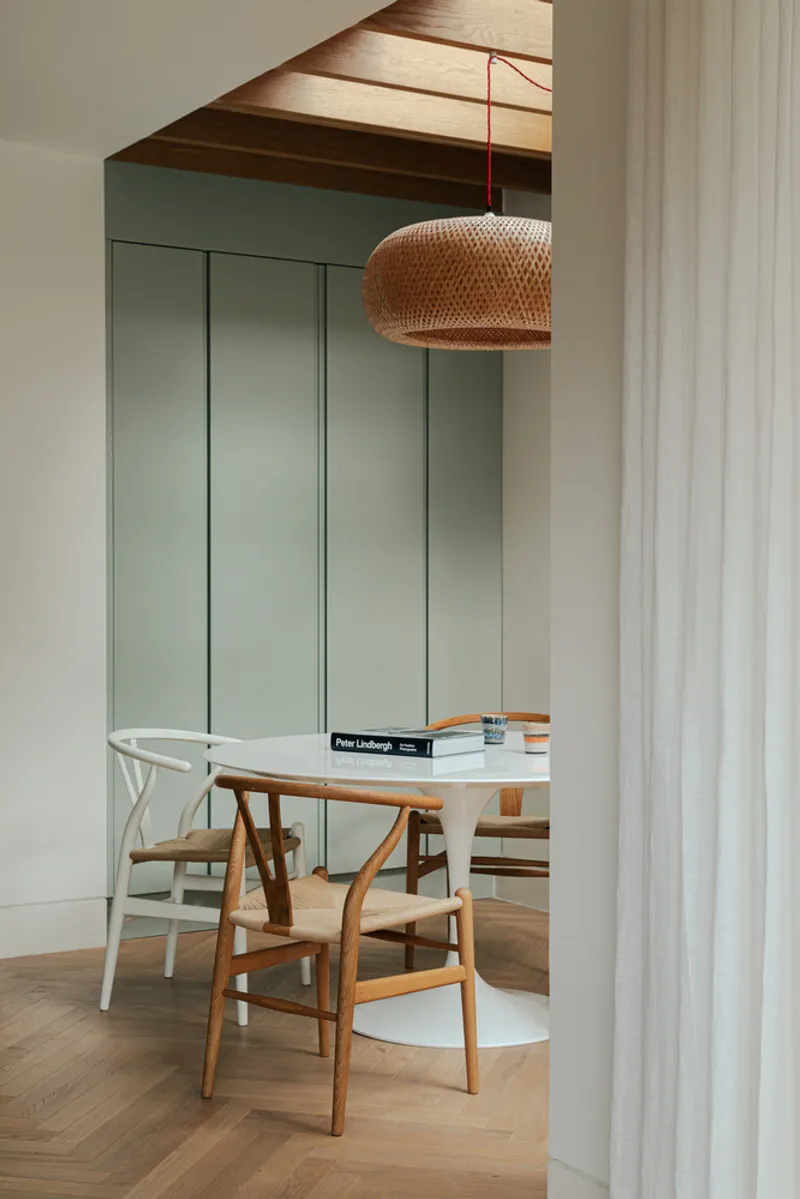
The most interesting spatial decision here is a refusal. The owner did not want an open-plan rear extension, that ubiquitous London gesture where kitchen, dining, and living collapse into a single glazed volume. Instead, ROAR designed a stepped plan that creates four distinct ground-floor areas linked by sliding timber doors. Close the doors and you have a kitchen, a dining nook, a living room, and a garden threshold. Open them and the spaces flow into each other along a shifting axis.
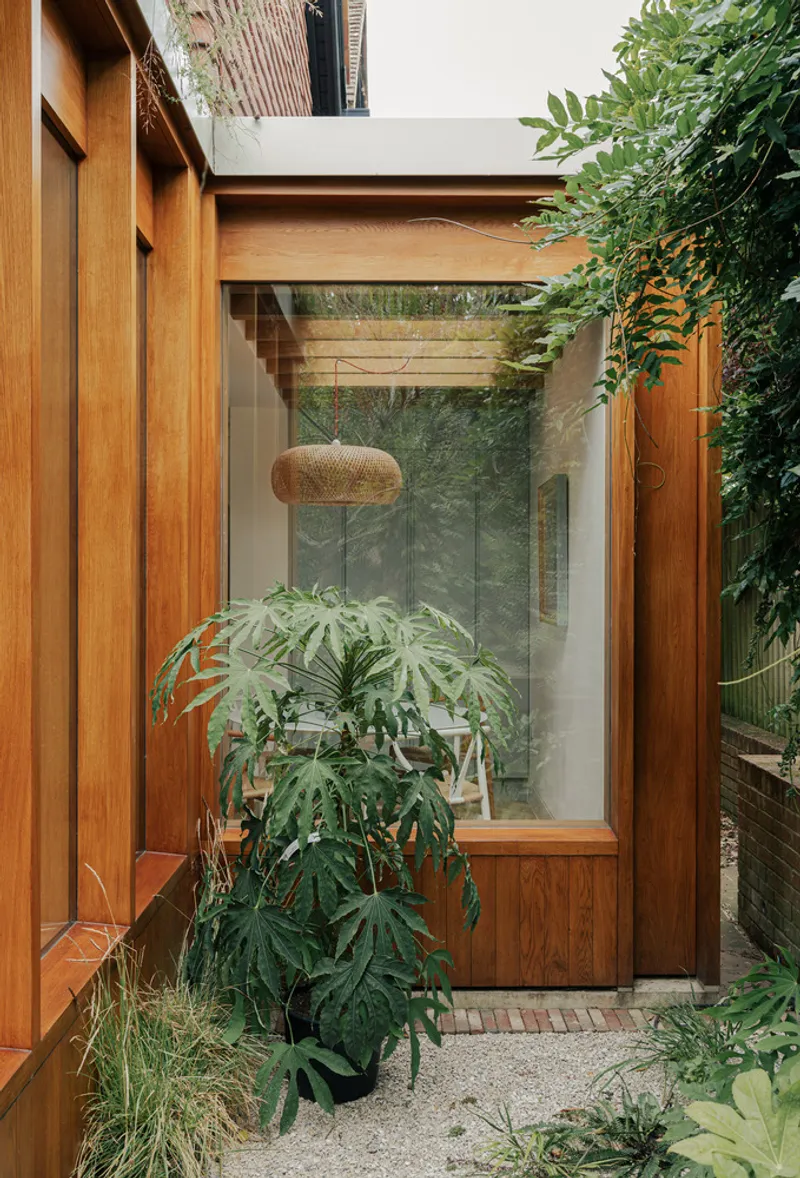
The dining area sits in its own pocket, set back from the main building line to respect the original footprint. It is framed by a skylight above and a generous picture window that fills the nook with filtered green light. A woven pendant lamp and red string pendant lighting punctuate the ceiling, drawing the eye upward along the exposed oak joists. The effect is intimate rather than expansive, a quality that open-plan extensions almost never achieve.
The Garden Threshold
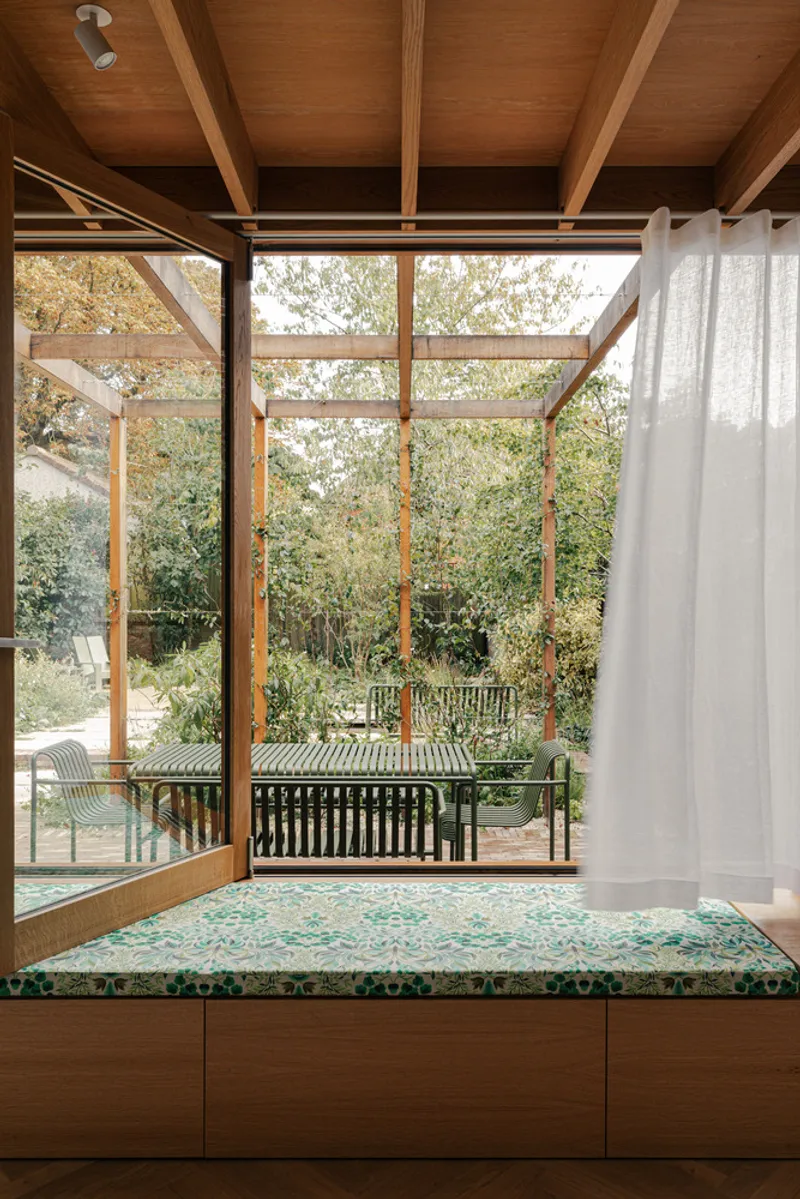
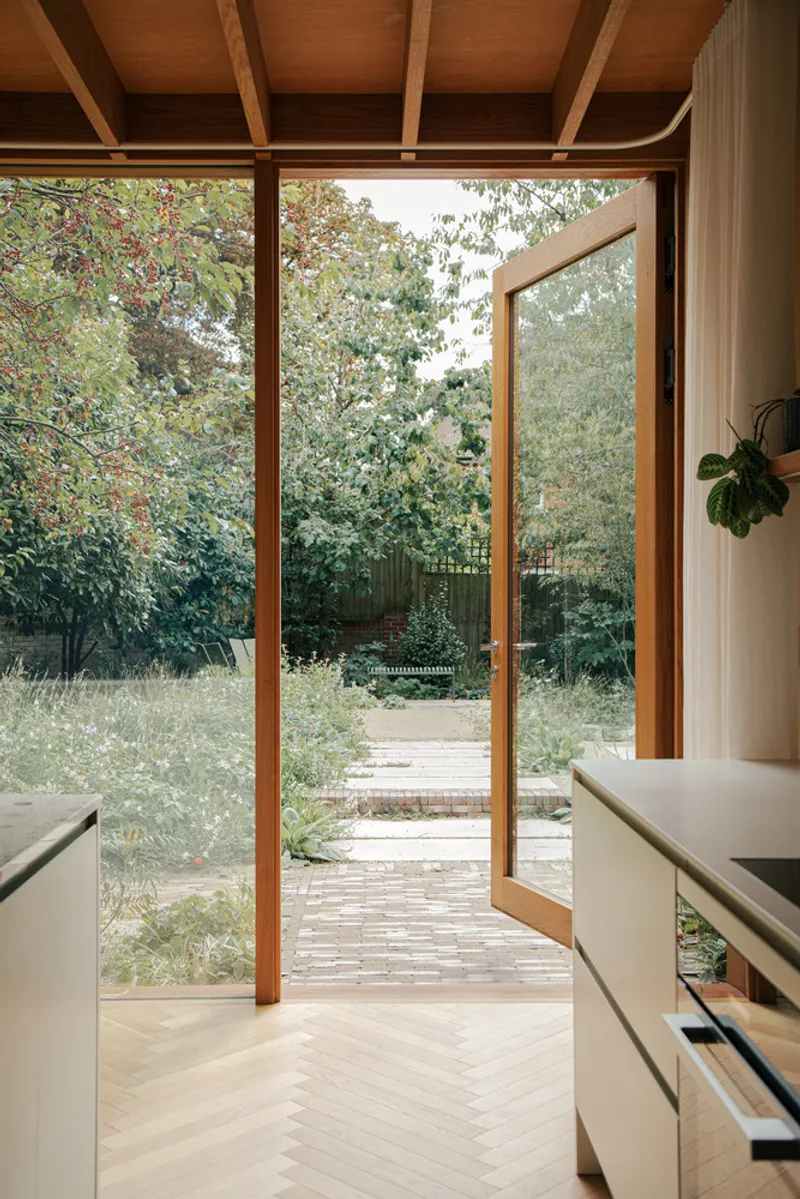
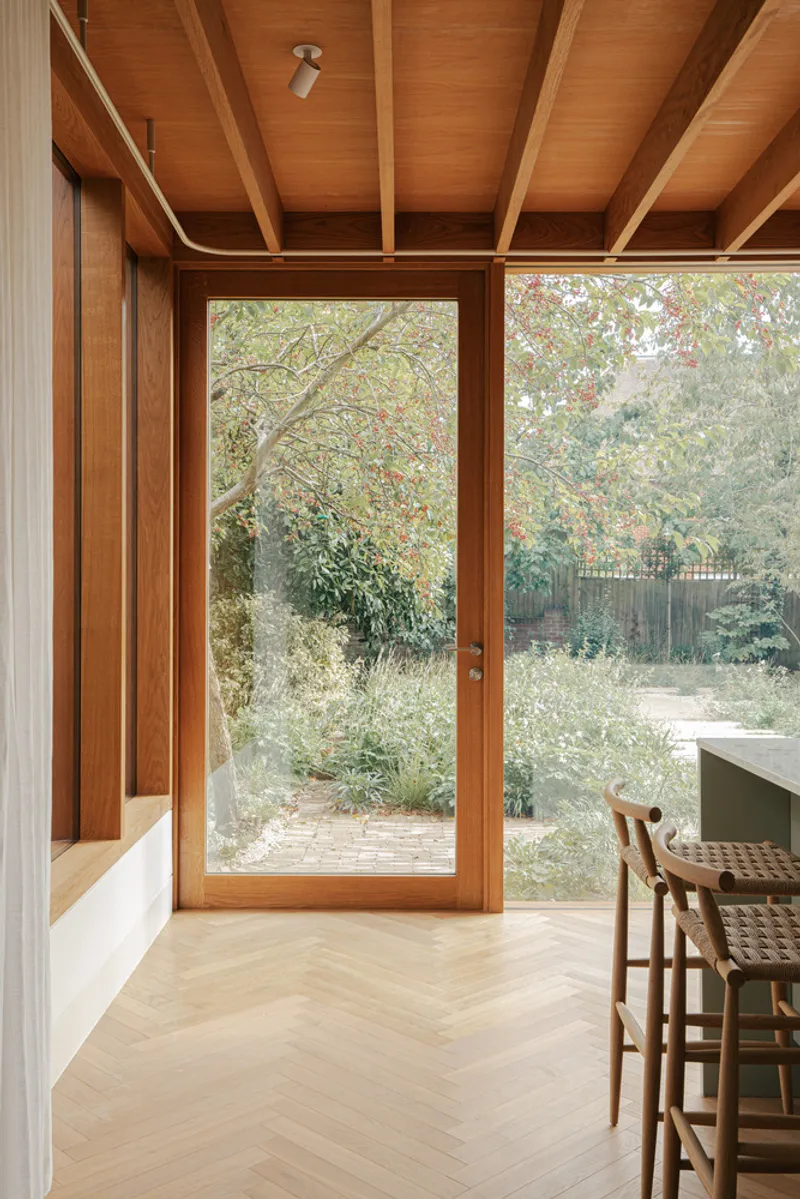
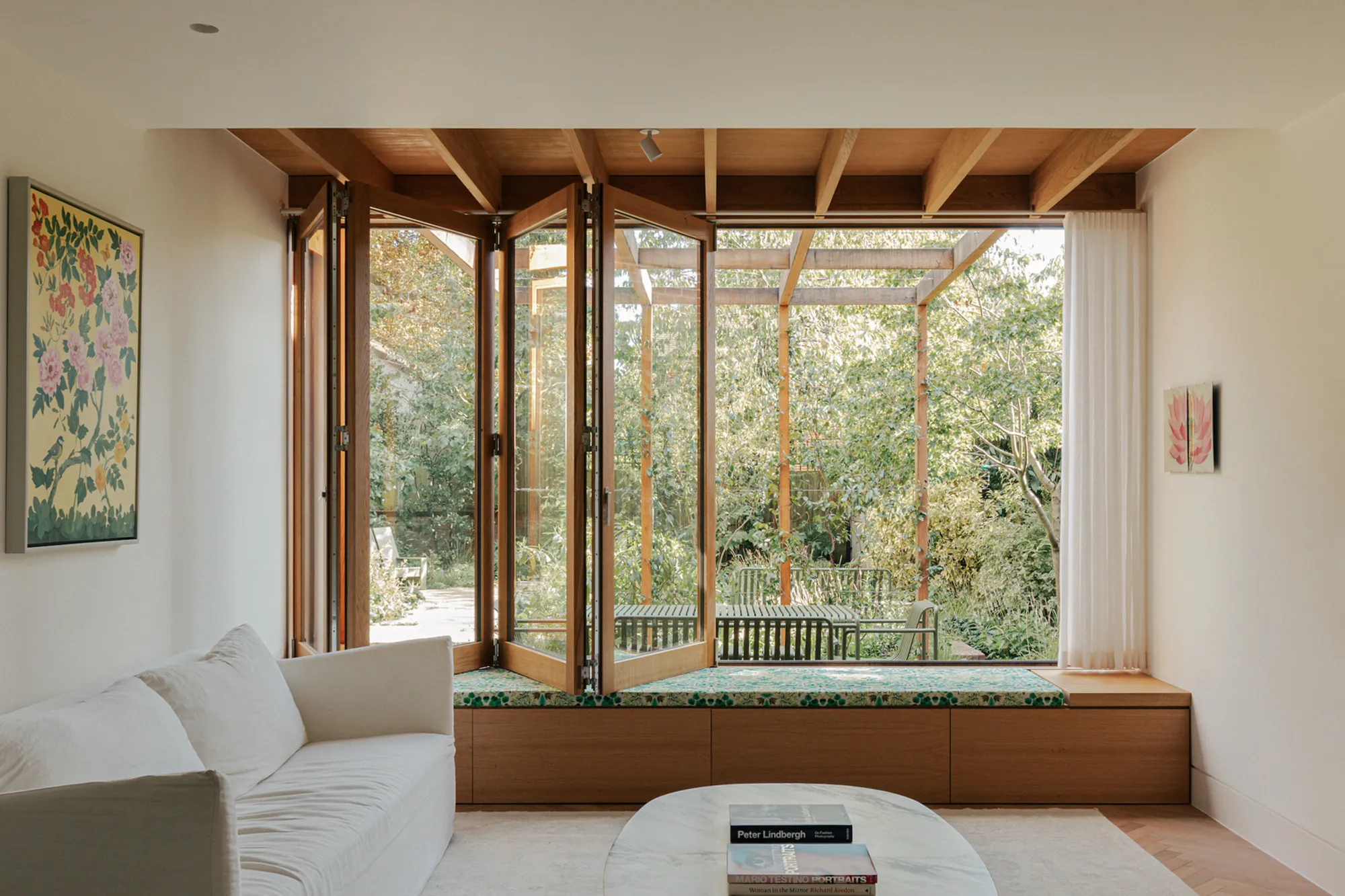
Four metres of bi-folding doors collapse the boundary between living room and landscape. An integrated window seat, built into the door threshold, gives the occupant a place to sit at the exact point where inside becomes outside. It is a small move with disproportionate effect: it turns the window from a viewing device into a piece of inhabitable furniture. When the doors are open in summer, the pergola beyond extends the ceiling line into the garden, and the oak joists overhead become a canopy for outdoor dining.
Garden designer Lily Gomm worked closely with ROAR to ensure that the landscape reads as an extension of the architecture rather than an afterthought. Clay pavers near the house give way to self-binding gravel farther out. The garden is divided into two zones: a reflective area with a pond and bench seating, and an open social space anchored by feature tree planting. The planting itself has a Mediterranean looseness, varied and biodiverse, that softens the precision of the timber frame.
Oak Structure as Interior Finish
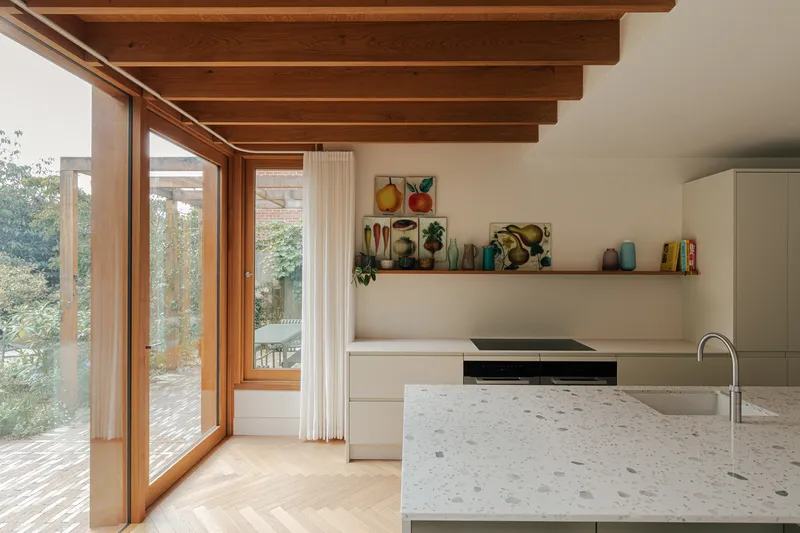
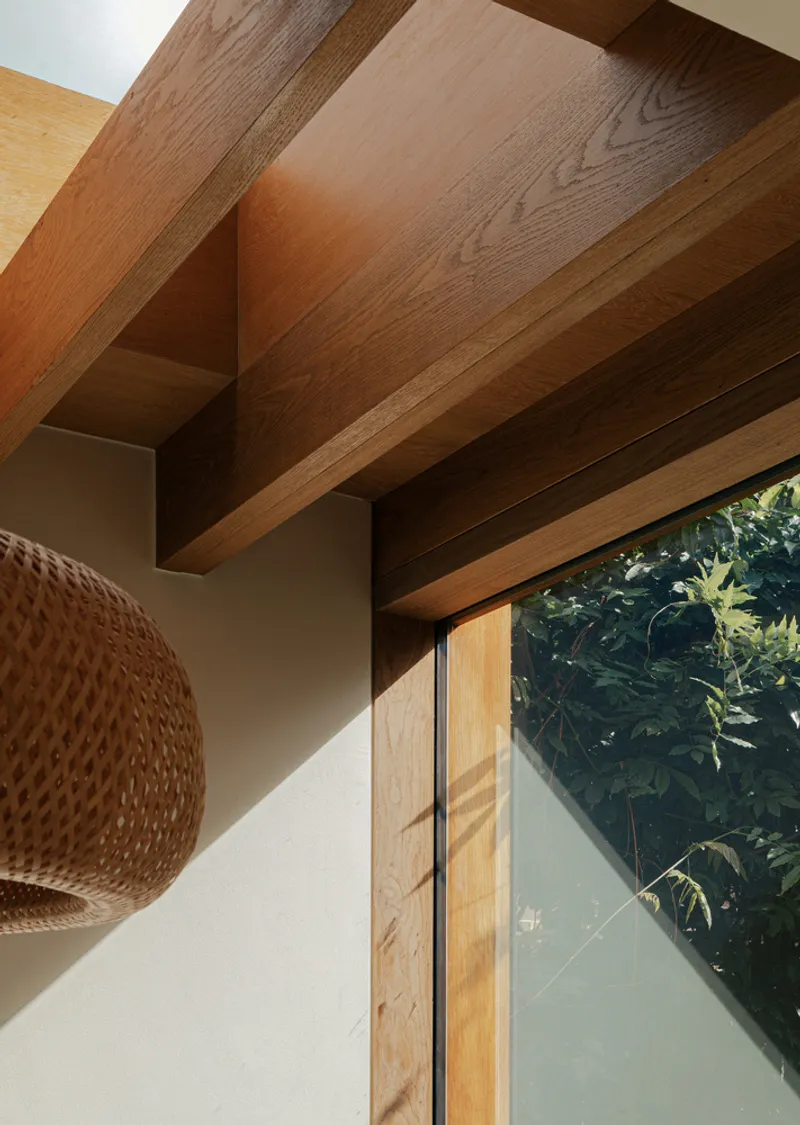
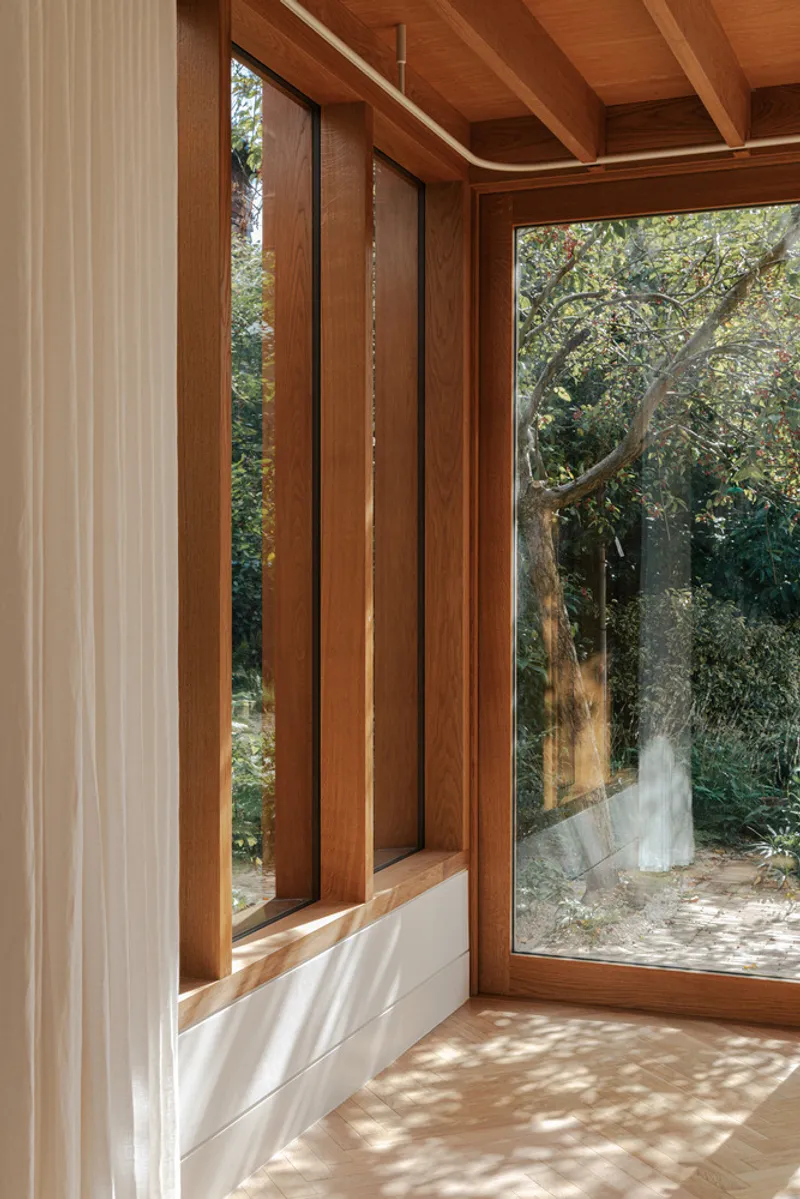
Because the oak frame is exposed throughout, structure doubles as decoration. The joists, beams, and corner connections are left visible, their joints tight and legible, forming a rhythmic grid that organizes the ceiling plane. Where two beams meet above a glazed door, the connection is celebrated rather than concealed. The timber ages and darkens over time, which means the extension will look better in a decade than it does today, a rare quality in contemporary residential work.
The material palette is restrained. Terrazzo countertops, herringbone oak flooring, and a green kitchen island provide warmth without competing with the structure. Corner glazing with narrow sidelights casts dappled light across the floor, breaking the oak grid with shifting patterns of shadow. The approach trusts the material to do the work, and it does.
Details That Earn Their Keep
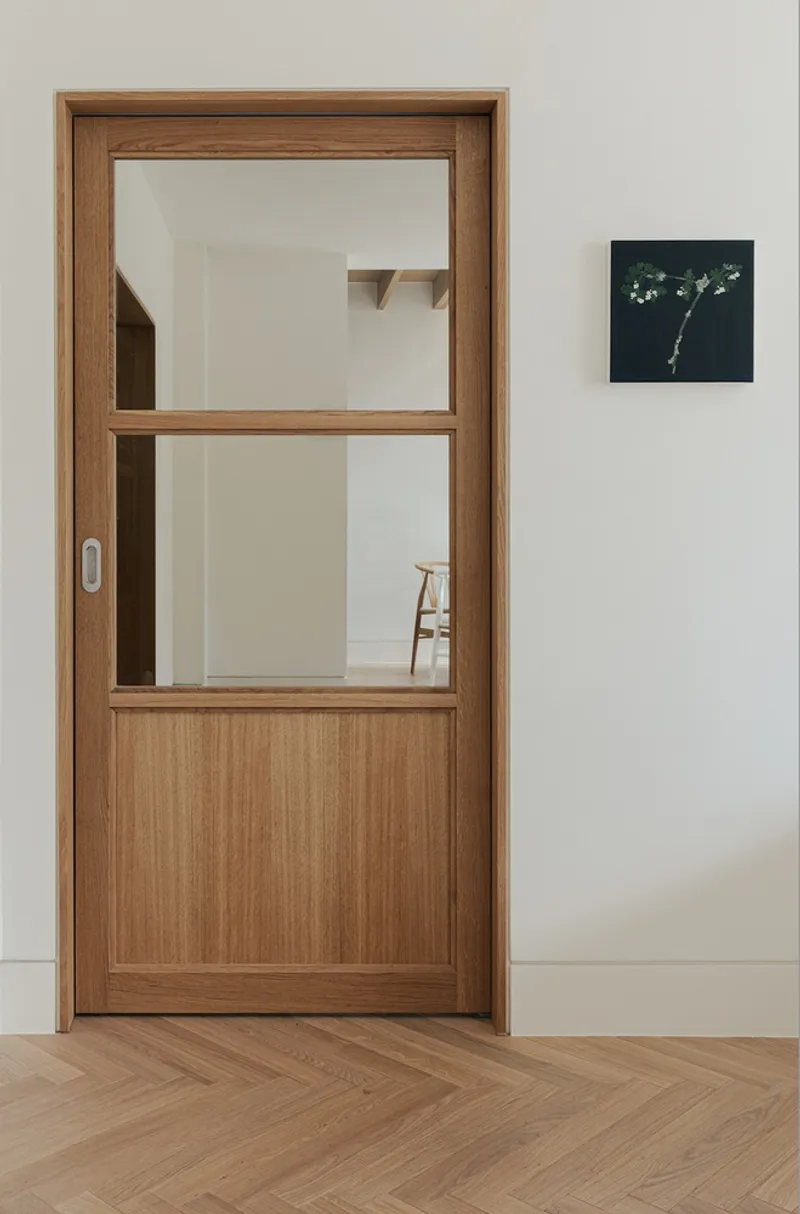
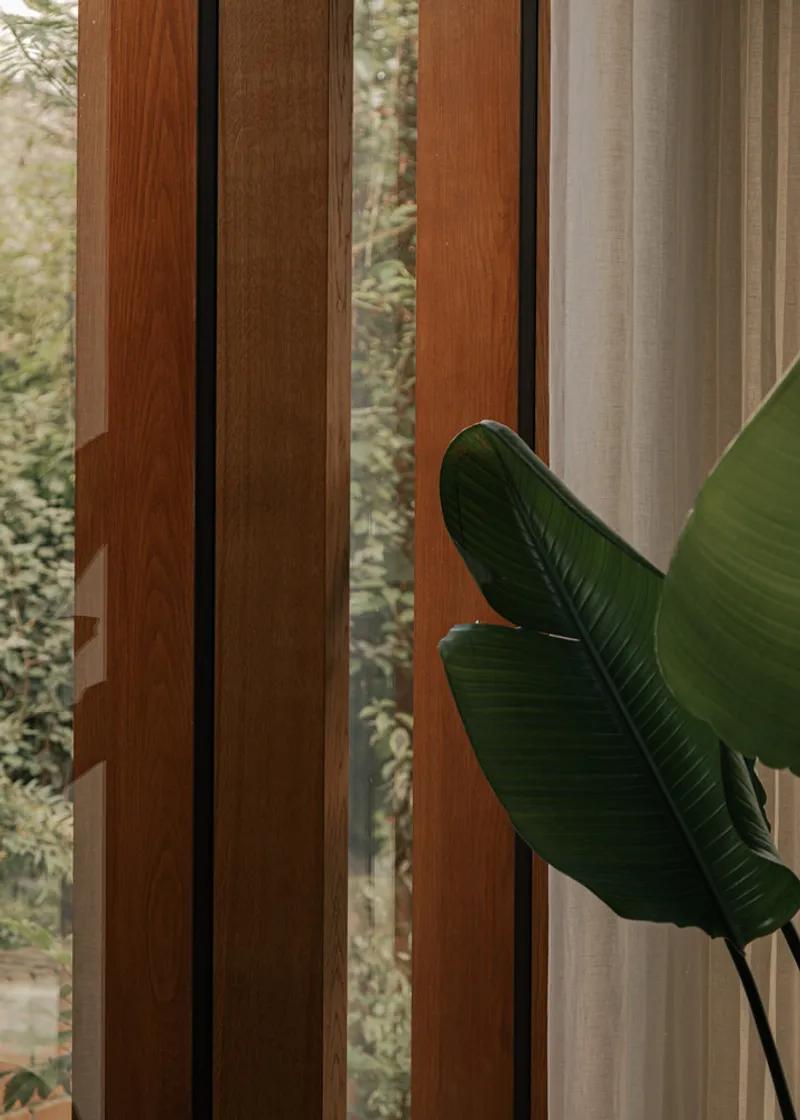
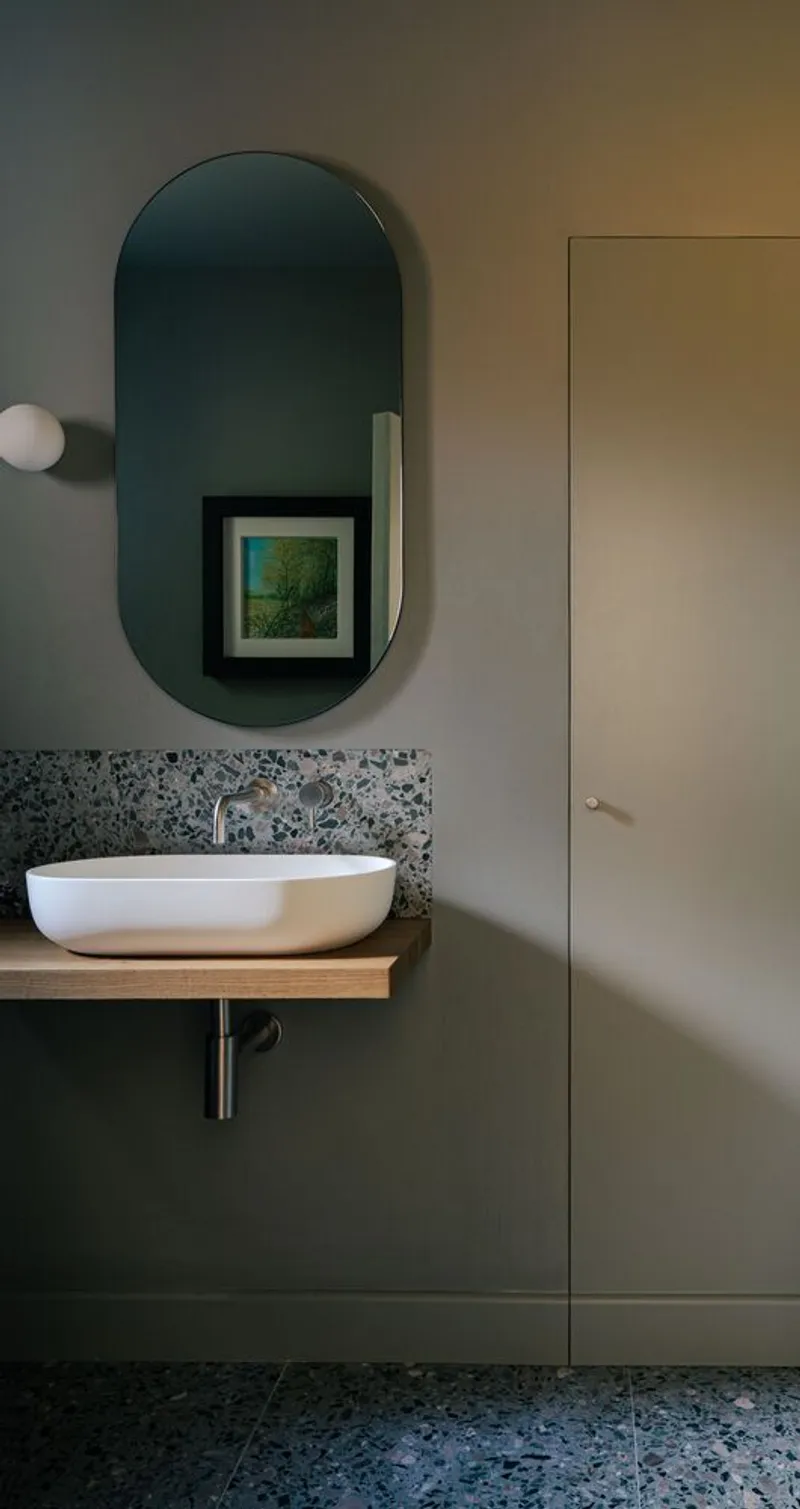
Sliding timber pocket doors with horizontal rails and glazed panels allow rooms to be sealed or connected in seconds. The detailing is consistent: dark metal joints where timber meets glass, vertical mullions that echo the cladding outside, and flush thresholds that eliminate the usual awkward step between old and new. Even the bathroom, with its terrazzo backsplash, floating timber shelf, and arched mirror, follows the same logic of honest materials and precise joinery.
These are not showy moves. They are the kind of decisions that only register after you have lived with them, which is exactly the point. A house extension has to survive daily use for decades. ROAR's detailing is calibrated for durability and quiet pleasure, not Instagram impact.
A Spiral Cellar Beneath the Kitchen Island
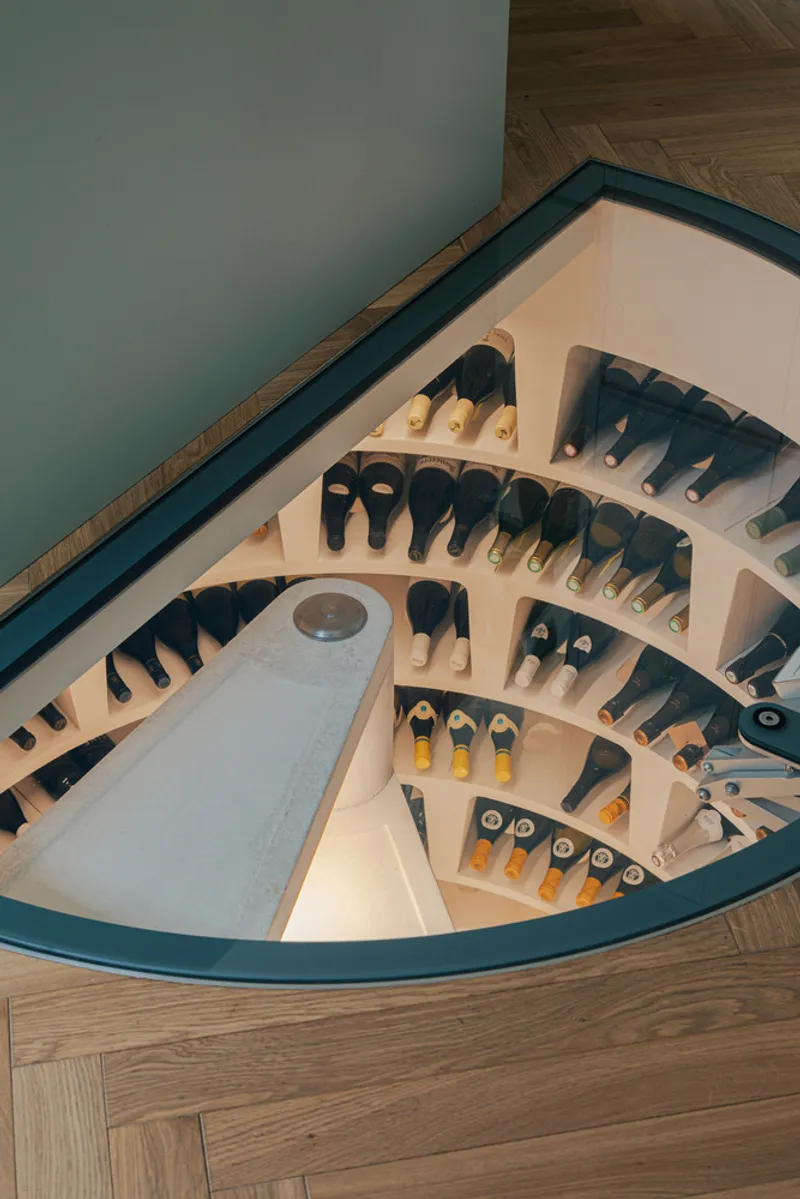
Three metres below the kitchen island, a spiral wine cellar stores 2,000 bottles in illuminated stepped shelving made from interlocking limestone concrete modules. The cellar is naturally ventilated, maintaining stable temperatures without mechanical cooling. It is an extravagant inclusion, certainly, but also a technically elegant one: the spiral form maximizes storage in a minimal footprint, and the concrete modules lock together without mortar, making the system both structural and modular.
Accessing the cellar through the kitchen floor collapses the distance between storage and use. There is something satisfying about the contrast between the lightweight oak pavilion above ground and the dense, cool masonry cylinder below it. One breathes and opens; the other contains and insulates. Together they form a complete domestic ecosystem.
Plans and Drawings
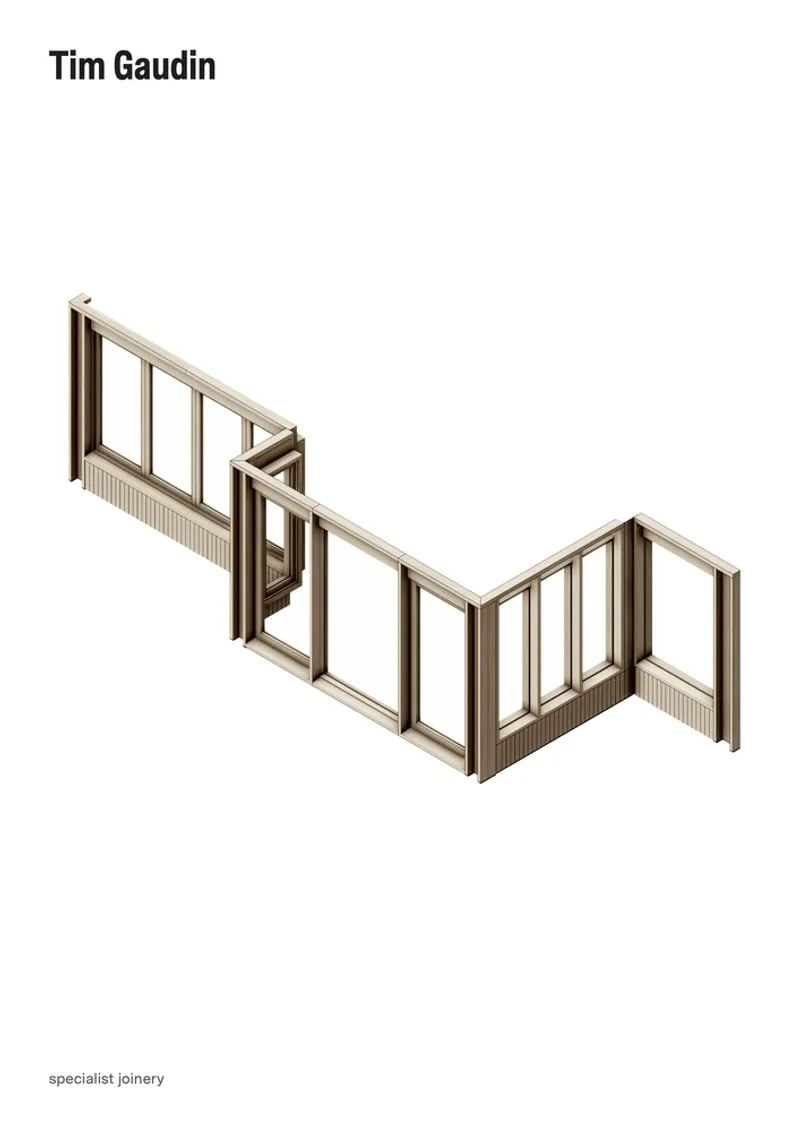
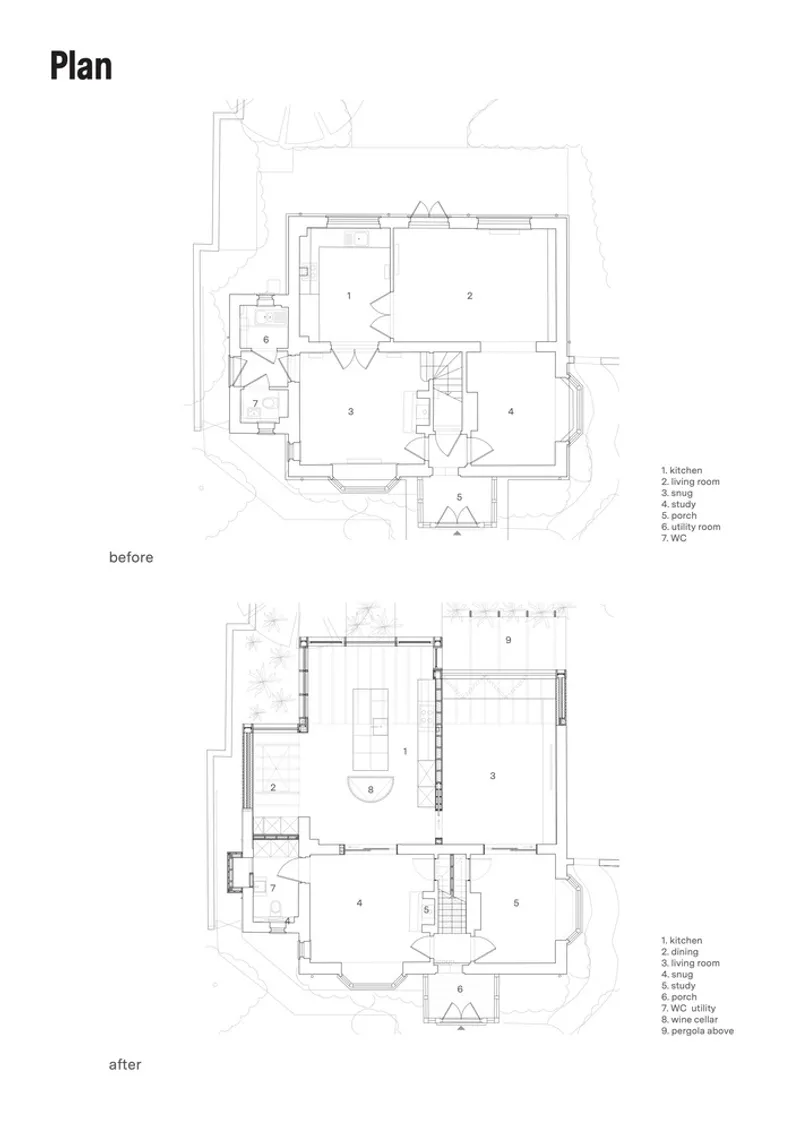
The axonometric drawing reveals the layered composition of the extension: a sequence of timber-framed glazed screens and paneled walls that step and pivot to create the distinct rooms described above. The floor plans show the before and after layouts, making clear how the stepped plan form preserves the original footprint while adding usable area at the rear. The dining nook sits in its own bay, offset from the kitchen, while the living space aligns with the four-metre opening to the garden. The drawings confirm what the photographs suggest: this is an extension designed room by room rather than as a single volume.
Why This Project Matters
Newton Park Place challenges two defaults in London residential architecture. The first is the assumption that extending a listed building means imitating it. ROAR's oak pavilion is frankly contemporary, and the building is better for it. The contrast clarifies the original house rather than diluting it. The second default is the open-plan rear extension, that seamless kitchen-dining-living space that has become so universal it no longer registers as a design choice. By insisting on separate rooms connected by sliding doors, ROAR and their client recovered something that open plan sacrificed: the ability to be in one space without being in all of them.
The prefabrication strategy matters too. Workshop fabrication in Devon followed by on-site assembly in London is not a novelty; it is a practical response to the constraints of working on a listed property in a conservation area. It minimizes disruption, controls quality, and allows traditional joinery techniques to be executed at a level of precision that site conditions rarely permit. At £450,000 plus VAT for a 30-square-metre extension, this is not a budget project. But the investment is legible in every joint, every threshold, and every carefully framed view. The oak will outlast whoever pays for it, which is more than most extensions can claim.
Newton Park Place by ROAR Architects. Chislehurst, South East London, United Kingdom. 30 sqm extension. Completed 2023, garden completed 2024. Garden design by Lily Gomm. Timber frame fabrication by Tim Gaudin.
About the Studio
Share Your Own Work on uni.xyz
If projects like this are the kind of work you want to make, uni.xyz is a place to publish your own, find collaborators, and enter design competitions.




Popular Articles
Popular articles from the community


Co-Life: Senior Housing Design That Reconnects Older Adults With the City
Co-Life reimagines senior housing design through healing gardens, shared streets, workshops, and a sustainable community across generations.

Riyadh For All: Intergenerational Urban Design for Active Aging in Rabat
Riyadh For All reimagines urban design in Rabat with intergenerational co-living, adaptive courtyards, and Moroccan cultural exchange today.

Co-life: Sustainable Architecture for Age-Friendly Community Living
Co-life reimagines sustainable architecture for seniors through courtyards, rammed earth, shared gardens, and spaces designed for belonging.

Conexión: Biophilic Design Reimagines High-Rise Living in Hong Kong
Conexión reimagines high-rise living in Hong Kong through biophilic design, green facades, shared spaces, daylight, water and nature within.


Similar Reads
You might also enjoy these articles


Hodi-Mandai Geram
Project Function: Preservation and revitalization of the Intangible heritage and socio-spatial identity of the Hodi by Housing, Cultural Memory Center, Sacred Grove, landscape, local tourism economy


Olio Towers: A Mid-Rise for Performers That Fuses Housing, Rehearsal, and Stage
Located blocks from Houston's Theater District, this modular tower stacks living units around a central performance atrium.

Oasis: Modular Green Housing Carved into Dhaka's Urban Fabric
A shortlisted Plugin Housing entry reclaims unauthorized settlements in Dhaka with stepped concrete volumes, green roofs, and ventilation-driven design.

Black Hole: A Floating Megastructure for the Post-Physical Era
Emiliano Mazzarotto envisions a spherical, self-scaling arena where e-sports, digital hotels, and holographic stadiums replace traditional public space.


Explore Building Extension Competitions
Discover active competitions in this discipline



Challenge to reimagine the Iron Throne


Photograph architecture without architects


Illustrate the lost glory of Angkor Wat - Render Challenge


Design challenge to reuse E-waste
Comments (0)
Please login or sign up to add comments
No comments yet. Be the first to comment!