
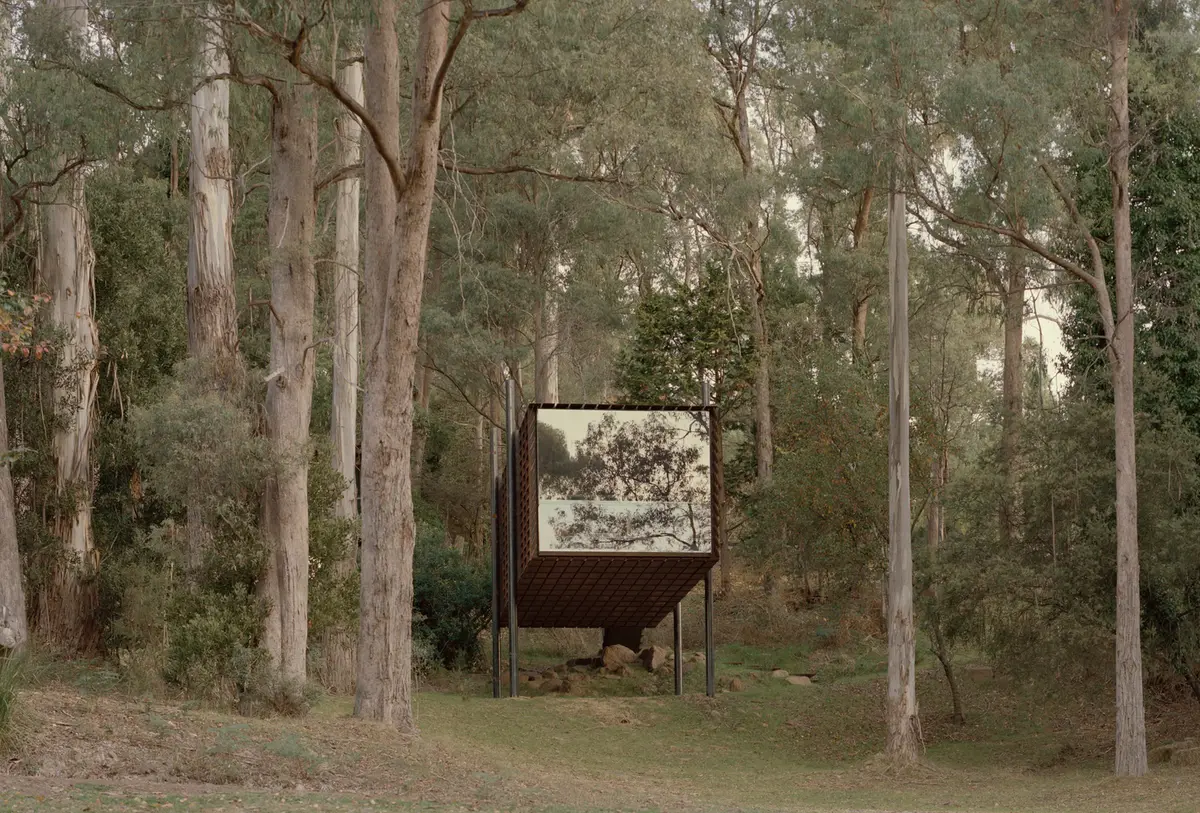
Robbie Walker Lifts a Steel Treehouse into the Snow Gums of Victoria's High Country
A bushfire-resistant retreat in Sawmill Settlement proves that building small is the most radical sustainable gesture of all.


At the foot of Mount Buller, where ancient snow gums crowd the slopes and stormwater carves gullies through the forest floor, Robbie Walker has planted a small steel box on four columns and called it a home. The Sawmill Treehouse, completed in 2024, is barely a house at all by the standards of Australian real estate: one bedroom, one bathroom, a kitchen, a living room, and the trees. That is the whole program. In a settlement built to serve skiers and offering little more than basic infrastructure, Walker's project makes a case that less architecture, placed precisely, can deliver more experience than any sprawling lodge.
What makes the project genuinely interesting is the tension between its material reality and its poetic ambition. This is a building sited in a BAL 40 bushfire zone, where every external surface must be non-combustible. Timber, the instinctive material for anything calling itself a treehouse, is forbidden on the outside. So Walker wrapped the cabin in Corten steel slats, spaced to catch light the way eucalyptus leaves do, and lined the interior entirely in locally sourced Victorian ash. The result is a building that performs like a bunker and feels like a nest.
Steel Skin, Forest Shadow
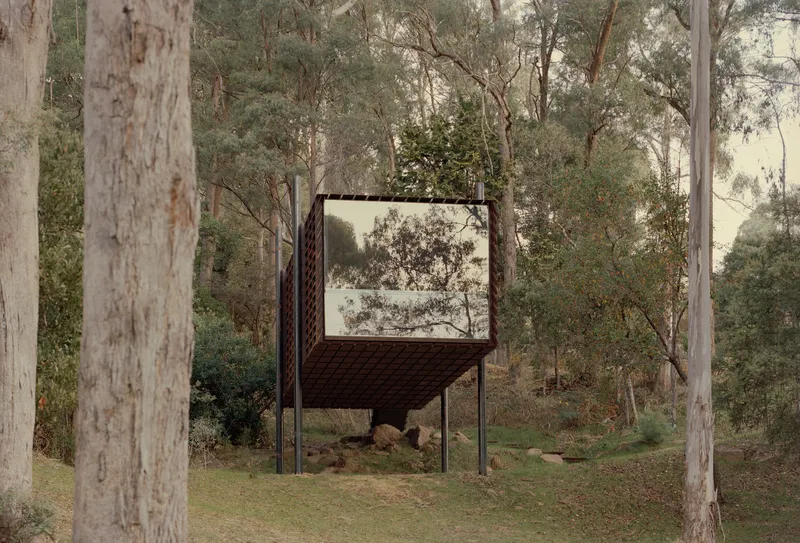
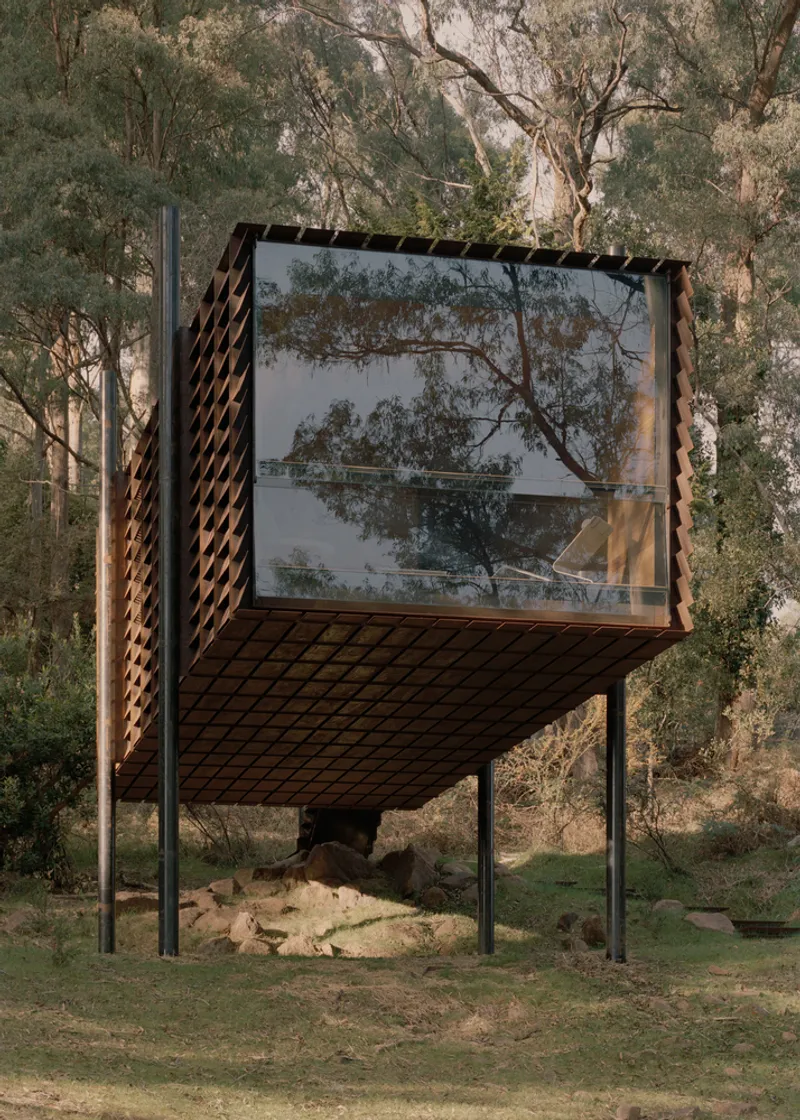
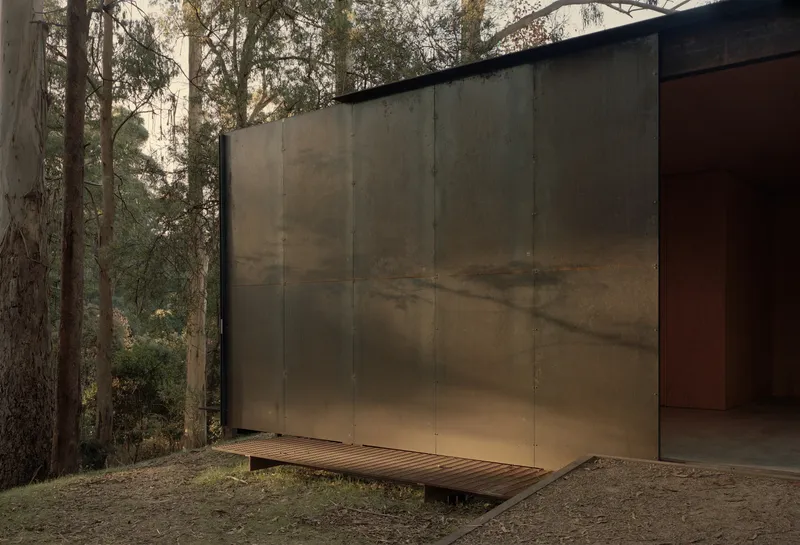
From the outside, the Sawmill Treehouse reads as a weathered metallic volume suspended among the trunks. The Corten steel cladding wraps three sides, its rust-orange tone shifting with the light and rhyming with the bark of the surrounding eucalypts. Walker treats the steel slats not as mere cladding but as a functional double skin. Gaps between the slats and the building envelope allow air to circulate freely, cooling the structure without mechanical assistance and shading the roof sheets and wall lining from the fierce summer sun.
The diamond and horizontal patterns of the screen change character depending on the angle and time of day, casting shifting shadows across the facade and into the interior. It is a deliberate inversion of the treehouse archetype: instead of timber boards nailed to branches, you get steel plates hovering among the canopy, catching and releasing sunlight like a kinetic sculpture.
Four Columns and the Logic of Elevation
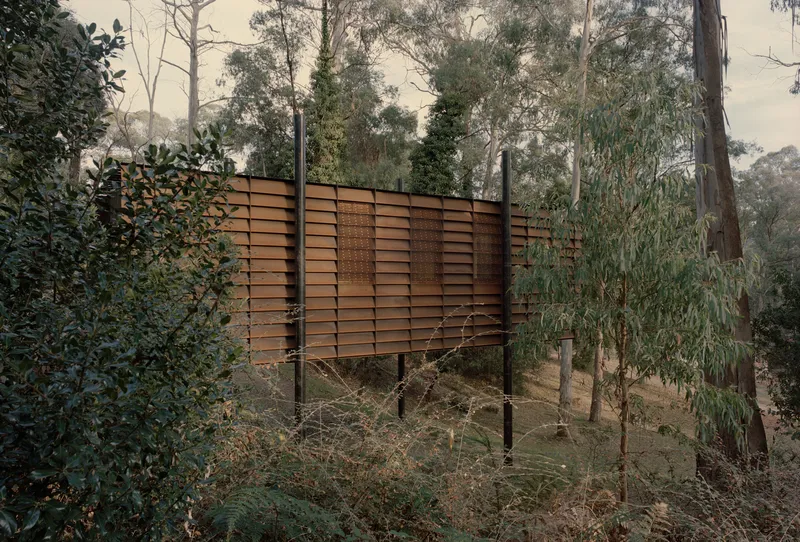
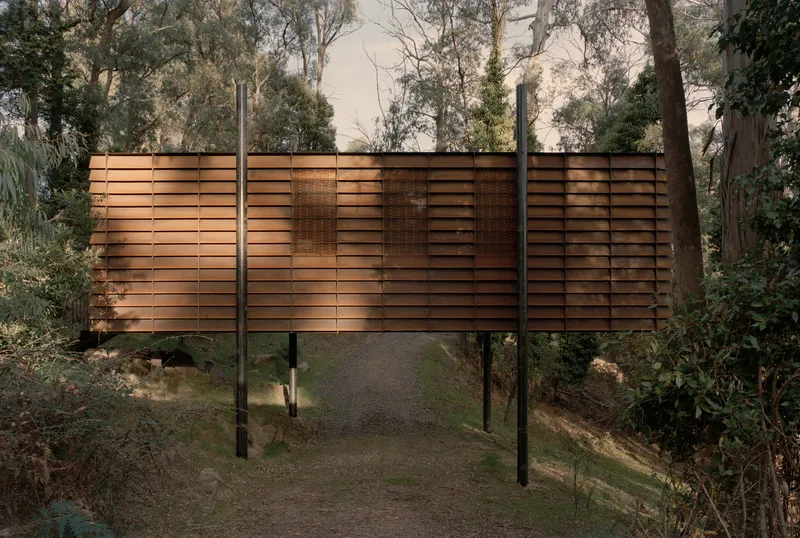
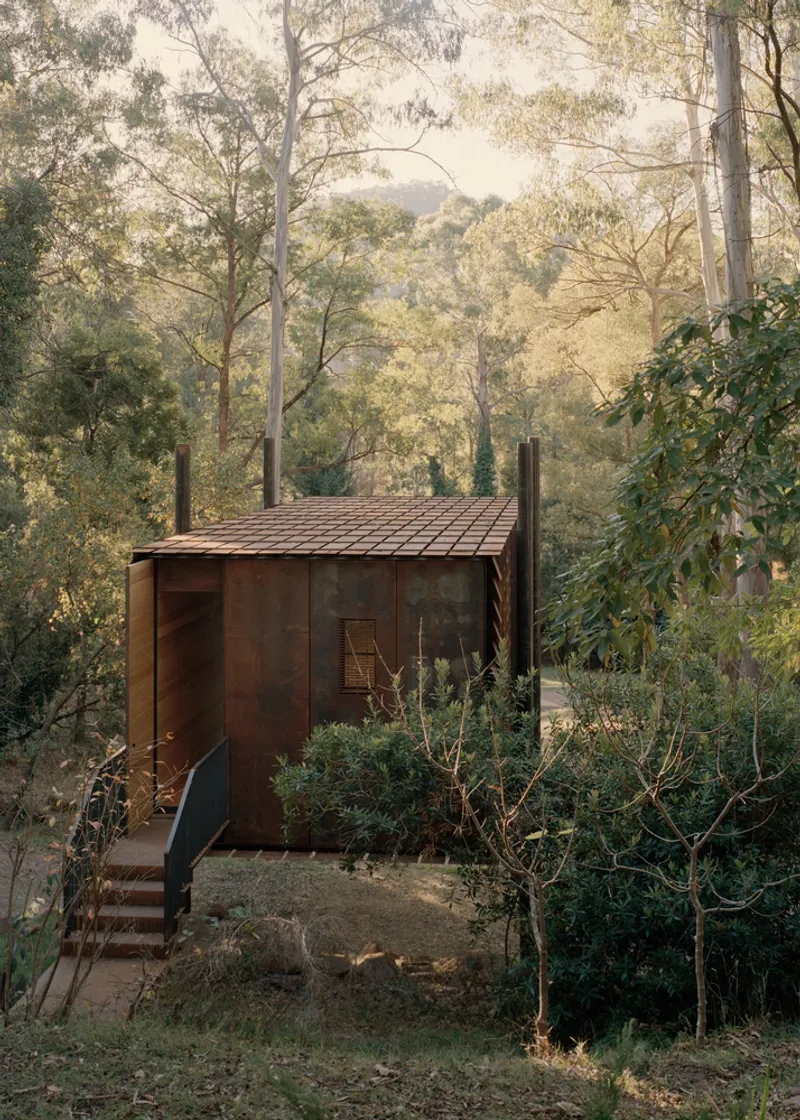
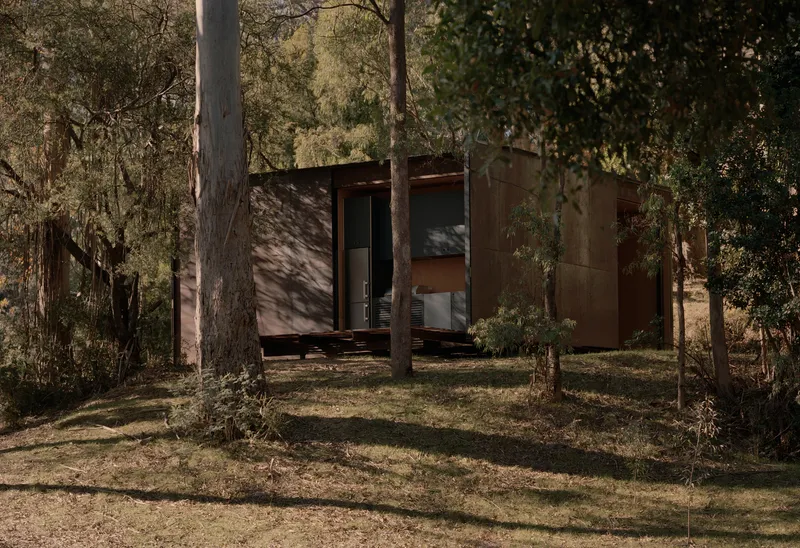
The site sits at the head of a gully where neighboring properties once discharged stormwater. Rather than fight the hydrology, Walker lifted the building entirely off the ground on four slim steel posts, conceptual stand-ins for tree trunks. Water, cars, and foot traffic pass freely underneath. A garage and outdoor kitchen occupy a separate ground-level structure on the flatter portion of the site, keeping the elevated cabin pure in function: sleep, cook, look out.
Elevation also solved the perennial problem of site disturbance in sensitive landscapes. The columns touch the earth lightly. Beneath the cabin, the rocky terrain and native vegetation remain largely intact, a strategy that quietly earns more environmental credibility than any green roof ever could.
Into the Canopy
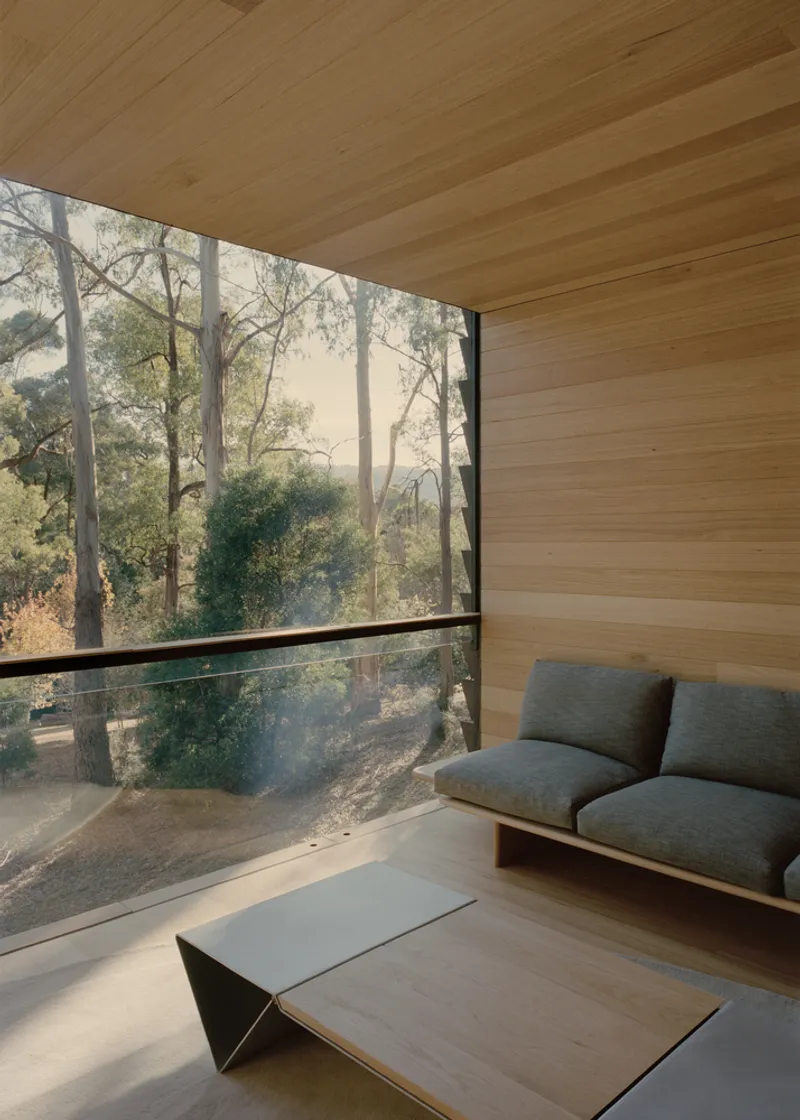
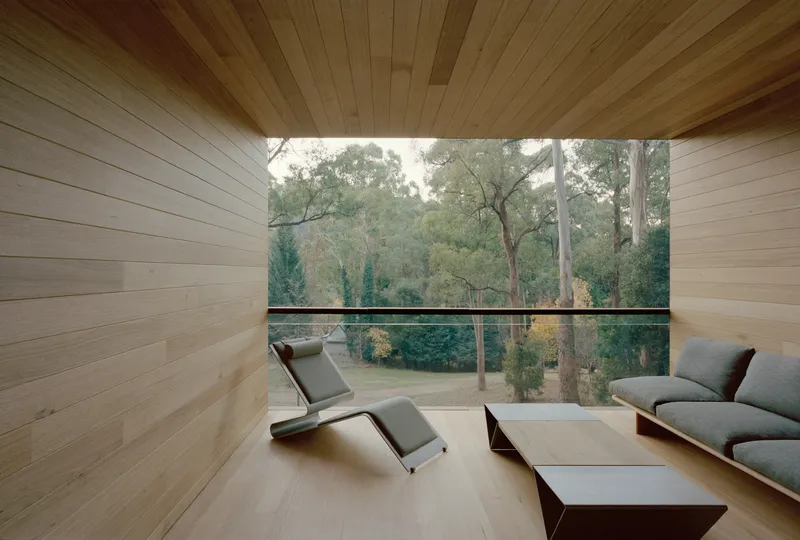
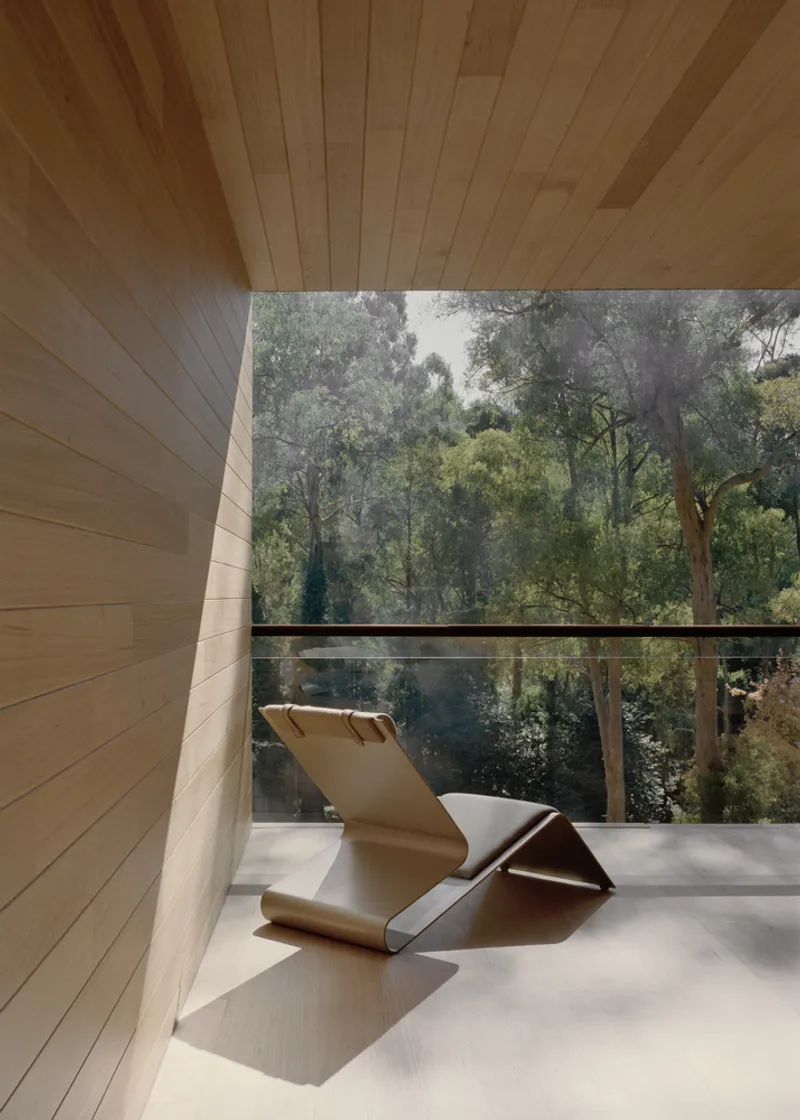
The payoff for all the structural gymnastics arrives the moment you step inside. One end of the cabin dissolves into wall-to-wall glazing that frames the eucalyptus canopy at eye level. Victorian ash lines every interior surface: walls, ceiling, floors, the built-in sofa, vent covers, cabinet fronts. The material is sourced from the same species of eucalyptus that surrounds the building, collapsing the distance between inside and out.
The living room, viewed from the covered terrace through the cable railing, feels suspended in the forest rather than adjacent to it. Openable windows with permanent fixed fly screens allow breezes in while blocking embers. Flush floor vents pull cool air upward. The entire climate strategy is passive, and the absence of air conditioning is not a compromise but a design outcome.
Kitchen and Wet Spaces
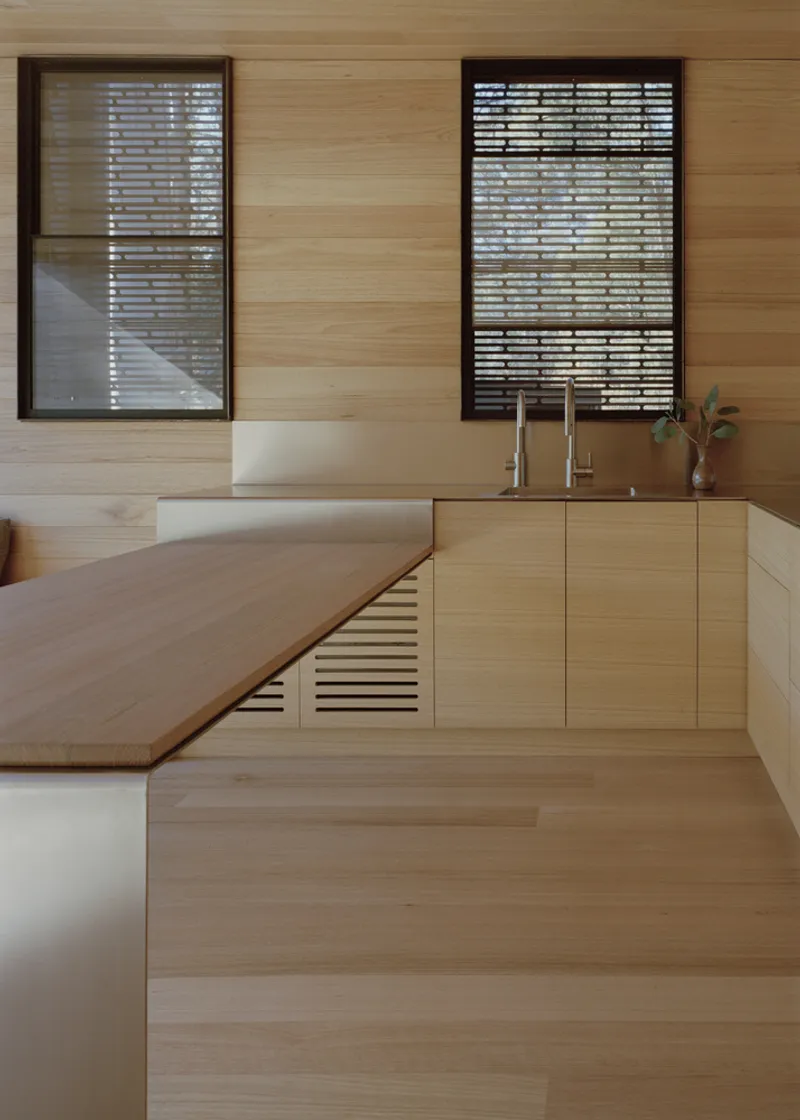
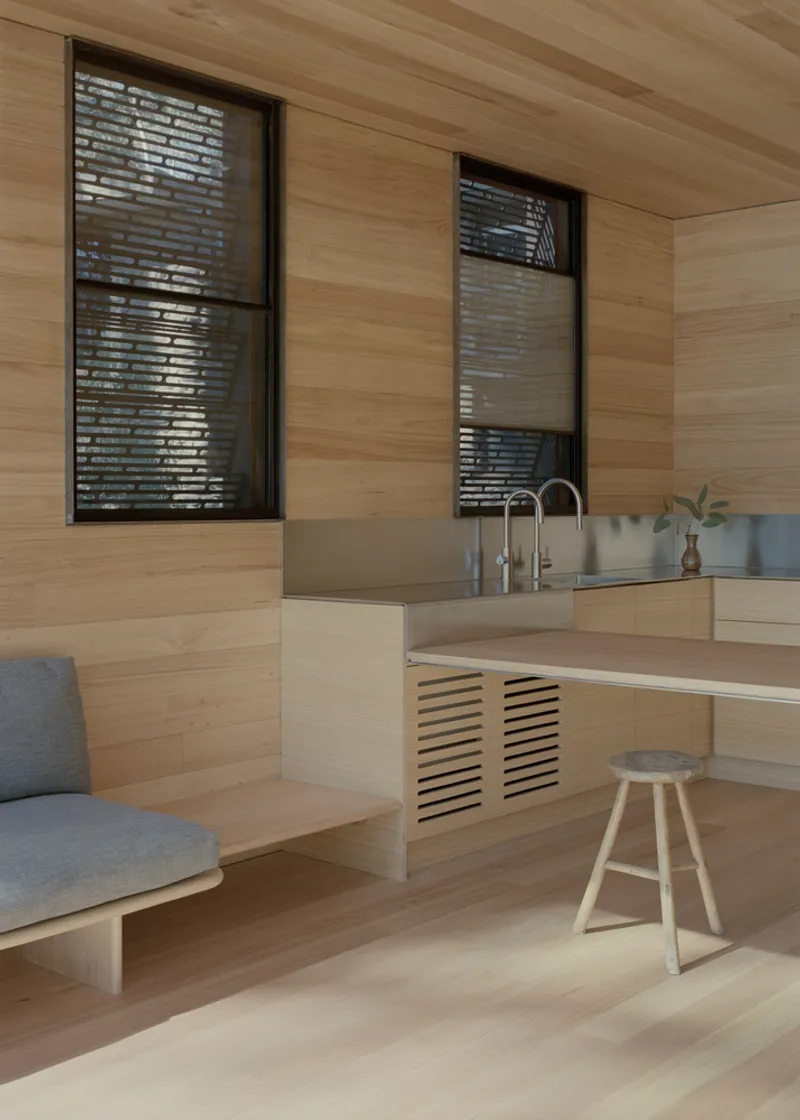
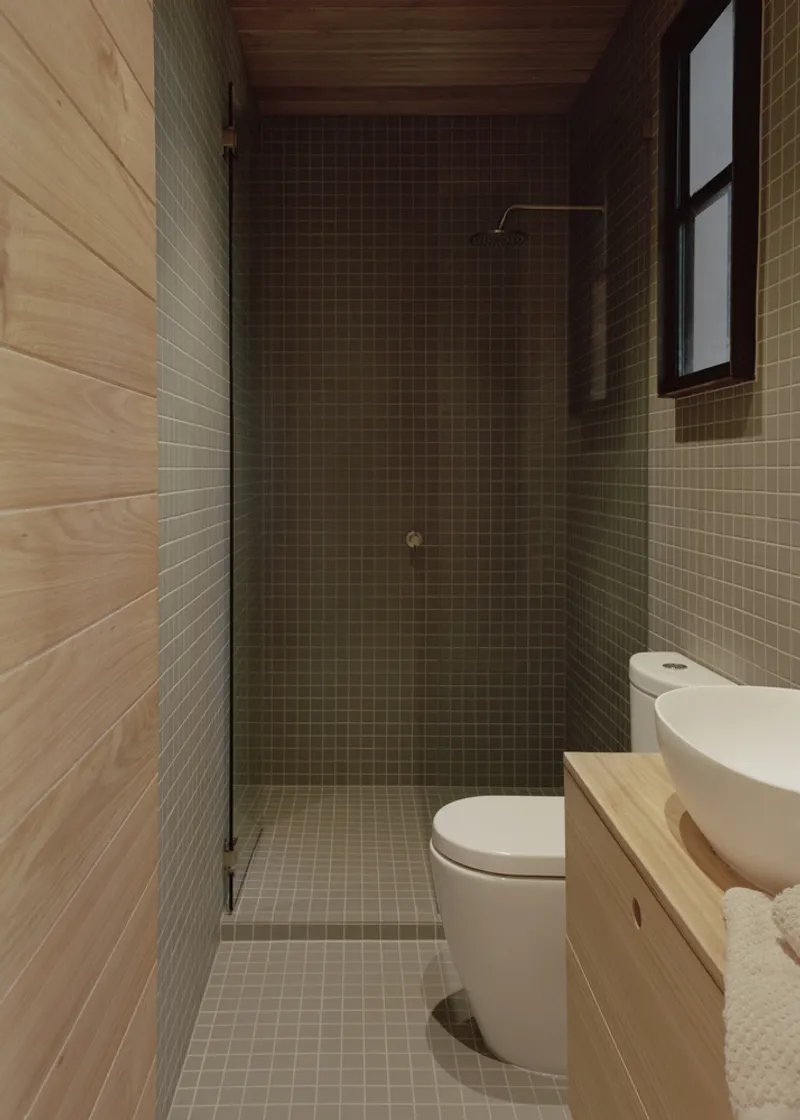
The hallway spine of the cabin feeds a compact sequence of rooms: kitchen, bathroom, bedroom. In the kitchen, stainless steel benchtops meet the Victorian ash island and louvered cabinetry, a pairing that reads as both utilitarian and warm. Tall windows with horizontal blinds filter light through the steel slat facade beyond, layering the interior with bands of shadow.
The bathroom introduces the only change in material palette. Olive mosaic tile lines the shower enclosure, a moment of color and texture that sets the wet zone apart from the timber envelope without breaking the mood. It is a small room that feels considered rather than cramped, evidence that restraint in square meters can coexist with generosity in finish.
Detail and Threshold
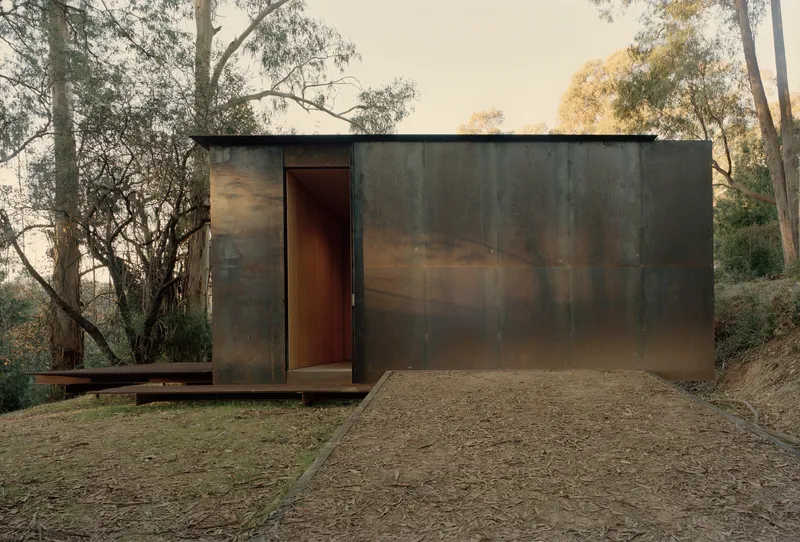
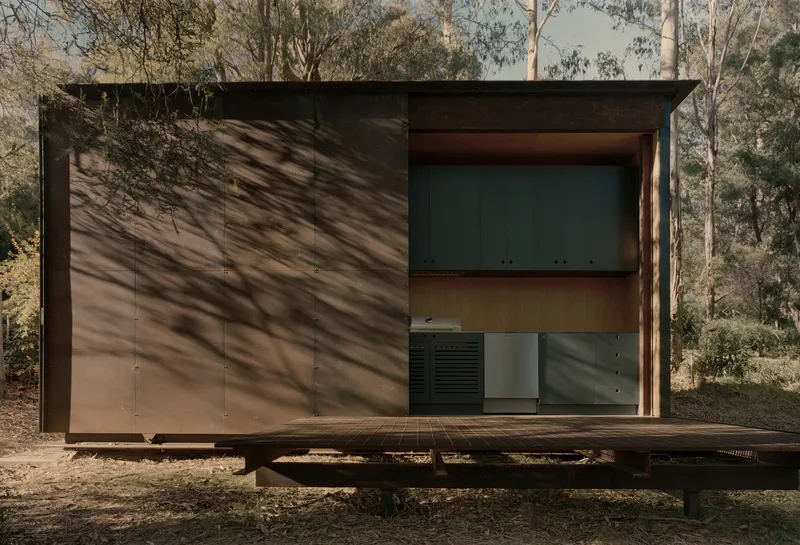
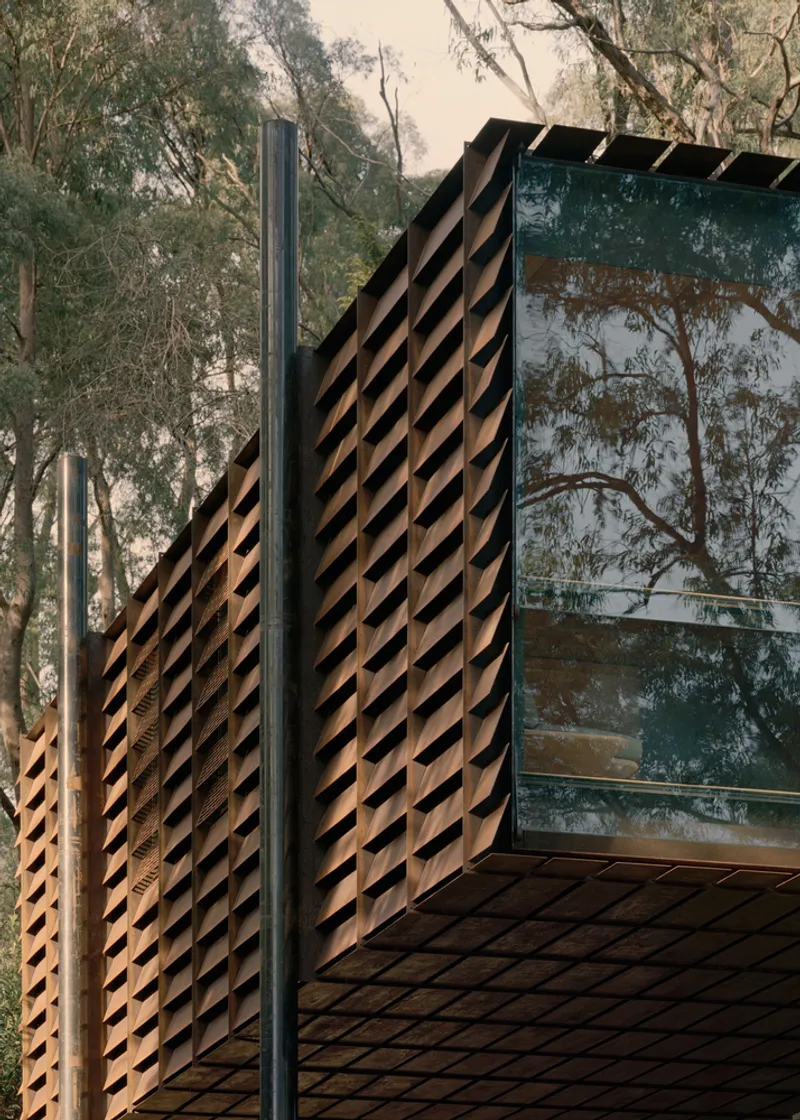
Walker handles thresholds with particular care. The narrow entrance doorway, framed by Corten panels, compresses your field of view before the interior opens to the forest panorama. At dusk, tree shadows slide across the steel and timber surfaces, turning the facade into a register of the day's last light. The corner detail where diagonal timber battens meet full-height glazing shows how the screen system negotiates transparency and enclosure at once.
These moments are not decorative. They are the product of a building that must simultaneously resist bushfire, breathe in summer heat, and frame a landscape that the client valued above any interior finish. Every joint between steel and glass, every gap between slats, is doing more than one job.
Approach and Landscape
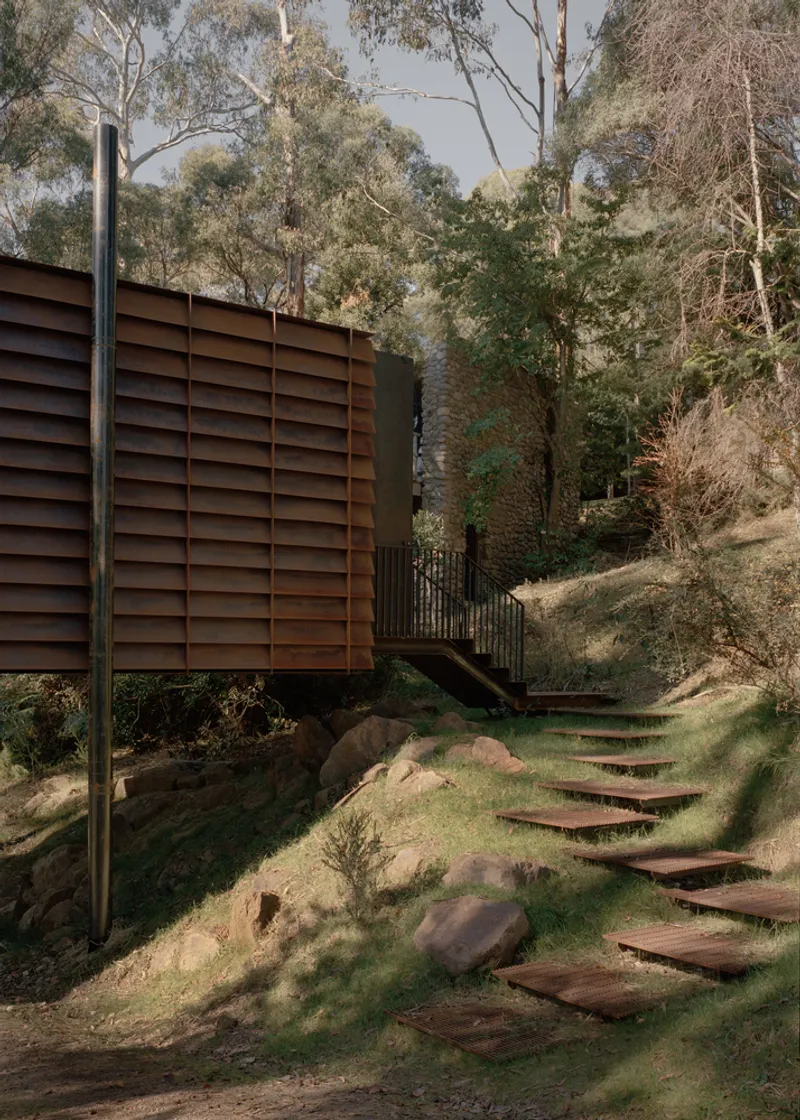
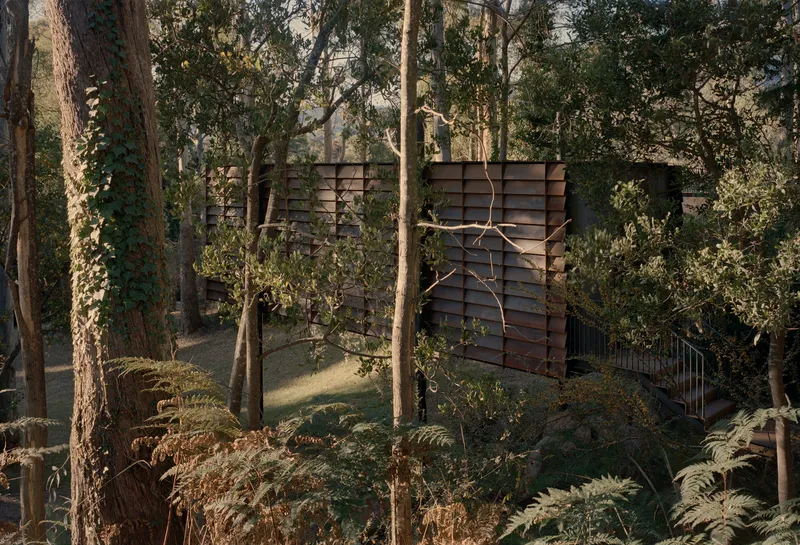
The approach sequence matters. A timber deck ramp extends from the Corten volume into the clearing, bridging the gap between ground and elevated living. External stair treads set into the grassy hillside reinforce the sense that you are ascending into the canopy, not simply entering a house. From below, the horizontal louvre facade nestles among trunks and tree ferns, its lines echoing the layered strata of the bush.
Walker and engineer Taylor Engineering + Design calibrated the structure so that slender columns and cantilevered volumes read as lightweight even in steel. The visual trick is effective: a building that must be entirely non-combustible manages to look provisional, almost temporary, as though the forest could reclaim the clearing at any moment.
Plans and Drawings
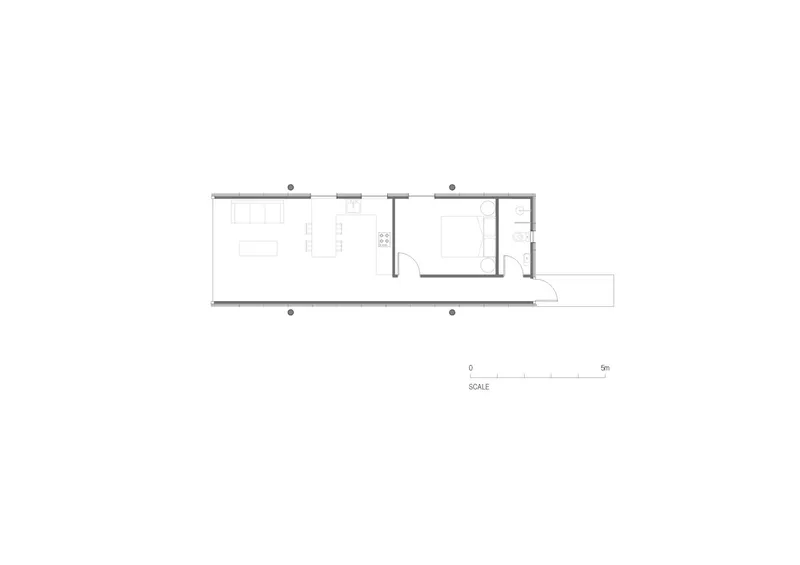
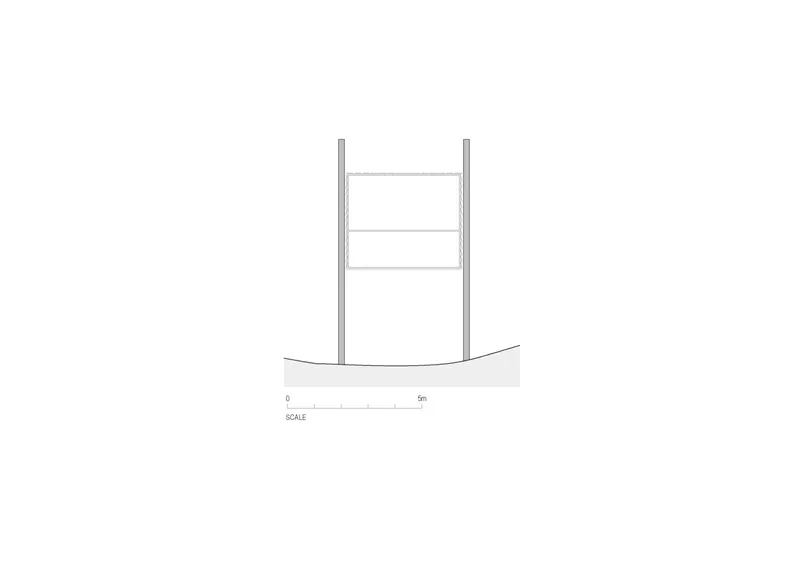
The floor plan confirms just how linear and compact the layout is. Living areas sit at the glazed end, with bedroom, bathroom, and kitchen threaded along a narrow hallway. The section drawing reveals the structural logic more clearly: steel beams span between the four columns, lifting the habitable volume well above grade while the ground beneath remains open. The two-story reading from the section is somewhat deceptive; the lower level is largely open air, used for parking and services rather than enclosed living.
Why This Project Matters
The Sawmill Treehouse is a quiet provocation against the logic of contemporary residential development. In a country where housing debates revolve around density, affordability, and floor area ratios, Walker built a one-bedroom retreat in a bushfire zone and lined it with local wood. The client never asked about resale value. Financing a project this small is harder than funding a larger one, a structural absurdity in the industry that rewards excess. Walker and his client chose to ignore all of that.
More broadly, the project demonstrates that bushfire compliance and atmospheric architecture are not mutually exclusive. The BAL 40 rating could have produced a defensive concrete bunker. Instead, it produced a Corten lantern in the snow gums, a building that breathes passively, touches the ground lightly, and reframes its constraints as a design language. If sustainable design has a future in fire-prone landscapes, it looks something like this: small, elevated, steel on the outside, timber on the inside, and nothing you do not need.
Sawmill Treehouse by Robbie Walker, Sawmill Settlement, Victoria, Australia. Completed 2024. Photography by Tasha Tylee.
About the Studio
Share Your Own Work on uni.xyz
If projects like this are the kind of work you want to make, uni.xyz is a place to publish your own, find collaborators, and enter design competitions.


Popular Articles
Popular articles from the community


U.GA Architects Wraps an Oval Rooftop Pool in Curved Board-Formed Concrete on Busan's Jeollidan-gil
In Busan's Jeonpo-dong, a 454 m² mixed-use block stacks a neighborhood facility, guest rooms and an oval rooftop pool inside spiraling concrete walls.

longwave studio Reorganizes a 112 m² Tainan Apartment Around the Daily Routines of a Family and Two Cats
In Tainan, Taiwan, birch plywood, rust-red furniture and a freestanding plaster wall link arrival, storage, work and family life in one apartment.

David Macias Steps a Doorless Stone and Plaster House Down a Tropical Colombian Hillside
In the humid hills of Colombia, Threshold House replaces the front door with an open void and terraces its 850 m² down the slope instead of fighting it.

GROUP A Strips a 1969 Rotterdam Harbor Headquarters to Its Frame and Wraps It in Timber Louvers
In Rotterdam's M4H harbor district, Ferro Offices reuses a 1969 frame, adds one timber storey and reaches BREEAM-NL Outstanding.

Similar Reads
You might also enjoy these articles

Gil Mello Arquitetura Tilts a Single Roof Toward the Waterfalls on a Plateau Above Aiuruoca, Brazil
In Aiuruoca, Minas Gerais, a 200 m² house of local labor and reclaimed poles pairs a low valley veranda with a tall mountain one.
U.GA Architects Wraps an Oval Rooftop Pool in Curved Board-Formed Concrete on Busan's Jeollidan-gil
In Busan's Jeonpo-dong, a 454 m² mixed-use block stacks a neighborhood facility, guest rooms and an oval rooftop pool inside spiraling concrete walls.

Felipe Hess Arquitetos Turns a Blind Stone Wall to the Street and Opens a Brazilian House onto a Courtyard and Canal
A canal-front house in Brazil hides behind painted stone and planting, then opens to an olive-tree courtyard, a reed-ceilinged porch and a curving pool.
David Macias Steps a Doorless Stone and Plaster House Down a Tropical Colombian Hillside
In the humid hills of Colombia, Threshold House replaces the front door with an open void and terraces its 850 m² down the slope instead of fighting it.
Explore Tree House Competitions
Discover active competitions in this discipline

Challenge to reimagine the Iron Throne

Photograph architecture without architects

Illustrate the lost glory of Angkor Wat - Render Challenge

Design challenge to reuse E-waste
Comments (0)
Please login or sign up to add comments
No comments yet. Be the first to comment!