TEDZUKURI
CENTRE OF TRADITIONAL JAPANESE CRAFS


IDEA
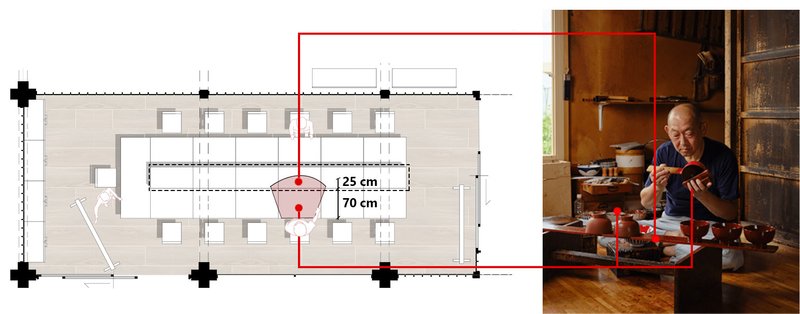
One of the main objectives of the project was to 'break the barrier' and create a space that allows the creative process to be observed and allows visitors to move among the artisans and their products. The main hall, which acts as both a communication space, art gallery and workshop venue, will showcase the artists' products. The project also aims to promote education by providing a workspace for experienced artisans to pass on their knowledge and teach volunteers to create traditional everyday items specific to the Akita region.
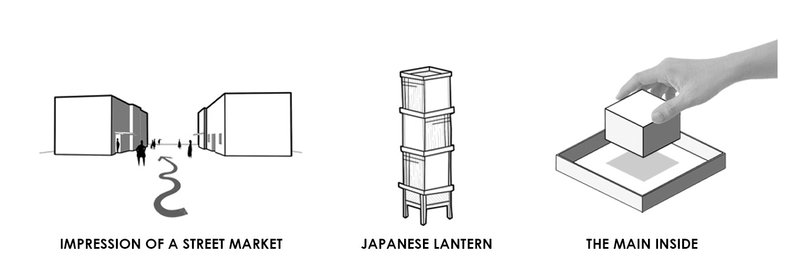
Impression of a street market- One of the ideas behind the project was to create a space reminiscent of atmospheric crowded street markets, between which tourists and visitors to the centre can stroll. In addition to observing the works, it is possible to visit the workshops next door and watch the craftsmen at work.
Japanese lantern - The interior and exterior of the building resemble a Japanese lantern with soft light reflected off the paper walls. This shapes the unique light and shadow effect and contrast of the building - during the day the predominance of shadow and illumination through the skylight, at night the light from the internal lamps.
The main inside - The entire interior space inside serves as a display of the craftsmen's works. Inside the open hall, a cube has been placed to act as workshop studios. This is the most important element of the building to allow observation from all sides and to encourage visitors to participate in the workshops.
SCOPE OF THE PROJECT - SELECTION OF CRAFTSMEN
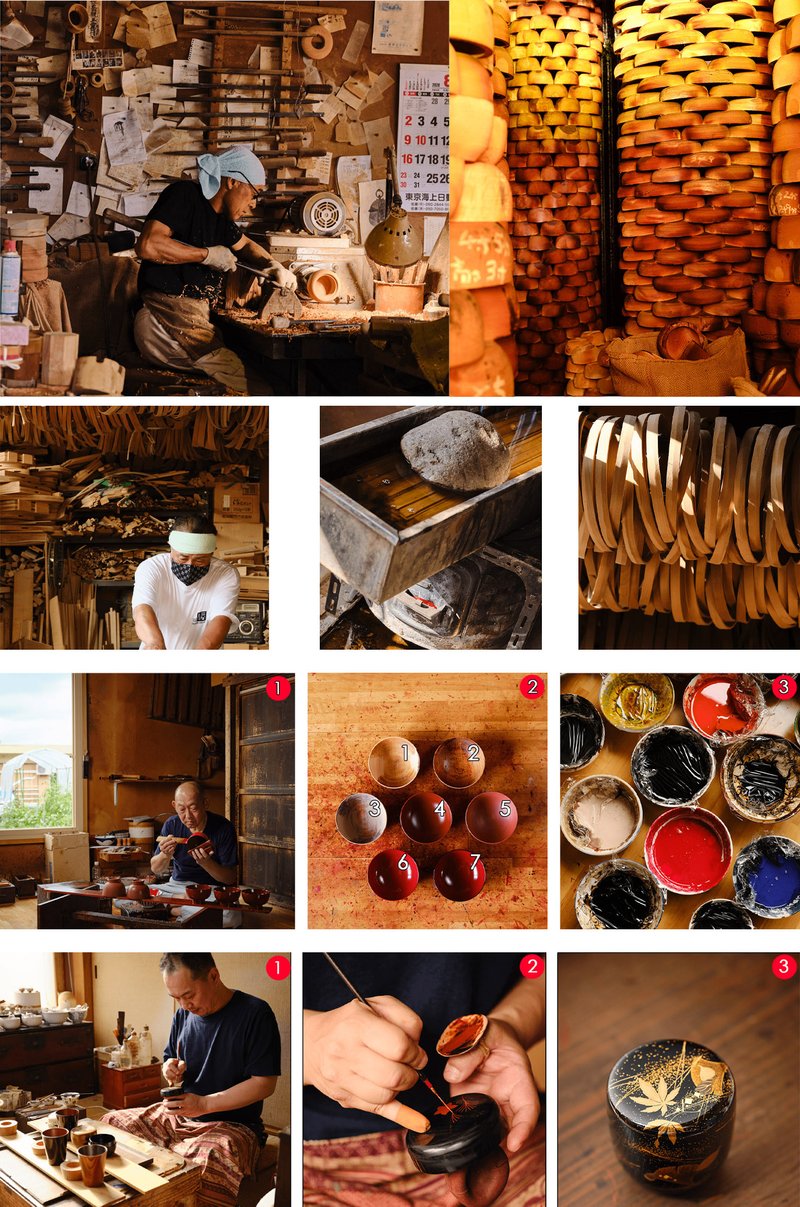
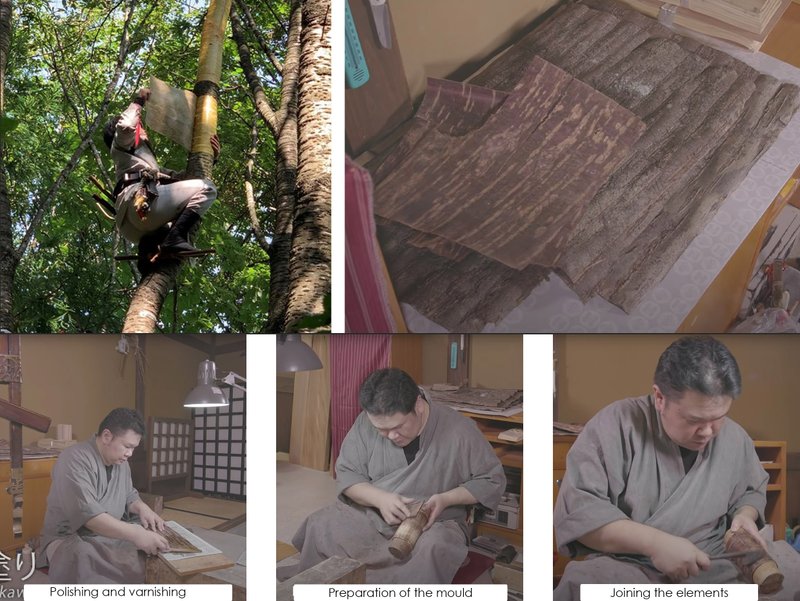
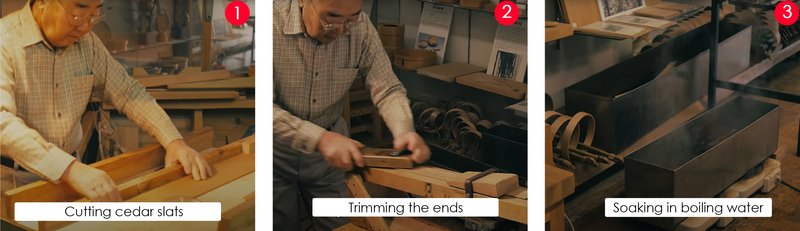
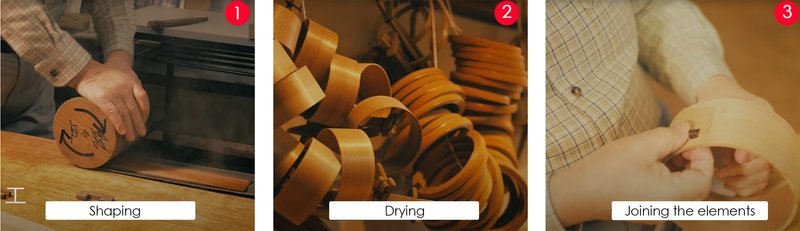
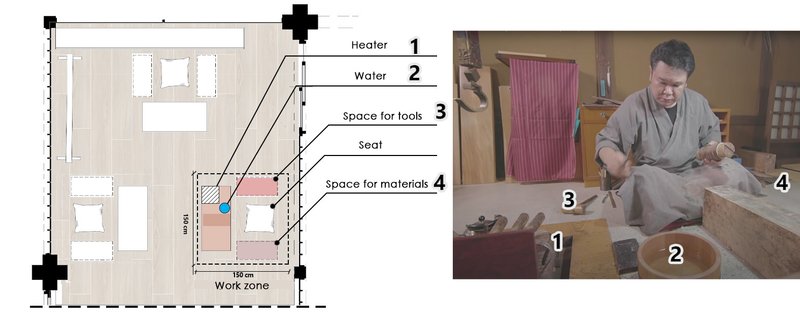
The scope of the project includes the development of a residency facility for artists and workshop participants, which will consist of hotel rooms, an auditorium with support spaces, a library, a catering area, an outdoor stage, a souvenir shop, administrative and storage spaces, landscaped areas and dedicated workshop rooms adapted for the production of crafts. Three traditional Japanese crafts will be included: kawatsura lacquer, kabazaiku boxes and odate magewappa.
KAWATSURA
KABAZAIKU
ODATE MAGEWAPPA
CLIMATIC ANALYSES
Due to the uniqueness of the site, climatic analyses were carried out to determine the prevailing weather conditions, the amount of light supplied, the average temperature and precipitation. This was an important factor in the selection of building materials - frost-resistant cedar wood - and the surface area of the retention tanks.
ANALYSES OF THE CRAFTS, PLOT AND SITE CONTEXT
First, in-depth spatial analyses were carried out - communication, architecture, urban planning, site function and greenery. Next, the buildings that serve as the crafts centre in and outside Japan were analysed. Next, historical analyses of the site were carried out. The subject of the crafts to be addressed by the project was extensively researched. The process of creating each craft was studied and appropriate design guidelines were selected on this basis.
LAND DEVELOPMENT PROJECT
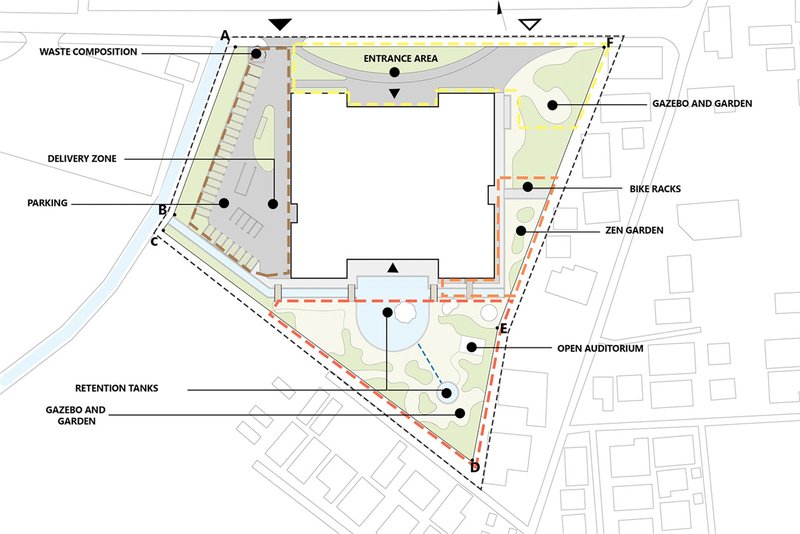
Several areas can be distinguished on the project site. On the northern part of the site there is an open entrance area in front of the building. On the western elevation, the car park is located, together with a delivery area for materials and products for the kitchen. At the southern part of the plot is the public area, which includes a zen garden with retention tanks, a gazebo and an outdoor auditorium. In contrast, a 'quiet zone' is located at the eastern boundary of the plot, adjacent to the hotel rooms. The building, which is inclined towards the north, continues the compositional course of the building lines of the surrounding residential buildings. In addition, it creates 'interiors' in the form of larger green squares within the plot.
FITTING THE BUILDING INTO THE CONTEXT OF THE SITE - MATERIALS
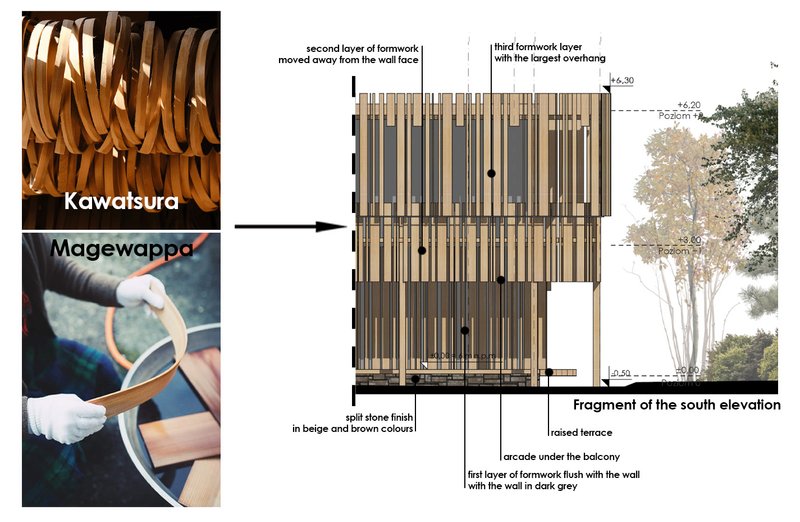
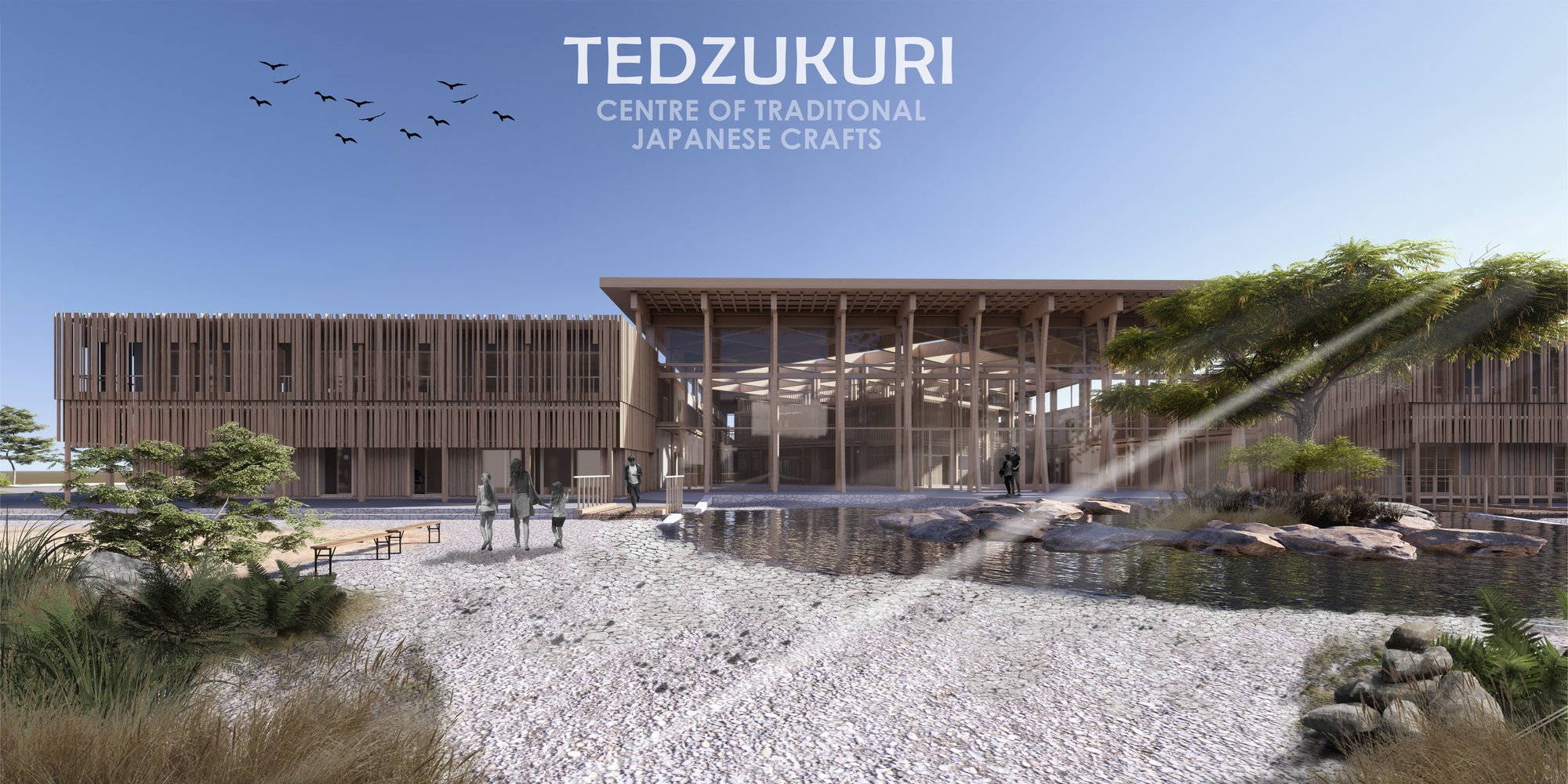
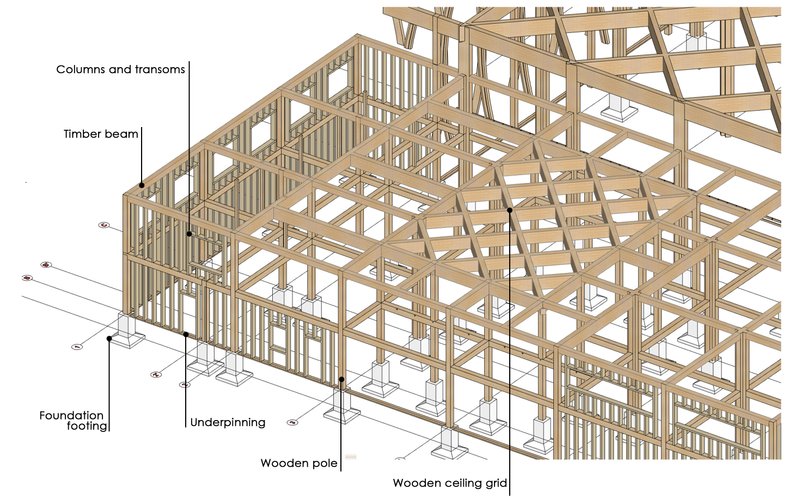
Local materials and typical Japanese construction methods were analysed. On this basis, appropriate design guidelines were put forward. As a result, the designed building fits into the context of the site, reflecting the character of Japanese construction. Following a long-standing tradition, timber invariably remains the main building material in both country houses and representative public buildings in Japan. Wood appears both in the structure in the form of columns and beams, as well as in the interior finishes and facades. Among other things, ceilings typical of local architecture were used, with a heavily overhanging and carved cornice, which gives them a unique appearance and originality. In addition, sliding shoji walls were used to allow for flexible space arrangement and terraces raised from ground level that provide pleasant places to relax and observe the surrounding landscape. The use of wood in the design not only reflects Japanese tradition, it is also a response to climate problems arising from the construction sector, among others. As a material, wood has a negative carbon footprint and, unlike reinforced concrete structures, has no negative environmental impact. A number of environmentally friendly solutions, such as extensive green roofs, retention basins and photovoltaic panels, were used in this project. In order to minimise heating and cooling costs, the building envelope has an exceptionally low U-value and shading blinds have been designed under the skylights to control the amount of light coming in. The south elevation has been overhung, creating an additional layer of boarding to provide additional shading. With glazing, the vertical planks can rotate about their own axis to control the amount of light passing through.
THE FORMATION OF THE MASS
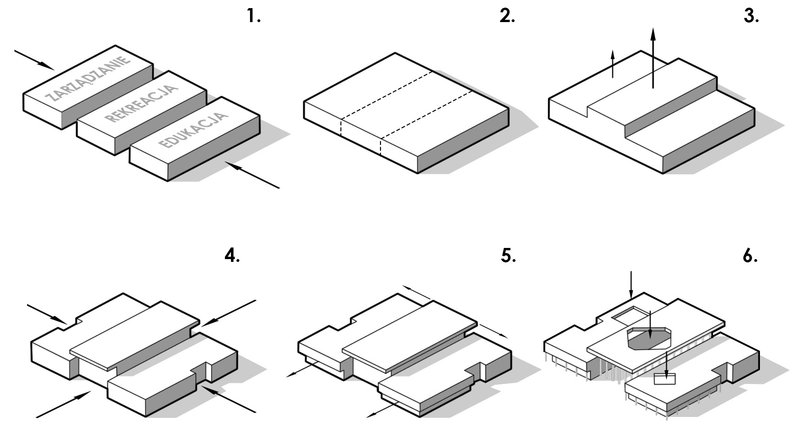
The massing and façade were constantly changing during the design phase. The main principles guiding the work were contrast - light and shadow, light and heavy masses, openings and closings. The designed building takes the form of an H-shape, with two lower, closed wings on the outside and an inner, fully glazed section that rises above the roofs of the surrounding segments. This layout relates to the street frontage, where most of the craftsmen work in their homes or small workshops, displaying their handicrafts on the street. The inner, glazed part of the building is spacious, open and full of natural light. A smooth transition through the building allows one to move almost unnoticed into the garden, which is located in the southern part of the complex. Inside the building, a smaller cube-shaped structure is designed, lit by a skylight. This is where the workshop rooms are located, between which and next to which visitors can pass to observe the process of working on specific products. The rooms, located on the first floor, have sliding walls that further blur the boundary between the creator and the viewer. This procedure is intended to encourage observers to join in the creative activity and thus support the local tradition.
ELEVATIONS
Several façade designs were made during the work. It was important to use natural materials found in Akita and to relate to the function of the building. The facades were designed to reflect the material as well as the handicrafts themselves made inside the building. Products such as Kabazaiku, Kawatsura Lacquer and Odate containers are made from wood and wood-based materials. One part of the process of creating these handicrafts is the long strips of wood that are later used during production. The façade design uses wooden planks with an irregular cross-section reflecting cedar slats, which have been formed into three vertical strips. The planks were placed at a distance from each other, creating a spatial effect and unique chiaroscuro patterns on both the exterior walls of the building and its interior. This creative interpretation of the use of wood not only draws on traditions and craft techniques, but also gives the building a unique character and impression of depth.