
Temporary Identity: Modular Housing Architecture as a Strategy for Urban Regeneration
A flexible modular housing architecture prototype redefining urban regeneration through temporary, adaptable living systems in Bologna.


Cities across Europe are increasingly challenged by aging building stock, rigid urban layouts, and the urgent need for adaptable responses to social, environmental, and economic change. (Ti) Temporary Identity emerges as a speculative yet highly pragmatic architectural proposal that positions modular housing architecture as a catalyst for urban regeneration. Developed for the Pilastro district in Bologna, the project introduces a temporary architectural system capable of easing interventions within existing neighborhoods while opening new possibilities for future urban living.
Rather than relying on demolition or permanent transformation, Temporary Identity proposes a reversible, lightweight, and adaptable framework, one that operates in parallel with the city’s long-term evolution. The project was developed by Marica Iandolo and explores how temporary structures can generate lasting spatial, social, and infrastructural value.
Temporary Architecture as a Tool for Urban Adaptability
At the core of the project lies a critical redefinition of temporary architecture. Instead of being viewed as a short-lived or emergency-only solution, temporary architecture is reframed as a strategic layer within the urban fabric. The proposal introduces modular housing units that can be installed, removed, reconfigured, or repurposed according to evolving needs.
This approach allows cities to respond to:
- Transitional housing demands
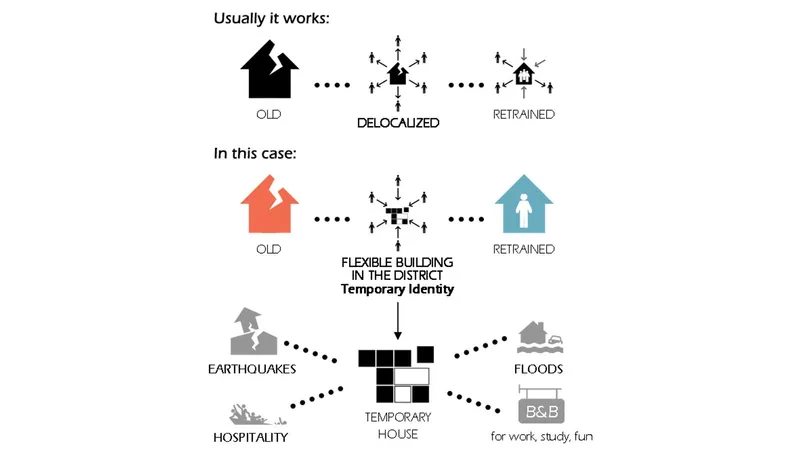
- Emergency accommodation (earthquakes, floods, displacement)
- Short-term hospitality and student housing
- Experimental urban programs and social infrastructure
By operating at both architectural and district scales, Temporary Identity demonstrates how modular housing architecture can function as a flexible urban system rather than a static object.
The Concept of “Temporary Identity”
The term Temporary Identity refers to the ability of architecture to adopt multiple roles over time without losing coherence. In conventional urban processes, buildings are often abandoned, demolished, or functionally displaced before being retrained. This project proposes an alternative trajectory.
Instead of the typical cycle, old → delocalized → retrained, the project introduces a flexible building layer within the district that allows transformation without displacement. Temporary modules act as intermediaries, absorbing change while preserving continuity within the urban environment.
This strategy enables districts like Pilastro to evolve gradually, reducing social disruption and construction impact while maintaining spatial identity.
Modular Housing Architecture: System, Not Object
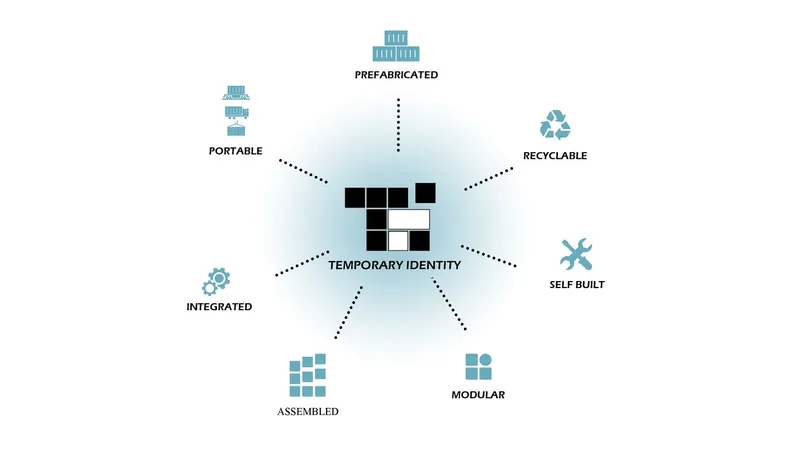
Temporary Identity is structured around a modular housing system composed of prefabricated living units. These modules are:
- Prefabricated for efficiency and speed of deployment
- Portable to allow relocation across sites
- Modular to support multiple spatial configurations
- Recyclable to reduce environmental impact
- Self-built / Assembled to allow phased construction
- Integrated with existing infrastructure
Rather than producing a singular architectural form, the project establishes a system capable of generating diverse outcomes depending on context, density, and program.
Flexible Living Modules and Spatial Configurations
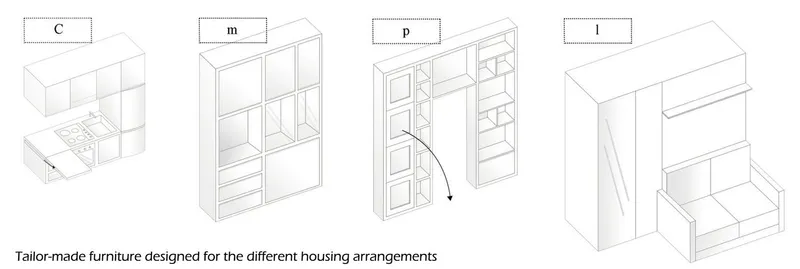
The modular system supports a wide range of residential typologies, from single-room units to multi-room family configurations. The Abacus Living Modules illustrate how spatial layouts respond to:
- Different household sizes
- Accessibility requirements
- Day–night usage patterns
- Seasonal and climatic variation
Plans and sections demonstrate how modules can be stacked, aligned, or bridged to create collective spaces, circulation corridors, and semi-public terraces. This adaptability allows the architecture to support both private living and shared urban life.
Urban Integration in the Pilastro District
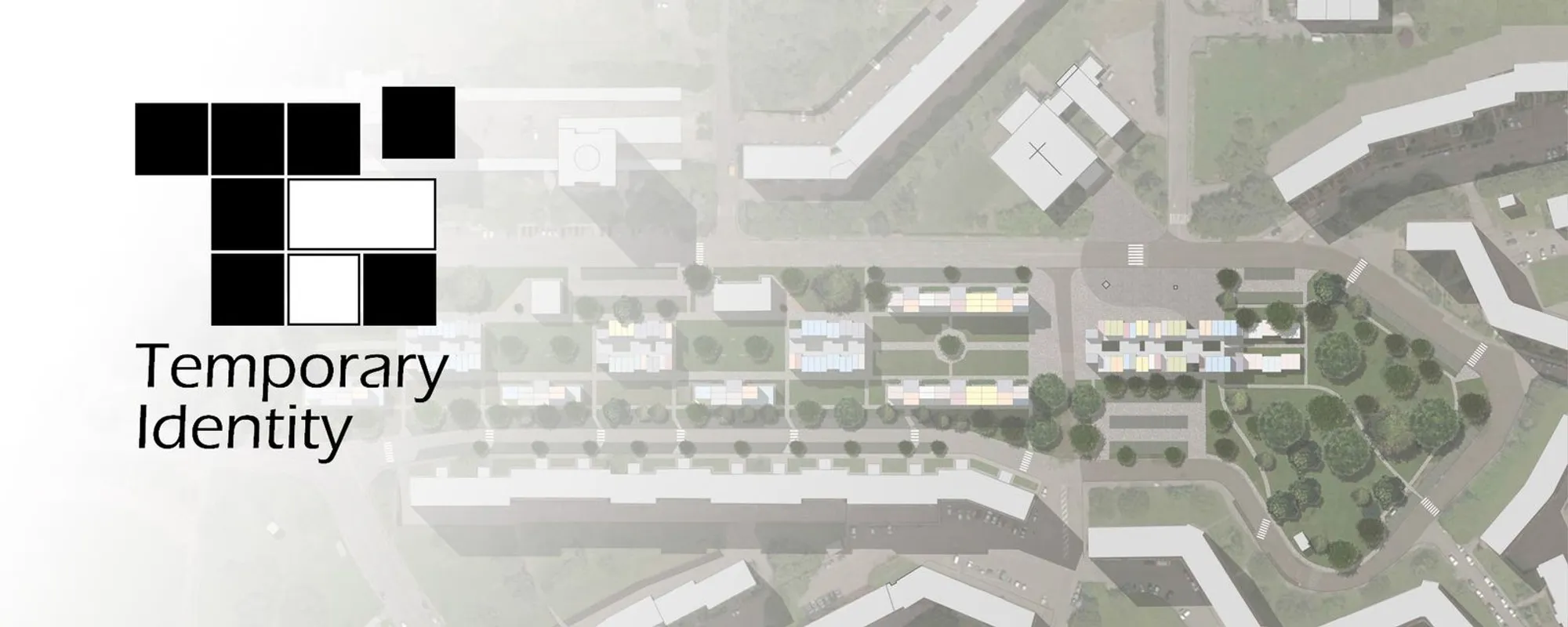
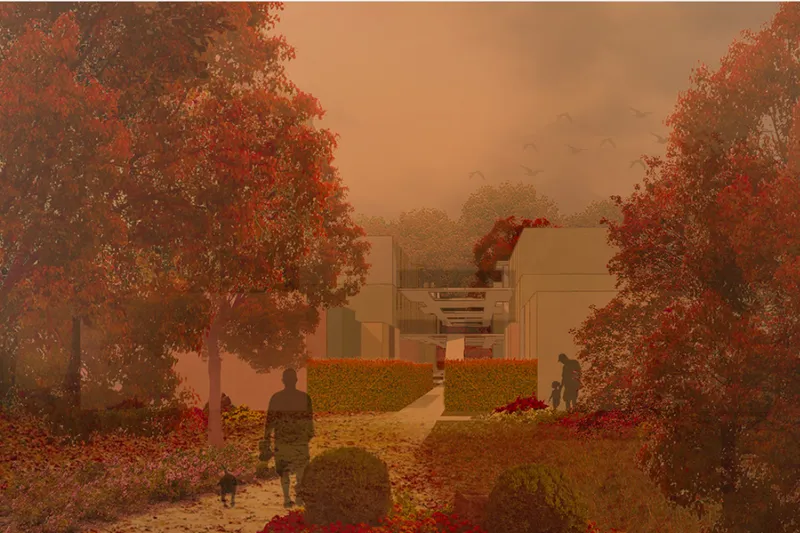
The masterplan situates the modular housing architecture within the existing urban fabric of Pilastro, carefully aligning new interventions with roads, green corridors, and public amenities. The linear arrangement of modules creates a porous urban spine that connects neighborhoods rather than isolating them.
Key urban strategies include:
- Preserving existing green spaces
- Activating underused urban voids
- Introducing pedestrian-oriented pathways
- Enhancing social interaction through shared courtyards
Through this approach, temporary architecture becomes a mediator between old and new, permanent and adaptable.
Environmental and Social Sustainability
Beyond spatial flexibility, Temporary Identity addresses sustainability through material efficiency, reversibility, and reduced construction waste. Prefabrication minimizes on-site impact, while modular repetition allows components to be reused across multiple life cycles.
Socially, the project promotes inclusivity by supporting diverse living arrangements and lowering barriers to access housing. Temporary structures can accommodate changing demographics without locking the city into irreversible decisions.
A Prototype for Future Urban Scenarios
While developed for Bologna, Temporary Identity functions as a transferable prototype applicable to multiple urban contexts. Its relevance extends to cities facing housing shortages, climate-related displacement, or rapid demographic shifts.
By positioning modular housing architecture as a permanent strategy rather than a temporary fix, the project challenges conventional notions of urban permanence and architectural authorship.
Temporary Identity demonstrates how modular housing architecture can redefine urban regeneration through adaptability, reversibility, and systemic thinking. By introducing a flexible architectural layer within the city, the project offers an alternative path toward resilient, inclusive, and future-ready urban environments.
Through the work of Marica Iandolo, the project stands as a compelling example of how temporary architecture can produce lasting urban value, proving that impermanence, when strategically designed, can become a powerful driver of sustainable city-making.





Popular Articles
Popular articles from the community


Co-Life: Senior Housing Design That Reconnects Older Adults With the City
Co-Life reimagines senior housing design through healing gardens, shared streets, workshops, and a sustainable community across generations.

Lunar Spiral: Space Architecture Shaped by the Mathematics of the Universe
Lunar Spiral reimagines space architecture through Fibonacci geometry, lunar regolith, levitating habitats, and self-sustaining Moon living.

Co-life: Sustainable Architecture for Age-Friendly Community Living
Co-life reimagines sustainable architecture for seniors through courtyards, rammed earth, shared gardens, and spaces designed for belonging.

The Ocean Hive: Sustainable Architecture for a Self-Sufficient Civilization at Sea
The Ocean Hive imagines sustainable architecture at sea, where modular habitats, algae, wave power and ocean waste sustain a growing colony.


Similar Reads
You might also enjoy these articles

Eco Chapel: A Green Architecture Pavilion Designed in Symbiosis with the Forest
Eco Chapel uses green architecture to weave prayer, learning and reuse into a forest pavilion shaped by modular hexagonal canopies for life.
Kaffeebühnen: Coffee Shop Architecture Designed as a Civic Stage Between Vienna’s City and Park
Kaffeebühnen turns coffee shop architecture into a civic stage, linking Vienna’s park edge, urban life, warm timber yards, and coffee craft.
Healing Façade: Sustainable Architecture for Reforestation, Community, and Sacred Ecology in Ethiopia
Healing Façade reimagines sustainable architecture as a living wall that restores soil, catches water and renews Ethiopia's forest churches.


Urban Forest: A Vertical Ecosystem for 5,000 Workers in Singapore's Changi Business Park
Radially stacked pods and layered green decks turn a 7-acre plot into 47 acres of ecological workspace projected for 2040.

Comments (0)
Please login or sign up to add comments
No comments yet. Be the first to comment!