

Thanchi Bazar Tourist Development: Reviving a Hill Market as a Base-Camp Built on Stilts and Terraces
A phased, bamboo-built plan turns an informal riverside bazar in Bandarban into a tourist base-camp that steps with the hills instead of flattening them.


Thanchi translates to "place of rest," and this proposal takes the name literally. Rather than treating a growing tourist flow as a problem to be managed with one large building, the project recasts the existing market town as a tourist base-camp: somewhere to pause, get oriented and meet the local community before heading deeper into the hills. The ambition is economic, but the method is restraint. Light frames, terraces and stilted pavilions are threaded into a site that already works, socially and topographically, in its own informal way.
Designed by Karan Srijan, the project addresses Thanchi Bazar in Thanchi, an upazila of Bandarban, Bangladesh. The bazar has grown without a plan along a river edge and up steep hill contours, a cluster of informal shops and temporary structures that sees rising footfall but offers visitors little in the way of public space, organised circulation or basic amenities. Srijan's starting point is a careful mapping of existing paths, water bodies and social activity zones, so that every new element extends what is there rather than erasing it.
Raised Timber Beds That Turn Open Ground into Working Terraces
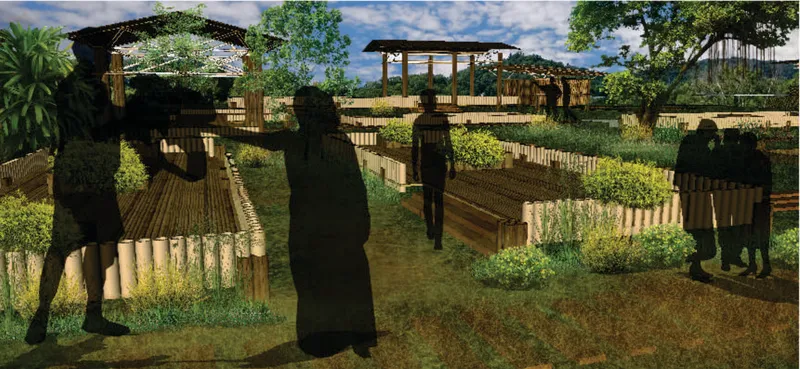
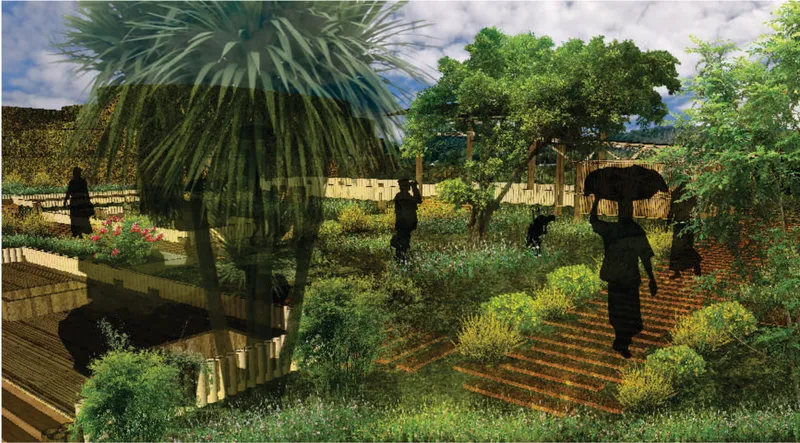
The opening renderings set the tone at ground level. Raised timber beds edged with bamboo poles organise the slope into stepped, planted platforms, while open-sided pavilions sit lightly behind them. A figure carrying a basket on her head crosses one terrace, a quiet signal that this landscape is meant to stay in daily use rather than become a backdrop for visitors. The terracing is the same move the master plan makes at a larger scale: follow the contours, build platforms, and keep the ground productive.
This matters because the brief could easily have produced a tidy tourist precinct sealed off from local life. Instead the terraces read as shared infrastructure, giving structure to a central bazar spine of retail and craft shops, public gathering and refreshment areas, and tourist information and rest zones, all zoned but visually connected so that walkability and views of the surrounding hills stay intact.
Walkways and Vine-Draped Fences as the Connective Tissue
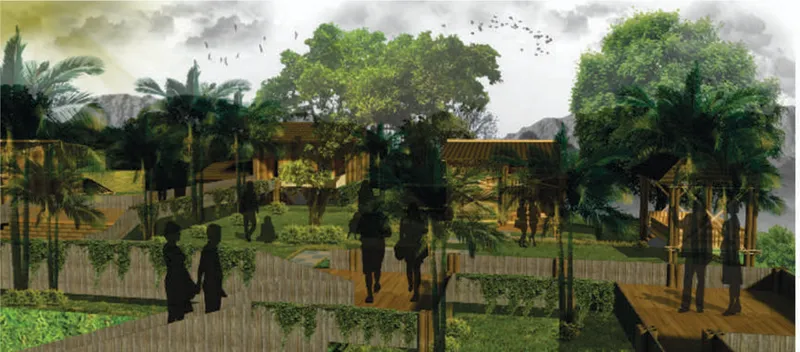
Timber walkways and bamboo fences carrying vines link small pavilions among the palms, with mountains closing the view. The image captures the project's strongest idea: circulation is the architecture. Pedestrian bridges and stepped pathways do the real work of organising a site that previously had none, and they arrive in a deliberate sequence. Phase 1 concentrates on core bazar organisation and pedestrian circulation, before any significant building appears.
That sequencing is the proposal's sharpest strategic decision. Phase 2 introduces shop prototypes and public amenities, Phase 3 expands tourist facilities and accommodation, including resort and VIP rest house clusters, and Phase 4 consolidates the landscape for long-term economic stability. Each phase is meant to respond to real usage patterns, so the bazar grows with demand rather than on speculation, a refreshingly honest stance for a tourism project in an ecologically fragile region.
A Valley Section That Reads River, Bridge and Slope Together
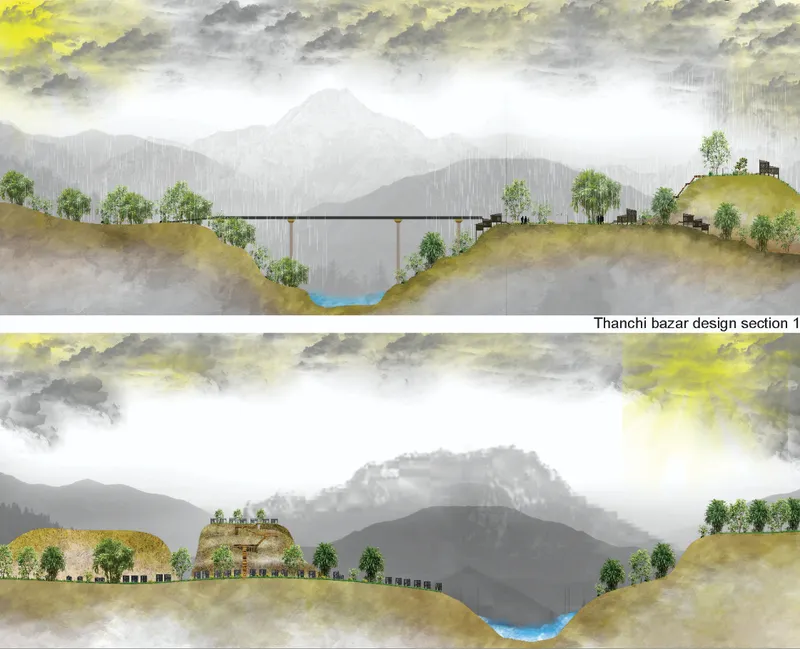
The pair of valley sections is where the site's logic becomes legible. A bridge spans the river gorge, buildings settle into the slopes with earth over them, and rain and sun are drawn in as active conditions rather than decoration. The river here is not scenery; it supports agriculture and daily life, and the section shows the intervention stepping back from it while tying both banks together.
Drawing the site this way, as one continuous cross-section from hill to water to hill, reinforces the claim that infrastructure, landscape and human activity form a single system. It is the clearest argument in the set for why the project avoids a single large intervention: the terrain simply does not allow one without damage.
Bamboo Pavilions on Stilts That Step Up the Hillside

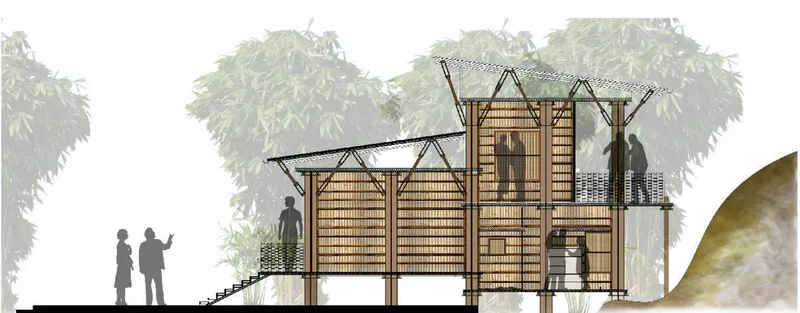
The building sections bring the material strategy into focus. Bamboo-clad pavilions with sloped roofs rise on stilts and step up the slope among bamboo trees, and a multi-level unit adds a stair, an upper deck and angled roofs beside the hillside. Bamboo, wood and simple structural frames dominate, chosen for low environmental impact, ease of maintenance and their fit with local construction practice. Lifting the shop and cottage prototypes off the ground lets them adapt to uneven terrain, stay clear of seasonal water flow and keep views passing beneath and between them.
The prototypes are designed as a family rather than a fixed object. Shop types A, B and C accommodate different plot sizes and commercial needs and can expand vertically or horizontally, while cottage prototypes offer short-term tourist accommodation placed to capture views. Modularity here is a practical tool: it lets local traders add space as business grows, keeping the bazar's incremental, informal character alive inside a more coherent framework.
Why This Project Matters
Tourism planning in hill regions too often begins with a resort and ends with a cleared slope. Srijan's proposal inverts that order. It starts with paths, water and existing social life, adds shops and shelters only once circulation is resolved, and saves accommodation for the later phases. The result is a plan that treats the informal bazar as an asset to be strengthened, not a mess to be replaced.
The project's broader lesson is that light construction and phased growth are design positions in their own right. Stilts, bamboo and modular units are not stylistic choices here; they are how the scheme protects a fragile hill ecology and indigenous ways of life while still giving Thanchi the infrastructure its visitors need. For a town named for rest, that balance feels exactly right.
View the Full Project
About the Designers
Designer: Karan Srijan
Enter a Design Competition on uni.xyz
uni.xyz runs architecture and design competitions year-round that reward proposals with spatial conviction and real site intelligence.
Project credits: Thanchi Bazar Tourist Development urban revitalization by Karan Srijan.


Popular Articles
Popular articles from the community


Cloaked Colonization: A Mobile Underwater Habitat That Moves Like a Fish
Micah Abaya's shortlisted EHC Pacific entry reimagines ocean settlement as a dispersed network of self-sustaining architectural organisms.
Opera by the Sea Estonia: Three Shells Dissolving Architecture into Tallinn's Coastline
A winning opera house proposal replaces monumental form with interconnected shells that blur the boundary between building, park and Baltic Sea.

Tsunami Convergenics: Turning Catastrophic Ocean Forces into Underwater Housing Infrastructure
A speculative underwater settlement off the coast of Onagawa, Japan, treats tsunamis and typhoons as energy sources rather than threats.

The Amber Palace Opera: A Geological Fiction Surfaces on Tallinn's Baltic Waterfront
Pierre Brillard reimagines a Baltic legend as a public landscape, opera house, and waterfront promenade rooted in Tallinn's coastal identity.

Similar Reads
You might also enjoy these articles

Healing Façade: A Modular Chapel System That Restores Ethiopia's Sacred Forests
Winner of the Eco-Chapel competition, this circular timber façade collects water from air to rebuild soil and reforest degraded Ethiopian landscapes.
Kaffeebühnen: Where Coffee Shop Architecture Becomes a Civic Stage in Vienna
A linear sequence of timber boxes, transparent shells, and open yards turns the Viennese café tradition into a public performance space.
Eco Chapel: A Modular Forest Pavilion That Grows Like the Landscape It Protects
Hexagonal timber modules weave through existing trees, turning a chapel into a living system for prayer, education, and reforestation.


Urban Forest: A Vertical Ecosystem for 5,000 Workers in Singapore's Changi Business Park
Radially stacked pods and layered green decks turn a 7-acre plot into 47 acres of ecological workspace projected for 2040.

Comments (0)
Please login or sign up to add comments
No comments yet. Be the first to comment!